To really move the needle on Google Maps, you have to get obsessed with three things: Proximity, Relevance, and Prominence.
You can’t change your physical address, so Proximity is what it is. But you have total control over proving your Relevance through a perfectly tuned profile and building your Prominence with reviews, citations, and real-world engagement.
This is where the game is won or lost. Mastering those last two is the secret to owning local search.
Why Ranking on Google Maps Is a Non-Negotiable for Local Business
For a local business, showing up on Google Maps isn't just a nice-to-have—it's everything. It’s the modern-day storefront, the digital main street where potential customers find you when they’re ready to buy, book, or visit. Visibility here translates directly into foot traffic, phone calls, and sales.
If you're a local marketer or managing a multi-location brand, you have to understand how the Maps algorithm thinks. It’s not simply about being the closest option anymore. It's about being seen as the best and most trusted answer for whatever a user is looking for.
The Three Pillars of Local Ranking
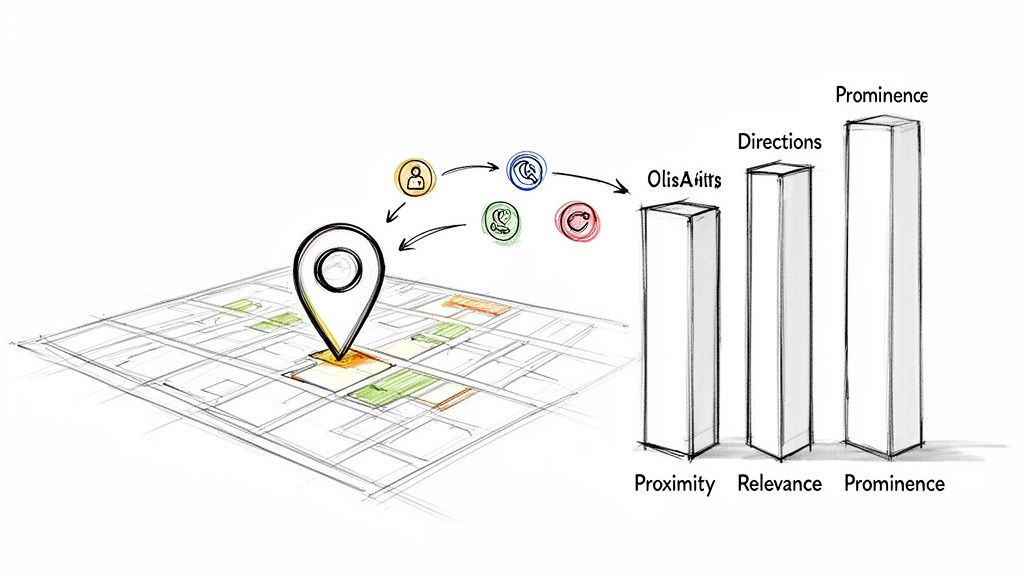
Google's local algorithm really boils down to three core factors that decide who gets a spot in the coveted "Map Pack."
I've broken them down in this table to make it crystal clear what Google is looking for and how you can deliver it.
| The Three Pillars of Google Maps Ranking | ||
|---|---|---|
| Pillar | What It Means for Google | How You Influence It |
| Proximity | "How close is this business to the searcher?" This is the most basic check. | You can't move your store, but you can signal your service area through website content and localized keywords. |
| Relevance | "How well does this business match what the user is looking for?" | This is all about optimizing your Google Business Profile categories, services, and using the right keywords in your descriptions, posts, and on your website. |
| Prominence | "How well-known and trusted is this business?" | You build this through a steady stream of positive reviews, high-quality local citations (mentions across the web), and backlinks to your site. |
It's a simple framework, but it's incredibly powerful.
Think of it this way: Proximity gets you in the game, but Relevance and Prominence are what win it. A slightly more distant business with stellar reviews and a perfectly optimized profile will almost always outrank a closer, less-established competitor.
This is more important than ever. With over 80% of local searches now showing Google Maps results, the competition is fierce. That visibility is what fuels the inbound calls and queries that can transform a business. This is especially true as zero-click searches and mobile interactions become the norm. You can dig into more insights about the impact of mobile on local search at dgtlmart.com.
The Power of Local Engagement Signals
Beyond these pillars, there's a powerful feedback loop that most businesses miss: user engagement.
When a potential customer clicks your profile, requests directions, or calls your business right from the map listing, they’re sending a direct signal to Google. These aren't just metrics; they're votes of confidence. Each action validates that your business is a relevant and popular choice for that search.
This is your secret weapon.
By actively encouraging and tracking these engagement signals, you’re literally showing Google that your business is a vibrant, active hub that real people choose. It creates a self-reinforcing cycle—more engagement leads to higher rankings, which leads to more visibility, which drives even more engagement.
Laying the Foundation: Mastering Your Google Business Profile
Your Google Business Profile (GBP) is the undisputed center of the local SEO universe. Think of it less like a simple listing and more like your digital storefront, brand ambassador, and first impression—all rolled into one powerful package. If you want to rank higher on Google Maps, you have to treat your GBP as the bedrock of your entire strategy. Every single field needs to be dialed in for both search engines and actual customers.
The importance of this one asset really can't be overstated. The latest data shows that signals from your Google Business Profile are the single biggest factor in local search, making up a massive 32% of what determines your spot in that coveted Local Pack. For multi-location brands like dispensaries or wellness clinics managing stores across different cities, mastering GBP isn't just a good idea—it's the only way to win. You can dive deeper into the numbers with this breakdown of the latest local search ranking factors at Advicelocal.com.
Nailing Your Business Categories
Choosing the wrong categories is one of the most common—and most damaging—mistakes we see. This one setting tells Google exactly what you do, and if you get it wrong, you're essentially invisible for your most valuable search terms.
It helps to think of it this way: your primary category is your main specialty, while secondary categories are all the other things you offer.
- Primary Category: This is your "what I am." A dispensary’s primary category should be "Cannabis store," not something generic like "Retail store."
- Secondary Categories: These are your "what I also do." That same dispensary might add "Vaporizer store" or "Herbal medicine store" to show up for those related searches.
Pro Tip: Stop guessing. Look up your top-ranking local competitors for your most important keywords. See what primary and secondary categories they're using. The goal isn't to just copy them, but to understand what Google is already rewarding in your specific market.
Writing a Business Description That Works
Your business description is prime real estate for telling both Google and potential customers what you're all about. You get 750 characters, and every single one should count. Write for humans first, but be strategic about weaving in the keywords and location-specific terms you want to rank for.
Don't do this: "We are a top-rated wellness clinic offering great services."
Do this instead: "Discover holistic wellness at our Austin, TX clinic. We specialize in chiropractic care, acupuncture, and massage therapy to help you find relief from chronic pain and stress. Our certified practitioners in downtown Austin are dedicated to your health."
See the difference? The second version naturally includes relevant services ("chiropractic care," "acupuncture") and location terms ("Austin, TX," "downtown Austin"), which sends much clearer signals to Google. To learn more, check out our complete guide on how to optimize your Google Business Profile.
Using Every Feature for Maximum Impact
An incomplete profile is a huge missed opportunity. Google rewards businesses that use its platform to the fullest, so you need to be actively managing every feature available to you.
The screenshot above shows an example of a platform designed to enhance these signals without ever needing direct access to your profile. It's a great illustration of how both on-profile activity and off-profile engagement work together to build a complete picture of your business's local authority.
Here’s a quick checklist of features you should be using all the time:
- Products & Services: Don't just list them out. Add detailed descriptions, great photos, and pricing. Every entry is another opportunity to include keywords.
- Google Posts: These are basically free, hyper-local ads. Use them to announce sales, new products, or company news. They expire, so posting consistently signals to Google that you're active and engaged.
- Q&A Section: This is a goldmine. You can proactively add your own common questions and answer them yourself. This lets you control the narrative, address customer concerns upfront, and work in more valuable keywords.
When you meticulously optimize every piece of your Google Business Profile, you're not just filling out a form. You're building a powerful, authoritative foundation that tells Google exactly why you deserve that top spot on the map.
Driving Authentic Engagement Signals to Win Google's Favor
A perfectly optimized Google Business Profile is an incredible starting point, but let's be honest—it's static. To really dominate the map and rank higher on Google Maps, you have to prove that real people are actively choosing your business over the competition. This is where you shift from passive optimization to active influence, and frankly, it’s your biggest competitive advantage.
Think of it this way: your profile details tell Google what you are, but the behavioral signals show Google how popular you are right now. Every single time a user interacts with your listing, they're casting a vote in your favor. Google’s whole algorithm is built to reward real-world activity, and these engagement signals are its ultimate source of truth.
This simple flow shows how your foundational profile details, keyword strategy, and consistent activity like posting all feed into one another to attract that critical user engagement.
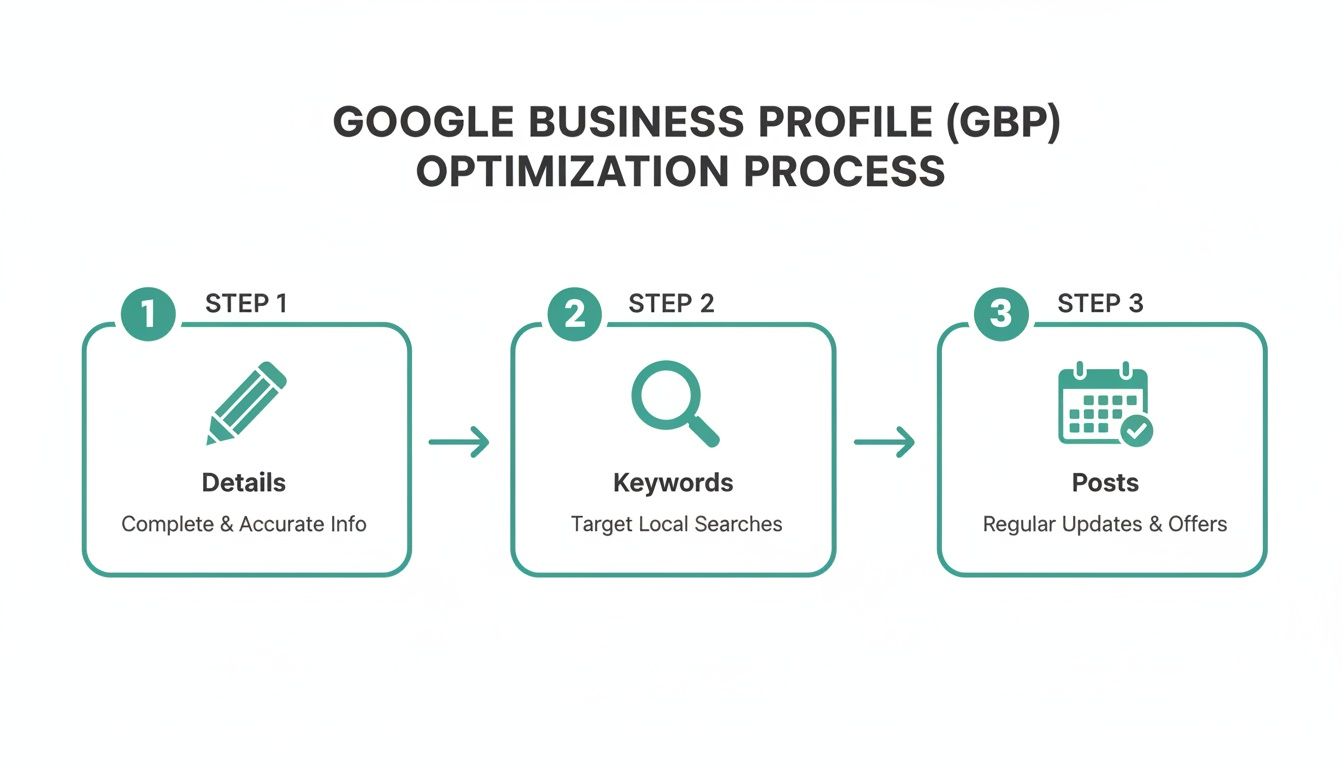
As you can see, a well-maintained profile is really just the launchpad. The clicks, calls, and direction requests are the fuel that creates real ranking momentum.
The User Actions That Google Values Most
Google pays extremely close attention to a few key interactions that signal trust and relevance. These aren't just vanity metrics; they are direct proof of user intent and satisfaction. If you want to climb the local search ladder, you need a steady stream of these signals.
The most impactful ones include:
- Clicks to Your Website: This tells Google your profile was compelling enough to make someone dig deeper for more information.
- Requests for Directions: This is one of the strongest buying signals out there. It means a user is planning an actual visit. In fact, Google says businesses with photos get 42% more requests for directions.
- Phone Calls from Your Profile: A direct call signals immediate interest and a high-value lead. It shows Google your business solves an urgent need.
- Local Search and Discovery: Just being found and clicked on for relevant, non-branded searches (like "dispensary near me") proves your relevance for that specific term.
These actions create a powerful feedback loop. More engagement gets you more visibility, which in turn generates even more engagement.
Think of it like a popular restaurant. A long line out the front door is the best advertisement possible. In the digital world, clicks, calls, and direction requests are your line out the door, signaling to Google that you're the place to be.
A Real-World Scenario: Generating Local Signals
Let's picture a multi-location wellness franchise, "Zenith Wellness," opening a new clinic in a crowded downtown neighborhood. They've dotted every 'i' on their GBP, but they’re still invisible on the map for high-value searches like "acupuncture for back pain"—even just a few blocks away. Their proximity is solid, but their prominence and relevance signals are nonexistent.
Instead of just waiting for engagement to happen, they can take a proactive approach.
Here’s how they could generate authentic signals to start ranking in those crucial micro-neighborhoods:
- Pinpoint High-Intent Keywords: They identify "acupuncture for back pain" and "sports massage downtown" as key service terms where they have zero visibility.
- Simulate Real User Journeys: Using a platform like Nearfront, they can simulate authentic user search behavior. This means generating searches for their target keywords from IP addresses located within those specific neighborhoods where they want to rank.
- Drive Targeted Interactions: After the search, the system simulates a click on the Zenith Wellness GBP listing, spends some time browsing photos and reviews, and then triggers a "click-to-call" or "request directions" action.
- Repeat Consistently: This process is repeated consistently over a few weeks, mimicking the natural discovery and engagement patterns of real local customers.
This strategy isn't about tricking the system; it's about demonstrating genuine local demand. It sends clear, geographically relevant signals to Google that people in that specific area are actively looking for Zenith Wellness and its exact services.
By focusing on these behavioral signals, Zenith Wellness isn't just polishing a static profile; they are actively proving their relevance and popularity in the real world. This is the difference between simply having a listing and having a high-performing local marketing asset that drives measurable foot traffic and new clients. For any business ready to move beyond the basics, mastering the art of generating authentic engagement is how you win the local search game.
Building Trust with Reviews and Citations
Once you've nailed your profile and on-page basics, it's time to focus on what the rest of the web says about you. Think of it this way: your Google Business Profile is what you say about your business. Reviews and citations are what everyone else says.
When those outside signals are strong, consistent, and positive, Google sees your business as a trustworthy pillar of the community. That's when you start climbing the map rankings for good.
The Unmistakable Power of Customer Reviews
Reviews are raw, unfiltered social proof. They are a direct line into the minds of your customers and one of the most powerful signals you can send to Google’s algorithm. A steady flow of fresh, positive reviews tells Google you’re an active, reputable business that people genuinely like.
The impact isn't just about perception, either. According to Google, businesses with strong reviews and photos see 42% more requests for driving directions. That’s a direct link between reputation and foot traffic.
Here’s how to get the ball rolling:
- Ask at the Right Time: The perfect moment to ask for a review is right after a customer has had a great experience. Train your team to spot these happy moments and make the ask.
- Make It Effortless: Nobody wants to jump through hoops. Use a direct link to your Google review page and share it via email, text, or a simple QR code at your checkout counter. The fewer taps, the better.
- Guide Them Gently: Don't just ask for a review; prompt them for specifics. A simple "We’d love to hear what you thought of your deep tissue massage today!" can lead to keyword-rich reviews that boost your relevance for that exact service.
Responding to Every Single Review—Good and Bad
Getting reviews is only half the battle. How you respond is just as critical. Replying to reviews shows both potential customers and Google that you're engaged, you care about feedback, and you're on top of your game.
A fast, professional response to a negative review can do more for your reputation than ten positive ones. It shows you’re accountable and committed to making things right, building immense trust with everyone who sees it.
Always thank positive reviewers personally. For the negative ones, acknowledge their complaint, apologize without making excuses, and offer to take the conversation offline to find a solution.
Demystifying Citations and NAP Consistency
Citations are simply mentions of your business's Name, Address, and Phone number (NAP) on other websites. Think online directories like Yelp, industry-specific portals, or local business pages.
Google is like a detective, scouring the web to cross-reference this information. When your NAP is identical everywhere, it solidifies your business's legitimacy. But when it finds an old address, a typo in your name, or a wrong phone number, it creates doubt. That doubt can directly hurt your rankings.
You can run a quick citation audit yourself:
- Define Your Source of Truth: Your Google Business Profile is the master record. Make sure your NAP is absolutely perfect there.
- Search for Old Info: Google your business name along with any old phone numbers or previous addresses. See what pops up and where.
- Check the Big Players: Manually check your listings on major directories like Yelp, Bing Places, and Apple Maps. Do they match your GBP exactly?
Cleaning up inconsistent citations can feel tedious, but it's a foundational piece of local SEO that strengthens your authority. For a deeper look, you can learn more about the role of a Google Map citation in our detailed guide.
By mastering both reviews and citations, you build a powerful moat of trust around your business that competitors will find nearly impossible to breach.
Measuring and Scaling Your Local SEO Efforts
You can't improve what you don't measure. For any marketer who needs to prove ROI and make data-driven decisions, gut feelings just won’t cut it. If you want to actually rank higher on Google Maps and scale your efforts, you have to move past outdated methods and get serious about performance tracking.
The old way of checking your rank—searching for your business while standing right outside—is dangerously misleading. Of course, you rank #1 when you're right there. The real question is, where do you rank for a customer searching just a few blocks away? That's where modern measurement tools become absolutely essential.
Visualizing Your True Visibility with Heatmaps
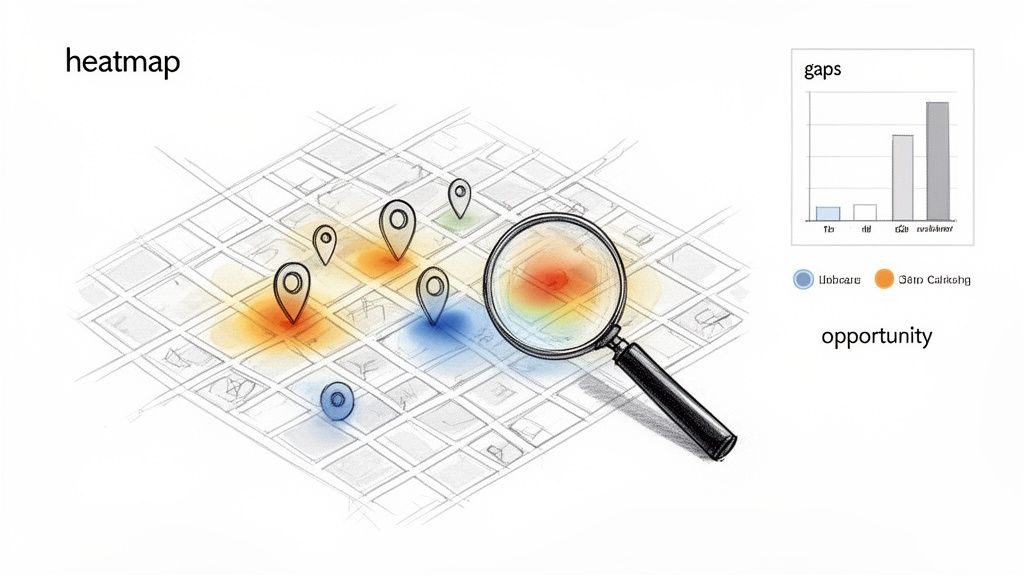
The single best way to understand your real-world visibility is with a live ranking heatmap. Think of it as an X-ray of your Google Maps presence, showing you exactly where you stand across an entire city. Instead of a single, meaningless number, it gives you a visual grid of where you’re strong, where you’re weak, and where you’re completely invisible to potential customers.
I’ve seen this time and time again with clients. A dispensary in Denver might dominate the three blocks around its shop but completely disappear from the map for customers in a high-income neighborhood just one mile away. A heatmap instantly reveals these blind spots, turning abstract data into an actionable battle plan.
This level of insight is a game-changer. It allows you to:
- Pinpoint High-Opportunity Zones: Discover underserved neighborhoods where competitors are weak and you can quickly gain traction.
- Track Competitor Movements: See exactly where your rivals are gaining ground and where their visibility is fading.
- Measure Keyword Performance: Analyze which keywords (like "dispensary near me" vs. "best edibles Denver") perform best in different parts of the city.
By visualizing your true search footprint, you stop guessing and start strategizing. You can pinpoint specific areas for targeted engagement campaigns, focusing your resources where they will have the greatest impact on foot traffic and sales.
Comparing Local SEO Tracking Methods
For years, local SEO reporting was stuck in the past. But modern platforms have completely changed the game, moving from vanity metrics to true visibility insights.
| Metric | Traditional Tracking | Modern Visibility Tracking |
|---|---|---|
| Ranking Data | Single, static rank from one point | Live heatmap showing visibility across entire service areas |
| Competitor Analysis | Manual, inconsistent checks | Automated, side-by-side heatmap comparisons |
| Keyword Insights | Basic keyword position tracking | Granular analysis of keyword performance by geographic area |
| Reporting | Static reports, often outdated | Dynamic dashboards with real-time growth trends and predictions |
| Actionability | Vague recommendations ("improve SEO") | Pinpoints specific geographic zones and keywords to target |
The takeaway is clear: relying on old-school rank checkers is like navigating with a paper map in the age of GPS. It gives you a piece of the picture, but you're missing the real-time intelligence needed to win.
From Data to Decisions
Once you have this granular data, you can start making much smarter decisions. Analyzing heatmap results helps you identify which keywords are driving the most valuable customer actions. You might discover that a long-tail keyword like "chiropractor for sciatica" has a much higher conversion rate for calls and direction requests than a broader term like "chiropractor Austin."
This insight allows you to refine your content strategy, update your Google Business Profile services, and focus your engagement efforts on the terms that actually move the needle. You can get a clearer picture of your standing by using a specialized Google Maps ranking checker that provides this level of detailed analysis.
Scaling Success for Multi-Location Brands
For franchises and multi-location businesses, this approach is even more critical. Managing dozens or even hundreds of locations without a centralized performance dashboard is like flying blind. You need a system to compare stores, identify your top performers, and replicate their success across the entire network.
Imagine a wellness brand with ten clinics in a major city. A unified dashboard allows them to see at a glance:
- Which locations have the best overall map visibility.
- The top-performing keywords for each individual clinic.
- Growth trends over time, showing which stores are improving and which are falling behind.
This comparative data is invaluable. The marketing team can dig into why the downtown location is outperforming the suburban one. Is it their review strategy? The specific services they're highlighting? The local engagement signals they're generating?
By identifying what makes your top locations successful, you can create a repeatable playbook for all your other stores. This transforms local SEO from a store-by-store chore into a scalable, predictable system for growth. It’s how you stop managing individual listings and start orchestrating a dominant local search presence in all your markets.
Answering Your Top Google Maps Ranking Questions
You're grinding away on local SEO, but some questions keep popping up. It's totally normal. Let's dig into some of the most common ones we hear from marketers and business owners trying to rank higher on Google maps.
How Long Does It Take to See Ranking Improvements?
This is the million-dollar question, isn't it? The honest answer is: it depends. The timeline for seeing real movement on Google Maps hinges on things like how competitive your market is, where you're starting from, and how consistently you're working on it.
If you’re just getting started with foundational stuff—like really nailing down your Google Business Profile categories and services—you might see a small, positive shift in just a few weeks. But let’s be real: cracking the top three spots in the Map Pack for your most valuable keywords is a marathon, not a sprint.
A realistic timeframe is usually three to six months of consistent, focused effort. That means a steady flow of new reviews, smart on-page SEO, and proactive work on your engagement signals.
We often see clients get a measurable lift in visibility and key metrics within the first 60 to 90 days of a focused campaign. But that's when they're hitting it from all angles—profile optimization and signal generation. It takes an active strategy to speed things up.
Do SEO Tools Need Access to My Google Business Profile?
Not always, and this is a really important distinction to understand. A lot of old-school local SEO tools do need direct, admin-level access to your GBP. They need to log in to make updates or post for you.
But a newer generation of platforms works differently, influencing your rankings from the outside-in.
How? By focusing on generating the kind of user engagement signals that Google trusts. These platforms can simulate what real customers do—like searching for your keywords locally, clicking on your profile, and requesting directions—all without ever needing your login info.
This approach gives you two huge advantages:
- Better Security: You never have to hand over the keys to one of your most valuable marketing assets.
- Authentic Signals: It mimics genuine customer interest, sending Google powerful, third-party validation that your business is a popular local choice.
Can I Rank in a City Where I Don't Have an Address?
This one's tough. Trying to rank in the Google Maps Local Pack without a verified physical address in that city is next to impossible. Google's entire local algorithm is built on proximity, and it gives massive preference to businesses that are physically located where the user is searching.
Sure, you can definitely rank in the standard organic search results for that city. A strong on-page SEO strategy with high-quality location pages on your website can get you there. But cracking the actual Map Pack? Highly unlikely.
Your best bet is to pour your resources into dominating the map results around your actual brick-and-mortar locations. That's where you can provide a legitimate address and prove to Google that you belong.
Which Is More Important: Reviews or Engagement Signals?
That’s a bit like asking if an engine or wheels are more important for a car. You absolutely need both, and they do different jobs.
Reviews are all about building Prominence and social proof. A great review profile, with a high star rating and a steady stream of new feedback, tells Google your business is established, trusted, and respected over the long haul. Think of it as your long-term reputation engine.
Engagement signals, on the other hand, show Relevance in real-time. A sudden burst of clicks, calls, and direction requests for a specific keyword tells Google that your business is the best answer for a user right now. A business with fewer reviews but a recent spike in engagement can often leapfrog a competitor who has more reviews but is getting no action.
The winning strategy isn't choosing one over the other—it's using them together. Build your foundational authority with a steady stream of reviews, then use targeted engagement signals to win those high-intent, "I need it now" searches that drive customers through your door.
Ready to see exactly where you rank and start driving the signals that matter most? Nearfront gives you the tools to visualize your true visibility with live heatmaps and automate the engagement signals that get you noticed by local customers. See how Nearfront can help you rank higher on Google Maps.