

Local voice search is exactly what it sounds like: someone using their phone or smart speaker to find a business around them. But it’s the way they search that’s changing the game. Queries like “find a top-rated coffee shop near me” are conversational, urgent, and packed with intent, completely shifting how customers find and choose local brands.
How Voice Search Is Changing Customer Behavior
Voice search isn’t just a fun new feature; it’s a direct line from a spoken question to a real-world action. Think about it. When you type a search, you might be doing casual research. But when someone asks their phone for "an open pharmacy nearby," they're probably already grabbing their keys.
This immediacy is forcing brands to catch up. Customers expect instant, accurate answers, and they expect them now.
The numbers back this up. It's predicted that by 2026, 46% of users will use voice to find local information every single day. This isn't just browsing, either. These searches convert. 28% of local voice searches lead to a phone call, and another 19% result in a store visit within 24 hours. You can learn more about these voice search findings and their impact on local SEO right here.
From Keywords to Conversations
The biggest mental shift for marketers is moving from choppy keywords ("pizza Brooklyn") to full, natural questions. This means your old SEO playbook needs an update. Instead of just targeting a list of terms, you have to optimize for the intent behind the questions real customers are asking.
We see a few common patterns:
- Urgency: Queries are loaded with time-sensitive words like "open now" or "today."
- Proximity: "Near me" is practically a given, making your hyperlocal visibility non-negotiable.
- Quality: People are constantly asking for the "best" or "top-rated" spots, which puts a huge spotlight on your reviews.
Voice assistants are built to give the single best answer, not a page of ten blue links. Your job is to become that one, definitive result for local searches in your area.
For multi-location businesses, this means you need to know exactly where you are—and aren't—showing up. A tool that visualizes your local search footprint is essential for this.
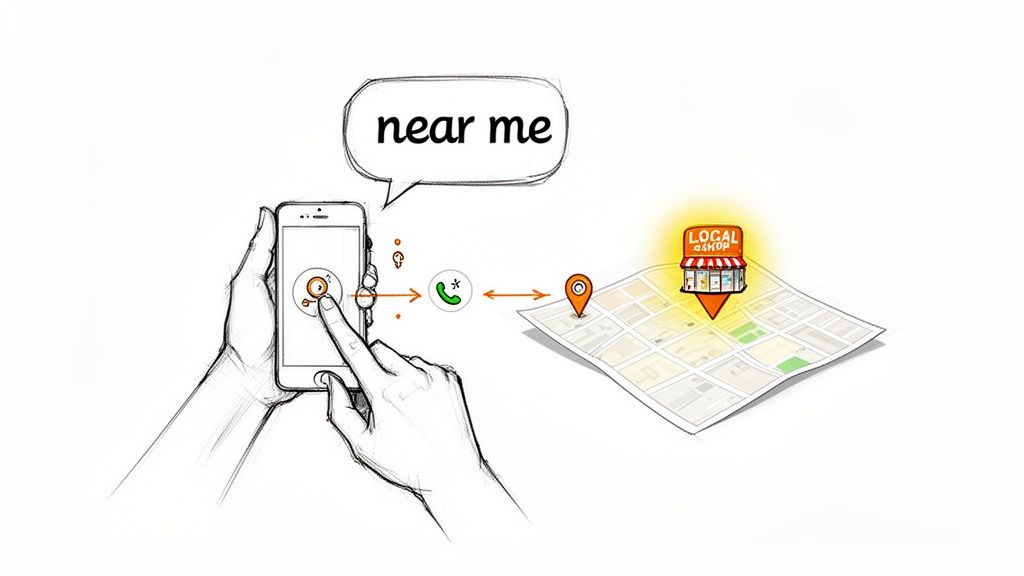
A heatmap view, for example, shows how your rankings change from one block to the next. This gives you a brutally honest look at where your voice search strategy is winning and, more importantly, where it's failing. For any brand with more than one location, getting a handle on this hyperlocal performance is the first real step toward dominating voice search.
How to Find the Conversational Keywords People Actually Use
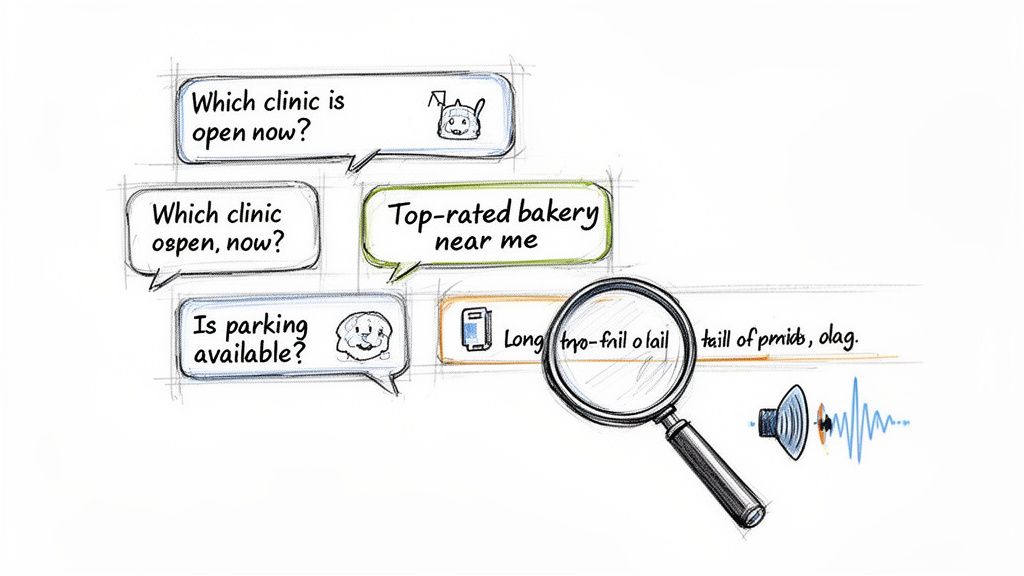
If you want to win at voice search local, your keyword strategy needs a serious reality check. It's time to stop thinking in robotic SEO-speak and start listening to how real people talk. Nobody speaks to their phone the way they type into a search bar. They ask full questions, often while they're on the move and need an answer right now.
Voice queries are naturally longer and packed with intent. Compare typing "dispensary Brooklyn" to asking, "Find a top-rated dispensary in Brooklyn with curbside pickup." The second phrase isn't just a search; it's a specific, high-intent command. Your job is to capture these spoken queries and build your content around them.
Think Like a Customer Not a Marketer
The best way to find these conversational gems is to get out of your own head and into your customer's. What problems are they trying to solve on the go? What questions would they shout at their phone while driving, juggling groceries, or walking down the street?
Imagine you run a multi-location wellness clinic. A potential customer isn't just looking for a "chiropractor." They're asking their voice assistant real-life questions like:
- "Which chiropractor near me is open on Saturdays?"
- "Find a clinic that accepts my insurance."
- "Where can I get a sports massage today?"
Each question reveals a specific need your business can solve. To dig deeper, you can use specialized local keyword research tools that are designed to uncover these long-tail, conversational queries.
The secret to voice search optimization is simple: answer the questions your customers are already asking. When your website offers the clearest, most direct answer, voice assistants will find you.
This shift requires moving away from old-school SEO habits.
| Aspect | Traditional SEO Keyword | Voice Search Keyword |
|---|---|---|
| Length & Structure | Short-tail, 2-3 words (e.g., "urgent care NYC") | Long-tail, full sentences (e.g., "Where is the nearest urgent care that's open now?") |
| User Intent | Often research-focused, broad | Highly specific, action-oriented |
| Focus | Matching exact keywords | Answering questions, solving problems |
| Example | "vegan restaurant Brooklyn" | "Find me a vegan restaurant in Brooklyn that has outdoor seating." |
In short, you're transitioning from targeting nouns to answering verbs.
Uncovering Action-Oriented Queries
Beyond just answering questions, you need to identify the commands that signal immediate intent. These are the phrases that lead directly to a customer walking through your door or hitting the "call" button.
Listen for queries that start with action words, like:
- "Find": "Find a vegan cafe near me."
- "Show me": "Show me the directions to the closest hardware store."
- "Call": "Call the nearest urgent care clinic."
- "Book": "Book an appointment at a nail salon nearby."
Weaving these phrases and their answers directly into your content is critical. Think FAQ pages, local landing pages, and especially your Google Business Profile Q&A section.
When you structure your content around natural language patterns, you make it incredibly easy for voice assistants to recognize your business as the best answer. This alignment is the entire foundation of a winning voice search strategy.
Optimizing Your Digital Storefront for Voice Assistants
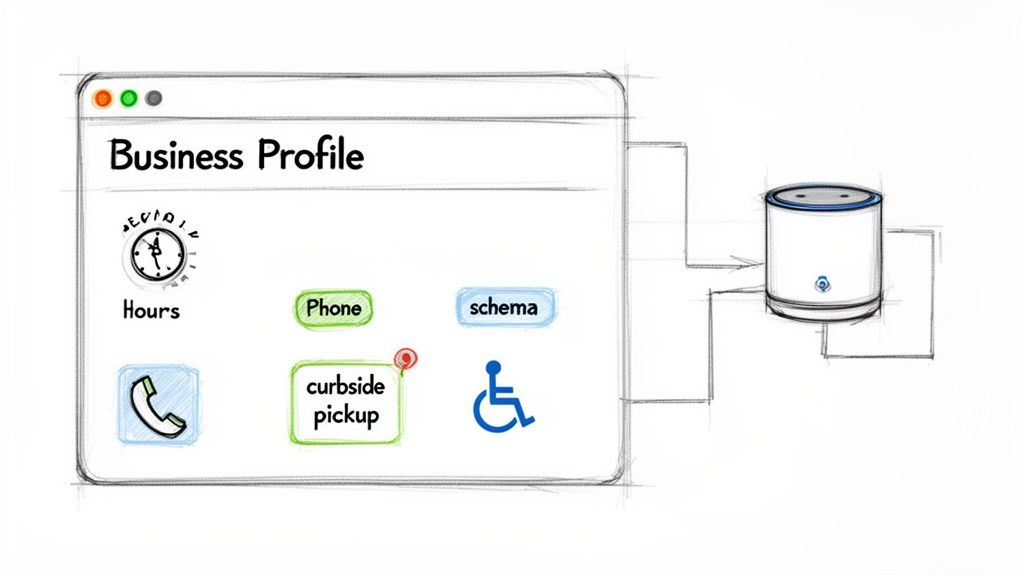
When a customer asks their smart speaker, "Find a clinic that's open now," where does the answer come from? Almost every single time, it's pulled directly from a Google Business Profile (GBP). For any brand with physical locations, your GBP isn't just another listing. It's your digital storefront and the single most important asset for winning at voice search local.
Of course, just having a profile isn't enough. Keeping your name, address, and phone number (NAP) consistent is table stakes. To actually stand out, you have to treat your GBP as a dynamic, content-rich hub that’s built to answer the conversational questions your customers are really asking.
Go Beyond the GBP Basics
Voice assistants are designed to deliver the most helpful, specific, and current information. That means you need to pack your profile with every relevant detail you can think of, moving far beyond your primary business category.
This is where Google's attributes feature becomes your best friend. Think of them as quick filters that help voice assistants match specific queries to your business.
- Accessibility: Add attributes like "Wheelchair accessible entrance" or "Gender-neutral restroom."
- Offerings: Get specific with "Curbside pickup," "In-store pickup," or "Delivery."
- Payments: Let people know you take "NFC mobile payments" or certain credit cards.
These little details are often the tiebreaker when a voice assistant chooses your location over a competitor’s. A search for "a cafe with outdoor seating near me" is going to prioritize businesses that have that exact attribute checked off.
The data backs this up. A massive 58% of consumers worldwide use voice search to find local businesses, turning simple questions into immediate action. This is especially true in major markets, where 76% of smart speaker owners conduct local searches weekly. They're firing off commands like "near me" or "open now," and you need to be the answer. You can explore more insights on voice search's local impact to see just how much it's shaping customer habits.
Use Google Posts and Q&A to Your Advantage
Google Posts are a massively underused tool for voice optimization. Use them to announce a local event, shout out a special offer, or highlight a new product. Every post is a fresh piece of content that Google indexes, giving it more context about what’s happening at your location right now. A simple post about a "weekend sale" could be the direct answer to a user asking, "any hardware stores near me having a sale?"
On top of that, you need to proactively build out your GBP Q&A section. Don't just wait for customers to ask things. Seed this section yourself with your own FAQs, written in the same natural, conversational language your customers use.
A well-curated Q&A section doesn't just help customers; it directly trains Google's algorithm on what your business is all about. This makes you a far more reliable source for voice search answers.
Reinforce Your Data with LocalBusiness Schema
While GBP is the main event, reinforcing that same data on your own website is the final piece of the puzzle. This is where LocalBusiness schema markup comes into play. Schema is just a snippet of code you add to your website that helps search engines understand your content on a deeper level.
When you structure your location data—like hours, address, services, and even specific menu items—in a format that machines can easily digest, you're essentially confirming everything in your GBP. This creates a powerful, consistent signal across the web. It screams to voice assistants like Siri and Google Assistant that your information is accurate and trustworthy, making your business the most confident and correct answer for a relevant local search.
Building Trust with Reviews and Real-World Signals
Voice assistants like Google Assistant and Siri are designed to do one thing really, really well: find the single best answer. When someone asks for "the best clinic near me," the algorithm isn't just looking for the closest option—it's hunting for the most credible and popular one.
This is where your customer reviews and real-world engagement become your most powerful assets for voice search local.
Think of every positive review as a direct vote of confidence. A steady stream of four- and five-star reviews tells search engines that you're consistently delivering a great experience. This social proof is a massive factor in whether a voice assistant recommends your business or a competitor with fewer, older, or lower-quality reviews.
Cultivating a Powerful Review Pipeline
You can't just sit back and hope happy customers leave feedback. It won't happen. You need a simple, repeatable process to actively generate reviews.
- Timing is everything. The best time to ask is right after a great interaction—a successful appointment, a fantastic meal, a smooth purchase—when the positive feeling is still fresh.
- Make it dead simple. Send a text or email with a direct link to your Google review page. The fewer clicks it takes, the more reviews you'll get. Period.
- Respond to everything. Acknowledge every single review, good or bad. Thanking happy customers shows you're listening. Professionally addressing criticism shows you're accountable.
Responding builds a layer of trust that both potential customers and search algorithms can see. If you want to go deeper on this, we've broken down all the benefits of Google reviews for your business.
A strong review profile does more than just boost your star rating. It populates your Google Business Profile with fresh, user-generated content filled with relevant keywords about your services, which voice assistants can use to match with specific queries.
The Power of Real-World Engagement Signals
Beyond what people write, voice search algorithms pay close attention to how people interact with your profile. These "engagement signals" are undeniable proof that your business is a relevant, popular choice. Every time a user takes an action on your profile, it tells Google you're a valuable local resource.
The signals that matter most are:
- Clicks-to-Call: A user tapping the "call" button is a high-intent action showing immediate interest.
- Direction Requests: This is one of the strongest signals you can get. It means someone is planning an immediate visit.
- Website Clicks: Users clicking through to your local page want more information, signaling strong consideration.
This kind of high-intent behavior is exploding. By 2026, 20.5% of internet users—that's roughly 1 in 5 people globally—are expected to use voice commands for their searches.
This trend translates directly into local action. An incredible 28% of local voice searches trigger phone calls, and another 19% lead to a visit within 24 hours. You can discover more insights about these voice search statistics to see just how big this opportunity is.
These signals provide hard proof of your business's real-world relevance, which directly impacts how often you show up in voice search results.
Measuring Your Voice Search Performance Across Locations
So you've optimized your locations for voice search. Great. But how do you actually know if it’s working? If you're just staring at traditional keyword rankings, you're missing the entire point.
Voice search is all about driving immediate, real-world actions—not just sitting at the top of a list. We're talking about making the phone ring, getting people to ask for directions, and pushing foot traffic through your doors. Measuring these tangible outcomes is the only way to prove your voice strategy is paying off, especially when you're managing dozens or hundreds of storefronts.
Moving Beyond Simple Keyword Ranks
Let's be honest: standard keyword trackers are nearly useless for true local SEO. They might show you a single, generalized rank for an entire city, but that's not how people search anymore.
A customer three blocks away might see you as #1, while someone just a mile down the road can't find you at all. Local search is intensely granular.
This is where hyperlocal visibility tracking becomes a necessity. Forget a single rank; you need to see your search footprint block-by-block.
- Heatmap Visualization: This is the game-changer. Heatmaps show you exactly where you're strong and where you're invisible across a city, revealing blind spots and opportunities you'd never see otherwise.
- Competitor Benchmarking: Are you gaining ground in a key neighborhood while a competitor is slipping? Tracking this hyperlocal movement shows you what’s working so you can double down.
This level of detail finally lets you compare performance store-by-store. You can answer critical questions like, "Is our downtown location crushing our suburban one for 'near me' searches?"
The real goal here is to create a data-driven feedback loop. Figure out what works for one location, and you've got a clear, repeatable blueprint to roll out across your entire brand.
Identifying Your Most Valuable Conversational Keywords
Once you know where you’re showing up, you need to figure out what phrases are actually driving business. It's time to connect those long, conversational keywords directly to tangible results.
For voice search, the most important KPIs are the ones that signal immediate intent:
- Phone Calls from GBP: This is a hot lead. Someone found you and wants to talk right now.
- Direction Requests: This is arguably the strongest local signal. It shows a clear intent to walk through your door.
- Website Clicks to Local Pages: When a user clicks through to a specific location page, they're past the initial discovery phase and are actively considering a visit.
By tracking which conversational queries lead to spikes in these actions, you can pinpoint your money-making phrases. You might find that "find a clinic with Saturday appointments" generates twice as many calls as a broader term. For a deeper dive, check out our guide to local SEO reporting tools that help connect these dots.
This kind of insight is pure gold. It tells you exactly how to refine your content, update your GBP Q&A, and focus your energy on the phrases that deliver actual revenue—not just vanity rankings.
Your Multi-Location Voice Search Rollout Plan
All the strategy in the world doesn't mean much until you put it into action. For multi-location brands, that means you need a repeatable process.
This isn't just a simple to-do list. Think of it as a phased deployment plan designed to build momentum, get consistent results, and make sure no critical step gets missed as you scale across all your locations.
First, A Foundational Audit
Before you even think about new initiatives, you have to get the basics right. This phase is all about locking down consistency and technical accuracy—they're completely non-negotiable for voice search.
Any slip-ups here will sabotage everything else you do.
- Nail Down Your GBP Consistency: Pull a full audit of every single location. Your Name, Address, and Phone Number (NAP) must be 100% identical everywhere—your website, every Google Business Profile, and all other local directories. Even a tiny variation like "St." vs. "Street" can throw a wrench in the works.
- Verify Your Schema Markup: Go through the LocalBusiness schema on every single location page. Double-check that your hours, address, and services are marked up correctly. This is what makes it dead simple for voice assistants to pull the right info.
Next, Tackle Content and Engagement
Once your foundation is solid, it's time to start enriching your profiles with content that actually answers customer questions and builds real trust. This is where you actively start shaping the story around each individual location.
- Tune Up Your Local Landing Pages: Weave those conversational keywords you found during your research into each location’s landing page. Make it sound natural.
- Kick Off Review Generation: Launch a simple, automated campaign—text or email works great—to nudge recent, happy customers to leave a review. Keep it easy for them.
- Get Proactive with GBP Q&A: Don't wait for people to ask. Seed each profile’s Q&A section with the questions you get all the time, then provide clear, direct answers yourself.
A successful rollout is all about creating a continuous feedback loop. You analyze performance, figure out which keywords are driving real action, and then you refine your strategy. It’s a cycle.
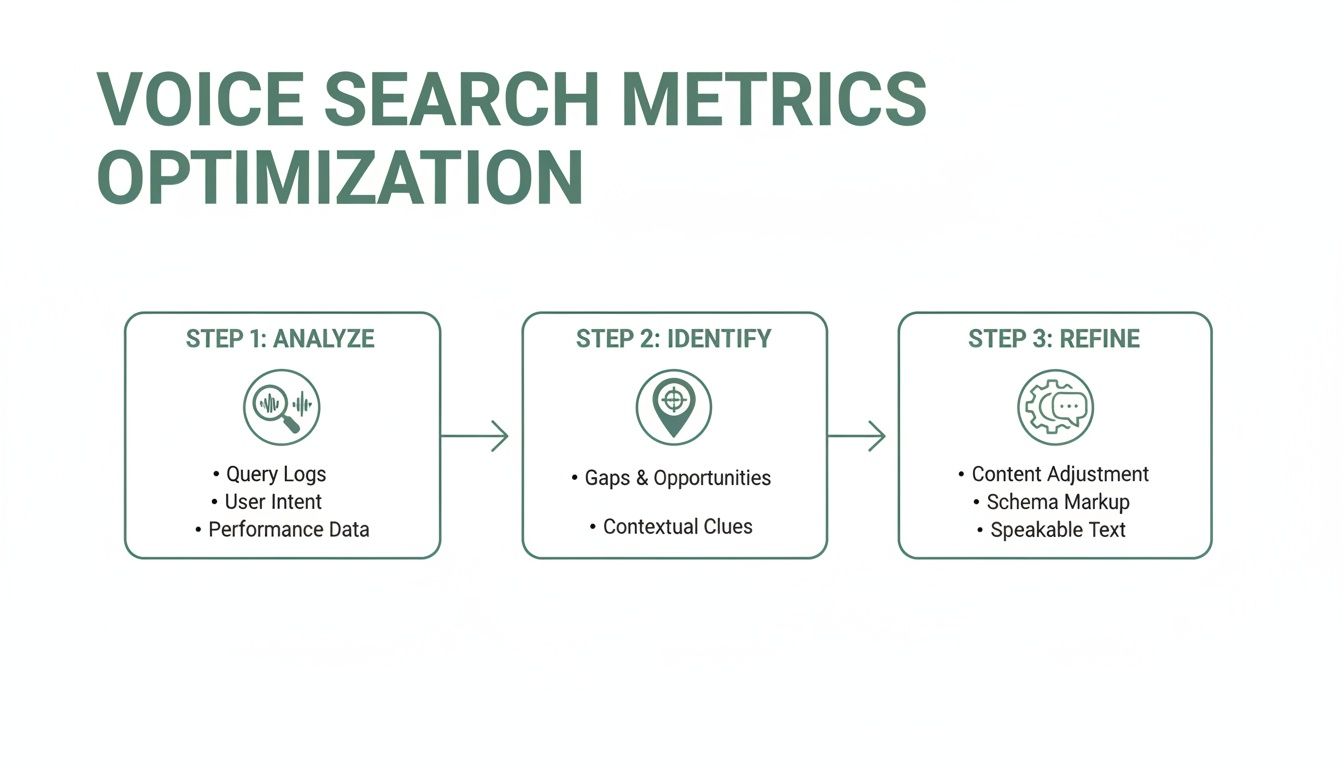
This process makes it clear that measurement isn't the last step—it’s the engine that fuels smarter decisions. When you consistently see which queries are leading to phone calls and direction requests, you can double down on what’s working and apply those insights across your entire brand.
Got Questions About Local Voice Search?
If you're still piecing together how voice search fits into your local strategy, you're not alone. Let's clear up a few of the most common questions we hear from multi-location brands.
How Different Is Voice Search SEO, Really?
It’s less of a total rewrite and more of a new chapter in the same book. Traditional SEO and voice search both rely on fundamentals like authority and relevance.
The big difference? Voice search SEO is all about conversations. Instead of typing "pizza near me," a user might ask, "Hey Google, what's the best pizza place open now that delivers?" This means your focus shifts to long-tail, question-based keywords.
It also puts a massive emphasis on structured data and a flawless Google Business Profile. Voice assistants need to pull quick, definitive answers, and that's where they look first. And since most voice searches happen on a phone while someone's out and about, mobile speed is non-negotiable.
Is There One "Magic Bullet" Factor for Ranking?
If there's one thing to obsess over, it’s your Google Business Profile. There's no single silver bullet, but an accurate, complete, and active GBP comes closest.
Think about it: when someone asks for your hours, address, or phone number, Siri and Google Assistant pull that information directly from your GBP listing. A strong profile, backed by a steady stream of positive reviews and local engagement signals (like clicks-to-call), creates the foundation for everything else. Get this right first.
Can I Actually Track Voice Search Traffic?
Directly? No. Google Analytics won't show you a neat little report labeled "Voice Search Queries." It’s one of the most common frustrations for marketers.
So, you have to shift your perspective from tracking queries to tracking outcomes. Are you getting more phone calls from your GBP? More requests for driving directions? Is organic traffic to your individual location pages on the rise? These are the real-world results that voice searches are meant to generate, and they are absolutely measurable.
Ready to stop guessing and see exactly where your locations show up for voice queries? Nearfront uses live heatmaps to visualize your hyperlocal visibility, helping you capture more calls and foot traffic from customers searching nearby.