When someone needs a plumber, a haircut, or just a good cup of coffee, where do they turn? Not the Yellow Pages. They pull out their phone.
Online marketing for your local business is simply the act of showing up in that exact moment. It’s about making sure when someone searches "coffee shop near me" or "best plumber in Brooklyn," your business is the one they find. Your digital presence has officially become your most important storefront.
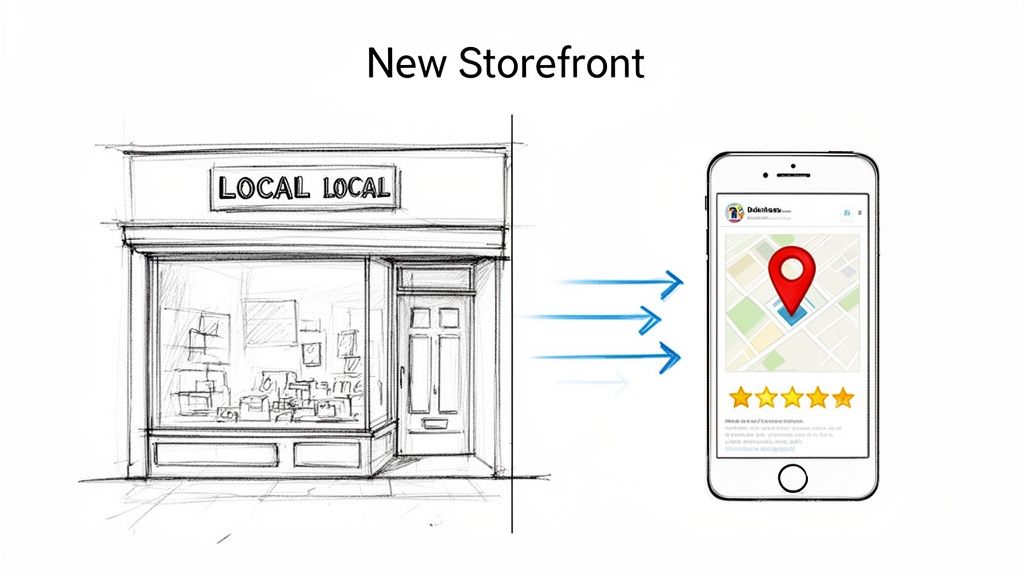
Why Online Marketing Is Your New Storefront
The way people discover local businesses has been completely flipped on its head. Gone are the days of relying on foot traffic and window shopping alone. Today, a customer’s first impression isn’t your physical location—it’s your Google Business Profile, your Yelp reviews, and your Instagram feed.
This isn't a "nice-to-have" anymore. It's the primary engine driving new customers through your door.
The Modern Customer Journey Begins Online
Think about your own habits. The vast majority of us start our search for local services online, making your visibility at that moment absolutely critical.
This shift has become a massive opportunity for brick-and-mortar businesses that get it right. An eye-opening 83% of consumers use Google to find and vet local businesses, with reviews being a major decision-maker.
Even better, companies that show up consistently across just three or more channels see 250% higher engagement and a staggering 89% customer retention rate. If you want to dig deeper into these trends, the team at Astoundz has some great data.
The takeaway is simple: your online presence has to be strong, consistent, and active across multiple touchpoints.
Core Pillars of a Local Strategy
A winning local strategy isn’t just a random collection of tactics. It’s built on a few core pillars that all work together to create momentum and drive real-world results.
- Local SEO & Maps: This is your foundation. It's all about optimizing your online profiles to dominate location-based searches, especially on Google Maps.
- Reputation Management: Your reviews are modern-day word-of-mouth. Actively managing them builds trust and directly influences whether a customer chooses you or a competitor.
- Hyper-Targeted Ads: Paid ads let you get in front of specific demographics right in your service area, making sure every dollar you spend is working as hard as it can.
- Community Engagement: Using social media and local content helps you build real connections with your community, turning one-time customers into loyal fans.
The goal isn't just to be found online. It’s to be the first and best choice for local customers. A powerful digital footprint convinces people to pick you before they've even walked through your door.
This guide will give you the playbook to master each of these pillars and turn your digital presence into a true growth engine.
Mastering Local SEO and Google Maps
When someone pulls out their phone and searches for "bakery near me," what do they see? Almost always, it's a map with three standout results right at the top. This is the Google Map Pack, and for any local business, it's the most valuable digital real estate you can own.
Getting your business into that top-three spot isn't about luck. It's about showing Google you're the most relevant, trustworthy answer for a searcher in a specific area. And thankfully, Google's algorithm isn't a total mystery. It boils down to three core ideas.
The Three Pillars of Map Pack Rankings
Google’s job is to give searchers the best possible answer. For local queries, that means weighing three key factors more than anything else. If you nail these, you'll climb the rankings.
- Proximity: This one's straightforward—how close is your business to the person searching? You can't move your store, but you can make sure your address is perfectly accurate and consistent across the web.
- Relevance: How well do you match what the searcher wants? This is where your Google Business Profile (GBP) comes in. Choosing the right categories, listing all your services, and using the right keywords tells Google exactly what you do.
- Prominence: How well-known is your business? Google figures this out by looking at your online reviews, how many quality websites link back to you, and how often your business is mentioned online (these are called citations).
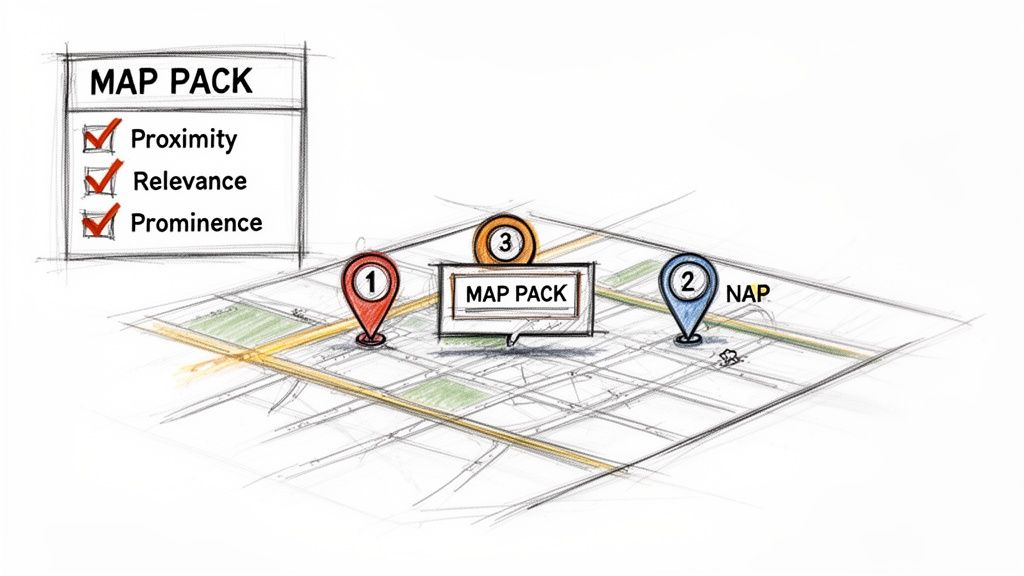
Think about it. If a friend asks for the best local pizza, you'd suggest a place that's nearby (proximity), actually sells great pizza (relevance), and is popular with lots of good buzz (prominence). Google's doing the same thing, just with data.
Your Google Business Profile Is Your Foundation
Your Google Business Profile is the absolute core of your local SEO. For many potential customers, it's the very first impression they'll have of your brand. Treating it like an afterthought is a huge missed opportunity.
First, get the basics perfect. Your business name, address, and phone number (your NAP) must be 100% accurate and identical everywhere—on your website, on Yelp, on Facebook, everywhere. Even a tiny difference, like "St." vs. "Street," can create confusion for search engines and hurt your rankings.
Then, you have to nail your categories. You get one primary category and can add several secondary ones. Be specific. If you're a cafe that’s famous for its espresso, your primary category should be "Coffee Shop," not something generic like "Restaurant." Then add "Bakery" or "Sandwich Shop" as secondary categories if you offer those. This is a direct signal to Google about your relevance.
Pro Tip: Don't just list what you do in your business description. Weave in local keywords to tell a story. Instead of "We sell coffee," try something like, "Your friendly neighborhood coffee shop in downtown Springfield, serving locally roasted espresso and fresh pastries daily."
Want the full checklist? We've got you covered in our guide on how to optimize your Google Business Profile.
Building Trust with Citations and Reviews
Beyond what you control on your GBP, Google is constantly looking for outside proof that your business is legit. The two most powerful signals it looks for are local citations and customer reviews.
Local citations are just mentions of your business's NAP on other websites. Think major directories like Yelp, industry-specific sites like TripAdvisor for a restaurant, or even your local chamber of commerce page. The more consistent these mentions are, the more confident Google becomes about your location and identity.
Reviews are pure gold. They're social proof that directly impacts both your ranking and whether a customer chooses you over a competitor. A steady flow of fresh, positive reviews tells Google that you're an active, trusted business that people like.
Don't Sweat the Bad Reviews
Look, negative reviews happen. But you shouldn't fear them—they’re an opportunity to show everyone else how much you care. A calm, professional response can completely turn a bad situation around and actually build trust with future customers who are watching how you handle things.
Here’s a simple script to follow:
- Acknowledge and Apologize: Start by thanking them for the feedback. Apologize for their experience, even if you feel it's unfair. "We're so sorry to hear your visit didn't live up to expectations."
- Show You're Listening: A little empathy goes a long way. Avoid excuses.
- Take It Offline: Give them a direct way to connect. "We want to make this right. Could you please email our manager at [email] so we can learn more about what happened?"
This approach shows you're accountable and committed to making things right. And in the long run, that reputation for great service is what will keep customers coming through your door.
Engaging Your Community with Social Media and Ads
Once your local SEO foundation is solid, you've earned your spot in search results. Great. But that's just the beginning. Now it's time to actually connect with your community and stay on their radar.
This is where social media and local ads come in. They're the perfect channels to build on your SEO and create a loyal local following. It’s not just about posting; it’s about starting conversations that bring people through your door.
Go Beyond Generic Social Posts
So many local businesses treat social media like a one-way billboard, just shouting promotions into the void. That approach almost never works. Real engagement comes from content that feels authentic, valuable, and genuinely local.
Instead of just another sales announcement, show the human side of your business. Tell stories that connect with your neighbors and make you a real part of the community—something a big national chain just can't do.
Here are a few ideas to get locals talking:
- Feature a "Customer of the Week." Get their permission, snap a photo, and share a quick story on Instagram about why they love your spot. It makes your customers feel seen and gives you powerful social proof.
- Team up with a neighboring business. Partner with a non-competing shop nearby, like a cafe joining forces with a local bookstore for a giveaway. You'll double your reach and show you’re invested in the local economy.
- Pull back the curtain. Give your followers a peek at what happens behind the scenes. A bakery could post a time-lapse of their morning prep, or a boutique could unbox new inventory on a live video. It feels exclusive and builds a ton of trust.
Mastering Hyper-Local Paid Ads
Paid ads on platforms like Facebook, Instagram, and Google are unbelievably effective for reaching the right people in the right place. The key is hyper-local targeting. Your goal isn't to reach everyone; it's to reach everyone who matters to your business.
I can't tell you how many businesses waste ad spend on clicks from people way outside their service area. It's one of the most common—and avoidable—mistakes. Luckily, today's ad platforms give you incredibly precise control.
You can target users based on things like:
- Specific Zip Codes: Only show your ads to people living in the neighborhoods you actually serve.
- Radius Targeting: Drop a "digital fence" around your store and target anyone within a few miles.
- Demographics and Interests: Get even more specific by layering on targeting for age, interests (like "yoga" or "craft beer"), and behaviors.
Picture a multi-location pet supply store. They can run a Facebook campaign with a separate ad set for each location, targeting pet owners within a 5-mile radius with a special offer. This drives both online chatter and measurable foot traffic, squeezing every drop of value from their ad spend.
The Power of Social and PPC Working Together
Think of social media and paid ads as two sides of the same coin, not separate channels. When you combine them, they become a growth machine. The data backs this up: a staggering 93% of internet users are on social media, making it a place you absolutely have to be.
Research from Sixth City Marketing found that 55% of US small business owners use social media for advertising, and a massive 84% report good results from their pay-per-click (PPC) campaigns. And for some industries, it's even more critical. For instance, 83% of cannabis consumers use Instagram to discover new products.
This is where the magic happens. An engaging social presence builds brand loyalty and an audience you can later retarget with paid ads. Then, those ads can boost your best organic content, getting your business in front of new local customers who are ready to convert.
For a deeper dive into budgeting, check out our guide on the costs of social media advertising. By weaving these strategies together, you create a powerful marketing loop that keeps attracting, engaging, and converting local customers.
How to Measure Your Marketing ROI
Pouring money and time into online marketing without knowing the return is like driving with your eyes closed. You have to know if what you're doing is actually working.
The good news? For local businesses, measuring success isn’t about chasing fuzzy “vanity metrics” like social media likes or impressions. It’s about tracking the real-world actions that lead directly to someone walking through your door.
This means zeroing in on the key performance indicators (KPIs) that prove the connection between your digital footprint and your bottom line. These are the numbers that turn marketing from a fuzzy expense into a measurable investment.
Focus on High-Intent Local KPIs
When a potential customer finds you online, they signal their intent to buy in a few critical ways. These actions are the lifeblood of any brick-and-mortar business because they represent a customer actively trying to engage with you right now.
Forget about getting bogged down in dozens of metrics. Just focus on the big three:
- Phone Calls: This is a direct line to a potential sale. Someone who picks up the phone is highly motivated and usually ready to book an appointment or ask a specific question about a purchase.
- Direction Requests: Think of this as a digital-to-physical handshake. When someone clicks for directions, they are literally planning a trip to your location. It's one of the strongest buying signals you can possibly track.
- Website Clicks: While a bit broader, clicks from your Google Business Profile to your website are a crucial step in the customer journey. This person is moving from just discovering you to actively evaluating what you offer.
These three metrics tell a powerful story. They show exactly how your online presence is generating real-world business, and they should be at the core of any local marketing report you create.
Proving ROI doesn't have to be complicated. If you can show that your marketing efforts last month led to an uptick in phone calls, more direction requests, and a lift in qualified website traffic, you have a clear, data-backed win.
Focusing on these high-intent actions is where you'll see a massive return. It’s no surprise that study after study confirms that website and SEO efforts are often the #1 ROI channel for local businesses. As more businesses ramp up their digital spend, the ones who get smart about local SEO see significantly higher close rates, turning simple online searches into real sales. If you're curious about the data behind these trends, you can discover more insights on marketing for small businesses.
The Right Tools for the Job
You don't need a complicated or expensive software suite to track these critical metrics. In fact, most of the data you need is available for free through the tools you're probably already using.
Your main source of truth will be the Google Business Profile Insights dashboard. It directly reports how many people called you, requested directions, and clicked through to your website—all from your Google listing. Think of it as your command center for local performance data.
On top of that, Google Analytics can show you what pages users visit after they click from your profile, giving you a deeper understanding of their journey and what they're interested in.
Building Your Simple ROI Report
To truly prove the value of your efforts, you need to present this data in a way that’s easy to understand. A simple table is often the most effective way to show progress over time and connect specific marketing channels to tangible business outcomes. This approach makes it easy to justify your budget, whether you're reporting to a boss or just tracking for yourself.
Here’s a look at how you can organize your KPIs to get a clear picture of what’s working.
Key Performance Indicators For Local Marketing Channels
This table breaks down the essential metrics to track for each local marketing channel to accurately measure performance and ROI.
| Marketing Channel | Primary KPIs | Secondary KPIs | Tools For Tracking |
|---|---|---|---|
| Google Business Profile | Direction Requests, Phone Calls, Website Clicks | Photo Views, Profile Discovery (Direct vs. Branded Search) | GBP Insights |
| Local SEO (Website) | Organic Traffic, Form Submissions, Keyword Rankings | Time on Page, Bounce Rate, Pages per Session | Google Analytics, Google Search Console |
| Local Social Media | Post Engagement (Comments, Shares), Website Clicks | Follower Growth, Reach, Click-Through Rate | Native Platform Analytics (Facebook, Instagram) |
| Local Paid Ads | Cost Per Click (CPC), Cost Per Acquisition (CPA), Conversions | Ad Impressions, Click-Through Rate (CTR) | Google Ads Dashboard, Facebook Ads Manager |
By consistently keeping an eye on these numbers, you move beyond guesswork. You start building a clear, compelling story that shows exactly how your online marketing for local business is driving real growth, one call and one visit at a time.
Scaling Your Strategy Across Multiple Locations
Running online marketing for one shop is one thing. But making it work for ten, twenty, or a hundred locations? That's a completely different ballgame.
It demands a repeatable system that keeps your brand consistent while giving each location the freedom to feel like a neighborhood spot. Without a solid workflow, you'll end up with mixed messages, a weaker brand, and a ton of wasted hours. The secret is to centralize what you can and localize what you must. This way, every new store launch is smooth, efficient, and ready to win from day one.
Standardize the Core for Brand Consistency
First things first: build a marketing playbook. This becomes your single source of truth for every location, making sure your core brand identity stays locked in, no matter where you are. Think of it as creating efficiency by standardizing the essentials.
Your playbook should lay out clear guidelines for:
- Google Business Profile Setup: Lock in the exact primary and secondary categories. Create a templated business description that local managers can tweak, and set clear standards for photo quality and quantity.
- Review Response Protocols: Write pre-approved templates for responding to positive, negative, and neutral reviews. This keeps your brand voice consistent but still leaves room for a manager to add a personal touch.
- Social Media Voice and Style: Define the brand’s tone, what kind of images to use, and the type of content that belongs on corporate versus local pages.
By getting these elements standardized, you eliminate the guesswork. You empower your local teams to execute confidently, which frees them up to focus on what actually makes their specific market unique.
Empower Hyperlocal Execution
Brand consistency is key, but what resonates in one city might completely flop in another. Real multi-location success happens when you empower local managers to connect with their actual communities. It's about blending your standardized playbook with genuine, on-the-ground knowledge.
A national chain of wellness clinics might find its Miami location gets huge engagement from Instagram stories featuring local fitness influencers. Meanwhile, its Denver branch sees better results from Facebook ads targeting skiers in specific mountain-adjacent zip codes.
This is exactly where having a centralized data platform is a game-changer. A tool like Nearfront lets you spot these regional differences in a heartbeat. You can see at a glance that the Denver location is ranking poorly for "sports massage," a super valuable local term. Armed with that insight, you can shift ad spend or create targeted content for that market and fix the weakness before it ever impacts sales.
This is what a centralized dashboard looks like—it’s a visual way to track and compare how every single location is doing.
You can even use heatmaps to see exactly where each store is visible on Google Maps, helping you pinpoint exactly where to focus your hyperlocal efforts.
A Repeatable Onboarding Workflow
When you open a new location, a checklist is your best friend. It makes sure nothing falls through the cracks. This systematic approach turns a potentially chaotic launch into a predictable series of steps, making your online marketing for local business truly scalable and effective. Our guide on local SEO for multiple locations goes even deeper on these strategies.
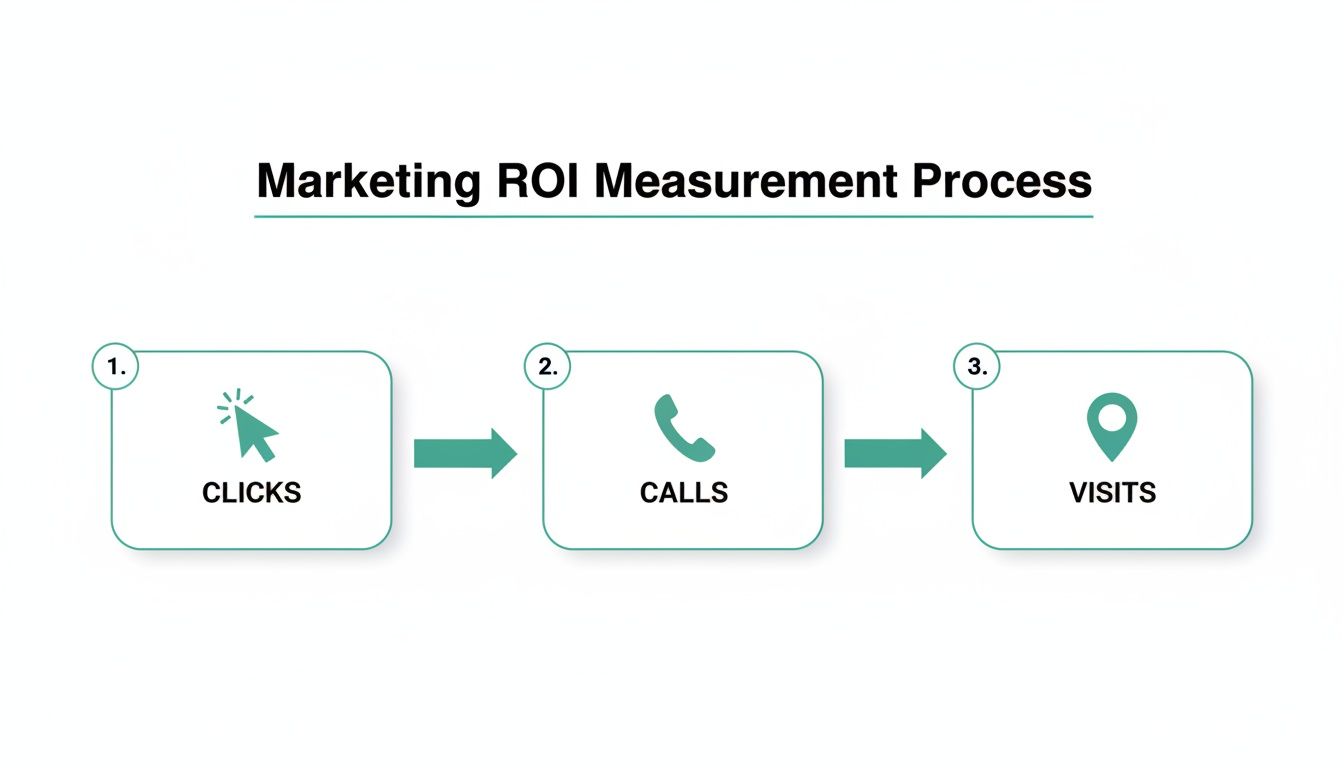
This process visualizes how online clicks turn into phone calls and foot traffic—the ultimate goals for any local campaign. By building a system that balances centralized control with local flexibility, you create a powerful, scalable marketing engine that drives real growth across your entire brand.
Your Top Questions, Answered
Even the best playbook comes with questions. I get it. After working with hundreds of local businesses, I’ve seen the same challenges pop up time and time again. Let’s cut through the noise and get you some straight answers.
How Much Should We Really Be Spending On This?
The classic rule of thumb is 5% to 10% of your total revenue on marketing, but that number is meaningless if you spend it wrong. Don't just light money on fire with a big ad campaign and hope for the best.
Start smart. Nail the things that cost more time than money, like fully optimizing your Google Business Profile and making a real effort to get new customer reviews.
When you do dip into paid ads, start small. Target a specific neighborhood or even just a few zip codes. The key is to track everything—especially calls and direction requests—to prove what’s actually working before you even think about spending more.
Do I Still Need a Website if My Google Business Profile is Solid?
Yes. A thousand times, yes.
Think of it this way: your Google Business Profile is the flashy billboard on the highway that makes someone pull over. Your website is the actual store they walk into.
Your GBP is built for discovery and quick actions, but your website is where you build trust and tell your story. It’s the one piece of digital real estate you completely own and control. One grabs their attention; the other turns that attention into a loyal customer. They’re a team, and you need both.
How Long Until I Actually See Results from Local SEO?
Local SEO is a marathon, not a sprint. You’re building a long-term asset for your business, not just chasing a temporary traffic spike. It's about earning trust with Google, and that takes time.
Typically, you’ll start seeing real movement in your local rankings—and more calls or visits—within three to six months of consistent work. Of course, that can change depending on how competitive your market is and where you're starting from.
But the work you do now compounds. Every review, every update, every local link builds a foundation that becomes incredibly difficult for your competitors to challenge later on.
The secret to winning online as a local business isn't about some fancy trick. It's about showing up consistently where your customers are already looking, day after day, until you become the only logical choice.
Should I Do This Myself or Hire Someone?
Honestly, you can probably handle the basics yourself. Things like posting on social media or keeping your GBP hours updated are totally manageable for most business owners, and it's a great way to stay connected to your customers.
But if you’re in a cutthroat industry or you’re trying to scale across multiple locations, an expert or a specialized tool can be a total game-changer.
A great middle ground? Use a platform that gives you the same data and insights an agency would use. This lets you or your team handle the day-to-day execution with a serious strategic advantage, all without the hefty agency price tag.
Ready to see exactly where you stand on Google Maps and get a clear, actionable plan to start winning? Nearfront uses AI-powered heatmaps to show you where you're visible and what to do next. Let us show you how to turn more searches into customers.