If you have a physical location, your online presence isn't just a website—it's your digital storefront. Winning at local search means showing up the second a potential customer searches "near me," and that all starts with a perfectly tuned Google Business Profile and consistent business information everywhere online.
Why You Must Optimize for Local Search Now
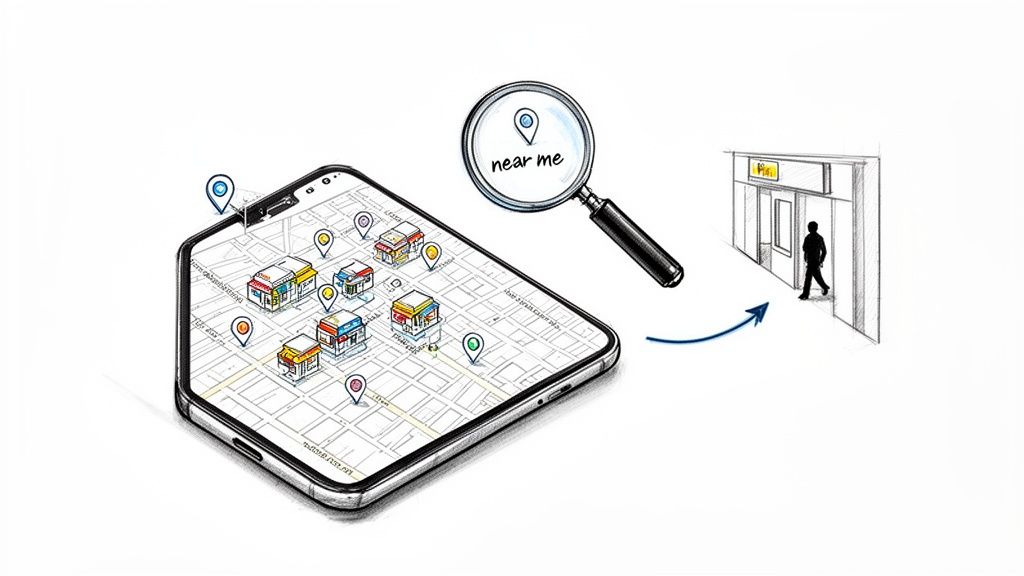
Let's be blunt: ignoring local search is no longer a missed opportunity. It's a fundamental business mistake. Today's customers don't just browse; they search with a specific, urgent need, and platforms like Google Maps have become the primary way they find local businesses.
Think about it. When someone searches for a "dispensary near me" or a "wellness clinic in my neighborhood," they aren't just looking for info. They're ready to buy or book an appointment, often within the next hour. Being invisible in that moment is like having a locked front door on a busy street.
The Power of Proximity and Intent
The data on local search behavior is staggering. There are an incredible 1.5 billion searches every single month that include the phrase 'near me.' That's a massive signal of local intent from people actively hunting for a nearby solution.
Even more telling, recent data shows that 46% of all Google searches carry local intent. Nearly half of what people are typing into that search bar is a cry for a location-specific answer. You can find more details on these powerful local search statistics on seo.com.
This isn't about casting a wide net. It's about precision. You're targeting customers who are:
- Ready to Act: They have an immediate need and are looking for a quick fix.
- Geographically Qualified: They are physically close enough to walk through your door.
- Trusting Search Results: Their first impression of your brand will likely be your Google Business Profile, not your homepage.
Local search optimization is the bridge connecting your physical locations to the digital searches of your most valuable customers—the ones nearby and ready to spend money. It closes the gap between online discovery and real-world revenue.
As you can see, these aren't passive browsers. Local searchers are primed for action, which translates directly into valuable business outcomes.
The High-Impact Actions of Local Searchers
This table summarizes the powerful, conversion-focused behaviors of users conducting local searches, demonstrating why optimization is critical for capturing immediate revenue.
| User Action | Conversion Statistic | Business Impact |
|---|---|---|
| Visiting a Store | 78% of local mobile searches result in an offline purchase. | Drives direct foot traffic and in-store sales. |
| Making a Phone Call | 61% of mobile searchers are more likely to contact a local business if they have a mobile-friendly site. | Generates qualified leads and appointment bookings. |
| Requesting Directions | Searches for "near me" have grown by over 500% in recent years. | Guides ready-to-buy customers directly to your door. |
| Making a Purchase | 28% of searches for something nearby result in a purchase. | Converts online visibility into immediate revenue. |
The numbers don't lie. Optimizing for local search puts your business directly in the path of customers who are ready to convert, making it one of the highest-ROI marketing activities you can undertake.
Your Roadmap to Local Dominance
This guide cuts through the fluff to give you an actionable roadmap for your brick-and-mortar business. We're going to break down the exact strategies that multi-location brands, dispensaries, and wellness clinics need to own their local search results.
From mastering your Google Business Profile to generating authentic engagement signals that Google loves, you'll learn how to turn online visibility into measurable foot traffic, phone calls, and sales. Consider this your playbook for winning the neighborhood.
Your Google Business Profile is Everything
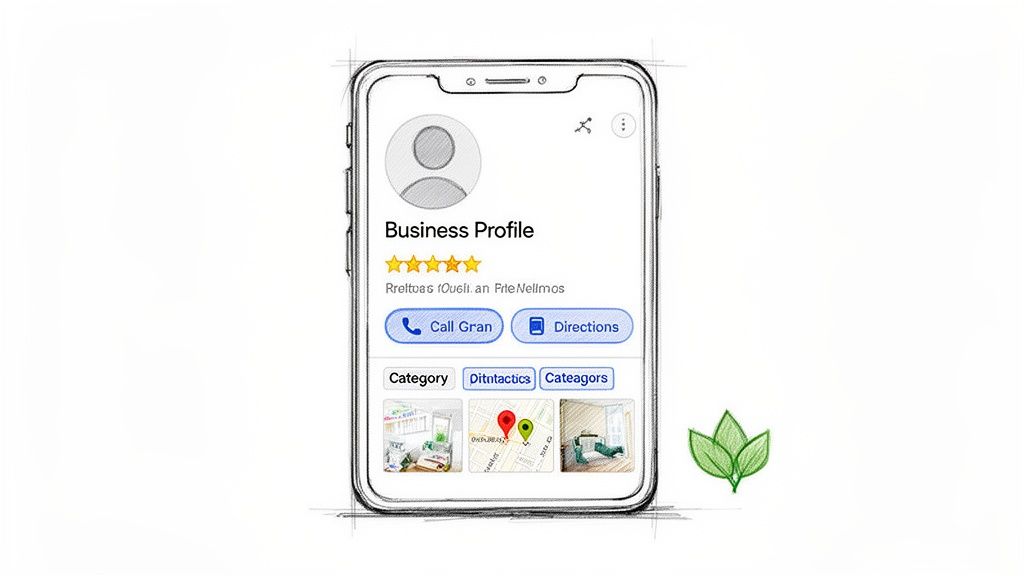
Let's get one thing straight: your Google Business Profile (GBP) is the single most powerful asset you have for local search. It's not just another listing. It's your digital storefront, the modern phone book, and the welcome mat for anyone searching nearby.
When a potential customer looks for what you offer, your GBP is their first handshake with your brand. A half-empty profile is a huge missed opportunity. A fully optimized, active profile, on the other hand, drives calls, website visits, and actual foot traffic—often without the user ever clicking through to your site. It’s the ultimate zero-click conversion machine.
Nail Your Business Categories
This is where it all starts. Your primary category has a massive impact on the searches you show up for, so get it right. Be as specific as you possibly can. If you run a wellness clinic that does massages, "Wellness Center" is your primary category, not the vague "Health."
Then, use secondary categories to fill in the details. Add every single service category that applies. For that wellness clinic, you’d also add:
- Massage Therapist
- Acupuncture Clinic
- Physical Therapy Clinic
- Nutritionist
These extra categories are what help you rank for more specific, high-intent searches like "acupuncture near me." You're casting a wider, smarter net for qualified customers.
Write a Description That Sells (and Ranks)
You have 750 characters to tell people—and Google—what you're all about. Don't waste it. Weave your local keywords into a story that actually connects with your community.
A generic "We offer massage and wellness services" won't cut it. Try something with a local pulse.
For example: "Your trusted downtown Austin wellness clinic for holistic health solutions. Since 2015, we've helped our community find relief through expert massage therapy, acupuncture, and personalized nutrition plans. We're conveniently located near the Capitol, ready to help you on your journey to better health."
See the difference? This version has key services and a clear geo-modifier ("downtown Austin"), making it exponentially more powerful for local search.
Show, Don't Just Tell, with Visuals
Photos and videos are non-negotiable. They build immediate trust and give customers a real feel for your business before they walk through the door. In fact, listings with quality photos get 42% more requests for driving directions and 35% more clicks to their websites.
But don't just upload random pictures. Be strategic.
- Exterior: Show your storefront and signage. Make it easy for people to find you.
- Interior: Post shots of your lobby, service areas, and decor to create a welcoming vibe.
- Your Team: Put a face to the business. Photos of your staff build a real human connection.
- In Action: Show what you do. A barista making coffee, a stylist at work, a product in use.
Pro tip: Geotag your photos with your business's coordinates before you upload them. It’s another small but powerful location signal for Google.
Stay Active with GBP's Features
A static profile is an invisible profile. Google rewards businesses that consistently use its tools, especially Google Posts and the Q&A section.
Google Posts are like mini-updates that appear right on your profile. Use them for promotions, new services, or company news. They expire every seven days, so posting regularly signals that your business is active and engaged. For a deeper dive, check out our complete guide on how to fully optimize your Google Business Profile.
The Q&A section is a goldmine. Don't wait for customers to ask questions—seed it yourself with your most common FAQs and provide detailed answers. This lets you control the narrative and gives potential customers key information right when they need it. Responding quickly to user questions also shows you’re on top of your customer service.
Building Authority with Citations and NAP Consistency
Outside of your Google Business Profile, search engines like Google and Bing are constantly looking for other online signals to confirm your business is real and located exactly where you claim to be. Think of it as a digital breadcrumb trail. Every time your business is mentioned consistently across the web, it acts as a small vote of confidence, boosting your local authority.
This is where local citations and NAP consistency come into play. A local citation is simply any online mention of your business’s Name, Address, and Phone number (NAP). You’ll find them on local business directories, industry-specific sites, social media, and data aggregators.
The key here is consistency. When your NAP information is identical everywhere, it sends a clear, trustworthy signal to search engines. But inconsistencies—an old address floating around, a typo in a phone number, or even a tiny variation in your business name ("Wellness Co" vs. "Wellness Company")—create confusion. That erodes trust and can directly tank your local rankings.
The Foundation of Trustworthy NAP Data
Your first move is to establish a single source of truth for your NAP information. This should always be your website, ideally on a dedicated contact or location page. Every detail needs to be perfect, right down to the suite number and phone number formatting.
Once you’ve got that gold standard locked in, the real work begins: auditing your entire digital footprint. You have to hunt down and fix every piece of incorrect or outdated information scattered across the internet.
"Inconsistent NAP information is one of the most common and damaging local SEO mistakes. A thorough citation audit and cleanup isn't just a best practice; it's a foundational step to optimize for local search and build the trust required to rank in the Map Pack."
You can start by manually searching for your business name and its variations to find some of these errors. But for a brand with multiple locations, this process quickly becomes a nightmare. To avoid getting bogged down in low-value directories, you need a focused strategy. Tackling this systematically is crucial, and a professional citation clean-up and building service can often cut through the noise, ensuring accuracy across the platforms that actually matter.
Prioritizing Your Citation Building Efforts
Not all citations are created equal. The goal isn't just to get listed everywhere; it's to be listed on high-authority, relevant directories that search engines already trust. You need to focus your energy where it will have the most impact.
Here’s a prioritized list to get you started:
- Core Data Aggregators: These are the big players that feed data to hundreds of other sites. Getting your information right with services like Foursquare is a top priority because it has a massive downstream effect.
- Major Search Platforms: Make sure your business is accurately listed on Apple Maps, Bing Places, and Yelp. These are massive platforms with huge user bases and high trust signals.
- Industry-Specific Directories: Find the top directories for your specific niche. A wellness clinic, for example, needs to be on platforms like Healthgrades, while a dispensary should prioritize listings on Weedmaps or Leafly.
- Local Directories: Don't sleep on your local chamber of commerce website, business associations, or even neighborhood blogs. These hyper-local signals are incredibly powerful for proving your connection to the community.
Managing Citations Across Multiple Locations
For brands with more than one storefront, managing NAP consistency gets exponentially harder. In Google's eyes, each location is its own distinct entity, and each one needs its own set of accurate, consistent citations.
Whatever you do, avoid using the same phone number for all locations if they have unique local numbers. Each profile should reflect the specific details of that physical store. I always recommend creating a master spreadsheet to track the NAP for each location, along with the login details for every directory you’re listed on. This initial organizational pain is critical for maintaining long-term accuracy and making future updates manageable.
A disciplined approach to citation management isn't just a good idea—it's a non-negotiable part of any successful multi-location SEO strategy.
Creating Content That Signals Local Relevance
Your Google Business Profile and a solid set of citations are the foundation. Now it's time to build the house on top of it: your website content.
This is where you close the gap between your physical storefronts and your digital presence, proving to both Google and actual customers that you’re a real, trusted part of the local community. Without this, you're leaving a massive piece of the puzzle on the table.
Develop Hyper-Local Keyword Intelligence
To really win at local search, you have to think past broad service keywords. Your customers aren't just searching for "wellness clinic"; they're searching for "yoga studio in the Mission District" or "best CBD oil near Union Square."
These are geo-modified keywords, and they are pure gold.
Start by brainstorming all the unique neighborhoods, landmarks, and districts around each of your locations. Think like a local who actually lives there.
- Neighborhoods: "River North," "South Loop," "Lincoln Park"
- Landmarks: "near Millennium Park," "across from the Art Institute"
- Local Slang: Terms only residents would use, like "the Loop" for downtown Chicago.
- Event-Based Searches: "pre-concert dinner near Wrigley Field"
This is how you shift your keyword strategy from generic to granular. You’re no longer just targeting a city; you're targeting specific blocks and the people who walk them every day.
Build Unique Landing Pages for Each Location
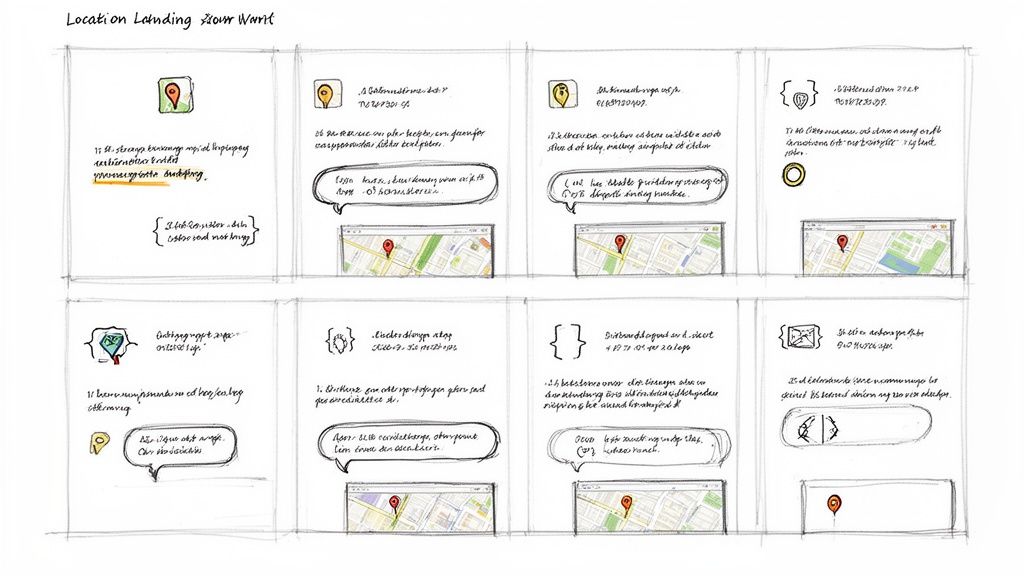
This is non-negotiable for multi-location brands. One of the most powerful things you can do is create a dedicated, unique landing page for each of your physical locations. A single "locations" page with a list of addresses just doesn't cut it anymore.
Each page needs to be a standalone hub of local relevance, meticulously crafted with location-specific details.
- Embed a Google Map: Make getting directions a one-click affair.
- Display the Full NAP: The exact name, address, and phone number, matching your GBP perfectly.
- Include Location-Specific Photos: Show the storefront, your team, and the inside of the shop. Authenticity matters.
- Feature Local Testimonials: Reviews from customers in that specific neighborhood build immediate trust.
- Highlight Local Promotions: Got a special offer or event happening only at that store? Feature it prominently.
The goal is to make it crystal clear to Google—and any visitor—that this page is the definitive resource for your business in that specific neighborhood.
Every location page should tell a unique story. It's not just about listing an address; it's about showcasing your commitment to the local community you serve. This approach builds authority and drives real-world foot traffic.
Create Content That Celebrates Your Community
Your blog is a fantastic tool for deepening your local ties. Writing about topics that matter to the community sends powerful signals of relevance and engagement. This strategy moves you beyond just selling a product and positions your brand as a valuable local resource.
Imagine you run a dispensary in Denver. You could create content like:
- A guide to the "Best Hiking Trails Near Denver"
- A feature on "Partnering with Local Denver Artists for In-Store Events"
- An article about "Supporting Local Denver Charities"
This type of content naturally weaves in local keywords and attracts an audience that is geographically tied to your business. It shows you're invested in the community, not just operating in it. That authentic connection is what separates local leaders from everyone else.
The effort you put into local content pays off. Big time. Local searches don't just attract eyeballs—they convert at an eye-popping 80% rate, far outpacing traditional web searches. For businesses like wellness studios or cannabis dispensaries, this is everything. When someone nearby searches for services, 86% check Google Maps first, and a whopping 42% click straight into the Map Pack results. This high-intent behavior is especially true on mobile, where 18% of local searches lead to a purchase within a single day. You can discover more insights about SEO statistics on aioseo.com. It all proves one thing: every piece of content you create should scream local.
Turning Clicks into Customers: Generating Engagement Signals
Alright, you’ve dialed in your on-site content and polished your Google Business Profile. But local SEO isn't a "set it and forget it" game. To really own the Map Pack, you have to actively generate the real-world signals Google uses to separate the contenders from the pretenders.
This all comes down to two things: encouraging real user interactions and obsessively managing your online reputation.
These two are completely intertwined. A killer reputation built on genuine, positive reviews naturally leads to more clicks, calls, and—the holy grail—requests for directions. Those actions tell Google your business is a popular, relevant spot in the real world. It creates a powerful feedback loop that just keeps pushing your rankings higher.
Master Your Online Reputation
Your reviews are the digital front door to your business. They’re one of the first things potential customers see, and a steady stream of positive feedback is a massive trust signal. It’s also a direct ranking factor. But this doesn’t just happen on its own; you need a system.
The first step? Just ask. Seriously. Happy customers are usually more than willing to leave a review, but they need a little nudge. Make it a seamless part of your process when they're happiest with your service.
- Email or SMS Follow-ups: A day or two after a purchase or visit, send a simple message with a direct link to your GBP review page.
- In-Store Prompts: Put up a small sign with a QR code at your checkout counter or on receipts. Make it effortless for them.
- A Personal Request: This one is huge. Train your team to ask satisfied customers for a review during a great interaction. A genuine, personal touch makes all the difference.
Once reviews start rolling in, responding is non-negotiable. Replying to all of them—good and bad—shows you’re engaged and that you actually care about what your customers think. A thoughtful, professional response to a negative review can even flip a bad situation into a public win for your customer service.
For brands with multiple locations, a consistent and quick response strategy is absolutely critical. It shows a unified commitment to your customers and strengthens the reputation of the entire brand, not just one storefront.
Drive the Clicks That Matter Most
A 5-star average is awesome, but Google is digging deeper. It’s watching what users do after they find your profile. These behavioral signals—clicks to call, website visits, and direction requests—are concrete proof of local interest. Think of them as the digital equivalent of someone walking through your front door.
This is where you can get really strategic. Winning at local search means mastering these high-intent signals. Google weighs actions like direction requests and phone calls heavily, often more than vanity metrics like the total number of reviews. We've seen businesses that actively focus on these signals achieve sustained visibility that others can't touch. Direction requests are the ultimate buying signal for a storefront, while calls confirm interest for a service. Both fuel higher rankings without you ever having to tweak your GBP again. You can see more data on these crucial local search ranking factors at localdominator.co.
So, how do you get more of these valuable signals?
- Use Your Google Posts: Don't just post updates. Use the "Call Now" or "Book" buttons to drive immediate action. A post about a flash sale can generate calls right then and there.
- Optimize Your Photos: Upload sharp, compelling images of your storefront, products, and team. A great photo is often the final push someone needs to request directions.
- Get Your Details Right: Make sure your phone number and address are 100% accurate. Nothing kills engagement faster than a wrong number or a map pin that leads to the wrong block.
Local Engagement Signal Priority Checklist
Not all engagement signals are created equal. When you're juggling a dozen tasks, you need to focus on what actually moves the needle. This checklist breaks down where to prioritize your time for the biggest impact on your Google Map Pack visibility.
| Engagement Signal | Impact Level | Actionable Strategy |
|---|---|---|
| Direction Requests | Very High | Use enticing Google Posts and high-quality photos of your storefront to encourage visits. Ensure your map pin is 100% accurate. |
| Phone Calls | Very High | Feature a clear "Call Now" button in your GBP. Run call-specific offers through Google Posts to drive direct inquiries. |
| Website Clicks | High | Ensure your GBP links to a mobile-friendly, fast-loading, and relevant local landing page, not just your homepage. |
| Review Generation | Medium | Implement a systematic process to ask happy customers for reviews via SMS, email, or in-person requests. |
| Photo Views | Medium | Regularly upload new, geotagged photos of your interior, exterior, team, and products to keep your profile visually fresh. |
By focusing your strategy on generating these authentic interactions, you're giving Google exactly what it wants to see. It’s a proactive approach that proves your business isn’t just a pin on a map—it’s a vital part of the local community.
How to Measure and Scale Your Local SEO Success
Executing a local SEO strategy is just the start. If you want to optimize for local search, you have to move past guesswork and into data-driven decisions that prove your work is actually driving more calls and foot traffic. This is where you connect online visibility to your bottom line.
Forget about vanity metrics like impressions. The real goal is measuring what matters: keyword ranking improvements in specific neighborhoods, spikes in phone calls, and more direction requests. These are the tell-tale signs of high-intent customers ready to walk through your door.
Visualizing Your Local Footprint
One of the most powerful ways to see what’s really happening is with live ranking heatmaps. These tools show you exactly where your business shows up on Google Maps for your money keywords, grid by grid, across your entire service area. Instead of one misleading rank, you get a crystal-clear picture of your strengths and weaknesses.
This kind of visualization instantly flags the areas where you're invisible to potential customers. Imagine a wellness clinic in a big city. A heatmap might show they’re crushing it downtown but have zero presence in a high-income suburb just a few miles away. That's a massive opportunity just waiting to be captured.
Measuring local SEO success means tracking how your online visibility translates into real-world actions. Every direction request and phone call is a direct result of your strategy working.
For multi-location brands, this data is gold. You can compare performance across different cities—or even different neighborhoods in the same city—to spot underperforming locations that need more attention.
This visual shows the simple but powerful loop of reputation management: earn reviews, respond to them, and track the engagement signals they create.
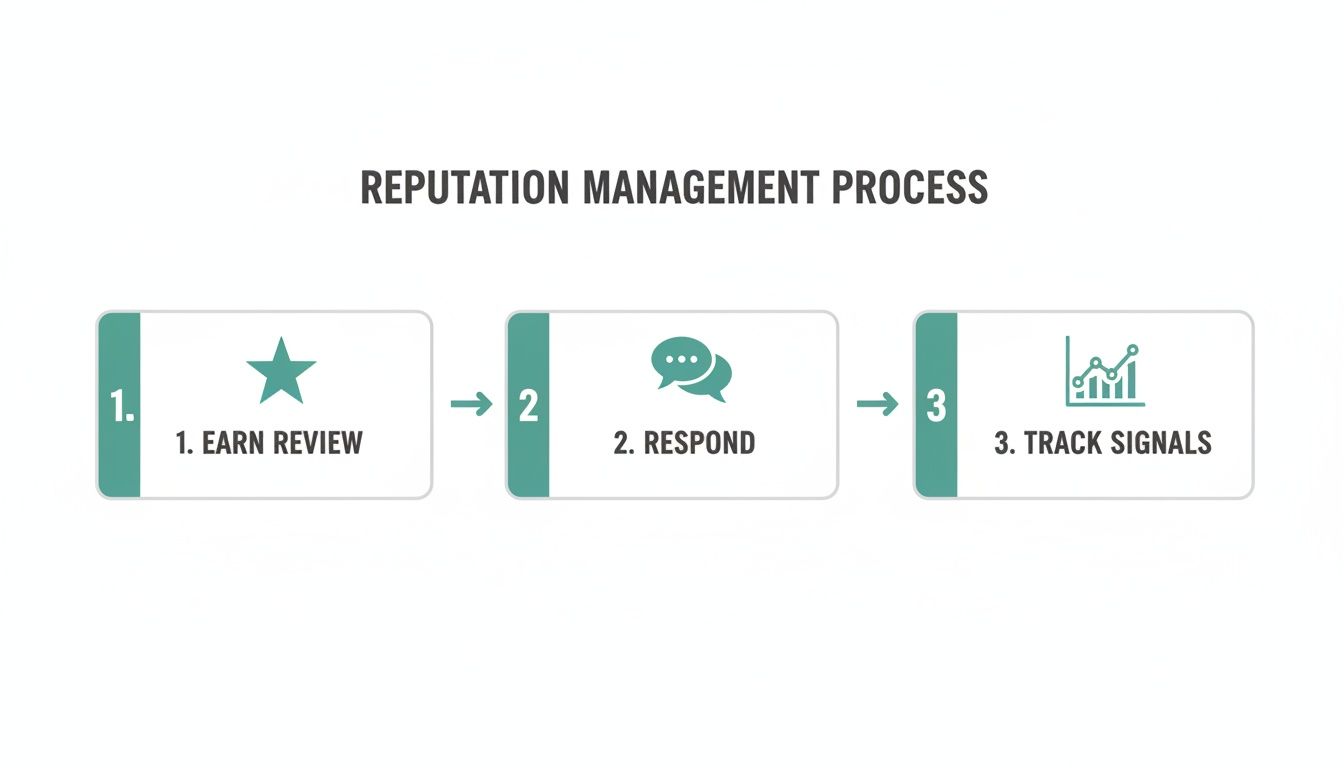
This workflow is a direct pipeline, fueling the very signals that boost your local rankings and drive customer action.
Creating a Scalable Workflow
Once you have clear data, you can build a repeatable process for growth. A structured workflow lets you systematically improve your local presence, one location at a time, without getting buried in the details.
Here’s a practical way to frame it:
- Benchmark Performance: Start by using heatmaps and keyword trackers to get a baseline for every location. You have to know where you are to know where you're going.
- Prioritize Opportunities: Look for the locations with the biggest gaps between their current rank and their potential. Focus your energy on these high-impact areas first.
- Execute and Track: Roll out your optimization tactics—whether it’s building local links, launching location pages, or running a review campaign—and watch the changes on your heatmaps and call logs.
- Report and Refine: Use the data to prove ROI and make your strategy even smarter. If a tactic works wonders for one location, replicate it for others facing similar challenges.
This systematic approach turns local SEO from a random set of tasks into a predictable growth engine. If you're managing multiple storefronts, check out our guide on the essential local SEO reporting tools to make this process even smoother. It’s all about making smarter decisions to scale your success.
A Few Common Questions We Hear
"How Long Does This Actually Take?"
This is the big one, right? While you might see a little bump from quick on-page tweaks or a Google Business Profile update, real, meaningful movement in local search rankings takes a bit of patience. You should realistically expect to see solid progress within 3 to 6 months of consistent work.
Think of it like getting in shape. You don't see results after one trip to the gym. The timeline really depends on your starting point—things like how competitive your industry is, how long you've been around, and what your online presence looks like today. The key is steady, sustained effort, not a one-and-done project.
"If I Can Only Do One Thing, What Should It Be?"
Look, there’s no single magic bullet for local SEO. But if you’re going to put your energy somewhere first, make it your Google Business Profile. A fully built-out, optimized, and active profile is the undisputed foundation of everything else. It's your single most impactful asset.
Once that’s dialed in, your next priorities should be generating a steady stream of authentic customer reviews and locking down your Name, Address, and Phone number (NAP) consistency across the web. Get those two things right, and you're way ahead of the game.
"Do I Absolutely Need a Physical Store to Show Up on the Map?"
For that super-valuable Google Map Pack, yes, a physical address that customers can actually visit is pretty much non-negotiable. Now, if you’re a Service Area Business (SAB)—think plumbers, mobile detailers, or landscapers—you can hide your street address and just show the areas you serve.
But even then, you still have to give Google a real, verifiable physical address to get your profile set up. At its core, local search is all about connecting people with genuine local businesses. A verifiable location is just part of the deal.
Ready to stop guessing and start seeing real results from your local SEO? Nearfront uses AI-powered heatmaps and generates authentic engagement signals to get your locations seen by more local customers. Discover how Nearfront can boost your foot traffic and calls.