So, what exactly is online local rank tracking?
Think of it as monitoring your business's visibility on Google Maps and in local search results from specific, real-world vantage points—like different neighborhoods, intersections, or even street corners. It's about seeing your business exactly how a potential customer sees it, revealing where you're a local hero and where you're practically invisible.
Why Online Local Rank Tracking Is No Longer Optional
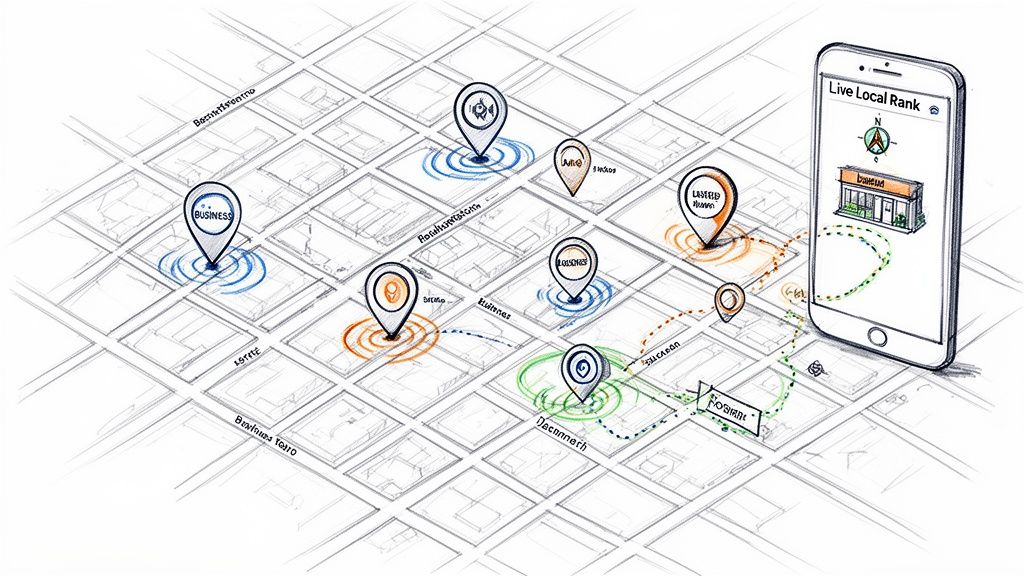
Trying to win at local search without proper rank tracking is like navigating a new city with a map from ten years ago. It’s a losing game. Modern online local rank tracking is your live GPS, showing you precisely how customers find you in the moments that matter.
The big problem it solves is that your search rank isn't one single number. It’s a fluid, hyperlocal reality that can change dramatically from one block to the next. You might be ranking #1 when you search from inside your own store, but you could be totally off the map just a few streets over.
Seeing Through Your Customer's Eyes
Old-school rank checkers that give you a single city-wide average are dangerously misleading for any business with a physical address. When a potential customer pulls out their phone and searches for "coffee shop near me," the results they see are tailored to their exact location. This hyperlocal search environment is the real battleground.
If you don't understand how you rank in different neighborhoods, you're marketing with a blindfold on. You're just guessing at the answers to critical questions like:
- Where are my biggest competitors stealing my customers?
- Which service areas have tons of potential but zero visibility for my brand?
- Are my marketing dollars actually moving the needle in my target zones?
The Direct Impact on Your Bottom Line
This isn't just another abstract SEO metric; it directly impacts your revenue. When you can accurately see your local rankings, you can finally make smart, strategic decisions that drive more foot traffic, more phone calls, and more sales.
For a local business, visibility is currency. If customers can't find you at the exact moment they need you, you simply don't exist. Effective rank tracking makes sure you show up in those critical micro-moments.
For multi-location businesses, this is even more crucial. A good tool lets you compare performance across all your locations, spot the underperformers, and apply winning strategies from one store to another. It turns guesswork into a data-driven plan for owning your local market. This guide will show you exactly how to do it.
Understanding The New Rules Of Local Search
Local search used to be a simple game. If you were the closest business and had the right keywords on your website, you stood a pretty good chance of showing up.
Those days are over.
Today’s local search runs on a completely different fuel: engagement.
Imagine you’re deciding between two neighborhood coffee shops. One has a quiet, dusty online profile. The other is buzzing with activity—fresh reviews pop up every week, customers are constantly asking for directions on Google Maps, and people are clicking to call for reservations. Which one feels more popular? Google’s algorithm is asking that same exact question.
It now rewards the businesses that real customers are actively choosing and interacting with. This means that static, set-it-and-forget-it optimization is dead. Your visibility is now directly tied to the real-world activity your business generates online.
The Power of Engagement Signals
Google's main job is to show searchers the best, most trusted local businesses. It figures this out not by what you say about yourself, but by what your customers do. These actions, or engagement signals, are the new currency in local SEO.
The signals that matter most are:
- Calls and Clicks: How many people click the "Call" button or your website link from your Google Business Profile.
- Direction Requests: The number of users asking Google Maps for directions to your physical storefront.
- Review Velocity: The frequency and consistency of new reviews being posted for your business.
- Customer Interactions: Engagement with your profile through photos, Q&As, and direct messages.
Every single one of these actions tells Google that your business is relevant, active, and a valued part of the local community. To get an accurate picture of your performance, online local rank tracking has to measure these dynamic, real-world signals.
Why Review Velocity Trumps Total Reviews
It’s a common mistake to think that the business with the most reviews wins. While a high number of reviews certainly helps, what Google cares about more is review velocity—that steady, consistent stream of fresh feedback.
Think about it: a business with 100 reviews collected over five years seems less relevant than a business with 50 reviews that all came in during the last six months.
A consistent flow of new reviews signals to Google that your business is popular and delivering a great customer experience right now. A pile of old, stale reviews—even if they're positive—suggests your best days might be behind you.
This is a massive shift. The local search game has completely changed, and these behavioral signals are now make-or-break for your ranking. Expert analysis shows that businesses with consistent online activity are crushing those with static, outdated profiles. In fact, data reveals that 90% of brands see a direct link between the quality and frequency of their online reviews and how well they perform in local search. You can see the full analysis of how these engagement factors are reshaping local SEO.
Building a strategy to encourage recent customer feedback isn't just a "nice-to-have" anymore; it's a fundamental piece of any modern local SEO plan. The goal is to create a constant feedback loop that keeps your online presence fresh, active, and alive. This shows search engines you're not just another listing on the map, but a thriving part of the local ecosystem.
The Key Metrics That Actually Matter
If you want to win at local SEO, you need to be looking at the right scorecard.
Relying on a single, city-wide ranking for one keyword is like judging a baseball game by a single player's batting average. It tells you a tiny piece of the story but completely misses the final score. Real online local rank tracking moves past these simple vanity metrics to focus on the KPIs that actually reflect how you're performing on the ground.
This means you stop asking, "Am I ranking?" and start asking much smarter questions, like, "Where am I ranking, and what business is that visibility actually driving?"
Let's break down the metrics that give you those answers.
Going Beyond a Single Rank
Traditional rank tracking spits out one number, but local search is way more dynamic than that. Your rank changes from one street to the next, and even the type of result you show up in makes a huge difference. Modern tools are built to measure this complexity, giving you the full picture.
The most important metrics to keep your eye on are:
- Grid Rank Position: This shows you where you rank from dozens or even hundreds of specific points on a map, often shown as a heatmap. It’s the only way to see your true visibility across your entire service area, highlighting your strong zones and, more importantly, your blind spots.
- Share of Local Voice (SoLV): Think of this as your market share. It measures your visibility across a whole set of keywords compared to your local competitors. A higher SoLV means you’re capturing more of the search demand in your area.
- Presence in Different Result Types: Are you showing up in the Local Pack? Organic results? The Local Finder? Tracking each is critical because they all attract different kinds of clicks and customers.
This is all driven by real-world engagement. Things like calls, reviews, and direction requests are the signals that tell Google you're a relevant, active business worth showing on the map.
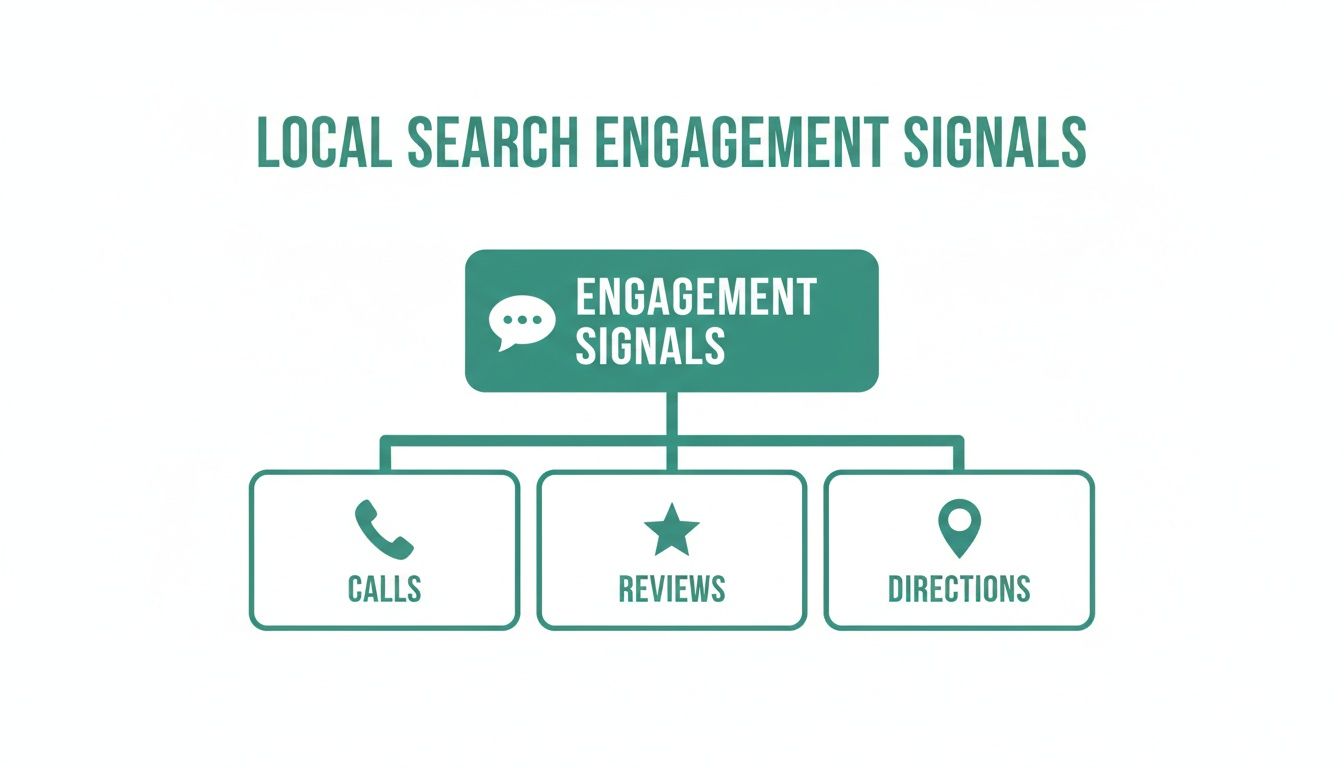
As you can see, genuine customer actions form the bedrock of a powerful local search presence.
Defining Your Core Local KPIs
Knowing these metrics is the first step, but understanding what they mean for your bottom line is what really drives growth. Basic tools might show you a rank, but a true local platform gives you the context needed to make smart decisions.
Here’s a quick look at the essential local rank tracking metrics you should be monitoring. This table breaks down what each KPI measures and why it's so critical for a complete picture of your performance.
Essential Local Rank Tracking Metrics
| Metric | What It Measures | Why It Matters |
|---|---|---|
| Grid Rank Position | Your keyword ranking at multiple, specific geographic points around your business. | It provides a true, hyperlocal view of your visibility, showing exactly where you are strong and where competitors are winning. |
| Share of Local Voice | Your overall market share of top search rankings for a group of keywords versus your competitors. | This metric moves beyond individual ranks to show how dominant your brand is in your local market's search landscape. |
| Local Pack Rankings | Your position within the top 3 map listings that appear for a local search query. | The Local Pack captures the vast majority of clicks, making a top-3 position extremely valuable for driving calls and foot traffic. |
| Local Finder Rankings | Your ranking when a user clicks "View all" from the Local Pack to see a longer list of businesses. | While not as prominent as the Local Pack, it's a key visibility area for users actively comparing local options. |
By focusing on these KPIs, you get a much clearer, more actionable view of what’s actually happening out in the real world where your customers are searching.
The goal of modern rank tracking isn't just to see a number go up. It's to understand your digital footprint on a granular level, connect it to real business outcomes, and find actionable opportunities for growth.
When you track these advanced KPIs, you stop guessing. You start building a data-driven strategy based on how real customers find you. This detailed insight is one of the most important local SEO ranking factors because it lets you pinpoint weaknesses and double down on what works, neighborhood by neighborhood.
Ultimately, this is how you measure what truly moves the needle for local growth and ROI.
Navigating The New AI-Powered Search Landscape
The ground is shifting under our feet in local search, and the earthquake is artificial intelligence. For years, the game was simple: get the customer to click a link. But now, with AI Overviews and conversational platforms like ChatGPT acting as a personal concierge, the rules have completely changed.
Customers aren't just sifting through a digital phone book of search results anymore. They're asking a trusted advisor—the AI—for a direct recommendation. This means that just ranking high isn't good enough; you have to become the answer the AI chooses to give.
From Clicks To Mentions
This shift forces a major pivot in how we measure success. The old obsession with click-through rates is quickly becoming obsolete because AI often serves up the answer directly, meaning users never even need to visit your website. The new priority is getting "mentioned" or recommended within these AI-generated responses.
Think of it this way: a click is a single action, but an AI mention is a powerful endorsement. It positions your business as the solution to a user's problem, building trust before they even land on your site. Effective online local rank tracking has to account for this new reality.
This fragmentation of the search landscape—across Maps, traditional organic results, and now AI—makes comprehensive tracking an absolute must. For any multi-location brand, trying to operate without monitoring all three ecosystems is like navigating a city with only one-third of the map.
Introducing The AI Visibility Score
To win in this new environment, businesses need a new metric. Enter the AI Visibility Score. This KPI measures how often your business gets cited or recommended by AI platforms in response to local queries. It’s the modern-day equivalent of word-of-mouth, scaled for the digital age.
In an AI-driven world, your goal is not just to be found, but to be recommended. The AI Visibility Score is the clearest indicator of whether you're winning that trust at a local level.
This isn't just a future trend; it's happening now. More than half of local search terms now trigger AI overviews, a change that is completely upending performance measurement. This has led experts to champion the AI Visibility Score, which tracks how often platforms like ChatGPT, Perplexity, and Gemini cite your business.
As click-through rates decline, local businesses must shift their focus to tracking impressions and overall presence, not just website visits. For multi-location brands, this means your rank tracking tools absolutely must monitor visibility across three distinct ecosystems: Google Maps, organic search, and the AI-assisted platforms that now guide customer discovery.
How To Adapt Your Tracking Strategy
Adapting means letting go of old habits. While traditional rank tracking for AI is a flawed concept—AI answers are dynamic and personalized—you can and must track your brand's presence within this new conversational layer.
Your strategy should now include:
- Monitoring Brand Mentions: Track how often your business name, products, or services appear in AI-generated answers for relevant local searches.
- Verifying Information Accuracy: Make sure that when AI does mention you, the information it shares (address, hours, services) is correct and positive. Bad data can be more damaging than no mention at all.
- Analyzing Competitive Presence: See which competitors are getting recommended by AI for your target keywords. This is your roadmap to understanding who the AI currently "trusts" most in your market.
This new world can feel complex, but understanding the interplay between AI and the future of local SEO is the only way to stay ahead. By expanding your tracking to include AI visibility, you're not just keeping up; you're preparing your business for the next generation of customer discovery. The concierge is here, and you need to make sure it knows your name.
How To Read Ranking Heatmaps Like A Pro
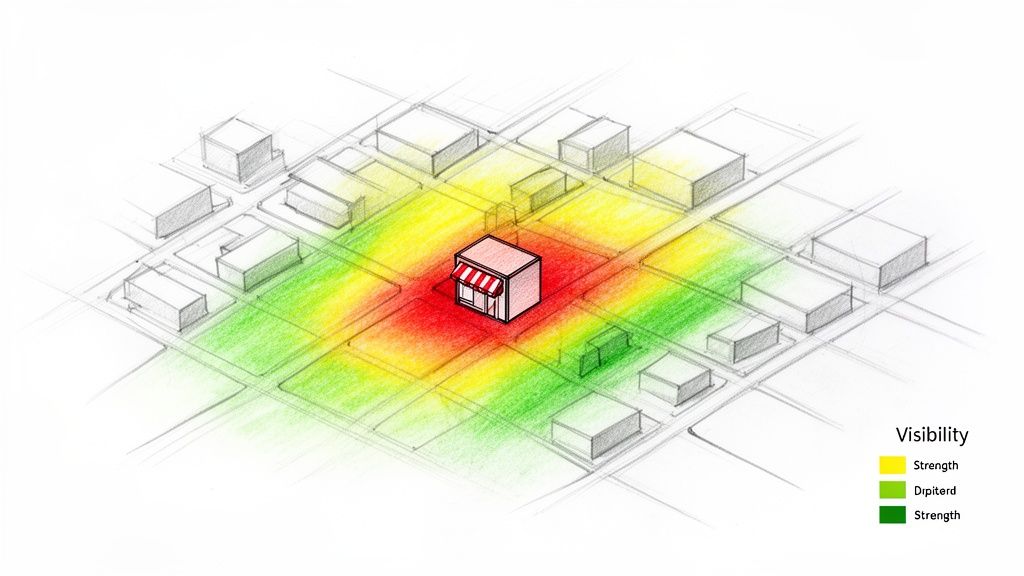
Raw data is just noise until you know how to make sense of it. This is where a ranking heatmap, a core feature of modern online local rank tracking, changes the game. It turns a spreadsheet full of confusing numbers into a clear, visual story you can act on immediately.
Think of it as a weather map for your local visibility. It shows you exactly where you’re shining and where you’re stuck in a storm.
Instead of relying on a single, misleading rank for your entire city, a heatmap grids out the area and shows your ranking from dozens—or even hundreds—of specific points. Each point on that map simulates a search from that exact location, revealing what a real customer would see from their neighborhood, street, or intersection.
This visual approach cuts right through the complexity of hyperlocal search, giving you an intuitive, on-the-ground understanding of your true performance.
Decoding The Colors And Patterns
The real power of a heatmap is its simplicity. The colors tell you everything you need to know at a glance.
- Green (Positions 1-3): This is your high-visibility zone. A big, solid green core around your business means you're dominating the Local Pack. This is where you want to be.
- Yellow/Orange (Positions 4-10): These are your opportunity zones—or potential weaknesses. You’re on the map, but you're not in the top spots. Customers are definitely seeing your competitors first.
- Red (Positions 11+ or Not Ranking): These are your blind spots. Red means you’re effectively invisible to customers, highlighting major gaps in your local reach.
A healthy heatmap shows a dense green center that slowly fades to yellow and orange at the edges. If your map looks patchy, with red spots creeping in close to your location, it’s a clear sign that competitors are eating into your territory.
This is a classic example of a business that ranks #1 right on its doorstep, but its visibility plummets to the 4-6 range just a few blocks away. That’s not a problem; it’s a crystal-clear opportunity for targeted optimization.
Turning Heatmap Insights Into Action
Looking at a heatmap isn't just an academic exercise. It’s about finding real opportunities to drive more business. When you connect the visual data to what you know about your market, you can build a much smarter, more surgical local SEO strategy.
A heatmap doesn't just show you where you rank. It shows you where your next customer is waiting to find you and who is standing in your way. It’s a strategic roadmap disguised as a colorful grid.
Once you see your visual footprint, you can take specific, data-backed actions. Here’s how to translate those colorful patterns into a concrete plan:
- Spot High-Value Opportunities: See a red or yellow patch in a wealthy neighborhood or an area dense with your target customers? You’ve just found your next growth zone. Create a location-specific landing page or run geotargeted local ads to boost visibility right there.
- Diagnose Competitive Threats: Is a rival showing up green where you’re red? Time to investigate. Dig into their Google Business Profile for that area. Are their reviews better? Is their profile more complete? The heatmap tells you exactly where to focus your competitive analysis.
- Validate Your SEO Efforts: After you make changes—like getting a burst of new reviews or updating your service area info—run a new scan. Seeing those red spots turn yellow or green is the ultimate proof that your strategy is actually working.
By checking your heatmaps regularly, you stop guessing what works and start knowing what works. This level of granular insight is what defines effective local marketing today.
For those looking to dive deeper, exploring the 12 best Google Maps ranking checker tools can offer a wider view of the available technology. Ultimately, mastering heatmaps gives you the power to dominate your local market, one neighborhood at a time.
Actionable Strategies To Improve Your Local Rankings
Seeing your data is one thing; acting on it is where the real money is made. The entire point of online local rank tracking is to turn those insights into real-world actions that get your phone ringing and your doors swinging. This is where your data stops being a report and starts being a roadmap.
Instead of throwing spaghetti at the wall to see what sticks, you can now move with surgical precision. A heatmap, for example, shows you exactly where you're weak, turning abstract data into tangible results and a clear ROI.
Responding to Heatmap Visibility Gaps
One of the most powerful things you can do with a rank tracking heatmap is spot—and fix—visibility gaps in high-value neighborhoods. If your report shows a big "red zone" in an area you know is packed with potential customers, that’s a flashing neon sign telling you to get to work.
Here’s a simple playbook to follow:
- If you spot a red or yellow patch, it's time to build a hyper-localized landing page just for that neighborhood. Seriously, get specific. Mention local landmarks, cross-streets, and community hubs to send strong relevance signals to Google.
- Next, run targeted ads aimed squarely at that geographic weak spot. Your ad copy can even call out the neighborhood by name, making it feel way more personal and relevant to the people who see it.
The goal isn't to be everywhere; it's to be visible where it matters. A heatmap shows you exactly where to put your time and money for the biggest impact, cutting out the guesswork and wasted ad spend.
This targeted approach is infinitely more effective than a generic, city-wide campaign. Why? Because you're addressing a specific weakness your heatmap has already handed you on a silver platter.
Boosting Review Velocity and Engagement
Your tracking data is also your secret weapon for reputation management. If you notice your rankings slipping in a competitive area, take a peek at the businesses outranking you. Chances are, they're pulling in a steady stream of fresh, positive reviews.
You need to fight fire with fire. It's time to kickstart your own review generation engine.
- Identify Your Biggest Fans: Think about your repeat customers or clients who have already given you great feedback in person. They're your low-hanging fruit.
- Make It Stupidly Simple: Send them a direct link to your Google Business Profile review page. A quick text or email is perfect. The fewer clicks it takes, the more likely they are to do it.
- Respond to Every Single Review: Thank the happy customers and professionally address any negative feedback. This engagement shows both Google and potential customers that you're an active, attentive business that actually cares.
Optimizing Your Google Business Profile for Conversions
Finally, remember that rankings are only half the story. Once a customer finds you, your Google Business Profile (GBP) has to do the heavy lifting and convince them to act.
If your heatmap shows you're crushing it for a keyword like "emergency plumber" but the calls aren't coming in, your GBP might be missing key conversion triggers.
- Showcase Your Offerings: Use Google Products and Services to clearly list what you do.
- Turn on Messaging: Let people contact you right from your profile with zero friction.
- Leverage Google Posts: Share updates, special offers, and news. A fresh profile looks like a healthy, active business.
By connecting your heatmap data to these specific, actionable strategies, you transform online local rank tracking from a simple reporting tool into a powerful engine for real-world growth.
Your Local Rank Tracking Questions Answered
When you first start digging into local rank tracking, a few questions always seem to surface. Let's walk through them, so you can feel confident you're on the right track.
How Often Should I Check My Local Rankings?
It's tempting to check your rankings every single day, but honestly, it's more likely to cause headaches than provide real insight. Local rankings can wobble up and down for countless reasons that are completely out of your control, leading to a lot of unnecessary stress over tiny shifts.
A much better rhythm is checking in weekly or bi-weekly. This gives you enough data to spot real trends and see how your efforts are paying off, without getting bogged down in the daily noise.
For most businesses, this cadence is the sweet spot. You can clearly see how a flurry of new reviews or a fresh Google Business Profile post impacts your visibility. A monthly check-in is also great for taking a step back and looking at the bigger picture—your overall progress and where you stand against the competition.
Why Do My Rankings Look Different From My Tracking Tool?
This is the classic "it doesn't look like that on my phone" problem. You pop open an incognito window, search for your keyword, and see a completely different result than what your rank tracking software is telling you. This happens for one simple reason: every search result is personalized.
A bunch of factors are at play here:
- Your physical location: Moving just a few blocks can completely change what you see.
- Your personal search history: Google remembers what you’ve clicked on before and tweaks results based on what it thinks you want to see.
- The device you're using: You'll often see different rankings on a phone versus a desktop.
A professional tracking tool gets around this by simulating searches from precise, fixed locations. It strips away all that personalization bias, giving you an objective, standardized baseline. It’s a far more accurate picture of your true market visibility than any manual search could ever be.
Ready to see your true local rankings without the guesswork? Nearfront provides live, AI-powered heatmaps that show you exactly where you stand, neighborhood by neighborhood. Start tracking your real visibility today.