At its core, small local business marketing is about being the first and best answer when someone searches for what you offer "near me." It's a focused set of strategies designed to turn those immediate, location-based searches into actual foot traffic and real sales.
Why Local Marketing Is Your Greatest Growth Lever
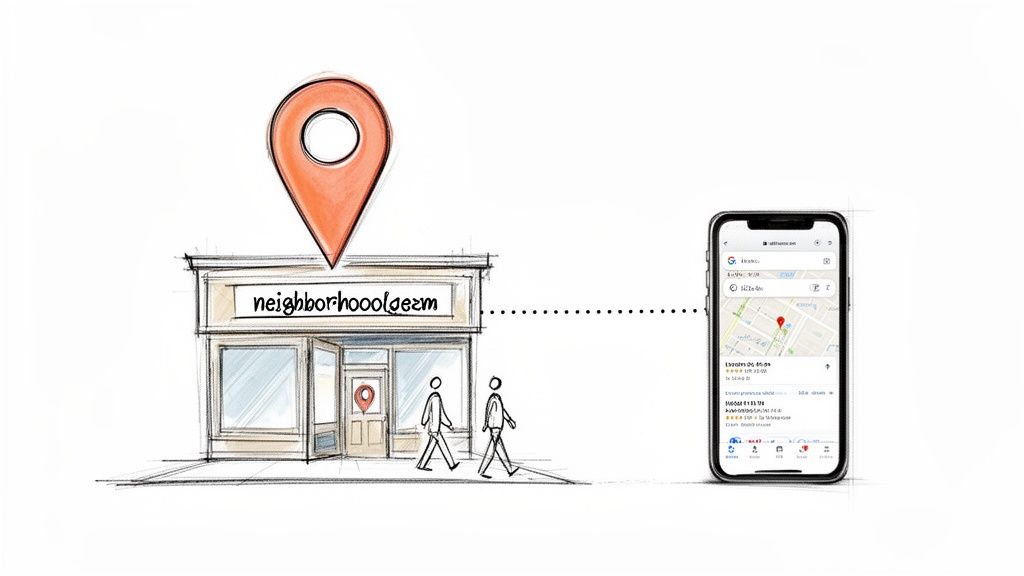
Forget the generic, one-size-fits-all marketing advice you've heard. For a business with a physical address, success isn’t about reaching everyone, everywhere. It’s about winning the hearts and minds of the customers just a few blocks or miles away.
Think of your business as a neighborhood gem. Without the right digital signposts, even the most eager customers will walk right on by, completely unaware you exist.
This guide cuts through the fluff to give you practical strategies that directly connect your online presence to your physical storefront. Success here means being impossible to miss the moment a potential customer pulls out their phone looking for what you sell.
The Modern Customer Journey Starts Locally
The old path to purchase is gone. Today's customers discover, vet, and choose local businesses almost entirely through their devices. This isn't a threat; it's a massive opportunity for businesses that know how to play the game. Your digital footprint—from your Google ranking to your social media vibe—is now the main driver of in-person visits.
A powerful local marketing strategy really boils down to three key pillars:
- Dominating Local Search: Making sure your business owns the top spots on Google Maps and in local search results.
- Engaging Your Community: Building real relationships with customers and other local businesses, both online and off.
- Using Smart Advertising: Targeting ads to people within a tight radius of your store to drive immediate, measurable action.
This isn't just theory; it's the new reality of how business gets done. When someone searches for "best coffee near me" or "emergency plumber," the businesses that show up first are the ones that win. It's that simple.
The Untapped Local SEO Opportunity
Local SEO has become an absolute game-changer, especially for businesses with a physical location. And here’s the kicker: only 19% of small businesses are currently using local SEO and Google Business Profile to get seen. That leaves a huge, untapped opportunity on the table for everyone else.
This statistic highlights a massive gap between how customers are searching and what most businesses are actually doing. To see just how wide this gap is, you can dive deeper into these small business marketing insights and get a clearer picture of the competitive landscape.
Master Your Digital Storefront with Google Business Profile
Your Google Business Profile isn't just another online listing—it's your digital front door. For most people searching for local businesses, your profile is the very first thing they see. It's the modern equivalent of your main street window display, and it needs to be clean, inviting, and full of the right information.
When someone nearby searches "bakery near me" or "emergency auto repair," the businesses that show up in Google's coveted Map Pack are the ones that get the click. A well-oiled GBP is your ticket to that prime real estate. It’s how you signal to Google that you’re a real, active, and relevant business ready to help.
Building Your Foundation The Right Way
First things first: get the basics right. This isn’t just about filling in boxes; it's about giving Google and your customers crystal-clear information. Any inconsistency can erode trust and tank your local rankings before you even get started.
Pay close attention to your name, address, and phone number (NAP). This information must be perfectly consistent everywhere it shows up online. A tiny variation, like listing "St." on your GBP but "Street" on your website, can create confusion for search engines and weaken your authority.
The core of local SEO is consistency. Google rewards businesses it can confidently recommend, and having consistent NAP information across the web is one of the strongest trust signals you can send.
Next, nail your business categories. Your primary category is the most important one—it should describe what your business is (e.g., "Italian Restaurant"), not what it does or sells (e.g., "Pizza and Pasta"). From there, add secondary categories to cover everything else you offer, like "Pizza Delivery" or "Caterer." This simple step helps Google match you with more specific, high-intent searches.
Bringing Your Business Profile to Life
With a solid foundation in place, it's time to transform your profile from a static listing into a dynamic tool that pulls customers in. This is where you inject your brand's personality and give people compelling reasons to choose you over the shop down the street.
Start with your business description. You have 750 characters to tell your story, so make it count. Don't just list your services—explain what makes you different. Are you a family-owned shop with a 50-year history? Do you use locally sourced ingredients? This is your chance to connect with people.
High-quality photos are just as crucial. A profile with photos gets 42% more requests for driving directions and 35% more clicks to their website. The data doesn't lie.
Here’s a simple photo strategy to get you started:
- Exterior Shots: Show your storefront from a few different angles so customers recognize it when they arrive.
- Interior Photos: Capture the vibe. What does it feel like to be inside your business?
- Product/Service Shots: Showcase your best-selling items or your team in action.
- Team Photos: Putting a face to the name builds trust and makes your business feel more human.
For a complete walkthrough on maximizing every feature, you can learn more about how to optimize Google Business Profile in our detailed guide.
Maintaining Momentum with Active Management
Your GBP is not a "set it and forget it" asset. If you want to keep your spot on the map, you need to stay active. An engaged profile shows Google you care about your customers and are committed to providing a great experience.
Get in the habit of using Google Posts to share updates, promotions, events, or new products. These posts show up right on your profile in the search results and act like free mini-ads. They expire every seven days, so posting consistently is key to staying visible.
Finally, take control of your Q&A section. Proactively add and answer frequently asked questions yourself. This lets you control the narrative and provide helpful information upfront. When customers ask new questions, answer them quickly. It shows both potential customers and Google that you're on top of your game, turning your profile into your most powerful local marketing tool.
A well-optimized Google Business Profile is a non-negotiable for any local business. It's the most direct path to getting found by the customers who are actively looking for you.
Below is a checklist to help you prioritize your efforts for maximum impact.
GBP Optimization Checklist for Maximum Local Impact
| Optimization Action | Why It Matters for Local SEO | Expert Tip |
|---|---|---|
| Verify Your Business | This is the first step. Unverified listings won't appear on Maps and have very limited visibility. | Check for and remove any duplicate listings for your address. This is a common issue that splits your SEO authority. |
| Perfect Your NAP | Name, Address, Phone (NAP) consistency is a massive trust signal for Google. | Use the exact same format for your address everywhere online—including your website's footer and contact page. |
| Choose a Precise Primary Category | Your primary category has the biggest impact on which searches you rank for. Be specific. | Think "what am I?" not "what do I sell?" For example, choose "Pizza Restaurant" over "Food." |
| Add Multiple, High-Quality Photos | Visuals increase engagement, clicks, and trust. Profiles with photos get more traffic. | Upload new photos at least once a month. Showcasing new products, seasonal decor, or team members keeps it fresh. |
| Actively Solicit Google Reviews | Reviews are a top 3 local ranking factor. A steady stream of positive reviews is critical. | Train your staff to ask happy customers for a review at the point of sale. Make it part of your culture. |
| Publish Weekly Google Posts | Posts signal to Google that your business is active. They also act as free, eye-catching ads. | Use Posts to announce promotions, events, or new products. A simple update once a week is enough to make a difference. |
| Answer Q&A Section Questions | This feature allows you to control the narrative and address common customer questions directly. | Proactively add your own FAQs to this section. If you don't, your competitors or misinformed customers might. |
| Complete All Available Profile Fields | Filling out sections like services, attributes, and accessibility helps you rank for more specific long-tail searches. | Check your profile quarterly. Google is always adding new attributes (like "women-owned") that can help you stand out. |
Focusing on these high-impact actions will put you miles ahead of competitors who treat their GBP as an afterthought. It's your digital storefront—keep it sharp.
Win the 'Near Me' Search with Powerful Local SEO
If your Google Business Profile is your digital storefront, local SEO is the engine that gets people in the door. It’s how you show up at the exact moment a potential customer pulls out their phone and types in a "near me" search.
Think of it as a collection of signals you're constantly sending to Google. These signals prove you’re the most relevant, trustworthy answer to someone's immediate problem. Getting this right is where most small local business marketing either wins or loses.
To really nail it, you need to understand how Google's algorithm thinks. It boils down to three core questions it asks before recommending you.
The Three Pillars of Local Search Visibility
Google’s job is to deliver the most helpful result, and it uses a simple but powerful framework to do that. If you can master these three elements, you're building a rock-solid foundation for your entire local strategy.
- Proximity: This one's the most obvious. How close are you to the person searching? You can't move your store, but you can make damn sure your address is perfectly accurate and consistent everywhere online.
- Relevance: How well does your business actually match the search? If someone looks for a "24-hour emergency plumber," Google scans your GBP, website, and reviews for those exact keywords. It's a game of matching what you offer with what people are asking for.
- Prominence: This is Google’s word for how well-known and respected your business is. It’s a measure of your local authority, built from things like the number and quality of your online reviews, links from other local websites (like the Chamber of Commerce), and mentions in local blogs or news.
At the end of the day, Google wants to show its users a business that's close by, does exactly what they need, and is well-liked by others. Your job is to make it incredibly easy for the algorithm to see that you check all three boxes.
This map shows how your Google Business Profile acts as the central hub, pulling all these signals together.
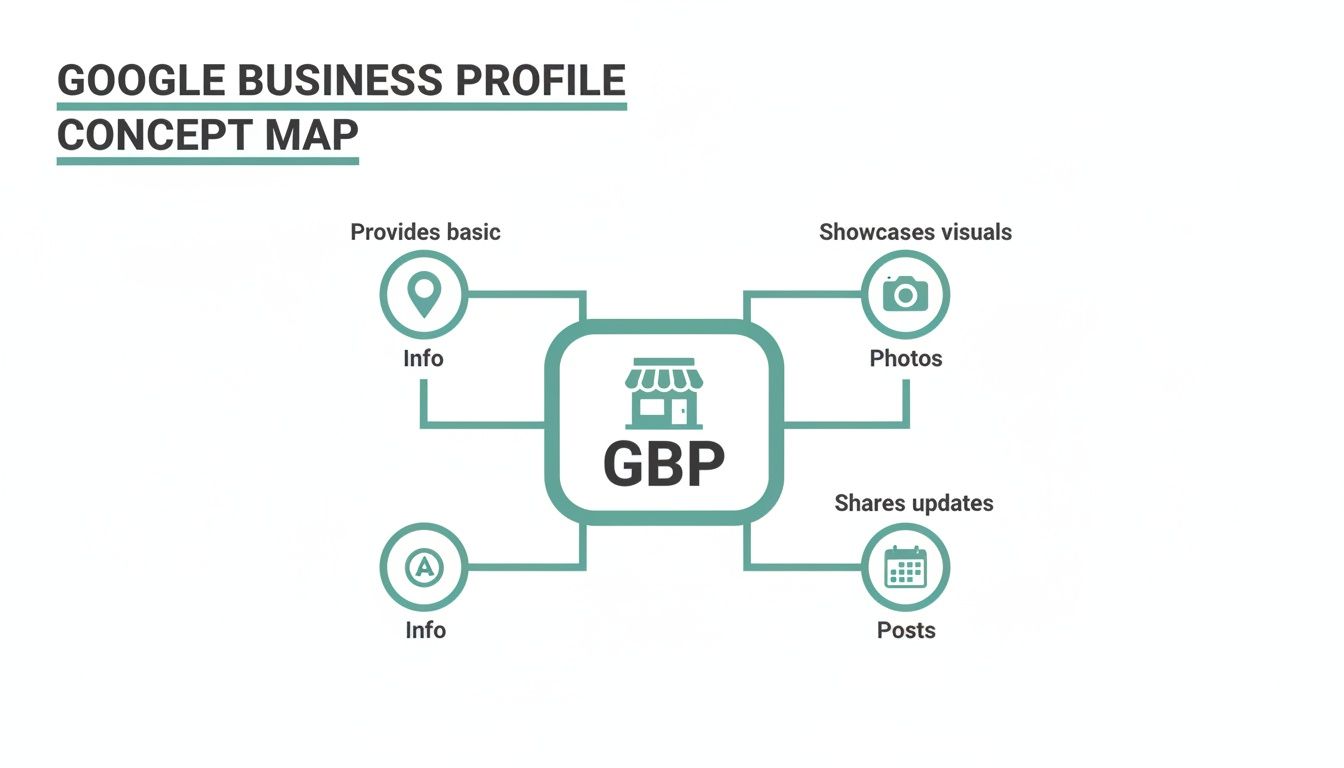
Every piece of your profile—from basic info to photos and posts—helps paint a clearer picture for both customers and Google.
On-Page SEO: Your Digital Turf
Your website is where you prove your relevance. It's your home base, the place where you can go into deep detail about what you do and where you do it. This is what we call on-page SEO.
A killer tactic here is creating location-specific service pages. Don't just make a generic "Services" page. Get granular. Create dedicated pages for each core service you offer in every neighborhood you serve.
A plumber in Austin, for example, could build out pages like:
- Emergency Plumbing Services in South Congress
- Zilker Drain Cleaning Experts
- Downtown Austin Water Heater Repair
Each page needs unique content that speaks directly to that neighborhood. Mentioning local landmarks or cross-streets signals extreme relevance to Google when someone searches from that area, giving you a massive edge. To dig deeper, it’s worth understanding all the major local SEO ranking factors at play.
Off-Page SEO: Building Your Local Reputation
Off-page SEO is everything you do outside of your website to build prominence and trust. For a local business, this is all about becoming a recognized name in your community.
First, managing your online reviews is non-negotiable. A constant flow of positive Google reviews is one of the most powerful prominence signals you can send. Actively ask happy customers to share their experience. And just as important—respond to every review, good or bad. It shows you're paying attention.
Another huge piece is earning local backlinks. A backlink is just a link from another site to yours, but think of it as a vote of confidence. A link from a local neighborhood blog, an event you sponsored, or the city's business directory is worth its weight in gold for local SEO.
Pinpoint Your Growth with Hyperlocal Tracking
Finally, to truly win, you have to see the search results exactly as your customers do. The problem is, results can change from one city block to the next. A standard rank tracker that gives you an "average" position is basically useless.
This is where hyperlocal keyword tracking tools are a game-changer. They use geo-grids to create a heatmap of your rankings, showing you precisely where you’re strong and where you’re invisible. You can literally see your digital blind spots, neighborhood by neighborhood.
It’s the difference between guessing where to focus your marketing and knowing exactly where your next customer is waiting to find you.
Drive Foot Traffic with Smart Local Advertising
If local SEO is your long-term foundation, smart local advertising is the turbocharger. It’s how you get immediate visibility in front of customers who are ready to buy right now. This is where you get to pinpoint your ideal audience with surgical precision.
Think of it like this: SEO is like building a great reputation around town over time. Local ads are like putting up a billboard on the busiest street, but it only shows up for people you know are looking for what you sell. It’s a powerful one-two punch for any small local business marketing plan.
Paid ads let you skip the line. You show up at the top of search results or in social media feeds, grabbing attention the moment someone is looking. The secret isn't a massive budget; it's a hyper-focused approach.
Target Customers Around the Corner
Hyperlocal targeting is your secret weapon. We're not talking about blanketing an entire city with ads. This is about drawing a tight circle around your storefront and showing ads only to people inside it. You can get as granular as a specific zip code or even a one-mile radius.
Platforms like Facebook and Instagram are brilliant for this. You can layer location targeting with demographics and interests to find your perfect customer. For example, a yoga studio could run a "New Client Special" ad targeting women aged 25-45 who live within three miles and are interested in wellness and fitness.
That level of specificity means you're not wasting a single dollar on someone who's never going to walk through your door. Your ad spend is concentrated where it has the best shot at driving real foot traffic.
Win High-Intent Searches with Google Ads
When someone needs something now, they Google it. Running targeted search ads makes sure you're right there at that exact moment of need. For service businesses like plumbers, electricians, or locksmiths, Google's Local Service Ads (LSAs) are a total game-changer.
Local Service Ads appear above the regular paid search ads and organic results. They come with a "Google Guaranteed" badge, which is a massive trust signal that instantly boosts your credibility and gets the phone ringing.
For other businesses, standard Google Ads with location extensions are a must. These ads show your address, phone number, and a map marker right in the search results, making it dead simple for people to find you. By bidding on keywords like "best coffee shop near me" or "emergency tire repair," you capture customers actively looking for a solution.
Crafting Ads That Turn Clicks into Visits
Your ad copy is the bridge between a digital click and an in-store visit. Generic, boring messages just won't cut it. Your ads need to speak directly to local customers and give them a compelling reason to come in today.
Here are a few tactics that work like a charm:
- Create Scarcity: "First 20 customers get a free espresso." This gets people moving.
- Offer In-Store Exclusives: "Show this ad for 15% off your purchase." This directly ties the ad to a physical visit.
- Highlight Local Relevance: "Come try our new [Local Neighborhood]-inspired menu!" This builds a connection to the community.
This stuff is getting more critical by the day. As economic pressures mount, small businesses are smartly shifting their marketing spend toward search and social ads that deliver a clear, measurable return. According to recent small business marketing trends, this focus on lead generation is only growing. Your goal is simple: make the decision to visit your store an absolute no-brainer.
Turn Local Searchers into Loyal Customers
Getting a potential customer to notice you on Google Maps is a huge win, but it’s only half the battle. The real magic happens when you turn that initial online discovery into a loyal, repeat customer who tells their friends about you. This is where your digital marketing efforts connect with the real-world customer experience.
Think of your online presence as a promise. When a customer sees a special offer in a Google Post or on your Facebook page, they expect to walk in and redeem it without a hitch. A seamless journey from their screen to your store is the first step in building real, lasting trust.
Bridge the Online to In-Store Gap
That transition from a click to a handshake needs to be flawless. When a customer walks in because of an online promotion, your team should be ready and informed. It’s a simple thing, but this alignment makes customers feel seen and valued from their very first interaction.
This requires clear communication between whoever manages your small local business marketing and your front-line staff. A quick weekly huddle or a shared doc outlining current promotions can prevent those awkward "I've never heard of that deal" moments that instantly kill customer confidence.
Your marketing doesn’t stop when someone walks through the door; it’s just getting started. Every in-person interaction is an opportunity to confirm that the customer made the right choice by picking you.
A fantastic in-store experience doesn't just satisfy a customer; it creates an advocate. And that’s fertile ground for glowing online reviews.
Cultivate a Strong Community Presence
For a local business, the community isn't just a market—it's your ecosystem. Embedding your brand into the fabric of your neighborhood builds a level of loyalty that big-box chains can only dream of. It transforms your business from a place that sells things into a place that belongs.
Start by getting involved in authentic ways:
- Sponsor a Local Event: Supporting a little league team or a neighborhood festival gets your name in front of local families in a really positive light.
- Partner with Neighboring Businesses: Team up with a non-competing business for a joint promotion. A coffee shop could offer a discount to customers of the bookstore next door, and vice versa. It’s a classic win-win.
- Host Your Own Events: A free workshop, a product tasting, or a meet-and-greet can turn your location into a genuine community hub.
These activities create real connections and give people reasons to talk about you that have nothing to do with making a sale.
Turn Happy Customers into Your Best Marketers
Word-of-mouth has always been powerful, but its digital twin—online reviews and social media tags—is even more critical today. Your happiest customers are your most credible and effective marketing channel. You just need to give them a gentle nudge.
After a great interaction, make it incredibly easy for them to leave a review. A simple follow-up email or a text with a direct link to your Google Business Profile can dramatically increase your review count. And when those glowing reviews come in, share them! Post them on your social media channels.
Encourage customers to share photos of their experiences with a branded hashtag. When someone posts a great picture of your product or service, you're getting an authentic, trusted endorsement. This user-generated content is marketing gold, building social proof that resonates far more than a polished ad ever could. This cycle of excellent service leading to public praise is the engine of sustainable local growth.
Measure What Matters for Sustainable Local Growth
Connecting your small local business marketing to actual results is the final, most important piece of the puzzle. It’s the only way to know if your strategy is actually working and where you can double down for even better returns. Without measurement, you're just guessing.
Think of it like this: vanity metrics like social media likes or website page views are like faint, distant stars. They're nice to look at, but they won't guide you to your destination. Actionable metrics are your North Star—they give you a clear direction for growth.
These are the numbers that directly translate to revenue and foot traffic. They tell you if your online presence is actually getting customers through your door.
Focusing on KPIs That Drive Growth
To really get a grip on your marketing's impact, you have to shift your focus from broad, feel-good numbers to specific, location-based outcomes. These are the key performance indicators (KPIs) that signal genuine progress for a brick-and-mortar business.
Your main focus should be on metrics that draw a straight line between online activity and in-person action. These include:
- Google Maps Rankings: Are you climbing higher in the Map Pack for your most valuable keywords? This is a direct measure of your local SEO success.
- Phone Calls from Your GBP: How many people are tapping that "call" button on your Google Business Profile? This is a high-intent action that often turns into a new customer.
- Website Clicks: Tracking clicks from your GBP to your website shows that people are interested enough to dig deeper into what you offer.
- Direction Requests: This is one of the most powerful signals of purchase intent. An increase here means more people are literally planning to visit you.
A business pulling in 100 direction requests a month is in a much stronger position than one with 1,000 social media followers but no in-store visits. Focus on the metrics that actually pay the bills.
Using Analytics to Make Smarter Decisions
The good news is that tracking these KPIs isn't as complicated as it sounds. Your Google Business Profile Insights dashboard is packed with data on how users find and interact with your listing. You can easily see how many people called, visited your site, or asked for directions over specific time periods.
And for businesses with multiple locations, this becomes even more powerful. Comparing performance across different storefronts is essential. You might find that one location gets a ton of calls while another gets more direction requests. This kind of insight lets you tailor your marketing for each neighborhood, leaning into what's already working.
Using the right tools can make this even easier. You can explore a variety of local SEO reporting tools that pull all this data into simple, easy-to-read dashboards.
By consistently tracking these core metrics, you stop reacting and start building a proactive, data-driven strategy. You can confidently prove the return on your investment, justify your budget, and keep refining your approach for real, sustainable growth.
Got Questions About Local Marketing? We've Got Answers.
Jumping into local marketing always brings up a few questions. We’ve answered some of the most common ones we hear from business owners, with straight-to-the-point advice to help you focus your energy where it counts.
How Much Should a Small Business Actually Spend on Local Marketing?
There's no one-size-fits-all answer, but a solid starting point is 7-10% of your gross revenue. If you're brand new or fighting for attention in a crowded market, you'll probably want to push that closer to 12-15% to get your name out there.
The real key isn't the exact dollar amount—it's where you put it. Start with the heavy hitters like perfecting your Google Business Profile and running small, focused local ads. See what works, track everything, and then double down on the channels that bring you real, measurable business.
What’s the Single Most Important Thing for Local SEO?
If you can only do one thing, make it your Google Business Profile (GBP). No contest.
Think of your GBP as your digital front door. It’s the bedrock of your entire local online presence and the number one thing that gets you seen in the Google Map Pack—which is exactly where most local customers are looking.
A complete, accurate, and active profile is the clearest signal you can send Google that your business is legitimate, relevant, and ready for customers.
A strong Google Business Profile isn't just a good idea; it's non-negotiable. It tells Google you’re a real, active business ready to serve customers nearby, making it the foundation of any local SEO effort.
How Long Until I Start Seeing Results from Local Marketing?
This completely depends on what you’re doing. Some tactics give you an almost instant boost, while others are more of a slow burn.
Here’s a quick breakdown:
- Paid Local Ads: Results can show up almost immediately. A well-built campaign on Google or Facebook can have your phone ringing or your door swinging within a few days.
- Local SEO: This is a long game. You're looking at 3-6 months to see real, lasting movement in Google Maps rankings, especially if you're in a competitive field.
The smartest play is to mix short-term wins (like ads) with long-term foundation building (like SEO and gathering reviews). This gives you a steady flow of customers now while you build a presence that lasts.
Should I Do Local Marketing Myself or Hire Someone?
Honestly, you can do a lot of the foundational stuff yourself. Claiming and optimizing your GBP, posting on social media, and asking customers for reviews are all totally manageable for a hands-on owner, especially when you're starting out.
But as you grow, or if you're in a tough market, an agency can bring some serious firepower. They live and breathe technical SEO, complex ad campaigns, and deep data analysis that can really accelerate your growth. A great approach is to handle the basics in-house and bring in an expert to tackle the more advanced work. That way, you're free to focus on actually running your business.
Ready to see exactly where your business ranks on Google Maps, neighborhood by neighborhood? Nearfront provides AI-powered local SEO heatmaps and keyword tracking to help you dominate local search and drive more foot traffic. Get your personalized visibility report at https://nearfront.com.