When you type "local marketing near me" into Google, you're not just looking for an agency. You're looking for a way to get found by the customers just around the corner.
Let's be real: winning in today's market is all about being the most obvious choice for people in your immediate area. This is where high-intent, hyper-local discovery becomes your most powerful tool.
Why 'Near Me' Searches Are Everything for Local Businesses
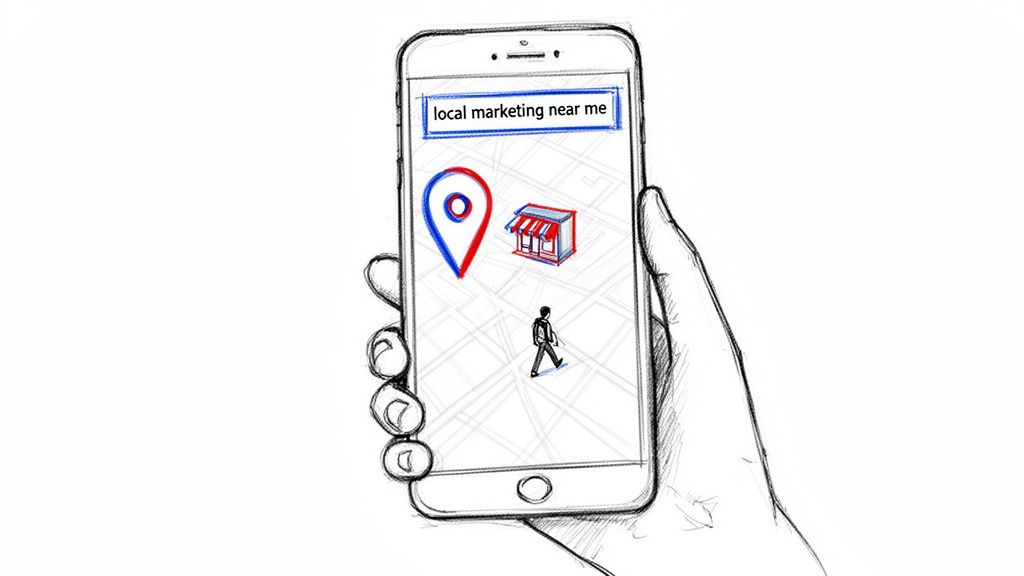
The simple phrase "near me" completely changed how people find and choose businesses. It's not about who has the biggest billboard anymore. It’s about who shows up first on a smartphone when a customer is ready to spend money. This shift is a move away from expensive, broad advertising and toward sharp, neighborhood-level visibility.
For any brick-and-mortar business—whether you're a single wellness clinic or a national retail chain—this is the whole game. Your target audience isn't some vague demographic; it's a real person standing a few blocks away, searching for exactly what you offer.
The Power of High-Intent Searches
Think about the last time you searched for something "near me." You weren't just browsing, were you? You had an immediate need and you were ready to act. That high-intent behavior is exactly what makes local marketing so incredibly effective.
The numbers don't lie. Every week, 80% of U.S. consumers search for a local business, and nearly a third do it daily. Mobile searches for "near me today/tonight" have skyrocketed by over 900% in just a few years.
Even better, 76% of these searchers visit a related store within 24 hours, and a massive 78% of location-based mobile searches lead directly to an offline purchase. Intent doesn't get much higher than that.
This isn't just data. It's a direct line from a search on a phone to a customer walking through your door. If you ignore this connection, you're just handing revenue to the competitors who do show up in those critical moments.
Turning Digital Discovery into Foot Traffic
Ultimately, any local strategy has one goal: turn online visibility into real-world customers. Your Google Maps listing is your new digital storefront. Every click, call, and direction request is a lead.
A strong local presence ensures that when someone searches for your services, you aren't just one of the options—you're the obvious choice. To get started, you can dive into our complete guide on Google Maps SEO. This is the new battlefield for customer acquisition, and winning means knowing exactly how to dominate these high-value searches.
Auditing Your Current Neighborhood Footprint
Before you can win the battle for local customers, you have to get an honest map of the battlefield. The first move isn’t a new campaign—it’s a clear-eyed audit of where you stand right now.
Too many business owners make the same mistake: they search for their own brand while sitting in their office and see a rosy, inaccurate picture of their rankings. It’s a classic case of confirmation bias.
To really understand your visibility, you need to see your business the way a customer does. That means simulating searches from different parts of your city, not just from your own desk. This is the only way to find the blind spots where your competitors are eating your lunch.
How to See What Your Customers See
The simplest way to start? Use a VPN or an incognito browser window to manually search from different geo-locations. Plug in your most valuable service keywords—things like "walk-in wellness clinic," "dispensary deals," or "emergency chiropractor"—and pair them with specific neighborhood names or zip codes.
This process quickly reveals your true ranking on Google Maps, block by block. Are you consistently landing in the top three results—the all-important "Map Pack"—or are you getting buried on the second page where no one looks?
An audit isn’t about validating what you're doing right. It’s about ruthlessly identifying what you're doing wrong. The goal is to find the gaps in your visibility before your customers do.
A Quick Local Visibility Checklist
As you run these searches, it helps to have a framework. A simple checklist turns a bunch of random searches into intelligence you can actually use to pinpoint what needs fixing.
To get started, we've created a simple table you can use to audit your visibility across your key neighborhoods. Just fill it out as you go.
Local Visibility Audit Checklist
| Audit Area | What to Check | Status (Good/Needs Improvement) |
|---|---|---|
| Map Pack Presence | Are you in the top 3 for your main keywords in this neighborhood? | |
| Information Consistency (NAP) | Is your Name, Address, and Phone number 100% identical everywhere? | |
| Review Health | What’s your average star rating? Are your reviews recent? | |
| Competitor Rankings | Who consistently outranks you in this specific area? | |
| GBP Completeness | Is your Google Business Profile fully filled out with all attributes? |
This quick self-assessment will immediately show you where you're strong and where you’re vulnerable.
Here’s a bit more on what to look for:
- Map Pack Presence: This is non-negotiable. Note where you’re strong and, more importantly, where you're weak. If you’re not in the top 3, you’re practically invisible.
- Information Consistency: Is your business Name, Address, and Phone number (NAP) identical across every single platform? Even tiny variations like "St." vs. "Street" can confuse search engines and tank your authority. You can learn more about why this matters and how to perform a citation clean-up.
- Review Health: What’s your average star rating? That’s just the start. How recent and frequent are your reviews compared to the top players in each neighborhood? Stale or negative reviews are a massive red flag for both customers and Google.
This neighborhood-by-neighborhood audit gives you the baseline you desperately need. It tells you where you’re winning, where you’re losing, and exactly which parts of your local presence need immediate attention. With this data in hand, you can finally stop guessing and start building a strategy based on reality.
How to Find Your Most Valuable Neighborhoods
Spreading your marketing budget across an entire city is like trying to water a giant field with a single watering can. It just doesn't work. Instead of a light sprinkle everywhere, you need to concentrate your efforts on the most fertile ground—the specific neighborhoods where your ideal customers live, work, and search.
So, where do you start? Your own sales data.
Dig into your customer zip codes. You’ll probably find a few surprising hotspots, those little pockets of the city that generate a disproportionately high chunk of your revenue. These are your proven markets. Defending your visibility here should be priority number one.
Once you know where you’re strong, it’s time to look for growth. Combine your sales data with local demographic information. Are there adjacent neighborhoods with similar income levels, family structures, or lifestyle interests that you haven't really touched yet? That’s where you'll find untapped potential.
Identify Your Keyword Goldmines
After you’ve mapped out your high-priority neighborhoods, you need to understand how people in those areas search. Forget about broad, generic keywords. Real local marketing success comes from nailing the hyper-specific, high-intent phrases that people actually type into their phones.
You have to think like a customer. They aren't just searching for "cafe." They're looking for "best vegan cafe near downtown" or "quiet coffee shop with wifi." A chiropractor's potential patient isn't typing in "back pain"—they're searching for a "walk-in chiropractor open late."
Here are the types of keywords that really matter:
- Service-in-Location: This is the bread and butter. Combine what you do with neighborhood names, like "hot yoga in Lincoln Park."
- Problem-Based Queries: Get right to the point by targeting the specific problems you solve. Think "emergency dental clinic near me."
- Qualifier Keywords: These are buying signals. Look for words that signal high intent, like "best," "reviews," or "deals."
This whole process is a simple loop: you search, you check your position, and you review the landscape.
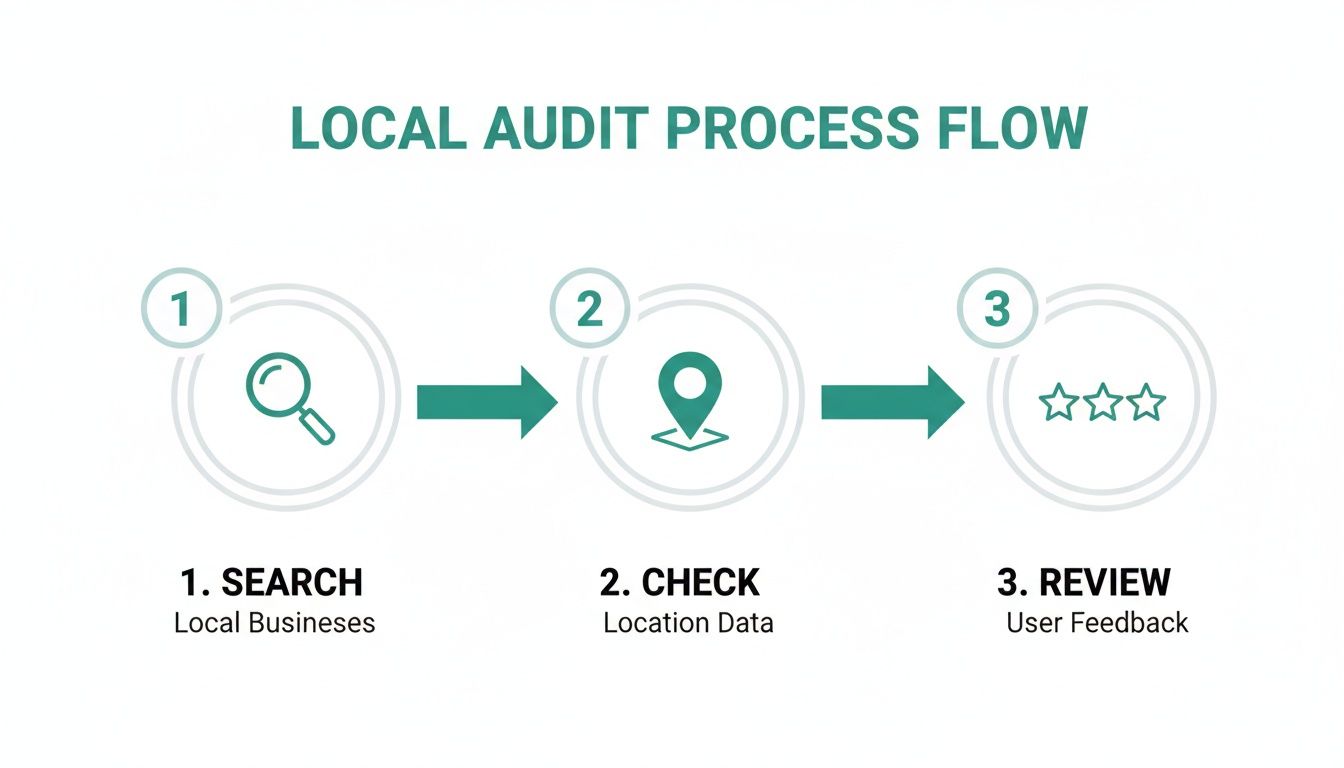
The real magic happens when you repeat this audit across different neighborhoods. You’ll quickly see where you’re strong and, more importantly, where you’re practically invisible.
Visualize Your Opportunities with Heatmaps
Let’s be honest: manually checking your rankings across dozens of neighborhoods for a bunch of different keywords is a nightmare. It’s slow, tedious, and often gives you a skewed picture.
This is where modern tools give you a massive leg up. A ranking heatmap can instantly show you where your real strategic opportunities are hiding.
A heatmap shows your Google Maps ranking for a specific keyword across a city, grid by grid. It turns complex data into a simple color-coded map, showing where you're a top result (green) and where you're buried (red).
This visual approach makes it dead simple to spot areas where competitor density is low but customer potential is high. It’s the clearest, fastest way to identify the neighborhoods that will give you the highest return on your marketing dollars.
Armed with this knowledge, you can finally stop guessing and start focusing your budget on the areas that actually drive foot traffic and phone calls. This is the bedrock of an effective local marketing near me strategy.
Optimizing Your Google Business Profile and Local Signals
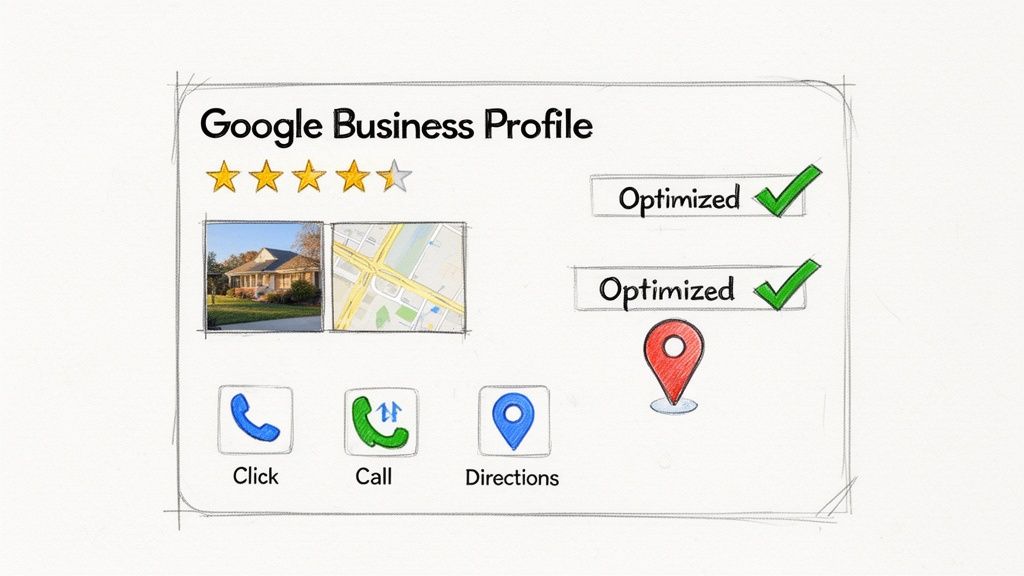
Once you’ve identified your high-value neighborhoods, it’s time to make sure you actually show up when people search there. Your Google Business Profile (GBP) isn't just a listing anymore; it’s your digital storefront.
Frankly, it's the single most critical factor in winning the local search game. Treating it as an afterthought is a surefire way to stay invisible.
A fully optimized GBP goes way beyond just getting your name, address, and phone number right. It’s about using every single feature Google gives you to signal relevance and build trust with potential customers.
Building a Complete and Compelling Profile
Think of your GBP as a living, breathing profile, not some static entry you set and forget. The more completely you fill it out, the more Google understands what your business is about—and the more confident it becomes in showing you to searchers. This requires ongoing attention.
Here are the non-negotiable elements you need to get right:
- Craft a Compelling Description: This is your elevator pitch. You have 750 characters, so use them to highlight what makes you unique. Make sure to weave in your primary keywords and mention the specific neighborhoods you serve.
- Select Every Relevant Category: Don't stop at your main category. Add secondary ones that accurately reflect all your services. A wellness clinic, for example, should probably add "Massage Therapy" and "Acupuncture Clinic" to broaden its reach.
- Upload Geo-tagged Photos Regularly: Fresh, high-quality photos signal an active, thriving business. Uploading images of your storefront, team, and products weekly helps. Geo-tagging them with location data before you upload adds another powerful layer of local authority.
- Use the Q&A Feature Proactively: Don’t just wait for customers to ask questions. Seed your own Q&A section with common queries about parking, hours, or services, and provide clear answers. This handles customer concerns upfront and showcases your expertise.
The goal is to leave no field blank. Every piece of information you provide—from service attributes to accessibility options—is another positive signal to Google’s algorithm. It helps you stand out from less-thorough competitors.
The Power of Local Engagement Signals
A perfectly optimized profile is your foundation, but Google's algorithm increasingly rewards real-world engagement. We call these local engagement signals—actions users take that show they find your business relevant and plan to visit.
What do these signals look like?
- Clicks to your website from your GBP
- Phone calls started from the listing
- Requests for driving directions
- High dwell time on your profile
These actions prove to Google that your business is a popular and valuable choice for people nearby. Generating these signals is crucial, but it's not something you can easily fake.
The local SEO software market is booming for a reason—it's projected to grow from $8.682 billion to $34.7 billion by 2035, largely because of tools that help generate these authentic signals. With a shocking 56% of businesses still managing SEO in-house without full optimization, using a platform that can ethically boost these metrics gives you a massive edge. You can see more on these trends in the local SEO software market report.
The best part? Some advanced platforms can generate these crucial signals without ever needing direct access to your GBP, securely complementing your own optimization efforts. We dive much deeper into this in our guide on how to optimize your Google Business Profile.
By combining a flawless profile with a steady stream of positive engagement signals, you create a powerful flywheel that pushes you to the top of the Google Maps results.
Tracking Local Growth and Proving Your ROI
Let's be honest: if you can't measure your local marketing, you can't improve it. The real goal isn't just to climb the rankings—it's to drive actual business results. That means ditching the vanity metrics and honing in on the Key Performance Indicators (KPIs) that directly translate to revenue.
For any brick-and-mortar brand, the only metrics that truly matter are the ones signaling a customer is about to walk through your door or pick up the phone. Everything else is just noise.
Focus on Actionable KPIs
Don't get lost in broad website traffic numbers. Instead, you need to zero in on the specific actions that prove your local visibility is actually working. These are the conversions that fill your appointment book and ring your cash register.
A winning local strategy should show clear, undeniable growth in these areas:
- Phone Calls: Track every call initiated directly from your Google Business Profile. These are almost always high-intent leads ready to book a service or ask a final qualifying question.
- Direction Requests: This is one of the strongest buying signals you can get. When someone requests directions, they are literally planning their trip to your location. It's a direct indicator of incoming foot traffic.
- Website Clicks: Keep a close eye on clicks from your GBP to your website. These users are typically looking for more detailed information—like a full service menu or pricing—right before they make a decision.
These three KPIs form the bedrock of your local ROI. They create a direct, measurable line between your online presence and real-world customer activity, giving you the hard data to prove your efforts are paying off.
Visualizing Progress with Ranking Heatmaps
Tracking individual numbers is essential, but seeing the bigger picture is what helps you make smarter strategic moves. This is where tools like ranking heatmaps become absolute game-changers.
A heatmap gives you a powerful "before and after" snapshot of your visibility for a key search term across an entire city or service area.
Think of a heatmap as a visual report card for your Google Maps ranking, grid by grid. It turns dense ranking data into a simple, color-coded map that instantly shows where you’re dominating (green) and where your competitors are winning (red).
This kind of visual data is far more insightful than a boring list of rankings. It lets you:
- See Neighborhood-Level Progress: Pinpoint exactly which parts of town are responding best to your optimization efforts.
- Compare Location Performance: For multi-location brands, you can see at a glance which stores are lagging and which are leading the pack.
- Identify New Opportunities: Spot underserved areas where a small, targeted push could lead to a massive visibility boost.
When you combine hard data on calls and clicks with the visual intelligence from a heatmap, you get a complete picture of your local growth. This data-driven approach takes all the guesswork out of your marketing, allowing you to see what’s actually working and confidently connect your spend directly to your bottom line.
A Few Common Questions About Local Marketing
Even with a solid game plan, you're bound to have questions. Local marketing has its own quirks and knowing how to navigate them can save you from a lot of common headaches. Here are some quick, no-fluff answers to the questions we hear all the time.
How Long Does This Actually Take?
Ah, the million-dollar question. The honest answer is, it depends.
You can often see small, immediate bumps from a one-time Google Business Profile cleanup within a few weeks. But if you're trying to build a real, sustainable presence that consistently brings in foot traffic, that’s more of a long game.
For significant, lasting ranking improvements, you should plan on 3 to 6 months of consistent effort. This means actively getting reviews, building authority in your service area, and generating the right kind of engagement signals. The key is to think neighborhood by neighborhood—you’ll likely see yourself pop in a few key areas long before you own the map for the entire city.
What's More Important: Reviews or Citations?
This is like asking if an engine or the wheels are more important for a car. You absolutely need both, but they do very different jobs.
Citations are all your Name, Address, and Phone number (NAP) listings across the web on sites like Yelp or other industry directories. Their main purpose is foundational—they prove to Google that your business information is consistent and trustworthy. A one-time audit and cleanup is usually enough to get this right.
Reviews are your ongoing proof. They're a powerful, constant signal of relevance, customer happiness, and trust. A steady flow of new, positive reviews doesn't just impact your rankings; it directly influences whether a customer clicks on your profile or your competitor's.
While both are critical, a proactive, continuous strategy for getting new reviews will almost always have a bigger and more immediate impact on your bottom line. Think of it this way: citations are the foundation you build on, but reviews are the engine that drives your growth.
Do I Have to Give Tools Access to My Google Business Profile?
Not always. It's a valid security concern, especially for brands with dozens or hundreds of locations. While a lot of traditional SEO management tools do need direct access to your GBP to make changes, a more modern approach works from the outside-in.
The most effective platforms today focus on influencing your rankings by generating authentic, external signals that Google’s algorithm is built to reward. We're talking about real user searches that lead to clicks on your profile, genuine phone calls, and direction requests from people in your target areas.
This method proves your relevance to Google without ever needing your login credentials. It’s a secure way to amplify your presence, complementing your own GBP management by proving that a real, local audience is actively engaging with you. When you're looking for a solution for local marketing near me, finding one that puts security first is a must.
Ready to stop guessing and start seeing real, local growth? Nearfront gives you the visual insights and automated engagement signals you need to dominate Google Maps in the neighborhoods that matter most. See how our platform can drive more foot traffic and phone calls your way.