When you search for something like "best tacos near me," what's the very first thing you see?
It's not a bunch of blue links. It's a map with a handful of pins and a short, powerful list of three businesses right below it. That, right there, is the Google Maps Pack.
Think of it as the digital world's most valuable real estate. It's the new main street, and getting your business on that block is one of the most powerful things you can do to drive real-world customers through your door.
Decoding the Digital Main Street
The Maps Pack (also called the Local Pack or 3-Pack) is Google’s direct answer to any search with "local intent." When someone types in a city name or a phrase like "near me," Google knows they aren't just browsing—they're looking to go somewhere and do something. Right now.
The pack is built for speed and action. It gives a potential customer everything they need to make a snap decision, all without having to click away to a website:
- Business Name: Who are you?
- Star Rating: What do other people think?
- Key Details: Address, hours, and phone number.
- Action Buttons: One-click options to get directions or call you directly.
It’s an interactive gateway designed to turn a search into a customer in the fewest possible steps.
Why This Matters More Than Almost Anything Else
For any brick-and-mortar business, showing up here isn't just a nice-to-have. It's a make-or-break part of your customer acquisition strategy. Why? Because it absolutely dominates the top of the search results page.
This isn't just a gut feeling; the numbers are staggering.
To put the power of the Local Pack into perspective, let's look at what the data tells us about how real people behave when they search.
Why the Google Maps Pack Is a Game-Changer for Local Business
| Metric | Statistic | Implication for Businesses |
|---|---|---|
| Top Position Dominance | 93% of local searches feature the Maps Pack in the #1 spot. | If you're not in the pack, you're practically invisible for the vast majority of local-intent searches. |
| User Preference | 44% of searchers click on a Maps Pack result. | Nearly half of all potential customers will choose a business from this top-three list over any other organic result. |
| Mobile-First Behavior | Over 80% of "near me" searches happen on mobile devices. | The pack is perfectly designed for mobile users who are on the go and ready to buy. |
These stats paint a clear picture: the Local Pack isn't just a feature; it's the primary way customers discover and choose local businesses. You can find more insights on this user preference and how it shapes local SEO.
This isn't about fuzzy brand awareness. It's about driving tangible, measurable actions that directly grow your revenue.
For a local business, the Google Maps Pack isn't just another marketing channel. It's the modern-day yellow pages, storefront, and welcome sign all rolled into one, delivered to customers at the exact moment they decide to make a purchase.
The True Impact on Customer Behavior
Picture the journey. Someone wants a haircut, needs to find a hardware store, or is looking for a place to grab lunch. Their first move is to pull out their phone.
The businesses they see in that Maps Pack instantly become their top contenders. It’s that simple.
Appearing in this elite group of three dramatically shortens the path from discovery to purchase. A curious searcher becomes a paying customer in minutes, because you're positioned to capture that high-intent traffic and convert it into:
- More Foot Traffic: Direction requests literally guide people to your front door.
- More Phone Calls: Customers can ring your business with a single tap.
- More Credibility: A top spot in the pack is a massive signal of trust—an endorsement from Google itself.
Ultimately, ranking in the Google Maps Pack is one of the single most effective ways to turn your online presence into a reliable stream of local customers.
How Google Determines Local Pack Rankings
If you want to win a spot in the coveted Google Maps Pack, you first have to understand how Google’s local search algorithm thinks. It’s not some unknowable black box; it’s a smart system built to give users the most helpful, accurate, and trustworthy results for what they need in the real world.
Think of Google as a super-efficient local guide. It’s instantly recommending the best spots based on a very clear set of criteria.
The entire decision-making process boils down to three core pillars: Relevance, Proximity, and Prominence. Get these right, and you're well on your way. These three pillars work together to answer a user's query, deciding which three businesses earn that prime digital real estate.
The First Pillar: Relevance
Relevance is the most straightforward piece of the puzzle. At its core, Google is just asking, "Does this business actually match what the person is searching for?"
If someone is frantically searching for an "emergency vet clinic," Google isn't going to show them a pet groomer, even if it's closer or has more five-star reviews. The algorithm's number one job is to connect what the user wants with the right type of business.
This is where the nuts and bolts of your Google Business Profile become mission-critical. Your primary business category, the services you list, and even the keywords that pop up in your customer reviews all send signals to Google about what you do. A well-tuned profile basically screams, “Yes, we are exactly what this searcher needs!”
This diagram shows how a simple search flows through Google's system, ultimately funneling just a few businesses into the Maps Pack.
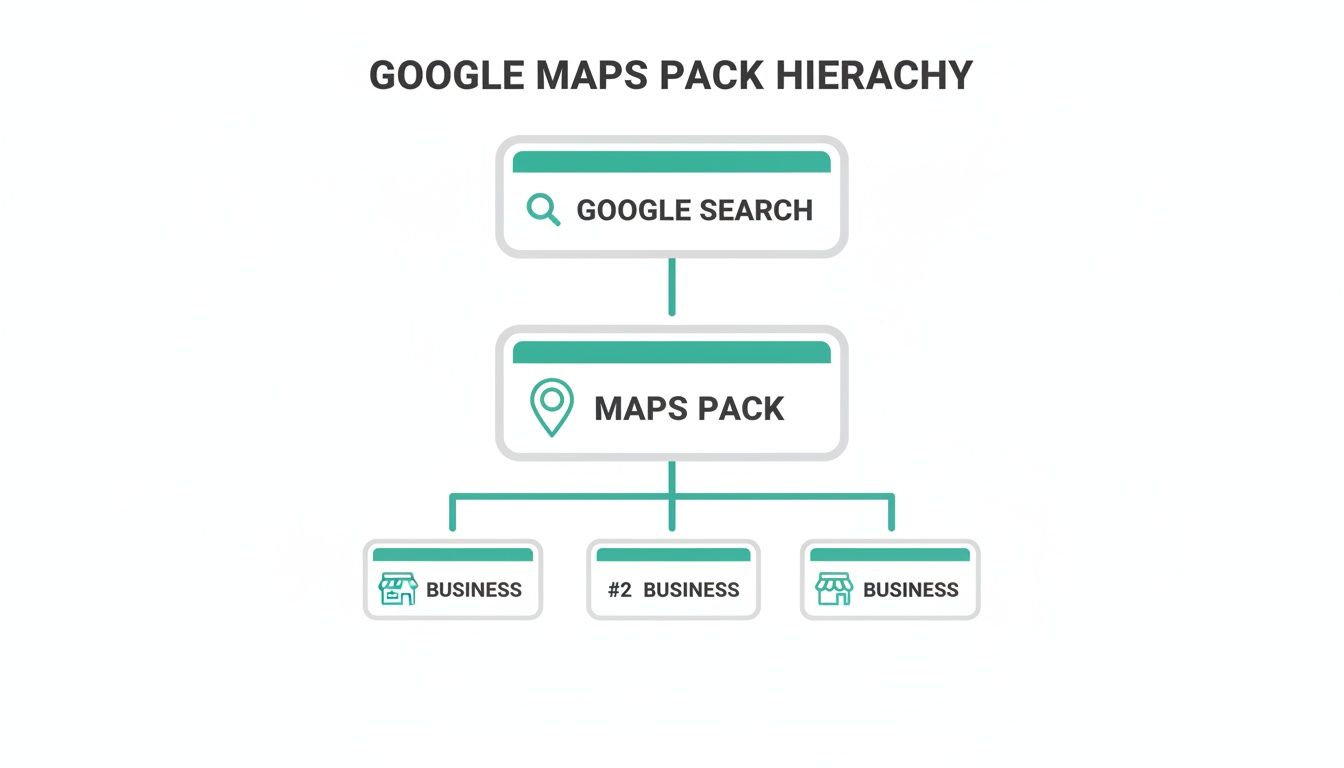
As you can see, only a tiny fraction of businesses make it from the wider pool of results into that highly visible Local Pack.
The Second Pillar: Proximity
Proximity answers the user’s unspoken question: "How close is this to me right now?" For local searches, distance is a huge deal.
Google uses the searcher's physical location—grabbed from their phone's GPS or IP address—to figure out which relevant businesses are nearby. This is exactly why your ranking can look completely different from one side of town to the other.
While you can't just pick up and move your store, you can make sure your location data is razor-sharp and consistent everywhere online. This factor is the reason "near me" searches have absolutely exploded, with over 80% of them now happening on mobile devices. The algorithm gives a massive advantage to businesses that can help a customer immediately, making proximity a non-negotiable part of the ranking equation.
The Third Pillar: Prominence
Prominence is Google’s way of figuring out how well-known and respected your business is in the real world. It's basically your digital reputation. A landmark hotel or a famous, long-standing restaurant has a ton of real-world prominence, and Google’s algorithm does its best to mirror that online.
But you don’t have to be a historic landmark to build prominence. Google measures this through a whole host of digital signals that act as votes of confidence.
Prominence isn't just about being popular; it's about being a trusted, authoritative part of the local community. Google rewards businesses that have earned their reputation both online and offline.
Google looks at several key indicators to gauge your prominence:
- Review Quantity and Quality: A steady stream of positive reviews is one of the most powerful signals of a trusted business. Your average star rating and the actual content of the reviews carry immense weight.
- Local Citations: Every time your business's Name, Address, and Phone number (NAP) are mentioned on reputable online directories like Yelp or industry-specific sites, it builds trust. Consistency here is everything.
- Local Backlinks: When other local websites—think a neighborhood blog, a local news outlet, or a community event page—link to your site, it’s a powerful local endorsement.
- Brand Search Volume: The number of people searching directly for your business name tells Google you're a known entity in your area.
Each of these elements contributes to your overall score. To dig deeper, you can learn more about the complete list of Google Maps ranking factors and how they all fit together. By systematically improving your signals across Relevance, Proximity, and Prominence, you build an undeniable case for why your business deserves a top spot in the Google Maps Pack.
Optimizing Your Google Business Profile for Top Rankings
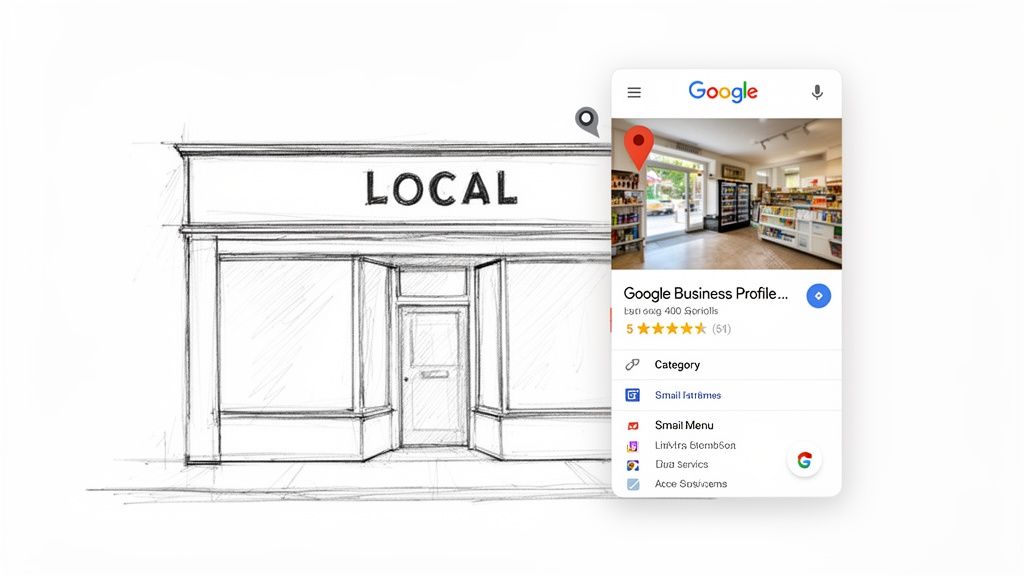
If the Google Maps Pack is prime real estate, your Google Business Profile (GBP) is the deed, the foundation, and the curb appeal all rolled into one. It’s the single most important asset you have for dominating local search.
A neglected profile is a locked storefront. A fully optimized one is an open door with a welcome mat, inviting customers in.
This isn’t about just plugging in your address and phone number. It’s about transforming your profile from a digital business card into a customer magnet, using every feature available to tell Google—and your customers—exactly who you are and why you’re their best choice.
Nailing the Foundational Details
Before you even think about advanced tactics, you have to get the basics right. These core details are the bedrock of your local SEO strategy and tie directly back to the Relevance and Proximity ranking factors we talked about earlier.
Start with the absolute essentials: your business name, address, and phone number (NAP). This information must be 100% accurate and perfectly consistent everywhere it appears online. A tiny inconsistency, like "St." versus "Street," creates confusion for Google and chips away at the trust in your listing.
Next up, your business categories. This is one of the most powerful signals you can send.
- Primary Category: Pick the one category that best describes your core business. If you’re a pizzeria that also serves pasta, your primary category is "Pizza restaurant," not just "Restaurant." Be specific.
- Secondary Categories: Use these to fill in the gaps. Now you can add "Italian restaurant," "Pasta shop," and "Food delivery." This gives Google a complete picture of everything you offer, making it easier to match you to more searches.
Think of your primary category as the headline and your secondary categories as the bullet points. Together, they tell Google an unambiguous story about your business.
Moving Beyond the Basics with Rich Content
A complete profile is a competitive profile. So many businesses stop after the basics, leaving a huge opportunity for anyone willing to put in a little more effort. Using every feature available doesn't just inform customers; it signals to Google that you’re an active, engaged business worth showing.
Your business description is a perfect example. Don’t just say "We sell coffee." Craft a story that connects with locals. Something like, "Your friendly neighborhood coffee shop in downtown Springfield, serving locally roasted beans and homemade pastries since 2015."
For a full checklist on getting this right, check out our complete guide on how to optimize your Google Business Profile.
Leveraging Advanced Profile Features
To truly stand out in a crowded Google Maps Pack, you need to use the advanced tools GBP gives you. These features are designed to answer customer questions before they even ask them.
Put these powerful features to work:
- Products and Services: Don’t just list what you do—detail it. Build out a full menu of your services or a catalog of your products, complete with descriptions and pricing. This feeds Google highly specific, valuable information.
- Attributes: These are quick tags that highlight key features. Wheelchair accessible? Free Wi-Fi? Women-led? Selecting the right attributes helps you show up in super-specific searches like "restaurants with outdoor seating near me."
- Photos and Videos: Visuals build trust. A profile packed with high-quality, recent photos and videos is infinitely more compelling. Show off your storefront, your team, your products, and your happy customers. Pro tip: geotagging your images with location data before you upload them adds another subtle but powerful proximity signal.
When you methodically complete and enrich every single part of your profile, you're building an undeniable case for your business. You’re not just telling Google you belong in the Local Pack; you're showing them with overwhelming evidence.
Building Local Authority Beyond Your Profile
A perfectly polished Google Business Profile is your engine for local search, but it won't win the race on its own. To really dominate the Google Maps Pack, you need to build authority and trust signals that live far beyond your profile. Think of it like building a solid reputation in a real-world community.
If your GBP is your storefront, these off-site signals are the glowing recommendations from other respected local players. They prove to Google that you aren't just saying you're a local leader; the community agrees. This is all about creating digital proof that your business is a legitimate, trusted, and prominent part of the neighborhood.
Mastering Citation Hygiene for Unshakable Trust
First things first: get your story straight. The initial step in building external authority is making sure your core business information is perfectly consistent everywhere it appears online. This is called citation management, and it’s the bedrock of local SEO.
A citation is any online mention of your business's Name, Address, and Phone number (NAP). You'll find them on major directories like Yelp, industry-specific sites, and local blogs.
Google acts like a detective, cross-referencing this information from dozens of sources to verify that you are who and where you say you are. When your NAP is identical across the board, it sends a powerful signal of trustworthiness. But when Google finds inconsistencies—like "St." on one site and "Street" on another, or an old phone number floating around—it creates doubt. That doubt can kill your rankings.
Inconsistent NAP data is the digital equivalent of having multiple, slightly different addresses for the same house. It confuses the mapmaker and makes it harder for customers to find you.
Acquiring Powerful Local Backlinks
While citations build consistency, local backlinks build credibility. A backlink is just a link from another website to yours. When a reputable local website links to you, it’s like a vote of confidence that tells Google you're a legitimate player in the area.
But not all links are created equal. For Maps Pack rankings, local context is everything. A link from a national blog is nice, but a link from the local chamber of commerce website is pure gold. It anchors your business to a specific geographic area, which is exactly what Google wants to see.
Start seeking out high-value local link opportunities:
- Community Partnerships: Sponsor a local youth sports team or a charity 5k. These organizations almost always list their sponsors on their websites, complete with a link back to you.
- Local News and Blogs: Did your business win an award, host a community event, or hire a new manager? Pitch the story to local journalists or neighborhood bloggers who cover that kind of news.
- Chamber of Commerce and Business Associations: Joining your local chamber or a business improvement district usually comes with a directory listing and that valuable, locally-relevant backlink.
- Hosting Local Events: Host a workshop, a free seminar, or a community meet-up. Promote it on local event calendars, which will link back to your site to drive sign-ups.
Each of these links reinforces your local prominence, proving to Google that you’re an active and integral part of the community fabric.
Proving Your Local Relevance with Content
Finally, you can build authority directly on your own website by creating content that proves your deep connection to the area you serve. This strategy shows you're not just in a neighborhood; you're part of it.
This kind of location-specific content directly supports your Google Maps efforts. It provides locally relevant keywords and context that Google’s crawlers can easily associate with your business profile.
Consider creating content like:
- Neighborhood Guides: Write a blog post about "The 10 Best Coffee Shops in Our Neighborhood," featuring other great local, non-competing businesses.
- Local Case Studies: Showcase a project you completed for a well-known local client, highlighting the specific location and the awesome results you delivered.
- Team Spotlights: Feature employees who live in the community. Share their favorite local spots or what they love about the area.
This type of content shows both search engines and potential customers that you are a genuine local expert. By combining pristine citation hygiene, authoritative local backlinks, and relevant on-site content, you build an undeniable case for your business's importance, pushing you past competitors and into a top spot in the Google Maps Pack.
Generating Engagement Signals That Google Loves
Getting your profile optimized and your citations in order gets you to the starting line. But if you want to win the race for the top spots in the Local Pack, you need real, human engagement.
Think of it this way: your profile is the digital storefront. Engagement is the line of happy customers stretching out the door.
Google’s algorithm is getting smarter every day, and it's learned to spot businesses that are genuinely popular in the real world. It looks for proof that people are not just finding you, but actually interacting with you. These interactions—reviews, questions, clicks-to-call, and direction requests—are powerful engagement signals that prove you’re a prominent, relevant choice in your community.
Cultivating a Five-Star Reputation with Reviews
In local search, customer reviews are the ultimate form of social proof. Nothing else comes close. A steady flow of positive, recent reviews tells both Google and potential customers that you’re the real deal.
Take a look at the top three results in any competitive Maps search. You'll almost always find they have more high-quality, recent reviews than everyone else below them. Your goal is to build a consistent pipeline of authentic feedback. Don't just wait for it to happen.
- Make it dead simple: Use a QR code at your register that links directly to your review page. Add the link to your email signature or send it in a follow-up text.
- Time it right: The best time to ask is right after a great experience, while the customer is still smiling.
- Reply to every single one: Responding to both good and bad reviews shows you’re an engaged owner who listens. A thoughtful reply to a negative review can actually win over more future customers than a dozen positive ones.
Responding to reviews isn't just good customer service—it's a direct signal to Google that your business is active and attentive. It essentially doubles the engagement value of every review you get.
Answering Questions Before They're Even Asked
The Q&A section on your Google Business Profile is a goldmine, but most businesses completely ignore it. It’s a direct line to your customers, allowing anyone to ask a question and anyone to answer.
If you don't take control of this conversation, someone else will—and their answer might be completely wrong. Being proactive with the Q&A is a brilliant way to generate positive engagement while heading off common friction points.
- Seed Your Own Q&A: Get a head start. What are the top 5-10 questions you get every single day? Think about parking, your most popular services, or accepted payment types.
- Post and Answer Them Yourself: Use a personal Google account to post the question, then log in as the business owner and provide a crystal-clear, helpful answer.
- Upvote the Good Stuff: Upvote your own answers (and other helpful ones) to make sure they're the first thing people see.
This simple strategy lets you control the narrative, provides instant value to searchers, and makes it that much easier for them to choose you.
Amplifying Authentic Engagement Signals
Beyond reviews and Q&A, Google is watching a whole range of user behaviors that signal genuine interest. These are the metrics that mirror a real customer journey, from discovery to action. They include things like profile views, website clicks, direction requests, and phone calls made right from your listing.
The ultimate goal is to generate these signals organically by being a great business. But for multi-location brands that need to scale, platforms like Nearfront can help amplify these signals by connecting your business with a network of real users performing verified local actions. This process demonstrates genuine local interest around your locations, mirroring the exact metrics Google uses to measure real-world prominence.
Tools like Nearfront give you a clear dashboard showing how these authentic engagement signals are driving improved visibility and real-world customer actions. By focusing on these core engagement metrics, you build a powerful, lasting advantage in the Google Maps Pack.
Tracking Your Performance and Making Data-Driven Decisions
You can’t improve what you don’t measure. Once your profiles are optimized and your local authority is growing, the real work begins: tracking what's working in the Google Maps Pack and making smart, data-driven decisions.
But here’s the trap most businesses fall into: they use outdated tracking methods. Simply searching for your business from your office computer gives you a single, often misleading, snapshot of your performance. The reality is your visibility changes from one city block to the next, all based on where the searcher is standing.
To win at local search, you have to stop chasing vanity metrics and start focusing on the key performance indicators (KPIs) that actually drive revenue. These are the actions that prove your local SEO is delivering real-world results.
- Phone Calls: How many customers are hitting the "call" button right from your Google profile?
- Direction Requests: How many people are asking Google Maps for turn-by-turn directions to your front door?
- Website Clicks: How many searchers are clicking through to your website or local landing pages?
These aren't just numbers; they represent high-intent customers who are on the verge of making a purchase. They are the ultimate proof of your Local Pack success.
The Problem with Old-School Tracking
The old way of checking your rank—manually searching from one spot or using a tool that pings from a generic city center—is fundamentally broken. It ignores the single most important ranking factor in local search: proximity.
Your ranking for "coffee shop near me" could be #1 for someone two blocks away, but you might be completely invisible to someone across town. A single-point check gives you a dangerously incomplete picture of your real-world performance.
Relying on traditional rank tracking for local SEO is like trying to understand a city's traffic by only looking at one intersection. You see a tiny piece of the puzzle but miss the entire system.
This is where modern tools become non-negotiable. To truly understand your visibility, you need to see how you rank across your entire service area, not just from one arbitrary point on the map.
Adopting a Modern, Data-Driven Approach
This brings us to how forward-thinking brands track local SEO today. A comparison highlights the difference:
Traditional vs. Modern Local SEO Tracking
| Tracking Method | Traditional Approach | Modern Platform (e.g., Nearfront) |
|---|---|---|
| Rank Checking | Checks from a single, static point (e.g., city center). | Uses live ranking heatmaps to visualize visibility across hundreds of points. |
| Data Scope | Provides a single, often misleading rank number. | Shows where you're strong (green), weak (red), and being outranked. |
| Actionability | Offers a vanity metric with no clear next steps. | Pinpoints specific underperforming areas for targeted optimization. |
| Competitor Insight | Limited to how you rank against them from one location. | Reveals competitor strengths and weaknesses across the entire market. |
The key takeaway? Modern platforms turn vague data into a clear, strategic roadmap.
Instead of a single number, advanced tools use live ranking heatmaps to give you a color-coded map of your actual visibility. You can see exactly where you’re winning (green), where you're losing (red), and where your competitors have the edge.
This granular insight is a game-changer for multi-location brands. It lets you stop guessing and start making strategic moves. By using a modern Google Maps rank tracker, you can focus your resources on the keywords and neighborhoods that deliver the highest return, ensuring every action you take is designed to drive more calls, visits, and sales.
Got Questions About the Google Maps Pack?
We get it. Navigating the world of local SEO can feel like trying to read a map in the dark. Let's clear up a few of the most common questions we hear from business owners.
So, How Long Does It Take to Actually Rank in the Maps Pack?
Look, ranking in the Maps Pack is a marathon, not a sprint. While some quick fixes can give you a little bump, real, lasting visibility usually takes anywhere from a few weeks to several months of consistent work.
Think about it: your industry's competitiveness, where you're starting from (is your profile brand new or just neglected?), and how hard you push your optimization efforts all factor in. In this game, a steady, long-term strategy beats short-term tricks every single time.
Can I Get into the Local Pack if I Don’t Have a Physical Storefront?
This is a big one. At its core, the Maps Pack is designed for businesses that customers can physically visit, so a verifiable physical address is non-negotiable.
But what about service-area businesses like plumbers or mobile dog groomers? You're in luck. You can (and should) hide your address from the public on your profile. You still have to give Google a real, verifiable address to prove you're legitimate, but it won't show up for everyone to see.
The whole point of the Maps Pack is to guide real people to a real location. Even if your address is hidden from customers, Google needs to verify it to trust that you actually serve the area you claim.
Why Do My Rankings Change When I Search from Different Parts of the City?
Ever notice you rank #1 when you search from your office, but you're nowhere to be found a few miles away? That’s the Proximity ranking factor in action. A user searching downtown will see completely different results than someone searching in the suburbs, even if they type in the exact same thing.
This is precisely why tools with ranking heatmaps are so powerful. They cut through the guesswork and show you what your visibility truly looks like across an entire service area, not just from one misleading vantage point.
Ready to see your true visibility across every neighborhood you serve? Nearfront provides live ranking heatmaps and amplifies the authentic local engagement signals that Google loves. Stop guessing and start making data-driven decisions that drive real foot traffic and phone calls. Learn more at https://nearfront.com.