When someone searches for a local business, the first thing they see isn't a website—it's the SEO local pack. You know the one: the block of three business listings sitting right below the map. For any brick-and-mortar business, this is the most valuable digital real estate, period.
Ranking here isn't just about SEO; it's about getting one of Google's top recommendations in your city. It's your digital storefront, loaded with the exact information a potential customer needs: your address, phone number, and reviews, all teed up to drive a visit or a call.
Why the Local Pack Is Your Most Valuable Digital Real Estate
Forget thinking of the Local Pack as just another search result. It's the place where decisions are made.
When someone searches "best coffee near me" or "emergency vet open now," they aren't just browsing—they're ready to act. They have a problem, and they need a solution right now. The Local Pack is built to give them that instant answer, which is why users trust it so much. It feels less like an ad and more like a direct, curated suggestion from Google itself.
Appearing in the pack cuts through all the noise of traditional search results and puts your business directly in front of your most motivated customers.
Where Clicks Actually Go in Local Search
The data doesn't lie. User attention is laser-focused on the map and those top three listings.
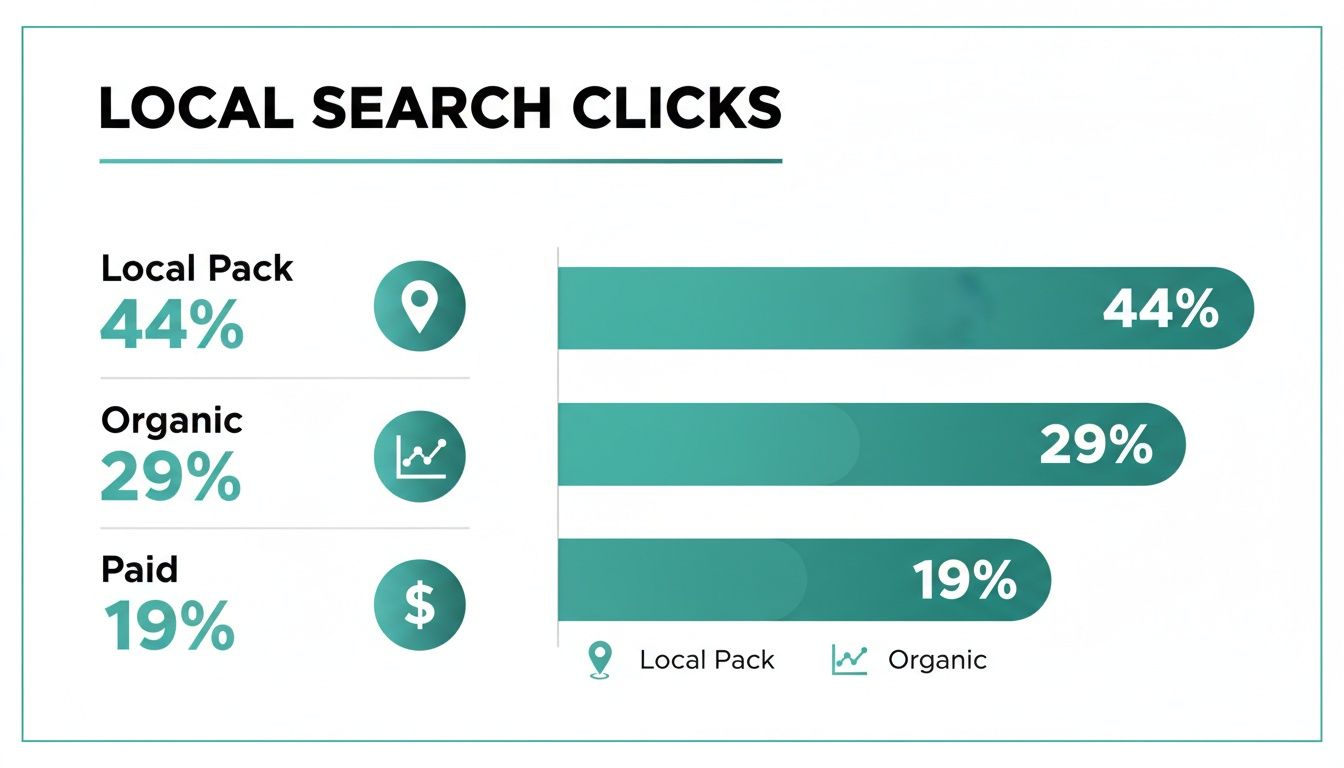
This chart breaks down exactly where people click when they're looking for local businesses, and it drives home just how critical the Local Pack is.
Here's a clearer look at how those numbers stack up.
How Users Interact with Local Search Results
This table breaks down where users click when searching for local businesses, highlighting the Local Pack's critical role.
| Search Result Type | Percentage of Total Clicks |
|---|---|
| Local Pack | 44% |
| Organic Results | 29% |
| Paid Ads | 19% |
The numbers are pretty staggering. A massive 44% of all clicks go straight to the Local Pack, blowing past traditional organic results (29%) and paid ads (19%). If you want to dig deeper into the numbers, you can explore more Google Local Pack statistics to see just how consistent this trend is.
The takeaway is simple: If you're not competing for a spot in the Local Pack, you're completely invisible to the largest and most motivated group of local customers.
The Real-World Impact of Visibility
Think about it from the user's perspective.
A hungry traveler finds your restaurant in the Local Pack and immediately clicks "Directions." A homeowner with a burst pipe finds your plumbing service and smashes the "Call" button. These aren't just vanity metrics; they're direct lines to revenue.
Every single position in that pack translates into real-world actions that fuel your business. This guide will walk you through the exact steps you need to take to claim that valuable space and turn searchers into customers.
Mastering Your Google Business Profile for Top Rankings
Let's get one thing straight: your Google Business Profile (GBP) isn't just another online listing. It's the absolute centerpiece of your entire local ranking strategy. Think of it as the engine powering your visibility in the seo local pack. A half-baked profile is like running that engine on fumes—you're not going to get very far.
To really dominate the map results, you need to treat your GBP as a dynamic hub for your business. This means going way beyond a simple setup checklist and meticulously optimizing every single field Google gives you. A profile rich with detail, constantly updated, and genuinely helpful sends powerful signals to Google that you're the most relevant answer for a local search.
And the data backs this up. Google Business Profile signals are now the single biggest factor for ranking in the Local Pack, directly influencing a massive 32% of the ranking algorithm. That's more than double the impact of on-page website signals (15%). This shift is huge—it means your off-site profile is now more important for map rankings than your actual website. The latest research on local search ranking factors paints a very clear picture of where you should be focusing your efforts.
Going Beyond the Basics of GBP Optimization
Too many businesses fill out their name, address, and phone number (NAP) and just call it a day. This is a massive missed opportunity. Real optimization happens in the details—the places your competitors are probably ignoring.
Start with your business categories. Your primary category is the most important choice you'll make here, as it defines the core of what you do. If you're a cafe that also sells whole beans, "Cafe" is a much stronger primary choice than "Coffee Store." Be specific.
Then, max out every single secondary category that applies to you. A dental clinic shouldn't just list "Dentist." It should add "Cosmetic Dentist," "Emergency Dental Service," and "Teeth Whitening Service" to cast a wider net and capture more specific, high-intent searches.
Your business description is another place to shine. Don't just list what you do. Write a compelling, keyword-rich story that speaks directly to your ideal customer. You've got 750 characters to explain what makes you the best choice in the neighborhood—use them wisely.
Actively Engage with GBP's Features
A static profile is an invisible one. Google rewards businesses that actively use the features designed to keep information fresh and engaging for searchers. This is where you can truly pull away from the pack.
- Google Posts: Get in the habit of using these to announce offers, new products, events, or company news. Posts have a shelf life, so a steady stream signals to Google that your business is active and engaged.
- Products/Services: Don't just list your offerings; build out a full catalog. Write detailed descriptions for each one, complete with high-quality photos, pricing, and relevant keywords.
- Q&A Section: This is a goldmine that most businesses neglect. Proactively seed this section by asking and answering your own FAQs. This not only helps potential customers but also lets you control the narrative and naturally weave in important keywords.
For a deeper dive into these tactics, our complete guide breaks down exactly what to do. Learn how to optimize your Google Business Profile for maximum impact.
The Unbreakable Rule: NAP Consistency
One of the most foundational—and most frequently botched—parts of local SEO is NAP (Name, Address, Phone Number) consistency. Every single mention of your business across the web, from Yelp to industry directories, must match what’s on your GBP. Exactly.
Even tiny discrepancies can confuse Google's crawlers, which erodes the trust and authority you need to rank. A missing suite number, an abbreviated street name ("St." vs. "Street"), or a different phone number format can be enough to hold you back. This is non-negotiable.
This is especially critical for multi-location brands. Each location needs its own unique, perfectly consistent NAP profile across all citations.
Below is an example of what a well-optimized listing looks like. It presents key information clearly and immediately builds trust with searchers.
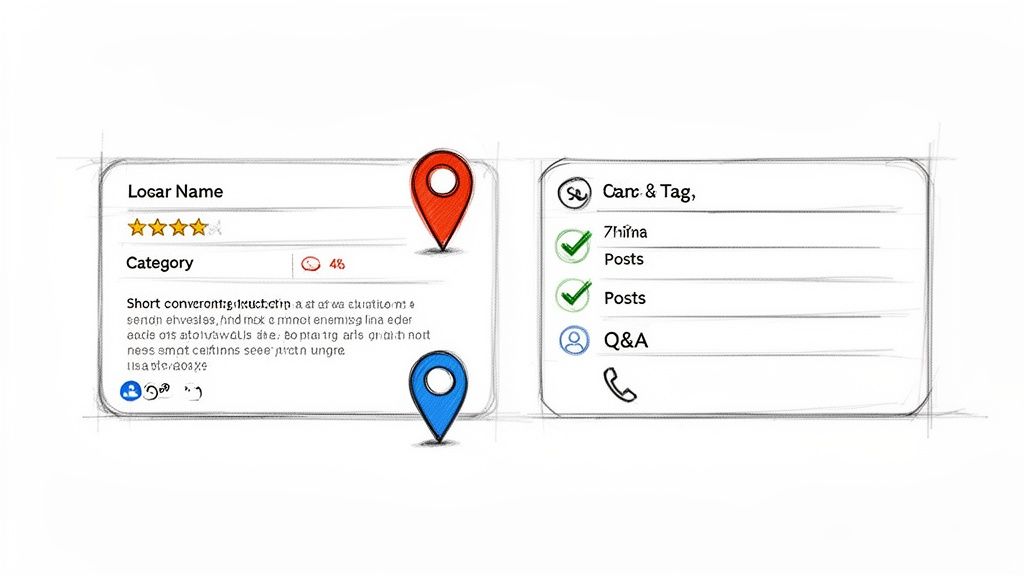
This visual shows how elements like a high star rating, clear service categories, and easy access to contact info create a compelling snapshot for users. By mastering these GBP fundamentals, you’re building the foundation needed to earn a spot in the coveted seo local pack.
Building a Powerful Review and Citation Strategy
Once your Google Business Profile is dialed in, Google starts looking at other trust signals to decide where you belong in the seo local pack. Two of the heaviest hitters? Customer reviews and online citations.
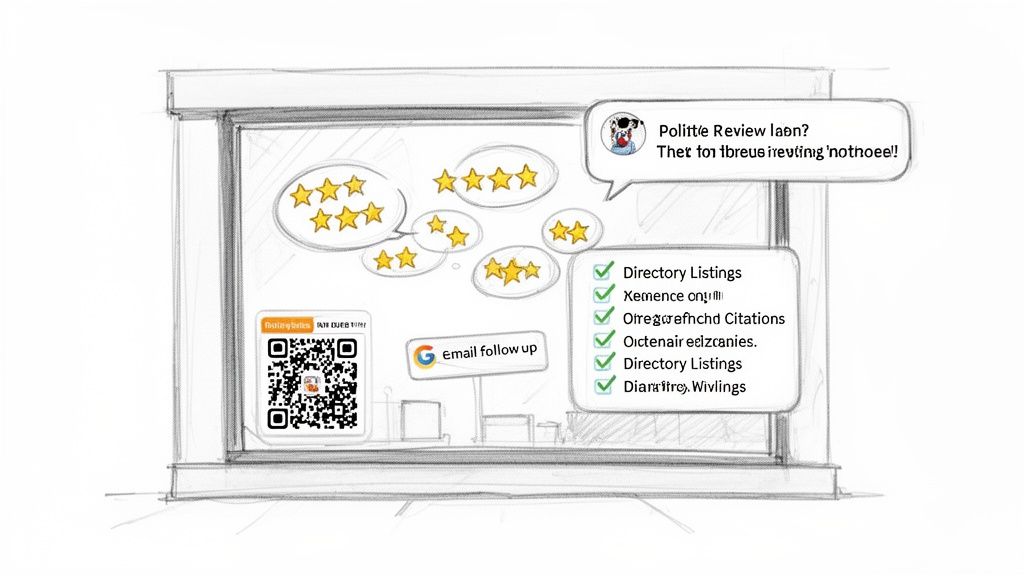
Think of these as digital word-of-mouth. A steady flow of fresh, positive reviews tells Google you’re a popular, trusted choice. Meanwhile, consistent citations across the web confirm your business information is accurate and reliable. It’s all about building a case that you're a legitimate and well-regarded local business.
Cultivating a Consistent Flow of Reviews
Let's be real: passively waiting for customers to leave reviews is not a strategy. To compete in the Local Pack, you have to actively encourage feedback. The trick is to make it incredibly easy for happy customers to share their experience right when they’re feeling good about your service.
You need a system. Simple, non-intrusive prompts can make a huge difference in your review volume.
Here are a few methods that just plain work:
- In-Store QR Codes: Put a QR code at your checkout counter, on a menu, or on the back of a receipt. One quick scan with a phone takes them directly to your Google review page—no friction.
- Personalized Follow-Up Emails: A day or two after a purchase, send a short, personal email. Something as simple as, "How did we do? We'd love your feedback," with a direct link, is incredibly effective.
- Text Message Requests: For service businesses, a follow-up text with a review link is gold. SMS open rates are through the roof.
Of course, you have to do this the right way. Our guide breaks down exactly how to get Google reviews compliantly so you can build social proof without crossing any lines.
Responding to Every Single Review
Getting reviews is only half the job. How you respond is just as important, showing both Google and potential customers that you're engaged and care about your reputation.
Make it a non-negotiable policy to respond to every single review—good, bad, and neutral.
For positive reviews, thank the customer by name and mention a specific detail from their comment. For negative ones, stay professional. Acknowledge their concern without getting defensive and offer to take the conversation offline to make things right.
Pro Tip: When you reply, try to work in keywords and location mentions naturally. Instead of a generic "Thanks for the review," try something like, "We're so glad you enjoyed our deep dish pizza here at our Chicago restaurant. Thanks for visiting!"
Building a Strong and Consistent Citation Profile
A citation is any online mention of your business's Name, Address, and Phone number (NAP). You'll find them on online directories like Yelp, industry-specific sites, and local business pages. Google crawls these to verify that your business information is correct.
Inconsistency is your worst enemy here. A tiny difference, like using "St." on one directory and "Street" on another, can confuse Google and weaken its trust in your listing. The goal is a perfectly uniform NAP profile everywhere.
Start by getting your business listed in the most critical directories:
- Core Data Aggregators: These are the big players that feed business data to hundreds of other websites.
- High-Authority Local Directories: Think Yelp, Apple Maps, and Bing Places.
- Industry-Specific Sites: Find the directories that matter for your niche, like TripAdvisor for hotels or Avvo for law firms.
Run a citation audit to find any existing mistakes or duplicate listings. Cleaning these up is a foundational step. This meticulous work signals to Google that you are a legitimate, established local business worthy of a top spot in the seo local pack.
How Real-World Engagement Drives Your Local Pack Ranking
Google’s algorithm for the local pack has gotten incredibly smart. It’s moved way beyond just looking at static info like your business category or the keywords stuffed into your reviews. Now, it’s actively watching how real people interact with your business profile in the wild.
What this means is that it's not just about what you say anymore; it’s about what your customers actually do.
These real-world engagement signals are Google’s way of checking that your business is a living, breathing part of the community, not just a name on a map. Every time someone interacts with your profile, they’re casting a vote of confidence that directly impacts your ranking.
So, What Are Local Engagement Signals?
When I talk about "engagement," I’m talking about specific, measurable actions that people take on your Google Business Profile. Think of them as digital foot traffic.
Here are the big ones Google’s algorithm is looking for:
- Branded Searches: People typing your actual business name into Google or Maps. This is a huge signal of brand recognition and existing demand.
- Profile Clicks and Views: The number of times people click on your profile after seeing it in a search result. A high click-through rate tells Google you're highly relevant for that search.
- Direction Requests: This one’s a big deal. When someone clicks the "Directions" button, it’s one of the strongest possible signs that they intend to visit you in person.
- Phone Calls: The "Call" button is another high-value action, signaling immediate interest from a potential customer.
Consistent activity across these metrics shows Google that your business isn't just an option—it's a popular choice. This is a massive piece of the puzzle for dominating the seo local pack.
Proving You're Relevant Beyond Just Being Close
Proximity has always been a cornerstone of local search. Of course, Google wants to show people places that are close by. But strong engagement signals can help you punch above your weight and overcome the limits of physical distance.
Picture this: someone is searching for a "specialty coffee shop" from a neighborhood three miles away. If your shop consistently gets a ton of engagement—lots of clicks, direction requests, and glowing reviews—Google’s algorithm learns that people are willing to travel to visit you.
This effectively expands your digital service area. Google starts seeing you as a "destination" business, making you a relevant result for searchers who aren't standing right on your doorstep. Your profile's authority begins to transcend your street address.
This is where generating authentic, widespread engagement becomes your secret weapon. It proves your relevance not just to the block you're on, but to the entire community you serve.
How to Generate Authentic User Activity
Okay, so how do you actually generate these crucial signals without being spammy or breaking the rules? This is where modern platforms designed specifically for local SEO, like Nearfront, come into play.
Some of these platforms work by connecting with a huge network of everyday consumer apps. When users of these apps are in a relevant area, the platform can generate legitimate interactions with your business profile. I’m not talking about bots or fake clicks here; this is about creating real user behaviors from real devices.
This method produces the kind of genuine engagement signals that Google wants to see:
- Legitimate User Behavior: The interactions look exactly like organic activity—someone deciding to look up a nearby store on their phone.
- Geographic Targeting: The engagement is hyper-localized to specific neighborhoods, which reinforces your relevance across different parts of your city.
- Consistent Signals: It delivers a steady, natural stream of activity, which is far more effective than sudden, artificial spikes that can look suspicious.
This approach builds a compelling case that your business is a popular, well-frequented spot, directly boosting the "Prominence" factor in Google's local ranking algorithm. By fostering these genuine interactions, you’re not just tweaking a profile; you're demonstrating real-world popularity. And that’s the key to locking down a top spot in the seo local pack.
Connecting Your Website SEO to Your Local Strategy
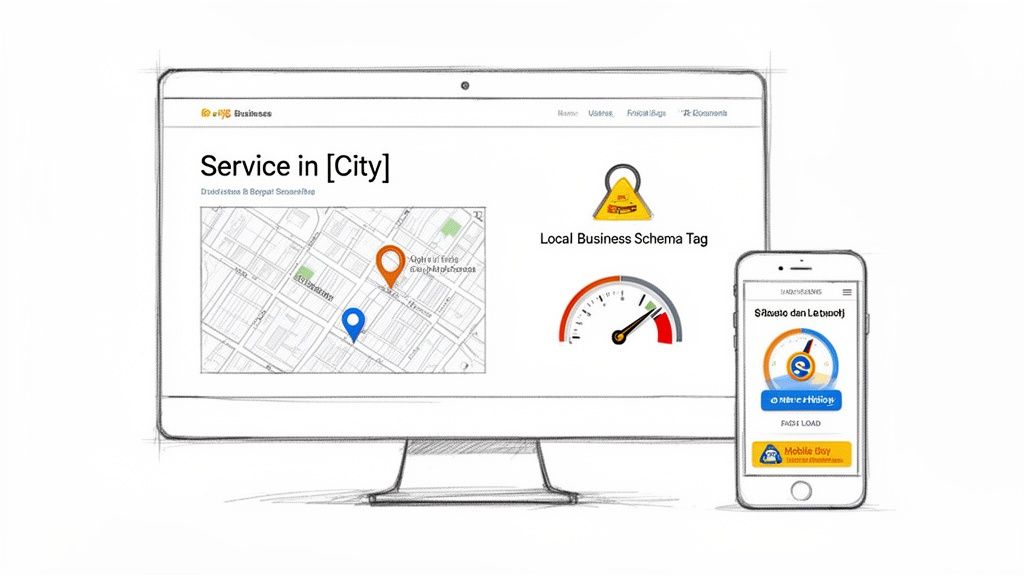
Think of your Google Business Profile as the engine for your local pack rankings. Your website? It’s the chassis holding everything together. Your GBP makes a promise about who you are and where you operate; your website's job is to prove it.
When these two assets are out of sync, it sends mixed signals to Google. That kind of confusion can seriously sabotage all your hard work to land a spot in the seo local pack. Your on-page SEO needs to reinforce every last detail of your local presence, creating a cohesive and trustworthy digital footprint that Google’s algorithm is built to reward.
Create Hyper-Specific Location and Service Pages
Let’s be honest: generic service pages just don't cut it anymore. If you want to compete, you have to build dedicated pages on your website for each service at each location. These pages become powerful landing spots for geo-targeted searches and send incredibly strong relevance signals to Google.
For example, a dental practice in Austin shouldn't have one vague "Services" page. A much smarter play is to create specific, targeted pages like:
- "Emergency Dental Clinic in Downtown Austin"
- "Teeth Whitening Services in South Austin"
- "Invisalign Consultations in North Austin"
Each page needs to be a rich resource, packed with unique content, locally relevant details, and testimonials from customers in that specific area. This proves you're not just in a city; you're the go-to authority for that community.
Weave Local Signals into Your Website
Beyond creating dedicated pages, you have to embed local signals across your entire site. This is about so much more than just sticking your address in the footer and calling it a day.
Your website needs to scream "local" to both users and search engines. Every element should work together to confirm that you are the best local choice for a user's needs.
Here are a few on-page tactics that make a real difference:
- Embed Google Maps: This is a no-brainer. Put an interactive Google Map on your contact page and on every location page. It’s a direct, powerful signal.
- Feature Local Testimonials: Showcase reviews and testimonials that mention the city, neighborhood, or even a specific street. This adds social proof and valuable geographic context.
- Mention Local Landmarks: When writing your content, reference well-known local spots or streets. It grounds your business in the community and makes your content feel authentic.
Use Local Business Schema Markup
Schema markup is code you add to your website that helps search engines understand your content without any guesswork. For local businesses, using LocalBusiness schema is non-negotiable. It’s one of those behind-the-scenes details that has a huge impact.
This code explicitly tells Google your:
- Business Name
- Address
- Phone Number
- Hours of Operation
- Service Area
By spoon-feeding this data directly to Google, you eliminate any potential confusion and guarantee the information it has is perfectly aligned with your GBP. It’s a foundational technical step for building the trust required to rank in the seo local pack.
Prioritize Mobile Speed and User Experience
A huge number of local searches happen on a phone. The user is often out and about, needing an answer right now. If your website is slow or a pain to use on mobile, you’re not just losing a customer—you’re actively hurting your rankings.
Google’s algorithm favors sites that provide a great user experience, and page speed is a massive part of that. A fast, mobile-friendly website signals that you’re ready to serve customers in their moment of need, which is exactly what local search is all about. This technical foundation is critical; without it, all your other local SEO efforts are built on shaky ground.
How to Measure and Scale Your Local Pack Success
You can't improve what you don't measure. Simple as that. Once your local SEO strategy is in motion, you need a sharp, accurate way to track what's working and where to double down.
Relying on a quick Google search from your office to check your rank just doesn’t cut it anymore. It gives you a distorted, incomplete picture of how you really show up for customers.
To actually scale your success in the seo local pack, you have to get serious about measurement. This means moving past outdated rank tracking and finally understanding your performance from the customer's perspective, no matter which neighborhood they're searching from.
Visualize Your True Local Ranking
Traditional rank trackers tell you where you rank from a single, static point. But local search is hyper-geographic. Your ranking can, and does, change dramatically from one block to the next.
This is where modern tools like live ranking heatmaps are a total game-changer. These tools paint a picture of your business’s visibility across an entire city, showing you exactly where you appear in the Local Pack for your most important keywords.
A heatmap might reveal you’re crushing it downtown but are completely invisible in the northern suburbs. Boom—you’ve just found your next big opportunity.
This granular view transforms your measurement from a simple number into an actionable map. It shows you which areas need more love and where your current strategy is already paying off.
Track the Actions That Actually Drive Revenue
Ranking is great, but it’s just a means to an end. The real goal is to drive real-world actions—the phone calls, direction requests, and website clicks that translate to revenue. Your measurement has to connect your ranking efforts directly to these valuable conversions.
Start by digging into your Google Business Profile Insights. You need to be tracking:
- Direction Requests: A powerful signal of someone intending to walk through your door.
- Phone Calls: High-value leads coming straight from the search results.
- Website Clicks: Users who want more info before they commit.
When you track these engagement metrics alongside your keyword rankings, you start to see which search terms are driving the most valuable actions. For example, you might discover that ranking for "emergency plumber near me" generates 3x more calls than "best plumbing services," telling you exactly which keywords to prioritize.
Use Data to Prioritize and Scale
With accurate data, you can finally make smart, strategic decisions about how to scale your local SEO. For any business with more than one location, this is absolutely critical. Dashboards that let you compare performance across different branches are key to spotting trends and replicating success.
You might notice that one location’s clever use of Google Posts is driving a huge spike in profile views. That's not just a win for them; it's a proven tactic you can now roll out across every other location.
A great way to get a handle on this is to compare the old way of doing things with modern approaches.
Comparing Local SEO Measurement Methods
A look at the difference between standard rank tracking and the advanced analytics offered by modern platforms.
| Metric | Traditional Method | Nearfront Method |
|---|---|---|
| Rank Tracking | Checks rank from a single, fixed point. | Visualizes rank across an entire city with heatmaps. |
| Engagement | Tracks website clicks and basic GBP data. | Connects keyword rankings directly to calls, directions, and clicks. |
| Prioritization | Relies on gut feelings and broad keyword volume. | Uses real-world engagement data to prioritize high-value actions. |
| Multi-Location | Manually compares data from separate reports. | Provides a unified dashboard to spot trends and replicate wins. |
As you can see, the shift is from guessing to knowing. For an even deeper look at what to track, check out our guide to the best local SEO reporting tools on the market.
Ultimately, effective measurement turns guesswork into a clear, data-driven roadmap. It allows you to prove ROI, prioritize your next move, and systematically expand your dominance in the seo local pack, city by city.
Common Questions About Ranking in the Local Pack
Even when you're doing everything right, some questions always pop up on the journey to mastering the SEO local pack. Let's clear up a few of the most common ones we hear from business owners.
How Long Until I See Results?
This is the big one, and the honest answer is: it depends. If you're starting from scratch with a brand new business, expect it to take three to six months of consistent work to see real, meaningful movement. An established business that just needs a tune-up might see improvements in a few short weeks.
A few things will speed up or slow down your timeline:
- How competitive is your area? Trying to rank in a packed city market is a much slower climb than in a small town with only a few competitors.
- What’s your starting point? A completely unoptimized profile will naturally take longer to get going than one that already has a solid foundation.
- Are you being consistent? Results are built on steady, ongoing effort—getting reviews, updating your GBP, and keeping citations clean.
Can I Still Rank if I Don’t Have a Physical Storefront?
Absolutely, but you have to play by Google’s rules. This is exactly what Service Area Businesses (or SABs) are for. Think of plumbers, mobile dog groomers, or electricians who travel to their customers.
The key is to set your business type as an SAB in your Google Business Profile and clearly define the specific areas you serve.
A critical rule: you must hide your physical address if it's not a place where customers are served. Don't even think about using a virtual office or P.O. box to fake a location. That’s a fast track to getting your profile suspended.
What Are the Biggest Mistakes I Should Avoid?
So many businesses unintentionally sabotage their own local SEO with a few simple, avoidable errors. The single most damaging mistake we see is NAP (Name, Address, Phone) inconsistency. Even a tiny variation like "St." vs. "Street" across different online directories can create confusion for Google and tank your rankings.
Another classic pitfall is simply ignoring your reviews. When you don't actively ask for them or bother to respond, it sends a clear signal to Google that you're not engaged. This leaves the door wide open for competitors with strong social proof to jump right past you.