
An automated rank tracker is a tool that does exactly what it sounds like: it automatically keeps an eye on your search engine rankings for the keywords that matter to your business. Instead of you (or someone on your team) manually plugging search terms into Google, these tools give you clean, consistent data on where you actually show up in search results over time.
For multi-location brands, this is a game-changer. It means you can finally see your real visibility in every single neighborhood you serve, without any of the guesswork.
Why Manual SEO Tracking Is Holding Your Business Back
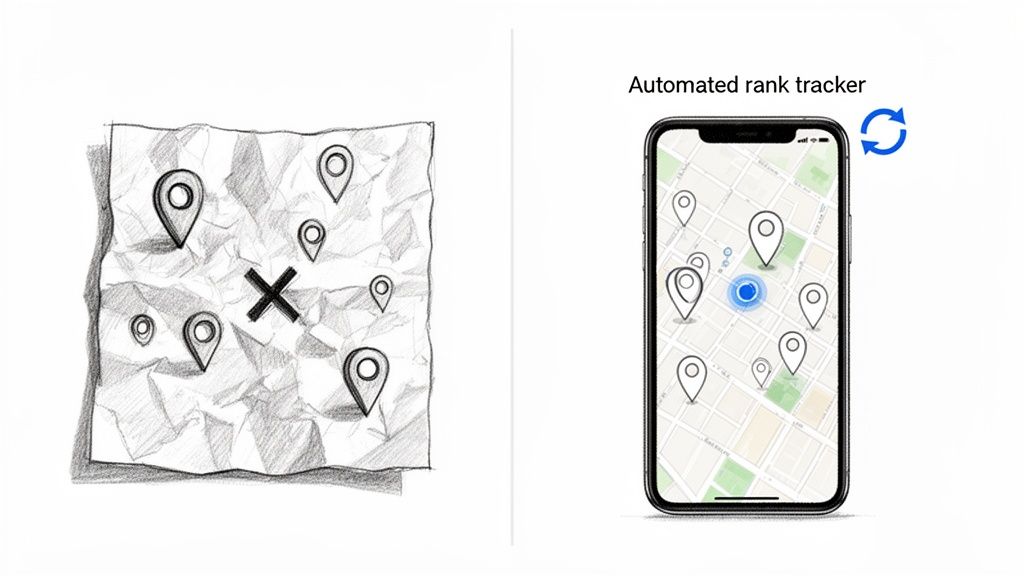
Ever tried navigating a big city with one of those old, crinkled paper maps you find in a glovebox? That’s what manual rank checking feels like for a business with multiple locations. It’s slow, frustrating, and completely blind to what’s happening in real-time. You might know your general position, but you have no clue about the traffic jam three blocks away or the new, faster route that just opened up.
This is the exact problem with manual SEO tracking. You’re flying blind.
An automated rank tracker is the live, turn-by-turn GPS for your local SEO strategy. It goes way beyond what a single, one-off search can tell you, offering a dynamic, comprehensive view of your entire digital footprint.
The Shortcomings of Manual Checks
When you manually search for your business on Google, the results you see are tailored just for you. They're skewed by your physical location, your past search history, and even the device you're using.
What you see is not what a potential customer across town is seeing. This creates a dangerously flawed picture of your search performance and leads to marketing decisions based on bad data.
For businesses with more than one location, this problem gets exponentially worse. Manually checking rankings for dozens of keywords across multiple storefronts isn't just a headache; it's literally impossible to do accurately or consistently. The data quickly becomes a tangled mess of unreliable snapshots.
Manual tracking gives you an illusion of control while hiding the real opportunities and threats. It’s like trying to listen to a city’s symphony one instrument at a time—you hear the notes but miss the music entirely.
Connecting Visibility to Business Goals
At the end of the day, tracking your rank isn't just about stroking your ego. It's about driving real business results. An automated rank tracker is the bridge between your search visibility and the goals that actually move the needle.
Think about it in terms of:
- Increased Phone Calls: Pinpointing where you rank for "dispensary near me" helps you optimize to capture more customers who are ready to buy right now.
- More Foot Traffic: Understanding your visibility in specific neighborhoods allows you to target local marketing efforts to drive more people through your doors.
- Competitive Advantage: Seeing exactly where rivals are outranking you gives you a clear roadmap for winning back market share.
By automating this process, you free up an incredible amount of time and resources. Instead of burning hours collecting questionable data, your team can focus on executing strategies that directly connect local search performance to revenue. It’s a fundamental shift from reactive checking to proactive, strategic growth.
How Automated Tracking Unlocks True Neighborhood Visibility
The biggest blind spot in traditional SEO tools? They treat local search like it happens in a vacuum. A tool might tell you you’re ranking #3 for "wellness clinic in Chicago," but that number is a mirage. In reality, your Google Maps rank is constantly shifting based on where the searcher is physically standing.
Ranking #3 in one neighborhood could mean you're totally invisible just a few blocks away.
This happens because Google’s #1 priority is proximity. A customer searching from the West Loop sees a completely different Map Pack than someone in Lincoln Park. If you’re not using a rank tracker built for this hyperlocal reality, you have no idea how most of your potential customers actually see you.
From Vague Numbers to Visual Intelligence
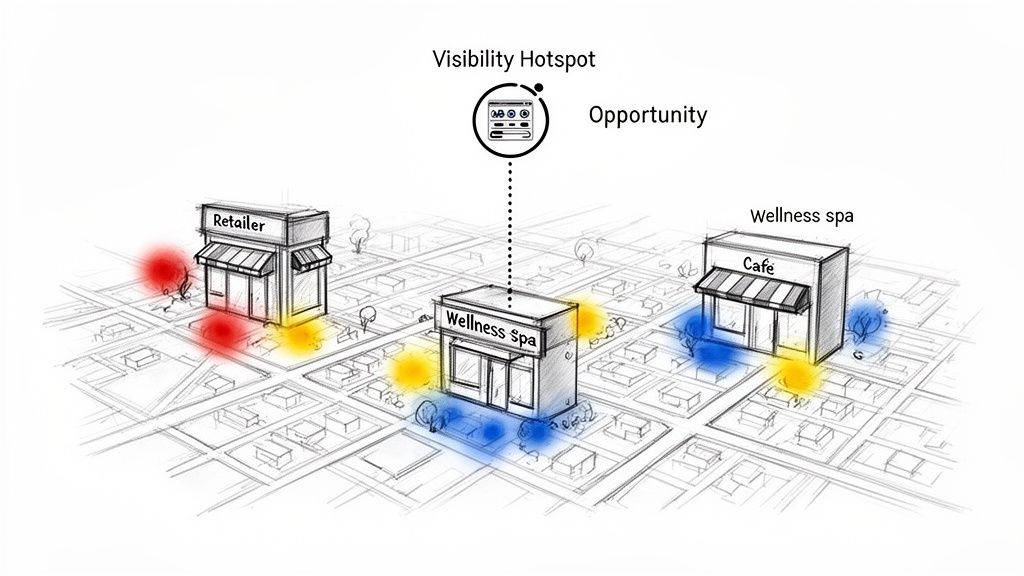
This is where ranking heatmaps change the game. Think of it like a weather map for your local search visibility. Instead of one misleading number, a heatmap gives you a visual report card of your ranking strength across an entire city.
A heatmap works by simulating hundreds of searches from different neighborhood-level points and then plots the results on a map.
- Red "Hot Spots" show where your business is crushing it, appearing in the top Map Pack positions.
- Blue "Cold Zones" instantly reveal the areas where you are practically invisible to local customers.
This visual data is a massive leap forward. It lets you stop guessing and start seeing your true market share, block by block.
Here’s an example of a hyperlocal visibility heatmap from an automated rank tracker.
The visual immediately tells a story, pinpointing exact areas of high and low performance across the city.
Pinpointing Weaknesses and Opportunities
Armed with this level of detail, you can finally see specific neighborhoods where your visibility is weak. For a multi-location retailer, a heatmap might reveal that a new competitor is stealing market share in a zip code that used to be a stronghold. For a cannabis dispensary, it could highlight underserved neighborhoods ripe for a targeted marketing push.
This kind of strategic advantage is just impossible with manual spot-checks or old-school tools that spit out a single, averaged ranking number. Manual checks from your office give you one biased data point; a heatmap gives you hundreds of unbiased ones. If you're looking for a tool that does this, you can learn more about how a sophisticated Google Maps rank tracker delivers this data.
A single rank is a number. A heatmap is a strategy. It turns abstract data into an actionable battle plan for winning at the neighborhood level.
Comparing Tracking Methods
The difference between manually checking your rankings and using an automated hyperlocal tracker is night and day. One gives you a guess, the other delivers a data-driven picture of your competitive landscape.
Manual vs Automated Rank Tracking for Local SEO
This table breaks down why modern automation is essential for any serious local marketing campaign.
| Feature | Manual Rank Tracking | Automated Rank Tracking |
|---|---|---|
| Geographic Scope | One single, biased location (your current IP address) | Hundreds of precise, neighborhood-level scan points |
| Data Accuracy | Highly unreliable; skewed by personal search history | Objective and consistent, simulating real user searches |
| Strategic Value | Provides a vague, often misleading performance snapshot | Reveals specific "hot" and "cold" zones for targeted action |
| Time Investment | Extremely time-consuming and difficult to scale | Fully automated, delivering reports on a set schedule |
| Competitor Insight | Limited to what you can see in a single search | Tracks competitor visibility across the entire service area |
Ultimately, relying on manual checks is like trying to map a city's traffic by looking out a single window. An automated rank tracker gives you the view from a helicopter, showing you exactly where the jams are and where the open roads lie. That clarity is non-negotiable for any local business serious about turning search visibility into real-world foot traffic.
Essential Features for Brick-And-Mortar Brands
Not all rank trackers are built the same, especially when your bottom line depends on a physical storefront. A basic tool might show you a single, national ranking, but that's vanity. Brick-and-mortar brands need features that turn digital visibility into actual foot traffic.
The right platform moves past simple numbers to give you hyperlocal, actionable intelligence. It's about seeing your performance exactly how your customers see it. That means tracking your keyword rankings at the neighborhood level—showing you precisely where you pop up (or disappear) on Google Maps from one block to the next.
This infographic breaks down how a business can get laser-focused on specific neighborhoods to win at hyperlocal SEO.
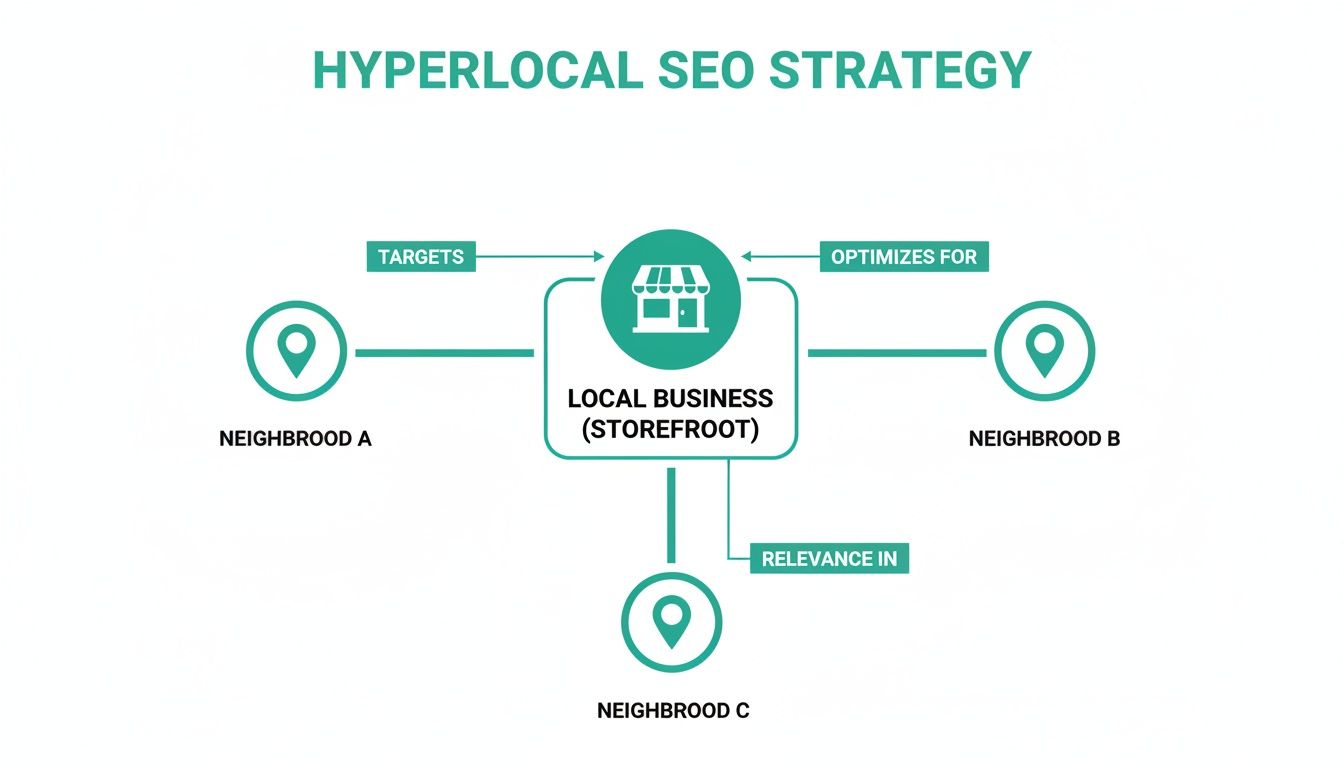
This kind of visual turns abstract data into a clear strategic map, instantly showing you where the real opportunities are hiding across the city.
Go Beyond Basic Rank Checking
The best platforms don't just track rankings; they track the metrics that actually drive revenue. This means keeping a close eye on the crucial engagement signals Google’s algorithm loves, like clicks, calls, and direction requests coming straight from your Google Business Profile (GBP). When you know which keywords trigger these actions, you can double down on what’s really working.
A solid automated rank tracker also needs to have robust competitor monitoring. It’s not enough to know where you stand. You have to know who’s outranking you in key neighborhoods and for high-intent searches. This is how you react fast, dissect their strategy, and reclaim your turf before they get too comfortable.
Privacy and Effortless Setup
Here's a critical feature: the ability to work without needing access to your Google Business Profile. The best modern tools gather data by analyzing public search results, just like a real customer would.
This approach gives you two huge advantages:
- Enhanced Security: You never have to hand over sensitive login details or mess with complicated permissions, which immediately slashes security risks.
- Simplified Onboarding: You can get started instantly. Track any location—including your competitors'—without waiting for administrative approvals.
This "no-access" method keeps your internal data private while delivering the competitive intel you need to dominate your local market. It's a massive leap forward from older tools that demanded direct account integration.
The best automated rank tracker empowers you with complete visibility without demanding access to your internal accounts. It respects your data privacy while delivering the competitive intelligence you need to win.
Automated Reporting and Predictive Insights
Raw data is just noise. The real magic of an automated rank tracker is its ability to turn complex numbers into a clear, actionable game plan. Look for platforms that deliver automated, scheduled reports with before-and-after snapshots, making it dead simple to show ROI to stakeholders. These reports should visualize your growth and pinpoint exactly which tactics moved the needle.
Even better, the most advanced platforms are now baking in predictive analytics. These features analyze your performance trends and market data to forecast potential growth and suggest your next best move. Your rank tracker transforms from a simple reporting tool into a strategic advisor, helping you prioritize the optimizations that will deliver the biggest impact, fastest.
The enterprise rank tracking software market has exploded for this very reason. The global marketing automation market was valued at around $47 billion in 2025 and is projected to hit $81 billion by 2026—a 72% jump in just one year. This shows just how essential automated tracking has become for any business trying to win in competitive local markets.
To round out your toolkit, check out our guide on the best local SEO tools that work hand-in-hand with a great rank tracker.
Real-World Use Cases for Retail and Wellness
Theory is one thing, but seeing an automated rank tracker in action is where the real value clicks. Abstract ideas like "hyperlocal visibility" suddenly become tangible business results when you apply them to the messy, real-world challenges your business faces every day.
Let's walk through how smart businesses in retail and wellness are using these tools to stop guessing and start building a data-driven strategy that actually grows the bottom line.
Each story follows a simple playbook: find a problem, use a specific feature to uncover a new insight, take a targeted action, and measure the real-world outcome.
The Dispensary Discovering Hidden Markets
A multi-location cannabis dispensary in a crowded city market had a classic growth problem. With several storefronts, their marketing budget felt spread thin. They were essentially flying blind, spending money without knowing which neighborhoods held the best opportunities for new customers or targeted ads.
Their big question was where they were truly visible for high-intent searches like "dispensary near me" and "local cannabis delivery."
- Feature Used: Ranking heatmaps were the game-changer. By running scans across the entire metro area, the dispensary could finally see its Google Maps performance, block by block.
- Insight Gained: The heatmaps instantly lit up several "cold zones"—affluent residential neighborhoods where the dispensary was completely invisible in the Map Pack, even though they were well within delivery range. Even better, their competitors weren't showing up there either. It was an untapped market.
- Action Taken: Armed with this data, they launched a surgical local ad campaign. They focused their budget only on the zip codes identified as cold zones, using ad copy that spoke directly to those residents.
- Business Outcome: Within a single month, online orders from those specific zip codes jumped by over 40%. The tracker didn't just give them data; it handed them a profitable, laser-focused marketing plan.
The Wellness Brand Allocating Its Budget Wisely
Now, picture a national wellness brand with dozens of clinics spread across multiple cities. The corporate marketing team was wrestling with how to allocate their national ad budget. Was a dollar spent in Denver bringing in the same return as a dollar in Austin? Without granular, city-by-city data, it was all just guesswork.
The real problem was a total lack of comparative local performance data, turning their budget meetings into debates based on opinion, not facts.
A national strategy without local data is just an expensive guess. An automated rank tracker provides the ground-truth needed to make smart, localized decisions at scale.
To fix this, they started using an automated rank tracker to monitor a core set of keywords for every single clinic. This finally gave them a clear performance baseline for each market.
- Feature Used: They relied on multi-location dashboards and competitor tracking. This gave them a side-by-side view of how their clinics stacked up against local rivals in each city.
- Insight Gained: The data revealed their Austin clinic was consistently getting crushed by a local competitor for high-value terms like "IV therapy" and "wellness spa." Meanwhile, their Denver location was dominating its local search results with almost no real competition.
- Action Taken: They shifted a portion of the Denver marketing budget over to the underperforming Austin market. That money went straight into targeted content, local link building, and a complete overhaul of the Austin clinic’s Google Business Profile.
- Business Outcome: After two quarters, the Austin clinic’s Map Pack visibility for their target keywords improved by an average of six spots. This directly led to a 25% increase in online appointment bookings, proving the ROI of their data-informed budget shift.
The Retailer Seizing High-Intent Keywords
Finally, let's look at a local retailer in the cutthroat sneaker game. They were losing foot traffic to big-box stores and needed a way to intercept high-intent customers who were literally walking around looking for products nearby. They knew ranking for terms like "sneaker store near me" was a matter of survival.
Their biggest challenge was being quick enough to react to competitor moves and pounce on opportunities to own those valuable, ready-to-buy keywords.
- Feature Used: They set up competitor rank tracking with automated, daily alerts.
- Insight Gained: An alert fired off one morning: a major competitor’s ranking had slipped for "best shoe store downtown" after getting hit with a wave of negative reviews. This created a temporary power vacuum in the local search results.
- Action Taken: The retailer immediately launched a Google review campaign, asking recent happy customers to share their experiences. They also updated their Google Business Profile to highlight their unique inventory and in-store service.
- Business Outcome: They snagged the #2 spot in the Map Pack for that keyword in less than two weeks. This quick, strategic move drove a noticeable spike in weekend foot traffic and a 15% lift in in-store sales for the month.
Putting Your Rank Data to Work
Collecting hyperlocal ranking data is just the first move. The real win comes when you start weaving those insights into your day-to-day marketing. An automated rank tracker shouldn't be some dusty tool you check once a month. It should be the central nervous system for your local marketing, creating a feedback loop that makes every single thing you do smarter.
This is how you turn abstract data points into a clear, actionable game plan. It’s about moving beyond just watching the numbers and actively using them to fine-tune your approach, prove your value, and outmaneuver the competition.
Creating Your Performance Baseline
You can't measure growth if you don't know where you started. The very first step is to lock in a performance baseline. This is your "before" picture, the one you'll hold up later to show stakeholders exactly how much ground you've gained.
Getting it done is simple:
- Set Up Locations and Keywords: Plug in all your physical stores and the high-intent keywords you want to own for each one. Think “dispensary near me” or “walk-in clinic downtown.”
- Run an Initial Scan: Your rank tracker will do its thing, running a full scan to generate the first set of ranking heatmaps and reports for every single location.
- Establish the Benchmark: This initial data set is your baseline. It shows your exact visibility across every neighborhood on day one, flagging your current strongholds and, more importantly, your biggest opportunities.
Once that benchmark is in place, every marketing action—from a simple Google Business Profile update to a full-blown local ad campaign—can be measured directly against it.
Your baseline isn't just data; it's your strategic map. It shows you where you are, where your competitors are, and the most direct path to capturing more market share.
Building a Continuous Feedback Loop
With your baseline set, the goal is to create a cycle: data informs action, and action creates new data. This loop ensures your marketing is always evolving based on what's actually working in the real world. Think of it as having a constant conversation with the market.
For example, your rank data might show a "cold zone" where you're basically invisible. That insight should immediately trigger your content team. You could spin up a new local landing page optimized for that specific neighborhood, peppering it with mentions of local landmarks and events. After it goes live, your automated rank tracker keeps watch, showing you precisely how your rankings climb in that target area.
This feedback loop doesn't stop with content. It plugs into everything.
- Paid Search Campaigns: Use your heatmaps to find areas with low organic visibility. Instead of blasting ads across the whole city, you can launch laser-focused paid campaigns targeting only those "cold" neighborhoods. Your ad spend just got a whole lot more efficient.
- Content Creation: Notice a competitor is ranking for a long-tail keyword you completely missed? That's a direct signal to create a piece of content that serves that searcher's needs even better.
- On-Page SEO: The tracking data might reveal that your pages mentioning specific local spots consistently rank higher. That’s a clear directive to go optimize your other local landing pages with similar, neighborhood-specific language.
This process transforms your rank tracker from a simple reporting tool into an active part of your strategic engine. It makes sure every ounce of effort is aimed directly at your biggest growth opportunities.
The Future of Rank Tracking in an AI-Driven World
The old game of climbing to the #1 spot on Google is over. It’s being completely rewritten by AI.
With the explosion of AI Overviews and other dynamic search features, the ten blue links we all grew up with are no longer the finish line. Visibility means something totally different now, and your rank tracking strategy has to evolve or it will quickly become useless.
In this new reality, getting cited as a source inside an AI-generated answer is often far more valuable than just holding a top organic position. This isn't just a theory; it has a massive, measurable impact on traffic.
When an AI Overview shows up, the click-through rates for traditional organic results can tank by a staggering 61%. But here’s the flip side: brands cited as sources within that AI answer see their organic CTR jump by a remarkable 35% compared to standard results. That 96-percentage-point swing is one of the biggest shifts in search visibility we’ve seen in years.
Beyond the Top Ten Blue Links
This is exactly why a modern, automated rank tracker is no longer a nice-to-have. It’s essential for future-proofing your business.
Legacy tools that only report on a single, static ranking number are giving you a dangerously incomplete picture. They can’t tell you if you’re being featured in AI answers, "People Also Ask" boxes, or the other dynamic spots where your customers are actually finding information now.
A forward-thinking automated rank tracker needs to monitor your brand’s total visibility across the entire search results page.
This includes tracking:
- AI Overview Citations: Pinpointing exactly when and where your content is used as a source in generated answers.
- SERP Feature Presence: Monitoring your visibility in image packs, video carousels, and local map packs.
- On-Demand Data: Giving you real-time refreshes to keep pace with the fluid, ever-changing nature of today’s SERPs.
The goal is no longer just to rank. It’s to become the definitive answer wherever a user looks. An advanced rank tracker provides the 360-degree view you need to compete for this new definition of visibility.
Preparing for What’s Next
Relying on old metrics is like using a paper map on a highway that’s constantly under construction. You might know where you were, but you have no idea where the road is actually heading.
Investing in a tool that gives you the complete picture of your brand's presence ensures your business is ready for Google’s next move. This proactive approach is at the core of understanding AI and the future of local SEO, where automation is the key to staying ahead of the curve.
By tracking your total SERP footprint, you stop reactively chasing old-school rankings and start proactively building authority wherever your customers are looking for answers.
Got Questions? We’ve Got Answers.
Even after seeing how it all works, you might still be wondering how an automated rank tracker actually fits into your day-to-day. Let's clear up a few common questions and show you how these tools deliver serious value without adding complexity.
How Is This Different from Google Search Console?
Think of Google Search Console (GSC) as giving you the average temperature for the entire city. It’s essential, but it gives you a high-level, averaged-out view of your performance. It tells you what generally happened, not what’s happening on the ground, right now.
An automated rank tracker is like having a thermometer on every single street corner. It shows you exactly how you rank block-by-block by simulating searches from specific neighborhood coordinates. GSC gives you the big picture; an automated tool gives you the street-level intelligence you need to actually win.
GSC tells you what happened on average. An automated rank tracker shows you what is happening right now, neighborhood by neighborhood.
Do I Need to Give a Tool Access to My Google Business Profile?
Nope. At least, not with a modern platform. The best tools are designed to track your public-facing rankings without ever needing your Google Business Profile credentials. This is a huge win for both security and simplicity.
Because you’re not sharing sensitive account info or managing permissions, your data stays secure. It also makes getting started a breeze. The tool simply analyzes live search results—the same way a real customer would—to give you a clean, unbiased view of your public visibility.
How Often Should I Be Checking My Local Rankings?
The beauty of an automated system is that it does the daily grind for you, so you don’t have to. For most multi-location businesses, a bi-weekly or monthly reporting cadence is the sweet spot for strategic reviews.
This rhythm is perfect for spotting real trends and measuring the impact of your SEO efforts, like a new local landing page or a GMB profile overhaul, without getting bogged down by daily noise. Plus, any good platform will have an on-demand refresh button for those times you make a big change and just can’t wait to see the results.
Ready to stop guessing and start seeing your true local visibility? With Nearfront, you get live ranking heatmaps, automated reporting, and the hyperlocal insights needed to turn local searches into real customers. Discover your hidden opportunities and start winning at the neighborhood level. Learn more and get started with Nearfront today.