So, what exactly is local small business marketing? It's all about focusing your marketing efforts on a specific geographic area to pull in customers who are literally right around the corner. It’s how you become the instant, obvious answer when someone types “wellness clinic open now” or “dispensary near me” into their phone, turning that quick search into actual foot traffic.
Why Local Marketing Is Your Greatest Advantage
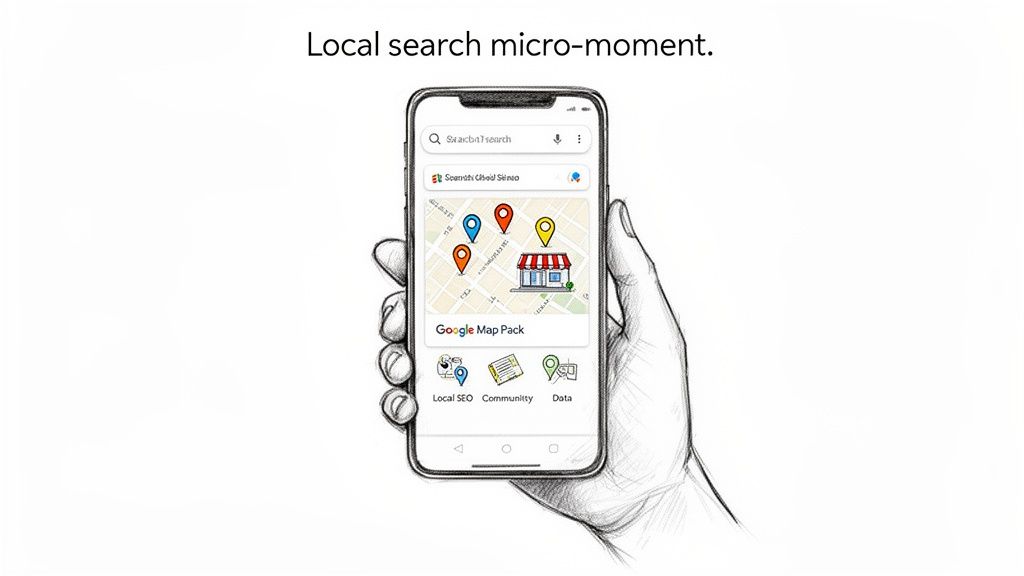
For any brick-and-mortar business, forget pavement and streetlights—the modern-day Main Street is the Google Map Pack. Your digital storefront is the very first impression you'll make on almost every new customer. Winning their business boils down to winning those split-second moments of discovery online.
This isn’t just another item for your to-do list; it's your most powerful competitive edge. While huge corporations often fall flat trying to create authentic local connections, your business can build a presence that genuinely clicks with the community. A sharp local marketing strategy lets you connect directly with people who are right now looking for exactly what you offer.
The Pillars of Local Success
Winning at local marketing really comes down to mastering a few core pillars. Whether you run a single shop or a multi-location brand, getting these right is non-negotiable. This guide will walk you through actionable steps to nail each one.
- Local SEO: Think of this as the science of showing up in local searches. It’s what makes your business pop up the moment a potential customer nearby is looking for your services.
- Community Engagement: This is about building real relationships with your local audience, both online and in person. It creates a kind of loyalty that digital ads just can't buy.
- A Data-Driven Strategy: Success isn't about vanity metrics. It’s measured by actions that matter—phone calls, direction requests, and in-store visits. Tracking these tells you exactly where to put your time and money.
Local marketing flips the script, turning your size into a strength. Instead of trying to be the loudest voice on the internet, you get to have real conversations with the people right outside your door, transforming your neighborhood into a loyal customer base.
A Roadmap to Your Goals
Knowing which channels to use is the first step toward building a plan that actually works. Different channels do different jobs, from driving immediate leads to building your brand over the long haul.
To give you a clear map from the get-go, here’s a quick look at the essential channels for local businesses and what they're designed to accomplish.
Key Local Marketing Channels and Their Goals
This table offers a quick overview of essential marketing channels for local businesses and the specific outcomes they help achieve.
| Channel | Primary Goal | Best For |
|---|---|---|
| Local SEO & GBP | Attracting high-intent customers | Driving calls and foot traffic |
| Social Media | Building community and brand loyalty | Showcasing your brand's personality |
| Paid Search Ads | Generating immediate, qualified leads | Promoting specific offers or services |
| Email Marketing | Nurturing existing customer relationships | Encouraging repeat business and referrals |
Getting these channels to work together is where the real magic happens, creating a powerful system that consistently brings new customers through your door.
Building Your Unshakeable Local SEO Foundation
Think of your local SEO strategy like building a house your customers can actually find. You need a solid foundation, clear street signs pointing the way, and some curb appeal to invite them in. Skip these core elements, and even the most creative marketing plan will fall flat.
This isn't about gaming the system with technical hacks. It's about earning trust and authority with search engines by proving you're a real, active, and relevant business in your community. Nailing these three pillars is the first—and most important—step to owning your local search results.
Pillar 1: Your Google Business Profile is the Foundation
Your Google Business Profile (GBP) is, without a doubt, the most powerful asset in your local marketing arsenal. It's your digital storefront, business card, and welcome mat, all in one. When someone searches for a business like yours, your GBP is often the very first thing they see in the Map Pack.
A neglected profile is basically a "closed for business" sign hanging on your digital door. An optimized one, on the other hand, is a magnet for local customers. Start by getting the details perfect.
- Complete Every Single Section: Your business name, address, phone number, website, and hours. Accuracy here isn't just important; it's everything.
- Choose Precise Categories: Don't just pick "Health." If you're a wellness center, choose "Wellness Center." Add relevant secondary categories to give Google more context.
- Upload High-Quality Photos: Show off your storefront, your products, your team, and happy customers. Profiles with photos get 42% more requests for driving directions.
- Encourage and Respond to Reviews: Make it a habit to ask satisfied customers for reviews. And just as importantly, respond to all of them—good and bad. Businesses that reply to reviews are seen as 1.7x more trustworthy.
For a complete playbook on getting the most out of your profile, check out our deep dive on how to optimize your Google Business Profile.
Pillar 2: Citations Are Your Digital Street Signs
Once your foundation is solid, you need to put up street signs so search engines—and customers—can find their way. In local SEO, these signs are called citations. A citation is simply any online mention of your business's Name, Address, and Phone number (NAP).
These pop up in directories like Yelp, Bing Places, and thousands of other industry-specific sites. Google crawls these to cross-reference and verify your business information.
The golden rule here is NAP consistency. Every single citation must match the information on your Google Business Profile. Exactly. A tiny difference, like "St." versus "Street," can confuse search engines and water down your authority.
Inconsistent NAP is like having a dozen different street signs all pointing to the same place with slightly different names. It creates confusion and kills the trust Google has in your listing. The goal is a clean, consistent trail of data across the web that confirms you are who and where you say you are.
Pillar 3: On-Page SEO Is Your Curb Appeal
Alright, the foundation is poured and the signs are up. Now it's time to work on the curb appeal. This is your on-page SEO—optimizing your website to signal local relevance to both people and search engines. Your website needs to scream "local expert" from the moment someone lands on it.
The single best way to do this is by creating location-specific content. This shows Google you don't just exist in a city; you actively serve its specific neighborhoods and communities.
Here are a few ways to boost your on-page local signals:
- Create Local Service Pages: If you serve multiple towns or neighborhoods, build out dedicated pages for each one (e.g., "Wellness Services in Downtown Denver").
- Weave in Local Keywords: Sprinkle terms like "[Your Service] near [Neighborhood]" or "[Your Product] in [City]" naturally into your website copy, headings, and meta descriptions.
- Embed a Google Map: Drop an interactive map of your location onto your contact page. It's a simple but incredibly powerful signal of your physical presence.
- Showcase Local Testimonials: Feature reviews from customers in the area, and don't be afraid to mention their neighborhood or city to reinforce that community connection.
By building out these three pillars—GBP, citations, and on-page SEO—you create an unshakeable foundation that doesn't just attract search engines. It turns local searchers into paying customers.
How to Dominate the Google Map Pack
Think of the Google Map Pack as the digital version of Main Street. Ranking there is like snagging the best corner storefront with the most foot traffic—it’s where everyone looks first. But getting there isn't like traditional SEO. It’s more of a neighborhood popularity contest, and Google is the judge.
This contest is decided by three core signals: proximity, relevance, and prominence. Proximity is simple: how close is the searcher to your business? But the other two are where you can really move the needle. Relevance is how well you match what someone is looking for, while prominence is a measure of how well-known and respected your business is.
This concept map breaks down the core pieces that build your authority and help you win.
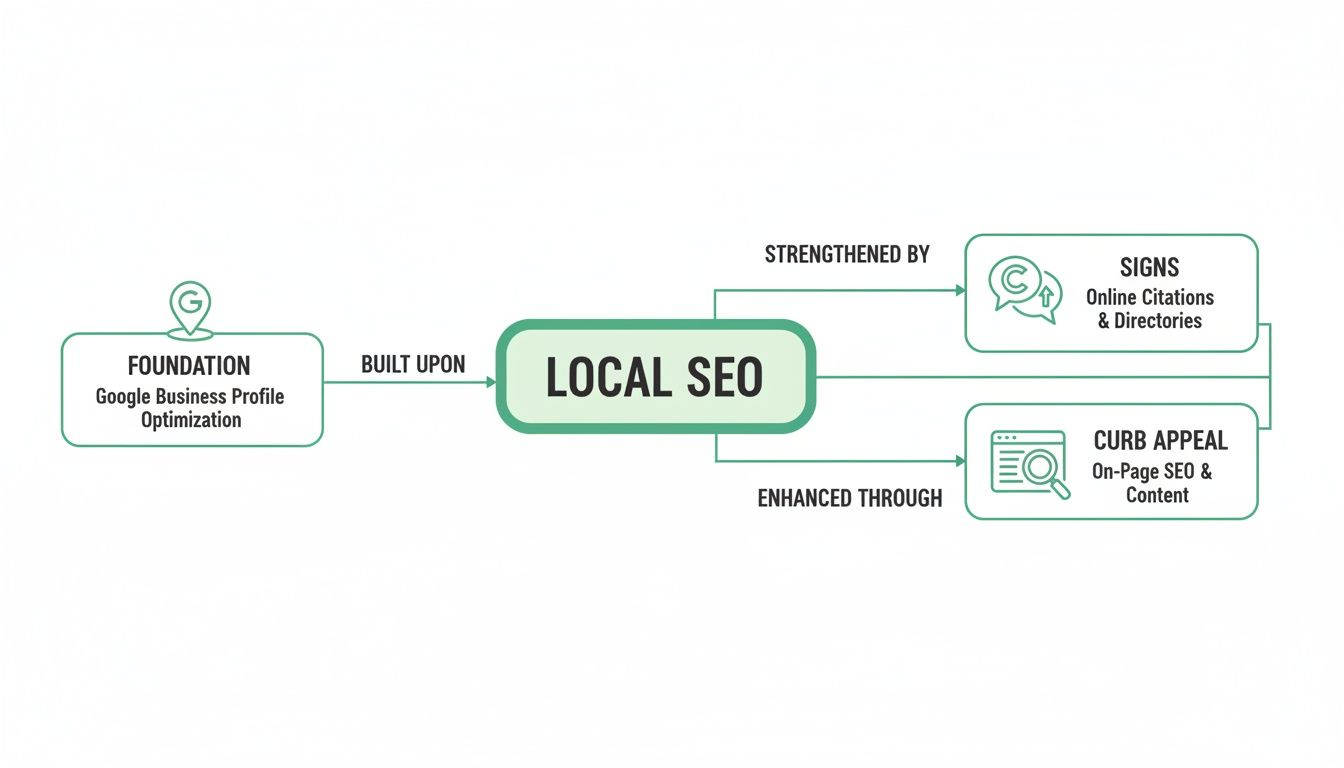
As you can see, it all starts with a rock-solid Google Business Profile. Consistent business listings (citations) act like digital road signs pointing to you, and your website’s on-page SEO is the curb appeal that pulls it all together.
The Real Signals Google Cares About
Google’s algorithm is smarter than ever. It doesn't just scan for keywords; it watches real-world user behavior to figure out which businesses deserve the top spots. These are the signals that prove customers are actually engaging with you.
- Profile Clicks: How many people click on your Google Business Profile after it pops up in search?
- Direction Requests: How often do users hit the "Directions" button? This is a massive signal of real-world intent.
- Phone Calls: The number of calls made straight from your profile is a direct line to customer interest.
- In-Person Visits: Google uses location data to track foot traffic, rewarding the businesses that get people in the door.
These actions are the currency of local search. Every click, call, and direction request sends a powerful message to Google: this business is a valuable and popular choice. That's why focusing on real-world engagement is a cornerstone of modern local small business marketing.
The Hyper-Local Ranking Puzzle
Ever notice your business ranks differently when you search from one block to the next? That’s the reality of hyper-local rankings. Your visibility isn't a simple circle around your store; it's a dynamic heatmap that shifts from one street corner to another.
This makes tracking your actual performance incredibly difficult. You could be #1 for a customer across the street but completely invisible to someone just a half-mile away.
This variability is precisely why understanding your true local reach is so difficult. Without the right tools, you're essentially blind to where you're winning and, more importantly, where competitors are stealing potential customers right from under your nose.
Recent trends show just how critical this is. People want local, with 49% of shoppers choosing businesses based on location and convenience alone. But here’s the kicker: only 19% of small businesses are actively using local SEO and Google My Business. This leaves a huge opportunity for anyone willing to put in the work.
This is where advanced tools come in. Imagine seeing a map that shows exactly where you’re visible and where you aren't. That kind of insight lets you pinpoint specific weak spots and understand the competitive landscape on a block-by-block basis. To dig deeper into this, our guide on the Google Local Map Pack breaks it all down.
Choosing the Right Marketing Channels for Your Business
Trying to be everywhere at once is a classic trap for small businesses. It's a surefire way to burn out and get mediocre results across the board. The real strategy is to think like a sniper, not a machine gunner. Pick your channels carefully based on your business goals and how your customers actually behave.
The whole game is about matching the channel to the action you want a customer to take. Are you trying to build a loyal community that loves your brand? Or do you need to grab the attention of someone actively looking for a solution right now? The answer to that question tells you exactly where to put your time and money.
Aligning Channels with Customer Intent
Every marketing channel has a different job. A local wellness studio, for example, might crush it on Instagram. They can use beautiful visuals to show off their serene space and build a community around a healthy lifestyle. This is a long-term play, all about brand awareness and connection.
But what about a dispensary that just got a popular product back in stock? They need to reach customers who want to buy today. For them, search advertising is king. They can target someone typing "dispensary near me with [product name]" into Google and turn that search into a sale in minutes.
Nailing this distinction is the first step to making smarter marketing investments that actually pay off.
The best local marketing strategy isn't about using every channel. It's about mastering the one or two channels that put you in front of your ideal customer at the exact moment they need you.
Organic vs. Paid Channels: A Local Perspective
Your marketing efforts basically fall into two buckets: organic and paid. Organic channels, like your social media posts or email newsletters, are for building relationships over time. Paid channels, like Google Ads or social media ads, are for getting someone to take action immediately.
- Organic Social Media: This is perfect for showing off your brand’s personality and connecting with your local community. It’s a low-cost way to share updates, introduce your team, and build up a loyal following. The goal here is long-term awareness and loyalty.
- Email Marketing: Nothing beats email for nurturing relationships with people who already know you. Use it to announce special offers, share useful tips, and keep them coming back. This channel consistently delivers one of the highest ROIs because you're talking to a warm audience.
Capturing High-Intent Customers with Search
While organic channels are great for building your brand, paid search is designed to capture existing demand. This is where you find people who have their wallets out, ready to make a decision. The data on this is impossible to ignore.
Looking ahead to 2026, small businesses are still all-in on digital, with unpaid social media being the most common tactic at 66% usage. But here's the catch: only 45% are investing in search advertising. That’s a massive missed opportunity, especially when you learn that 65% of shoppers click on search ads when they're actually ready to buy. You can dig into more of these small business marketing trends from LocalIQ.
This gap points to a huge area for growth. By getting strategic with paid search, you can jump in front of local customers with sky-high purchase intent. You’ll drive immediate calls, direction requests, and in-store visits. It’s the most direct line from a local search to your front door.
Measuring Local Marketing Success That Matters
Proving your local marketing is actually working can feel like shouting into the void. It's easy to get distracted by vanity metrics like website traffic or a spike in social media likes. But for a brick-and-mortar business, those numbers don't pay the rent.
Real success is measured by real-world actions that lead directly to someone walking through your door.
Forget the abstract data points. The only key performance indicators (KPIs) that truly matter are the ones that signal a customer is about to spend money. These are the ultimate signs of a healthy local strategy—the ones that turn digital interest into actual business.
The KPIs That Actually Drive Revenue
If you want to know if your marketing is working, you have to track the metrics that show genuine customer intent. These are the signals Google’s algorithm cares about most, and they should be your North Star.
- Phone Calls: A direct call from someone who found you online is one of the highest-quality leads you can possibly get.
- Direction Requests: When someone hits the "Directions" button on your Google Business Profile, they're not just browsing. They’re planning a visit.
- In-Person Foot Traffic: This is the ultimate conversion. Modern tools can finally connect the dots between your digital marketing and the number of people walking into your store.
These three metrics are the lifeblood of any local business. They go beyond simple online visibility and measure what potential customers are doing in your area. Focusing on them gives you a clear, data-backed way to justify your marketing spend and make smarter decisions.
Vanity metrics make you feel good, but action metrics make you grow. A thousand website visits mean nothing if no one calls, asks for directions, or walks through your door. Your success depends on tracking the actions that lead to a transaction.
The Challenge of Accurate Tracking
While tracking these KPIs is critical, it's not always easy. This is especially true if you have more than one location.
How do you know which marketing campaign is driving calls to your downtown store versus the one in the suburbs? How can you tell if a new ad is boosting foot traffic in one neighborhood but falling flat in another?
This is where the real complexity of local marketing shows up. Accurately tying a phone call or a store visit to a specific campaign is tough without the right systems in place.
It's this exact problem that leaves so many businesses guessing about their ROI. A recent study highlights the gap: while 63% of businesses plan to increase their marketing spend, a shocking 73% doubt their current strategies are even working. Even worse, only 19% are actively trying to optimize for local SEO or Google Business Profile, leaving a massive opportunity on the table.
For brands in competitive markets, the winning formula is a strong local search presence paired with authentic social signals. That's how you outpace competitors and drive the calls and foot traffic that actually matter. You can discover more insights about small business marketing stats at Sixth City Marketing.
Modern platforms solve this by tracking the very signals Google values, connecting your marketing efforts with real-world results. By seeing exactly where you’re visible and which keywords drive customer actions, you get the clarity you need to invest with confidence and speed up your growth.
Using AI Tools to Accelerate Local Growth
Let's be honest: trying to manage all the moving parts of local marketing, especially across multiple locations, feels like an impossible task. You know what you should be doing, but connecting those efforts to actual phone calls and foot traffic is a constant struggle.
This is where the right technology stops being a nice-to-have and becomes the core of your strategy.
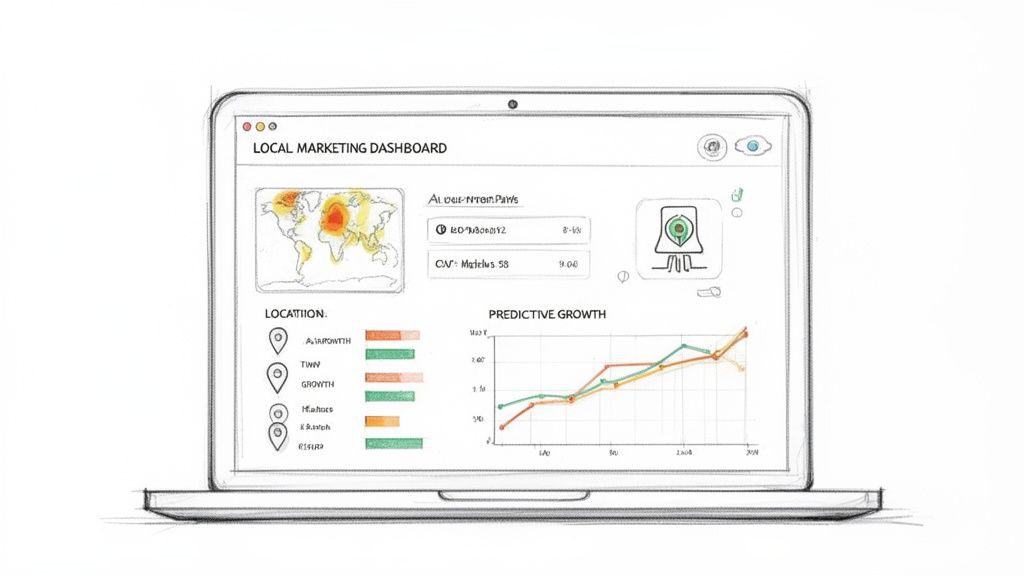
AI-powered platforms are built to solve these exact problems. Think of them as a command center for your local presence, automating the grunt work of tracking performance, spotting opportunities, and proving what’s actually working. They shift you from guessing to knowing, giving you the data to make smarter, faster decisions.
Diagnose Your True Local Visibility
One of the biggest blind spots in local small business marketing is not knowing where you really show up. A quick search from your office computer gives you a skewed, inaccurate picture of your visibility. AI tools cut through the fog by using ranking heatmaps to show you exactly how you appear across every neighborhood you serve.
These maps show you, block by block, where you’re winning and where competitors are eating your lunch. This granular view helps you diagnose spotty rankings and pinpoint specific areas that need more attention, turning vague problems into a clear action plan.
Instead of just knowing if you rank, you finally see where you rank. This transforms your strategy from broad-strokes marketing to precise, targeted actions that address your weakest points and protect your strongest ones.
With this data, you can put your marketing budget to much better use. You can focus your efforts on the neighborhoods with the biggest growth potential, making sure every dollar you spend has a real impact on bringing in new customers.
Generate Authentic Engagement Signals
At the end of the day, Google's algorithm rewards businesses that real people actually engage with. Clicks, calls, and direction requests are the currency of local search. Today's tools can help generate these genuine engagement signals at scale, aligning your marketing directly with what Google wants to see.
These platforms work by simulating the real-world behaviors of potential customers. They can generate signals such as:
- Targeted Searches: Simulating searches for your most important keywords from specific geographic locations.
- Profile Clicks: Driving clicks to your Google Business Profile, which signals its relevance and authority.
- Customer Actions: Triggering signals for direction requests and phone calls, showing clear purchase intent.
The best part? This can be done without requiring any direct access to your Google Business Profile. It’s an approach that complements your other SEO efforts, building a foundation of authentic user activity that helps lift your rankings naturally. If you're curious about how this works, you can learn more about how AI is shaping the future of local SEO in our deep-dive guide.
Prioritize Efforts and Prove Your ROI
For any brand with more than one location, the biggest win is clarity. An AI-powered dashboard pulls all your performance data into one place, letting you compare locations side-by-side. A marketing manager can instantly see which stores are falling behind and identify the keywords driving the most calls or visits for the top performers.
This data-driven approach takes the emotion and guesswork out of your strategy. You can use performance reports and growth predictions to justify your marketing spend, show clear before-and-after results, and prioritize the actions that will deliver the fastest return. It’s how you prove that local marketing isn't just an expense—it’s a primary driver of growth that puts more customers through your door.
Common Questions About Local Marketing
Getting started with local marketing always brings up a few key questions. Let's break down the most common ones so you can move forward with confidence.
How Much Should a Small Business Spend on Local Marketing?
There's no magic number here, but a good starting point is dedicating 5-10% of your revenue to marketing. Honestly, though, how you spend that money is way more important than how much you spend, especially when you're just starting out.
Begin with the high-impact stuff that costs more time than money. I'm talking about fully optimizing your Google Business Profile and locking down consistent local citations across the web. Once you have that foundation, pick one or two paid channels to test—maybe local search ads to catch people ready to buy, or social media ads to build a neighborhood buzz. The key is to watch what actually drives calls and direction requests before you even think about scaling the budget.
What Is the Single Most Important Part of Local SEO?
If you only have time for one thing, make it your Google Business Profile (GBP). No contest. Think of it as your digital storefront—it's the absolute cornerstone of your local presence online. A complete, accurate, and active GBP is the loudest signal you can send to Google that you're a legitimate, relevant business.
This goes beyond just getting your Name, Address, and Phone number (NAP) right. It means digging in to select the most precise business categories, uploading high-quality photos that show off your space, and consistently getting—and responding to—customer reviews. Every other local SEO effort you make will fall flat without a strong GBP holding it all together.
An optimized Google Business Profile does more than just inform customers; it actively proves your relevance and authority to Google's algorithm, making it the highest-leverage activity in your entire local marketing toolkit.
How Long Does Local Marketing Take to Show Results?
It really depends on where you're putting your energy. The timeline for results varies a lot from one channel to the next.
- Paid Advertising: If you want speed, this is it. Channels like Google Ads can start generating clicks, calls, and leads almost the moment your campaign goes live. You're essentially paying for instant visibility.
- Organic SEO: This is the long game. While you might see some small ranking bumps within a few weeks of optimizing your GBP, it typically takes a solid 3-6 months to see significant, stable results that stick.
Consistency is everything for organic growth. Paid channels give you that short-term win, while organic strategies build a sustainable foundation that keeps paying you back over time. The best approach is usually a mix of both—using paid ads to get the phone ringing now while your organic presence builds momentum.
Ready to stop guessing and start seeing exactly where your business ranks on the map? Nearfront uses AI-powered heatmaps and predictive insights to help you dominate local search and bring more customers through your door. Diagnose your visibility and accelerate your growth.