Want to know what keywords you actually rank for? The best place to start is always Google Search Console. It's Google's own free tool, giving you a direct, unfiltered look at the exact search queries people are using to find your website.
First, Establish Your Baseline Keyword Performance
Before you can even think about improving your rankings, you need a crystal-clear picture of where you stand today. Forget guesswork. Forget vanity metrics. The goal here is to establish a rock-solid baseline of your current keyword footprint.
This isn't just a "nice-to-have" step; it's non-negotiable. This initial data gives you the context for every strategic decision you'll make down the road. Without it, you’re flying blind.
The only truly reliable source for this is Google Search Console (GSC). It's the one place you can see exactly how Google views your site and which queries are triggering its appearance in the search results. Think of it as your website's performance dashboard, built by Google itself.
Diving Into the Performance Report
Once you're inside GSC, the "Performance" report is where the magic happens. This is your treasure trove of keyword data. Right away, you’ll see four key metrics:
- Total Clicks: How many people actually clicked through to your site.
- Total Impressions: How many times your site was shown in search results.
- Average CTR (Click-Through Rate): The percentage of impressions that turned into a click.
- Average Position: Your average rank for a keyword across all searches.
Now, these numbers give you a decent high-level overview, but the real insights come from seeing how they relate to each other. A high impression count is great—it means Google thinks you're relevant. But if it's paired with a low CTR? That could signal a weak title tag or a meta description that isn't compelling anyone to click. Understanding this interplay is how you start turning raw data into action.
The real opportunity lies in filtering this data. A high number of impressions combined with an average position between 11 and 20 is a goldmine. SEOs call this 'low-hanging fruit.' These are keywords where you're just off the first page, and a little bit of optimization can push you over the edge and deliver a serious traffic boost.
How to Pinpoint Your Most Valuable Keywords
Scroll down in the Performance report until you see the "Queries" table. This is it—the definitive list of what you rank for. A great first move is to sort this list by impressions. This will immediately show you which terms Google already associates most strongly with your brand.
From there, start applying filters to zero in on what matters. For instance, try setting a position filter to show only keywords ranking greater than 10. This instantly isolates all the terms where you have visibility but aren't cracking the first page. These are your prime targets.
Analyzing this data is a core part of any local SEO strategy. To get even more granular, especially for brick-and-mortar businesses, a dedicated local search rank tracker can show you how these rankings change from one neighborhood to the next. By establishing this clear baseline, you’re not just looking at data—you're building a strategic roadmap to own your local search results.
Visualizing Your Rankings in the Real World
Knowing your national keyword performance is a decent start, but for any business with a physical address, it's just a tiny piece of the puzzle.
Your real-world success is decided by who can find you block by block, not country by country. This is where hyperlocal rank tracking becomes absolutely essential.
For multi-location businesses like retail stores, wellness clinics, or dispensaries, a single national ranking number is incredibly misleading. Ranking #2 for "cannabis dispensary" means nothing if that position only shows up for people searching from inside your own store. True visibility is all about understanding how proximity impacts who sees you in Google Maps and the local search results.
This diagram breaks down the core keyword metrics and how they all connect.
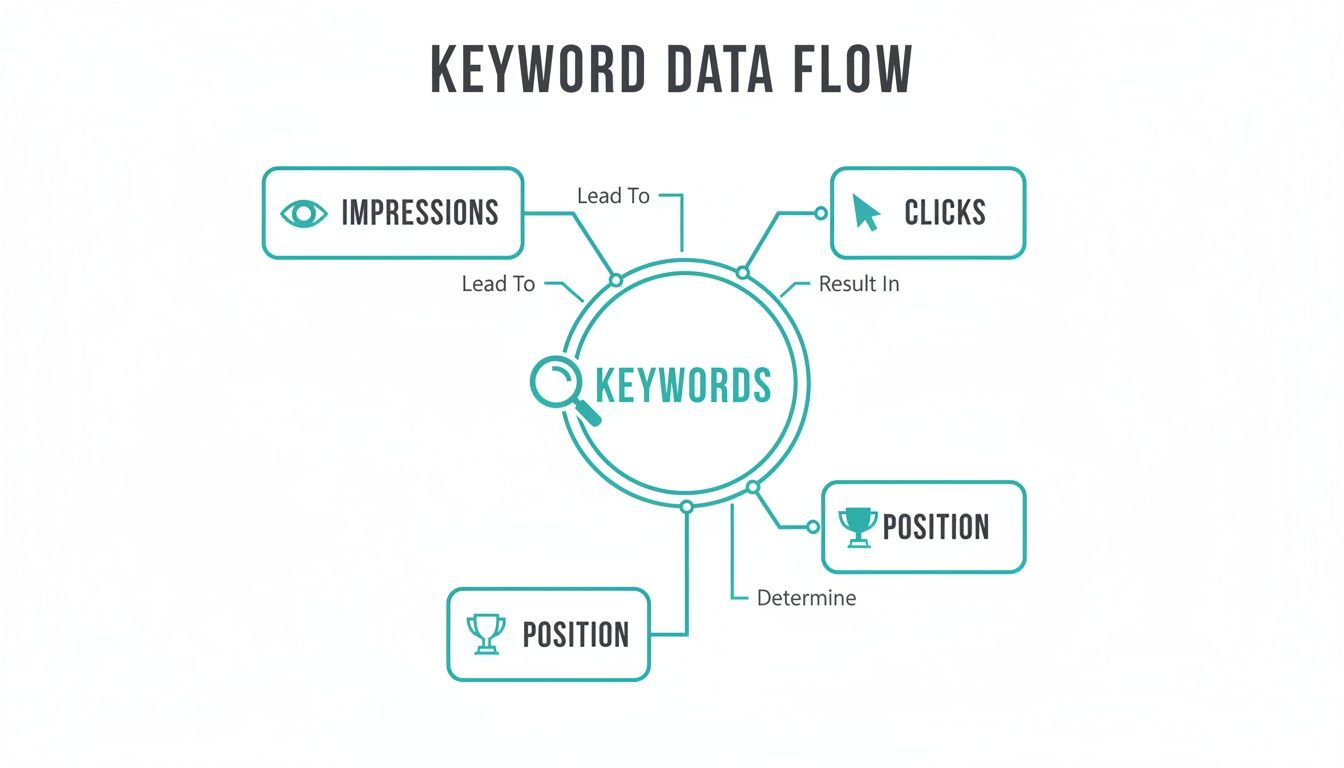
It shows how your keywords generate impressions (visibility), which hopefully lead to clicks (traffic), all while your search position (ranking) measures how well you're doing. This relationship is the foundation of turning a search presence into actual business results.
Moving Beyond a Single Ranking Number
The best tools move beyond simple lists of keywords and positions by visualizing this data in a way that actually reflects reality. One of the most powerful ways to do this is with a ranking heatmap.
A heatmap overlays your ranking data onto a map of your service area, showing you exactly where you are visible—and more importantly, where you are not.
Imagine a cannabis retailer in a dense urban market. A heatmap can instantly reveal "ranking deserts"—areas just a few miles from their storefront where they are completely invisible to potential customers searching on their phones. It's an insight that's impossible to get from a standard spreadsheet report.
Heatmaps transform the abstract question of "what keywords do I rank for?" into a tangible, actionable visual. They prove that your ranking isn't a single number but a dynamic radius of visibility that shrinks and grows based on where the searcher is standing.
Why Hyperlocal Data Is Critical for Growth
Understanding this hyperlocal performance is the key to capturing your true local market share. It helps you answer critical business questions that traditional SEO data can't even touch:
- Proximity Gaps: Are we invisible in high-value neighborhoods just outside our immediate area?
- Competitor Blindspots: Where are competitors outranking us and stealing our local traffic?
- Expansion Opportunities: Which new areas show strong search demand where we currently have no presence?
When you consider that Google processes over 5 trillion queries annually, the scale of opportunity is immense. But for local businesses, the focus sharpens: nearly 90% of consumers turn to Google Maps to discover nearby spots. This makes local keyword tracking not just smart, but essential for survival and growth.
To see how this works in practice, check out our guide on using a Google Maps rank tracker to gain a competitive edge. This approach lets you stop guessing about your visibility and start making data-driven decisions to attract more customers from the neighborhoods that matter most.
Building Your Local SEO Toolkit
The market is flooded with SEO tools. Figuring out which ones actually deliver the specific insights a local business needs can feel like trying to drink from a firehose. To get a real answer to "what keywords do I rank for?", you need to assemble a smart, cost-effective toolkit.
This isn't about finding one magical platform. It's about combining the strengths of different tools to get a complete picture of your visibility.
Start with the Ground Truth: Google Search Console
Every local SEO strategy has to start with Google Search Console (GSC). This isn't optional. It’s the most direct, unfiltered data you can get on your organic search performance, straight from the source. Think of it as the absolute ground truth for your website's visibility.
But for local businesses, GSC has its limits. It's great at telling you your average national ranking, but it can’t show you how that ranking shifts when someone searches from a neighborhood just two miles away. That's a huge blind spot, and it’s exactly why you need to add more specialized tools to your arsenal.
Get the Competitive Edge with All-in-One SEO Suites
Platforms like Semrush and Ahrefs are the Swiss Army knives of the SEO world. They do a bit of everything—keyword research, competitor analysis, backlink tracking, site audits. They are incredibly powerful for understanding your broader digital footprint and seeing how you stack up against the competition.
For a local business, their real magic lies in sizing up your rivals. You can plug in a competitor's domain and see exactly what terms they rank for that you don't. This gives you a ready-made roadmap for new content and optimization opportunities.
A common mistake I see is people relying solely on these suites for local rank tracking. While they offer location-based data, it’s often just a simulation from a single data center. That doesn’t come close to reflecting the real-world, proximity-based nature of local search results.
Go Hyperlocal with Specialized Platforms
This is where you get true local intelligence. Specialized tools like Nearfront are built from the ground up to answer the hyperlocal questions that all-in-one suites just can't. Instead of giving you a single ranking number, they focus on visualizing your actual visibility on Google Maps across specific neighborhoods, towns, and cities.
Here’s a quick rundown of what each type of tool is really for.
Comparing Different Keyword Tracking Tools
When building your toolkit, it helps to think about what job each tool is designed to do. Ahrefs isn't built for hyperlocal heatmaps, and a local tracker won't give you a deep backlink analysis. Using the right tool for the right job is key.
| Tool Type | Primary Use Case | Key Feature | Best For |
|---|---|---|---|
| Foundational (GSC) | Tracking core organic keyword performance | Direct data feed from Google | Establishing a baseline and spotting "low-hanging fruit." |
| All-in-One (Ahrefs, Semrush) | Competitor and market analysis | Keyword gap analysis | Finding new keyword opportunities and content ideas. |
| Specialized (Nearfront) | Hyperlocal rank tracking & Maps visibility | Live ranking heatmaps | Visualizing real-world visibility for multi-location businesses. |
By combining these different tool types, you finally get the complete picture. You use GSC to monitor your website's fundamental health, an all-in-one suite to spy on competitors, and a specialized local platform to see exactly where you're winning—and losing—the battle for nearby customers on the map.
Finding Keyword Opportunities Your Competitors Miss
Knowing what keywords you already rank for is a great starting point. But the real magic? It’s figuring out what your competitors are ranking for that you aren’t.
This isn’t about just copying their strategy. It’s about reverse-engineering what’s already working in your market to find proven, high-intent keywords you've completely overlooked. Think of it as strategic eavesdropping.
First things first: you need to identify your actual competitors. I'm not talking about the big national chain. I mean the local business a few blocks over that keeps stealing your spot in the Google Map Pack for your most important searches.
Uncovering Their Keyword Strategy
Once you’ve zeroed in on 2-3 of your closest local rivals, it's time to do a keyword gap analysis. Most modern SEO tools have this feature. It directly compares your website’s keyword profile against a competitor’s and spits out a list of all the terms they rank for that you don't. This is where the gold is.
For example, a local physiotherapy clinic might run this analysis and discover their main competitor is ranking #2 for "sciatica relief downtown." That's a super valuable, high-intent keyword they hadn't even considered, and it opens up a clear opportunity to build a new service page or write a targeted blog post.
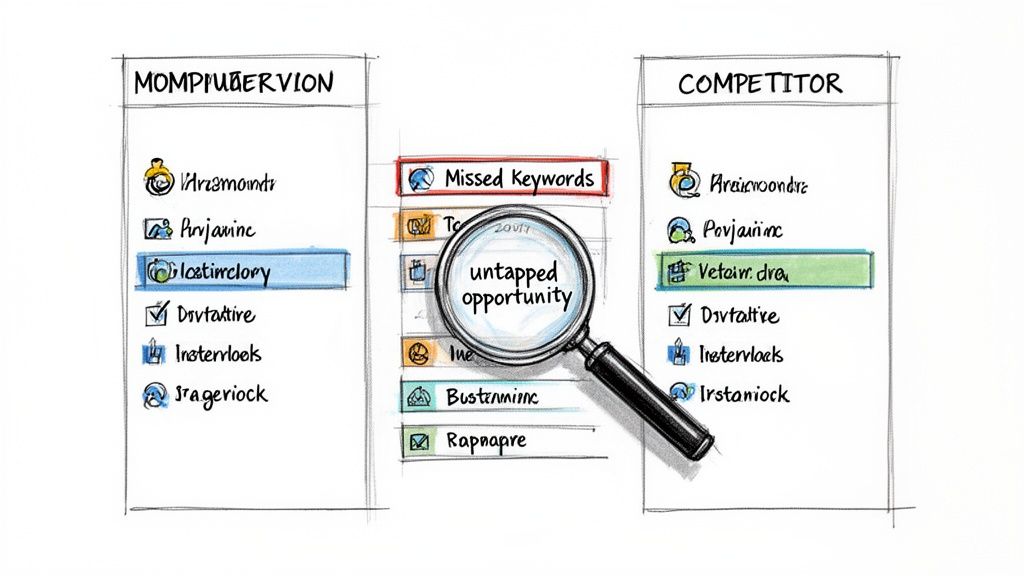
Your competitors have already done a lot of the heavy lifting. They've spent time and money figuring out which keywords attract actual customers. By analyzing their wins, you get a shortcut to what works.
Turning Intelligence into Action
A keyword gap analysis will likely give you a massive list of terms. Now, you have to cut through the noise and find the real opportunities.
- Filter for Relevance: Be ruthless. If a keyword doesn't perfectly match a product or service you offer, toss it.
- Prioritize Local Intent: Look for terms with geographic modifiers ("in [city name]") or phrases that scream immediate need ("near me," "open today"). These are your money-makers.
- Assess the Difficulty: How hard will it be to outrank them? Sometimes, a lower-volume keyword with less competition is a much smarter, faster win than going after a highly competitive term right away.
This whole process lets you build out your keyword list with terms that are already proven to convert in your specific market. You can explore a ton of different local keyword research tools to make this even faster. By using competitor intelligence, you stop guessing and start making strategic moves that capture traffic and give you a serious edge.
Turning Your Keyword Data Into a Winning Game Plan
You've done the digging. You have a mountain of data from Google Search Console, rank trackers, and local heatmaps. You finally have a real answer to the question, "what keywords do I rank for?"
But here’s the hard truth: data without action is just noise.
The final, and most important, step is to turn all that raw information into a smart, prioritized action plan. This isn't about chasing every single keyword you found. It's about surgical precision—focusing your time and budget on the terms that actually drive results, like phone calls and new customers walking through your door.
It all comes down to evaluating every keyword through the lens of local commercial intent.
Prioritizing Keywords for Maximum Impact
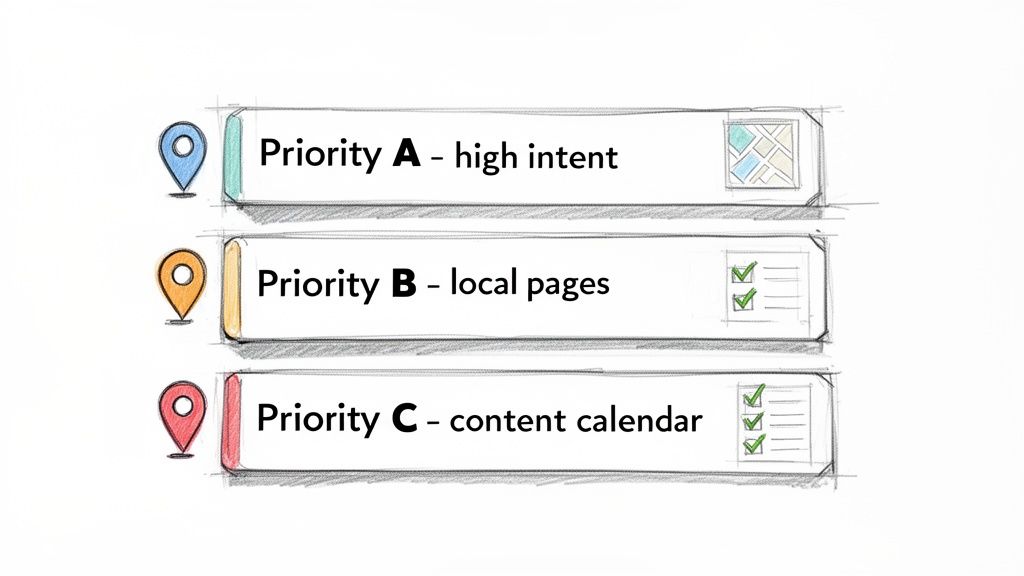
I like to think of keywords in three simple tiers. This framework immediately separates the quick wins from the long-term projects and keeps your team focused on what actually moves the needle.
Priority A: High-Intent "Money" Keywords. These are your golden geese. They’re packed with buying signals and location modifiers, like "emergency dentist near me" or "same-day weed delivery downtown." The searcher is ready to act now. These keywords are your immediate focus for Google Business Profile optimization.
Priority B: Local Service and Product Keywords. This next tier includes searches for specific things you offer in a certain area, like "physical therapy for runners in Chicago" or "best cold brew Brooklyn." These terms are the perfect fuel for creating dedicated local landing pages on your website.
Priority C: Informational & Top-of-Funnel Keywords. These are the broader "how-to" and "what is" queries, like "what are the benefits of acupuncture" or "how to choose a dispensary." While they don't signal an immediate sale, they are absolutely crucial for building authority and catching potential customers early. These are your blog post ideas and content calendar gold.
The real goal here is to move beyond just knowing what you rank for and start directing your SEO efforts with purpose. Prioritizing ensures your work translates directly into measurable growth.
Building a Location-Specific Action Plan
For any multi-location business, a one-size-fits-all strategy is a recipe for failure. A keyword that’s a top priority for your Miami store might be totally irrelevant for your location in Denver. You have to build micro-strategies for each market.
Start by breaking down your keyword data by city or even by neighborhood.
Let's say a wellness clinic chain discovers their Austin location ranks poorly for "IV therapy Austin," a term with huge search volume. That immediately becomes a Priority A target for that specific Google Business Profile.
Meanwhile, their Portland store might see a wide-open opportunity around "sports massage for cyclists" (Priority B), which calls for creating a brand new local landing page to capture that traffic.
This granular approach keeps your optimization efforts hyper-relevant. Remember, 'Google Maps' alone gets 15.5 million searches a month in the US. The real prize for local businesses is the Map Pack, where the top three spots grab 70-80% of all clicks from these proximity-based searches.
And since optimized profiles see 2.7x more views, ignoring city-specific rankings means leaving a massive amount of foot traffic on the table. If you want to dive deeper into what people are actually looking for, check out this comprehensive list of popular queries.
By systematically turning keyword discovery into a prioritized, location-specific action plan, you close the loop. You shift from analysis to execution, creating a clear roadmap for updating Google Business Profiles, building targeted content, and ultimately, owning your local search landscape.
Your Top Keyword Ranking Questions, Answered
Jumping into keyword tracking can feel like opening a can of worms. It’s a space where the rules seem to change by the minute, especially when you're fighting for visibility in local search. We get these questions all the time from marketers and business owners, so let's clear up the confusion with some straight answers.
How Often Should I Check My Keyword Rankings?
For your most important, high-intent local keywords—the ones that bring customers through the door—weekly checks are the sweet spot. This cadence is frequent enough to let you spot a sudden drop and react quickly, whether it's caused by a competitor's move or a sneaky Google algorithm update.
For your broader, more informational terms, a monthly check-in is usually fine to see how your content strategy is performing over time.
The key isn't just frequency, it's consistency. Tracking consistently is how you connect the dots between your efforts (like updating a Google Business Profile or launching a new landing page) and the results you see. This is where automated tools really shine, saving you from the grind of manual spot-checks.
Don't just look at the number. The point of tracking is to understand the story behind the number. A weekly look at your top 10 "money" keywords gives you the agility you need to protect your most valuable traffic sources.
Why Do My Local Rankings Fluctuate So Much?
If your rankings feel like they’re on a rollercoaster, you're not wrong. Rankings are naturally unstable, but local search takes it to a whole new level.
A few things are constantly stirring the pot:
- Google Algorithm Updates: Google is always tinkering with its systems, and those tweaks can ripple through local results.
- Competitor Actions: A rival just down the street might launch a new service, get a flood of fresh reviews, or update their profile.
- Your Own Changes: Did you update your website or GBP? Expect some temporary turbulence as Google re-evaluates things.
- Searcher Location: This is the big one for any local business. Your ranking isn't a single, static position. It changes dramatically based on where the searcher is physically standing.
That last point is exactly why looking at a single ranking number is so misleading. You could be #1 for "best coffee" to someone on your block but totally invisible to a potential customer just one mile away.
What Is a Good Ranking Position to Aim For?
For any business with a physical location, the holy grail is the Google Map Pack. These are the top three local results that show up with the map, and they vacuum up the vast majority of clicks from people ready to buy or visit. Getting into the Map Pack should be your primary goal.
For the standard "blue link" organic results that appear below the map, aiming for a top-five position is a solid objective that will drive real, meaningful traffic.
But context is everything. Ranking #4 for a super-competitive, high-value term like "emergency plumber downtown" is way more valuable than being #1 for a vague term that brings in zero customers. Always prioritize your keywords based on their real-world business impact.
Ready to stop guessing and start seeing exactly where you stand in your local market? Nearfront provides live ranking heatmaps that show your true visibility on Google Maps, neighborhood by neighborhood. Discover your real local rankings today.