So, what exactly are local citations?
At the simplest level, a local citation is any online mention of your business’s core information: its Name, Address, and Phone number (NAP). Think of these as digital breadcrumbs scattered across the web.
Each time a search engine like Google finds your business details on a reputable site, it’s like a little vote of confidence.
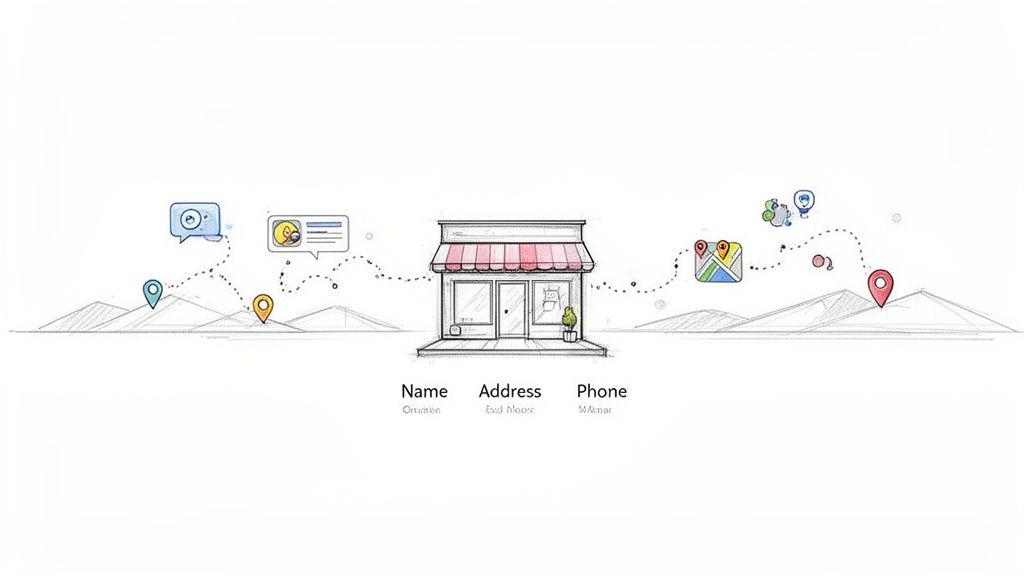
Imagine Google is a detective trying to verify that your shop is real, located where you say it is, and is a trustworthy place to send its users. Every consistent NAP mention it uncovers on a credible directory or website is another piece of evidence. The more evidence it finds, the more it trusts you.
This digital footprint is a cornerstone of local SEO. It directly impacts how high you rank in local search results, especially in the coveted Google Map Pack. A wide and accurate web of citations tells search engines you’re a legitimate business, which is the first step to earning their recommendation.
The Anatomy of a Local Citation
While your NAP is the non-negotiable core, a truly powerful citation goes a bit deeper. A complete listing is far more valuable to both search engines and potential customers, providing a richer, more useful snapshot of your business.
Let’s break down the components of a high-quality citation.
The Anatomy of a Local Citation
| Component | Description | Example |
|---|---|---|
| Business Name | Your official, legally registered name. | Main Street Coffee Roasters |
| Address | A valid physical street address (no P.O. boxes). | 123 Oak Avenue, Anytown, USA 12345 |
| Phone Number | A direct line with a local area code. | (555) 123-4567 |
| Website URL | A direct link to your business's homepage. | https://mainstreetcoffee.com |
| Business Category | Specific industry classifications. | Coffee Shop, Cafe, Restaurant |
| Hours of Operation | Your current and accurate business hours. | Mon-Fri: 7 AM – 6 PM; Sat-Sun: 8 AM – 4 PM |
Adding these extra details turns a basic mention into a robust business profile that helps customers make a decision.
Local search has become incredibly competitive. In fact, grabbing the top spot in the local 3-pack can earn you a 42% click-through rate, while falling to third place slashes that to just 15%. A solid citation strategy is no longer optional—it's essential for capturing that local traffic.
Ultimately, a well-built citation doesn't just satisfy a search engine algorithm; it delivers a better experience for the customer looking for you. If you're just getting started, our guide on creating a free business listing on Google is a great first step.
Why Citations Are the Bedrock of Local SEO
To get why citations matter so much, you have to think like a search engine. Google's main job is to give people the most accurate, trustworthy, and relevant local information it can find. Citations are one of the most reliable clues it uses to confirm your business is real and located exactly where you say it is.
Every consistent citation is like a vote of confidence from a third party. When Google’s crawlers see your business's Name, Address, and Phone number (NAP) listed correctly on dozens of reputable sites—from Yelp to a niche industry directory—it reinforces their trust in your data. This digital agreement tells Google your business is a legitimate part of the local community.
On the flip side, inconsistent or missing information creates doubt. If one site lists you on "Main St." while another says "Main Street," it’s a red flag. That kind of confusion erodes trust and can sink your chances of ranking in the highly competitive Google Map Pack.
Building Trust Through Digital Verification
At its core, a citation is all about verification. Google's algorithm is constantly cross-referencing information to make sure the data it shows people is correct. A strong, clean citation profile makes this job easy, proving your business is both credible and active.
The more authoritative and consistent your online mentions are, the more confidence Google has in your business. This directly translates to higher visibility in local search results, leading to more calls, clicks, and foot traffic.
This isn't just about feeding an algorithm; it's about building a foundation of digital trust. Each citation adds another layer to the story of your business's prominence and reliability.
From a Numbers Game to a Quality Game
Years ago, local SEO felt like a race to get the most citations. The thinking was simple: more listings meant better rankings. Today, the game has changed. While having a wide footprint is still important, the focus has shifted from sheer volume to the quality and consistency of those listings.
Modern search engines now use citations as precision tools for verification. Recent studies show a clear link between citation quality and performance. Businesses with consistent citations across 50+ authoritative directories often see a 25-35% improvement in local pack visibility compared to those with messy or sparse profiles. It’s a fundamental shift in how Google decides if a local business is the real deal. You can explore the full findings on effective local citations to see the data for yourself.
Ultimately, a well-managed citation profile does two critical things:
- It confirms your identity for search engines, boosting your authority and ranking potential.
- It ensures potential customers find accurate information about your business, no matter where they’re looking.
Structured vs. Unstructured Citations
Not all local citations are created equal.
Think of them like recommendations. Some are neat, organized entries in a directory, while others are casual shout-outs in conversation. In the world of local SEO, we call these structured and unstructured citations, and you absolutely need both to build a strong online footprint.
A structured citation is the most common and straightforward type you'll encounter. It’s a clean listing of your business's Name, Address, and Phone number (NAP) on a business directory. The information fits perfectly into designated fields, making it incredibly easy for search engines and potential customers to read.
These are the listings you find on well-known platforms where businesses are categorized and searchable. You can see tons of examples in our list of top small business directories to get a feel for how they work.
Structured Citations in Action
Major directories like Yelp, Yellow Pages, and even Facebook are perfect examples of where structured citations live. They offer a predictable, trusted format that Google uses to verify your business information across the web.
Here’s a classic structured citation on Yelp, where every detail is clearly labeled.
This clean layout makes it a breeze for Google to cross-reference your NAP data. Every consistent structured citation it finds builds more confidence that your business is legitimate and located exactly where you say it is.
The Power of Unstructured Citations
Now, let's talk about the other side of the coin. An unstructured citation is a more organic, natural mention of your business. These pop up in less formal places across the web—think blog posts, news articles, social media updates, or event pages.
Unlike their structured cousins, these mentions don’t follow a neat, field-based format. Your business name might show up in a headline, with the address and phone number dropped into a paragraph later on.
For instance, a local food blogger might write a review that says:
"I had the best tacos in town last night at Downtown Cantina. If you're near 456 Maple Drive, you have to check them out. Give them a call at (555) 876-5432 to see if they have a waitlist."
Even without a formal directory listing or a direct link back to your website, this is an incredibly valuable citation. It's a natural, third-party endorsement that signals relevance and popularity to search engines.
A winning local SEO strategy doesn't choose one over the other—it builds both to create a complete and authoritative online presence.
Building a Winning Citation Strategy
Knowing what local citations are is one thing. Building a profile that actually moves the needle is something else entirely. A winning strategy isn't about blasting your business name across every directory you can find. It's a precise process of auditing, cleaning up, and then selectively building the mentions that matter most to search engines and, more importantly, to your customers.
The first, non-negotiable step is a citation audit. Before you add a single new listing, you have to get a clear picture of your existing digital footprint. This means digging in and finding every single mention of your business across the web to see where you stand today.
An audit almost always uncovers a few common culprits:
- Inconsistencies: Listings with an old address, the wrong phone number, or tiny variations in your business name (think "Main St. Cafe" vs. "Main Street Cafe Inc.").
- Duplicates: Finding multiple listings for the same location on a single directory. This is a huge source of confusion for search engines.
- Harmful Listings: Citations lurking on low-quality, spammy websites that can actually hurt your authority rather than help it.
Auditing and Cleaning Your Existing Citations
Think of your citation audit like a health check-up for your online presence. The job is to round up all your current listings and meticulously check them for accuracy and consistency against your master Name, Address, and Phone number (NAP) information.
Your goal is to forge one single, unified, and perfectly accurate identity for each of your business locations online. This means claiming ownership of existing listings, correcting every piece of bad information, and getting duplicate profiles removed for good. This cleanup phase is foundational. Building new citations on top of a messy, inconsistent profile is like trying to build a house on a shaky foundation—it just won't hold up.
This flow chart shows how citation information—both from structured directories and unstructured mentions—spreads across the web.
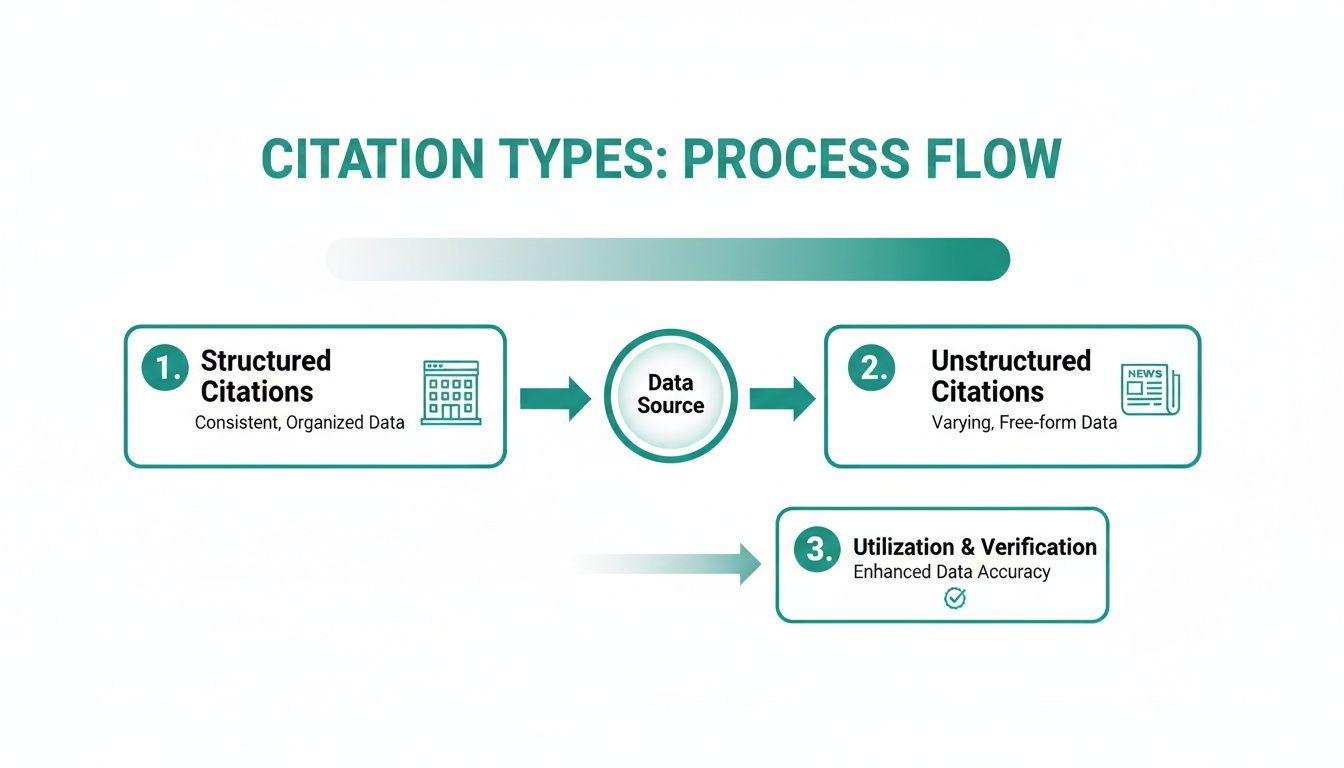
As you can see, both organized submissions and organic press mentions feed the data that search engines use to verify who you are, where you are, and what you do.
Building New Citations with Precision
Once your existing profile is squeaky clean, it’s time to start building new, high-value citations. The modern approach is all about quality over quantity. Forget submitting to hundreds of generic directories. Instead, focus your energy on sources that are truly relevant to your business.
A handful of citations on highly-respected, industry-specific directories and popular local websites will provide more SEO value than dozens of listings on low-authority, generic sites.
Start with the heavy hitters. This includes core data aggregators, the major search engines themselves, and top-tier national directories. After that, your strategy should branch out into two highly specialized areas:
- Industry-Specific Directories: Find platforms dedicated to your niche. For a law firm, that could be a legal directory; for a yoga studio, a wellness portal. A listing here sends a powerful signal to Google that you're a legitimate player in your field.
- Hyper-Local Websites: Go after mentions on local chamber of commerce sites, community blogs, or city-specific business roundups. These are the citations that anchor your business firmly within its geographic community.
This targeted approach ensures your time and effort are spent where they'll make the biggest impact, creating a powerful and relevant citation profile that directly supports your local SEO goals.
Common Citation Mistakes That Sabotage Your SEO
You can have a brilliant local SEO strategy, but a few simple, preventable citation mistakes can bring the whole thing crashing down. These errors are silent killers for your search rankings, creating confusion for Google and slowly eroding the digital trust you’ve worked so hard to build.
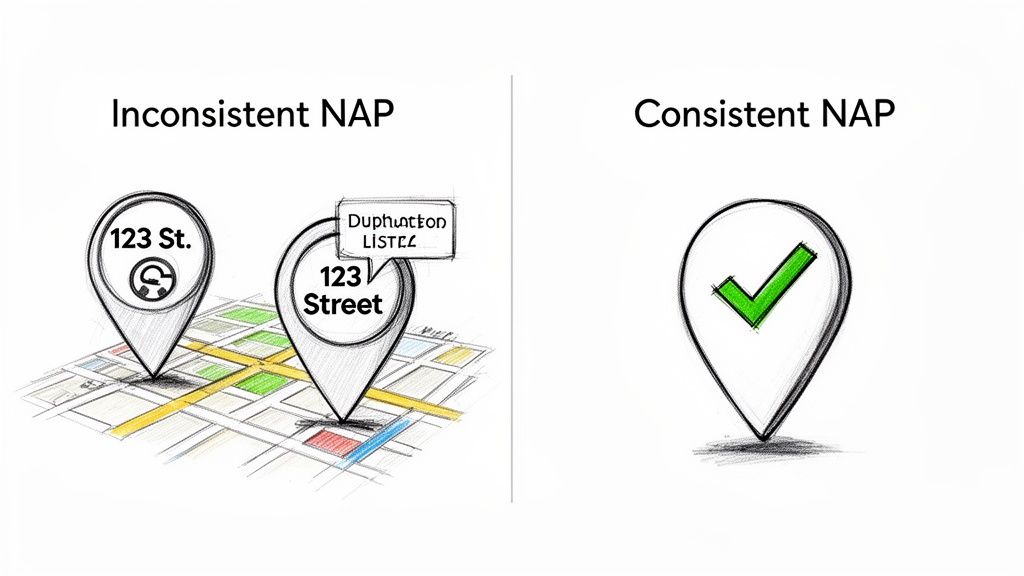
Let's start with the absolute biggest offender: NAP inconsistency.
This is what happens when different websites list conflicting versions of your business’s Name, Address, or Phone number. You might think small variations don't matter, but they create major headaches for search engine algorithms.
Imagine Google finds these three listings for the same coffee shop:
- Listing 1: Main Street Coffee Co. / 123 Oak St. / (555) 123-4567
- Listing 2: Main St. Coffee / 123 Oak Street / (555) 123-4567
- Listing 3: Main Street Coffee Company Inc. / 123 Oak St, Ste 100 / (555) 123-4568
A human can easily tell these are the same business. But to a search engine, these are red flags. It can't be 100% sure if it's looking at three different shops, a business that moved, or just a case of sloppy data. That sliver of doubt erodes its trust in your business, and your rankings pay the price.
It's Not Just About Inconsistent NAP
While messy NAP is the most common problem, a few other mistakes can seriously derail your efforts. You need to be just as vigilant about these.
-
Duplicate Listings: This is when a single business location has more than one profile on the same directory (like two separate Yelp pages for one storefront). This splits your authority, confuses search engines, and can even divide your customer reviews, weakening your social proof.
-
Incomplete or "Thin" Profiles: A citation that only lists your basic NAP is a massive missed opportunity. When you forget to add hours, photos, business descriptions, and website links, you're leaving valuable ranking signals on the table. Rich, complete profiles are rewarded by algorithms because they're far more helpful to real people.
-
Citations on Low-Quality Websites: Not all mentions are good mentions. A listing on a spammy, low-authority, or totally irrelevant directory can do more harm than good. Google judges you by the company you keep online, and being associated with digital "bad neighborhoods" will drag down your own credibility.
Think of it this way:
The goal is to have one single, authoritative, and perfectly accurate listing for each physical location on every important directory. Anything less creates unnecessary friction for both search engines and customers.
Spotting and fixing these common citation problems is a foundational part of any serious local SEO campaign. To help you get started, here's a quick reference guide to the most damaging issues and how to resolve them.
Common Citation Errors and How to Fix Them
| Citation Error | Why It Hurts Rankings | How to Fix It |
|---|---|---|
| NAP Inconsistency | Creates doubt for search engines, eroding trust and lowering ranking confidence. | Establish a "golden record" for your NAP and manually update or use a service to correct all variations across the web. |
| Duplicate Listings | Splits SEO authority, divides customer reviews, and confuses both users and search algorithms. | Use a duplicate finder tool to identify all instances, then claim and merge or delete the extra listings. |
| Incomplete Profiles | Missed opportunity for valuable ranking signals. Thin profiles appear less trustworthy and are less helpful to users. | Methodically go through your top 50+ citations and fill out every single available field: hours, photos, services, description, etc. |
| Incorrect Business Category | You won't show up for relevant searches. A coffee shop listed as a "restaurant" might miss out on "best coffee near me" queries. | Audit your listings and ensure your primary and secondary categories are precise and consistent, especially on your GBP. |
| Old Address or Phone # | Sends customers and search crawlers to the wrong place, leading to a terrible user experience and lost trust signals. | Prioritize updating your core data aggregators and top-tier directories immediately after a move or phone number change. |
Fixing these issues is non-negotiable for local search visibility. If you suspect your profiles are a tangled mess, the first and best step is to perform a thorough citation clean-up to get your digital presence back on a solid foundation.
How to Measure Your Citation Building ROI
Putting together a solid citation strategy takes serious time and effort. So, how do you actually know if it’s working? Measuring the return on your investment isn't about counting how many new listings you have—it’s about connecting that work to real, tangible business growth.
The most direct way to see if you're on the right track is to watch your local search rankings. A well-executed citation campaign should give you a noticeable lift in visibility, especially within the Google Map Pack. When search engines start to trust your location data more, they're far more likely to put your business in front of local searchers.
Tracking the Right Performance Indicators
Beyond rankings, a few key metrics will tell you if your strategy is really hitting the mark. You want to track improvements in these areas because they show you exactly how customers are engaging with your stronger online presence.
- Google Business Profile Insights: Keep an eye on the trends in your GBP dashboard. You’re looking for a steady increase in phone calls, website clicks, and especially direction requests—a clear signal someone intends to visit.
- Organic Traffic Growth: Jump into Google Analytics and filter your traffic for local search queries. If you see more people landing on your site from searches like "coffee shop near me," you know your local visibility is expanding.
A successful citation campaign doesn't just improve your search rankings; it drives real-world actions. The ultimate goal is to see more customers calling your business, visiting your website, and walking through your front door.
Visualizing Your Local Impact
To get an even clearer picture of your progress, specialized tools can offer some powerful insights. For instance, local rank tracking heatmaps are an invaluable way to visualize your search visibility across different neighborhoods or service areas.
Instead of just seeing a single ranking position, a heatmap shows you exactly where your business appears on the map for your most important search terms. Watching these "hot zones" expand over time gives you undeniable proof that your citation building is strengthening your local footprint and delivering a measurable ROI.
The Most Common Citation Questions, Answered
When you're knee-deep in a citation strategy, a few key questions always pop up. Let's cut through the noise and get you some straight answers so you can move forward with confidence.
How Many Citations Do I Really Need?
This is the big one, and the answer isn't what you might expect. Forget about quantity. Focus on quality. There’s no magic number of citations that will rocket you to the top of the rankings.
Your real goal is to get listed on the major, authoritative platforms first. After that, it’s all about industry-specific and hyper-local directories that matter to your business. A profile with 50 to 75 highly relevant, consistent citations is infinitely more powerful than one with 300 listings on generic, low-quality sites.
Once you’ve nailed the essentials, your time and budget are much better spent on other parts of your local SEO strategy.
How Long Does It Take to See Results?
Patience is the name of the game here. Building citations is not a quick win, and you won't see an impact overnight. After you’ve cleaned up all the messy, inconsistent data and built out new, high-quality listings, it can take anywhere from one to three months for search engines to crawl, index, and start trusting that information.
Results tend to creep in gradually. You might first notice a small boost in your Google Map Pack visibility in a couple of neighborhoods. As Google’s confidence in your business data grows, that visibility will expand.
It's a marathon, not a sprint. Consistent, accurate data builds trust over time, which is the foundation for lasting local search visibility and improved rankings.
Should I Use a Service or Do It Myself?
This one comes down to your resources—specifically, your time and expertise.
-
The DIY Approach: If you have the time to spare, building citations manually is definitely the most cost-effective route. It gives you complete control over the process, but it demands serious organization to make sure every single listing is perfect.
-
Using a Professional Service: A service saves a massive amount of time and ensures the job gets done right the first time. This is the ideal choice for any multi-location brand or for anyone who wants to know their foundational SEO is in the hands of an expert.
Ready to see how your local visibility stacks up? Nearfront provides live ranking heatmaps and actionable insights to show you exactly where your business appears on Google Maps, helping you turn local searches into real customers. Learn more at nearfront.com.