When pet owners in your area need a vet, the first place they turn isn't the phone book—it's Google. SEO for vets is all about making sure your clinic is the first one they see. It’s the art and science of fine-tuning your website, your Google Business Profile, and other online listings so you show up at the top of local search results.
This isn't some theoretical marketing guide. This is your hands-on playbook for dominating local search, and we're starting with the most powerful tool in your digital arsenal: your Google Business Profile (GBP).
Your Foundation in Local SEO for Vets
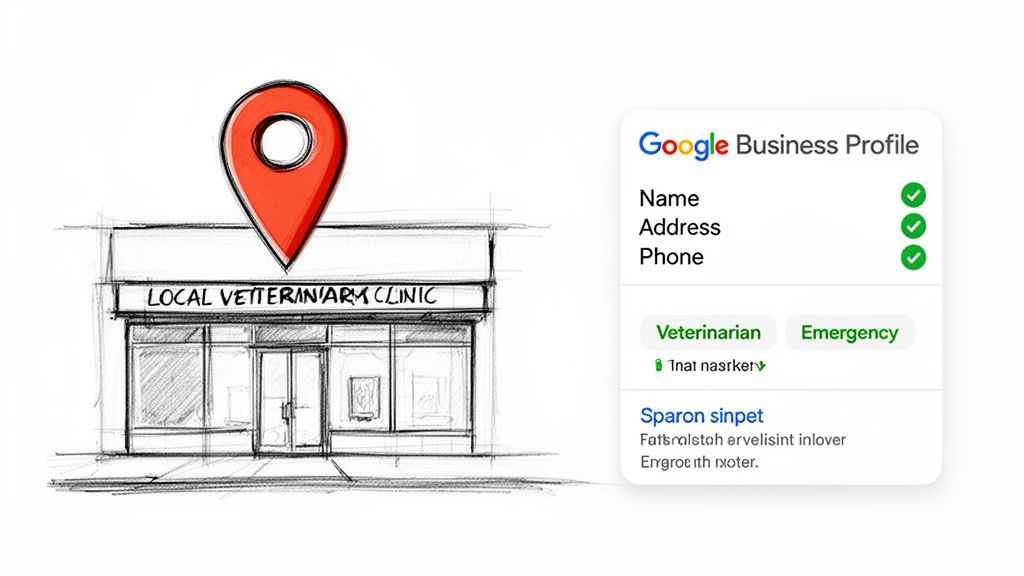
Think of your GBP as the digital front door to your clinic. For the vast majority of local searches, it's what pet owners see first. It’s the little box with a map and three businesses—the "Local Pack"—that pops up when someone searches for a vet in their area. Getting this right isn't just important; it's everything.
The Power of Local Search Intent
To really get why GBP matters so much, you have to understand how people search. When a pet owner types "emergency vet near me," they aren't just browsing. They have an immediate, often urgent, need.
The data confirms this. A staggering 46% of all Google searches have local intent. What’s more, 76% of 'near me' searches lead to a business visit within a single day. You can find more compelling vet clinic marketing statistics over on amraandelma.com.
What does this mean for your clinic? It means your local SEO efforts aren't just about long-term brand building. They translate directly into phone calls, direction requests, and appointments today.
Mastering Your Clinic's Digital Identity
The first step is locking down your clinic’s core information with perfect consistency. I’m talking about your:
- Name: This has to be the exact, legal name of your practice. No stuffing in extra keywords like "[City] Animal Hospital" if that's not your real name.
- Address: Use the official address that the post office recognizes. Make sure suite numbers and street abbreviations are identical everywhere online.
- Phone Number: Stick with your primary, local phone number for the clinic.
This trio—Name, Address, and Phone, or NAP—needs to be pixel-perfect across the entire web. From your website to Yelp to local pet directories, it must match. Any inconsistencies create confusion for search engines and erode the trust Google has in your business, which will absolutely tank your rankings.
Your NAP is the digital fingerprint of your clinic. If it's smudged or inconsistent across different platforms, Google will struggle to verify your identity, pushing you down in search results.
To get your GBP foundation right, use this checklist to make sure you've covered all the essential bases. It’s a simple but powerful way to ensure you're sending all the right signals to Google from day one.
Essential Google Business Profile Setup Checklist
| Element | Optimization Action | Why It Matters |
|---|---|---|
| Business Name | Use your exact, real-world business name. No extra keywords. | Builds trust with Google and users. Keyword stuffing can lead to profile suspension. |
| Address | Ensure the address is 100% accurate and matches your physical location. Include suite numbers if applicable. | Critical for map accuracy and local ranking signals. Inconsistencies hurt your visibility. |
| Phone Number | Use your primary, local business phone number. Avoid tracking numbers here. | A consistent phone number is a core trust signal for search engines. |
| Primary Category | Select "Veterinarian" as your primary category. | This is the single most important factor for appearing in relevant searches like "vet near me." |
| Secondary Categories | Add relevant secondary categories like "Animal Hospital," "Pet Boarding Service," or "Emergency Veterinarian Service." | Helps you show up for more specific, long-tail searches and captures a wider audience of pet owners. |
| Service Area | If you offer mobile or in-home services, define the specific zip codes or cities you serve. | Tells Google exactly where you operate, making you visible to customers in those specific locations. |
| Hours of Operation | Keep your hours (including holiday and special hours) meticulously up-to-date. | Prevents customer frustration and negative reviews from showing up to a closed clinic. |
| Website Link | Link directly to your clinic's homepage. | Drives traffic and connects your GBP to your main digital asset, strengthening your overall online presence. |
With these core elements perfectly optimized, your Google Business Profile becomes a powerful magnet for local pet owners.
Finally, let's talk categories. Choosing "Veterinarian" as your primary category is a no-brainer. But the magic is in the secondary ones. Adding categories like "Animal Emergency Service," "Veterinary Pharmacy," or "Pet Boarding Service" helps you appear for a much wider range of relevant searches. Nailing this foundation is the key to making sure local pet owners can find, trust, and ultimately choose your clinic.
Finding the Keywords Local Pet Owners Use
Once your Google Business Profile is dialed in, the next step is figuring out the exact phrases local pet owners are typing into Google. This isn't just about ranking for "vet near me." It’s about digging deeper to find the high-value, service-specific searches that bring qualified clients through your doors.
To do this right, you have to get inside the head of a concerned pet owner in your area. Their searches are often incredibly specific and driven by an immediate need.
Think Like a Local Pet Owner
Imagine a dog owner in the South Park neighborhood of your city. They aren't just searching for "vet." They’re much more likely to type something like:
- "Emergency vet in South Park open now"
- "Puppy vaccination schedule near me"
- "Affordable cat dental cleaning in [Your Town]"
- "Dog allergy testing [Your City]"
These longer, more detailed phrases are what we call long-tail keywords. They might not get a ton of search volume individually, but the person searching them has a very clear intent. Someone looking for "cat dental cleaning" is way closer to booking an appointment than someone who just typed "animal hospital."
A fantastic place to start finding these terms is Google itself. Just type one of your core services, like "dog vaccinations," into the search bar and pay attention to what Google autocomplete suggests. Those suggestions are a goldmine because they're based on real, popular searches happening near you.
Pro Tip: Don't just search from your clinic's computer. Open an incognito browser window to see what a potential new client sees. This gives you an unbiased look at search results, free from the influence of your own browsing history.
Mapping Keywords to Pet Owner Intent
After you've brainstormed a list of keywords, you need to understand the why behind each search. Not everyone is ready to book an appointment right this second. For a vet clinic, searches typically fall into two buckets.
- Informational Intent: The searcher is looking for answers or advice. Think "symptoms of kennel cough in puppies." They aren't ready to commit yet, but you can build massive trust by giving them helpful content.
- Transactional Intent: The searcher has a problem and needs a solution now. They're looking for a service provider. A great example is "book vet checkup online [Your City]."
Knowing the difference is huge for your content strategy. Informational keywords are perfect for blog posts and FAQs. Transactional keywords should be the star of your main service pages. By mapping your keywords this way, you make sure you’re creating the right content for every stage of a pet owner’s journey. For a deeper dive, you can explore some of the best local keyword research tools available to businesses.
Free Tools to Build Your Keyword List
You don't need to break the bank on fancy software to get started. Google gives you some powerful tools for free.
Google Keyword Planner is a must-use. It was built for advertisers, but it’s just as valuable for SEO. You can plug in your services ("pet surgery," "animal wellness exam") and your location, and it will spit out a list of related keywords along with their average monthly search volume. This data is critical for prioritizing your efforts and focusing on the terms that will actually make an impact.
Building Trust Through Reviews and Reputation
In veterinary care, trust is everything. A pet owner isn't just looking for a service; they're entrusting a family member to your care. They need to feel completely confident in that decision.
These days, that confidence is built online long before they ever step foot in your clinic. Online reviews have become the digital version of a trusted, word-of-mouth referral, and they're a massive ranking factor in local SEO for vets.
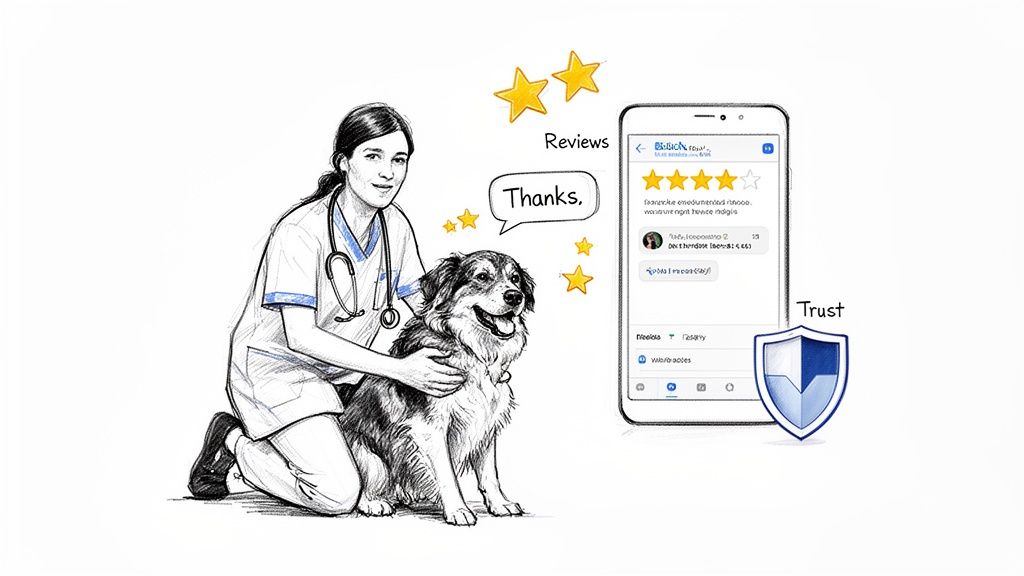
Managing your online reputation isn't a passive "set it and forget it" task. It's a proactive strategy. It shows both Google and potential clients that your clinic is engaged, professional, and absolutely worthy of their business. A steady stream of recent, positive reviews sends powerful signals that you are the best choice in the area.
Encouraging a Flow of Positive Reviews
The absolute best time to ask for a review is right after a positive experience. But simply hoping clients will leave one isn't a real strategy. You need a simple, repeatable process built right into your workflow.
- The Front Desk Initiative: Train your front desk staff to mention leaving a review after a smooth checkout. A simple, "We're so glad Fluffy is feeling better! If you have a moment, we'd love it if you could share your experience on Google. It really helps other pet owners find us."
- Automated Follow-Ups: Use your practice management software to send a personalized follow-up email or text a day or two after an appointment. The key is to include a direct link to your Google Business Profile review page to make it as easy as possible.
- Physical Reminders: A small, well-designed card or a QR code at your checkout counter can work wonders. It gives clients a tangible reminder that directs them right to your review profiles.
It's critical to make this process frictionless. The fewer clicks it takes, the more likely a busy pet owner is to actually follow through. For more on this, check out our in-depth guide that explains how to get Google reviews compliantly and effectively.
Responding to Every Single Review
Responding to reviews is non-negotiable. It proves you're listening, and it gives you a public platform to reinforce your brand's caring, professional voice. Make it a goal to respond to all new reviews within 24-48 hours.
Responding to a Positive Review:
Always thank the client by name and mention their pet if you can. This personalizes the interaction and shows you genuinely remember them.
Example: "Thank you so much for your kind words, Sarah! We were so happy to see Charlie for his checkup, and we're thrilled to hear you had a great experience. Give him some extra pets from all of us here!"
Responding to a Negative Review:
This is where you can turn a bad situation into a masterclass in professionalism. Never, ever get defensive. Acknowledge their frustration, take the conversation offline, and show anyone reading that you are committed to making things right.
Example: "Hi, Mark. We're very sorry to hear that your experience did not meet your expectations. We take feedback like this very seriously and would appreciate the opportunity to discuss this with you directly. Please call our practice manager, Jessica, at your earliest convenience."
This response shows accountability without getting into a messy public argument.
Leveraging Reviews for Maximum Impact
Your hard-earned reviews shouldn't just sit on Google. They are powerful social proof that can be put to work across your entire digital presence.
Create a "Testimonials" or "What Our Clients Say" section on your website. Feature screenshots or embedded snippets of your best Google reviews, complete with the star rating and the reviewer's name. This adds immense credibility to your service pages and can be the final nudge a pet owner needs to pick up the phone and book an appointment.
Crafting Website Content Pet Owners Actually Need
Think of your website as your digital front door. It needs to do more than just list your hours; it has to answer the questions local pet owners are typing into Google right now. A generic "Services" page just won't cut it anymore. If you want to stand out, your content strategy has to be intensely local and genuinely helpful.
This means getting specific. Your website content should directly mirror the search terms and worries of pet owners in your community, building your clinic's authority with every page you publish. The goal is to become the go-to local resource, not just another digital brochure.
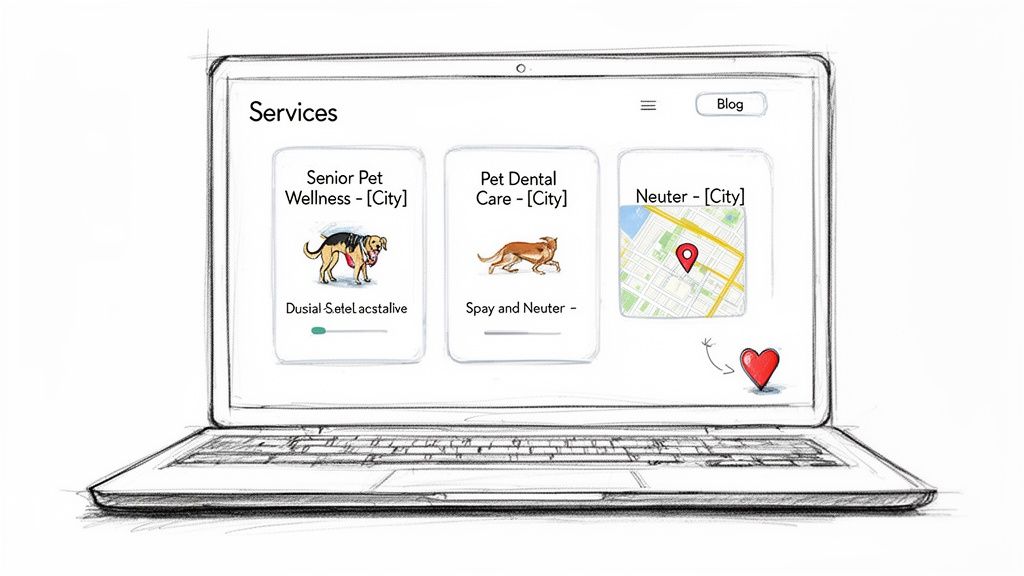
Build Dedicated Local Service Pages
Stop lumping all your services onto one page. It’s time to create a unique, dedicated page for each core service you offer—and, crucially, tie each one to your specific location. This is how you start winning the battle for those high-intent, transactional keywords we talked about earlier. You'll capture pet owners who are past the research phase and are ready to book.
This simple tactic turns a boring service list into a powerhouse for local SEO. Each new page becomes a hyper-relevant landing spot for a very specific search, which massively boosts your odds of ranking for it.
Instead of one broad page for "Wellness Exams," think more granularly. Build out pages like:
- Senior Pet Wellness Exams in [Your City]
- Puppy and Kitten Vaccination Packages in [Your Neighborhood]
- Spay and Neuter Services in [Your Town]
- Professional Pet Dental Care in [Your City]
Each of these pages needs to be fully optimized for its target keyword. Talk about the service in detail, explain the benefits, introduce the staff members who perform it, and make it incredibly easy to book an appointment with a clear call-to-action. This level of focus sends a crystal-clear signal to Google about what the page is about and who it’s for.
Answer Real Questions with Your Blog
Your service pages are for people ready to book. Your blog is for everyone else. This is where you build trust and establish your clinic as the local authority on all things pet health, answering the exact questions your community is asking.
Your blog is your opportunity to become the most trusted source for pet health information in your area. When a local pet owner Googles a question and your clinic provides the best answer, you've already started building a relationship.
Forget about generic, cookie-cutter topics. Zero in on issues that are uniquely relevant to your town or region. This hyperlocal content isn't just less competitive to rank for; it also hits home with your target audience, showing them you truly understand their world and their pets' needs.
Hyperlocal Blog Topic Ideas
Get started by brainstorming the challenges and opportunities specific to pet owners where you live. What seasonal dangers pop up every year? What local parks or trails are popular?
Here are a few ideas to get the wheels turning:
- Navigating Foxtail Season in Southern California
- Protecting Your Dog from Ticks on [Your County] Hiking Trails
- The Best Dog-Friendly Patios in [Your City's Downtown Area]
- Winter Paw Care Tips for [Your State's] Snowy Conditions
This isn't just about ranking in search results. It’s about forging a real connection with your community. By consistently publishing useful, location-specific advice, your website evolves from a business listing into an indispensable local resource. That's how you drive traffic that actually converts, building the kind of loyalty that turns one-time searchers into lifelong clients.
Alright, you've got a great website and a steady stream of happy client reviews. Now it’s time to get into the more technical stuff that really separates the top-ranking clinics from everyone else.
These aren't just minor tweaks. These are the behind-the-scenes signals that tell Google you’re a legitimate, authoritative, and relevant local practice. Think of this as learning to speak Google's language fluently, so there's zero confusion about who you are and what you do.
Giving Google the Full Picture with Schema Markup
Schema markup is a bit like a secret language for search engines. It’s code you add to your website that visitors never see, but it explicitly tells Google what your content is all about.
For a vet clinic, this is huge. Instead of Google just guessing that a string of numbers is your phone number, schema tells it, "Hey, this is the official phone number for this veterinary practice." This simple act of clarification helps Google pull your information directly into search results—think hours, appointment links, and other rich features that make you stand out.
The Bottom Line: Schema markup removes the guesswork for search engines. It builds trust, helps Google feature your clinic more prominently, and ultimately drives more clicks from pet owners who need you.
The most important schema type for your practice is VeterinaryCare. This single piece of code tells Google you’re not just some random business, but a specific type of animal healthcare provider. From there, you can layer in details about your services, hours, and location with total precision.
The Power of Consistent Local Citations
A local citation is any online mention of your clinic's name, address, and phone number (what we call NAP). These pop up on business directories like Yelp, Yellow Pages, and even niche sites like BringFido.
Each one acts as a small vote of confidence, verifying that your clinic is a real, established local business.
But here's the catch: consistency is everything. If you're "Main St Animal Clinic" on one site and "Main Street Animal Hospital" on another, you’re creating confusion. These little mismatches erode Google's trust and can hurt your local rankings. The goal is to get your NAP information perfectly identical across dozens of high-quality directories. It's tedious work, but it pays off by cementing your clinic's relevance in your service area.
Building Real Authority with Local Backlinks
While citations are just mentions, backlinks are actual, clickable links pointing from another website to yours. In the world of SEO, these are pure gold. They function as digital referrals. When a trusted local website links to you, it’s a powerful signal to Google that your clinic is a respected authority in the community.
But quality over quantity is the name of the game. A link from a random blog is worthless. You want links that are earned and make sense in context. For a vet clinic, this means getting creative with local partnerships.
Here are a few ideas that actually work:
- Sponsor a Local Shelter's Adoption Event: Offer a small sponsorship in exchange for the shelter featuring your clinic's name with a link on their event page.
- Partner with a Nearby Pet Supply Store: Write a guest post for their blog on a topic like "Choosing the Right Food for Your New Puppy" and include a link back to your site in your author bio.
- Team Up with a Local Dog Trainer or Groomer: Create a shared resource together, like a "New Pet Owner's Guide to [Your City]," and have both of your businesses link to it from your websites.
These aren't just link-building tactics. They embed your clinic directly into the local pet community, building your brand and driving real referral traffic—all while sending the exact trust signals Google is looking for.
Managing SEO for Multi-Location Vet Groups
Scaling SEO from one successful clinic to a whole group of them—whether it's two, ten, or a hundred—is a completely different ballgame. The tactics that got your first location on the map need to be systematized. It’s a constant balancing act between a unified brand strategy and the hyper-local execution each clinic needs to thrive in its own neighborhood.
The most common trap I see multi-location brands fall into is duplicate content. It's so tempting to write one great page for a service, then just find-and-replace the city name for each new location. Don't do it. This is a huge mistake that waters down your SEO and just confuses Google. Search engines want to see unique, valuable content for every single location, even if they all offer the same puppy wellness exams.
This doesn't mean you need to start from scratch for every clinic. The trick is to create a solid template for your core service pages and then empower your team—whether it’s local managers or a central marketing group—to flesh it out with details unique to that specific community.
Creating Unique Location and Service Pages
The bedrock of any multi-location strategy is building out distinct, non-duplicated pages for every single clinic. Each practice needs its own dedicated location page, which essentially acts as the digital front door for that community.
From there, you build out unique service pages for that location. So, instead of a single "Pet Dental Care" page for your entire brand, you need to create:
- A page for “Pet Dental Care in downtown [City A]”
- Another for “Pet Dental Care in the [Suburb B] neighborhood”
- And a third for “Pet Dental Care near [Landmark C]”
Each of these pages needs to be sprinkled with local flavor. Mention the dog park down the street. Feature bios and photos of the actual veterinarians who work at that specific clinic. Show pictures of the real facility. This approach proves to Google that each clinic is a legitimate, distinct entity that’s deeply rooted in its local community. We lay out the entire playbook in our guide on executing a multi-location local SEO strategy.
The goal is to build a "digital fingerprint" for each clinic. While they share the same brand DNA, each location should have its own unique stories, staff highlights, and community connections reflected on its webpages.
Centralized Management of Google Business Profiles
Trying to manage dozens of Google Business Profiles one by one is a surefire way to create inconsistencies and waste a ton of time. This is where GBP’s business group feature becomes absolutely essential. It lets you see all your locations in a single dashboard, push out bulk updates for things like holiday hours, and keep your branding tight across every single profile.
While some things should be uniform—like your brand name and primary business category—other elements must be localized. Get each clinic to regularly upload fresh photos of their team and facility. And most importantly, make sure review management has a local touch. A reply that mentions a specific pet or staff member by name at the Northside clinic feels infinitely more genuine than a canned corporate response.
Tracking Performance Across All Locations
You can't fix what you can't see. For a vet group, it's mission-critical to track local rankings for each clinic so you can spot who's winning and who's falling behind.
A geo-grid rank tracker is your best friend here. It shows you exactly where a clinic ranks for "vet near me," not just at its own address, but in all the surrounding neighborhoods it serves.
This data lets you pinpoint a struggling location and figure out why. Is the Southside clinic’s GBP missing key service categories? Does the East End branch have a bunch of unanswered negative reviews? This kind of granular insight helps you put your resources where they’ll actually make a difference.
This process flow shows how the more advanced pieces—schema, citations, and backlinks—all fit together.
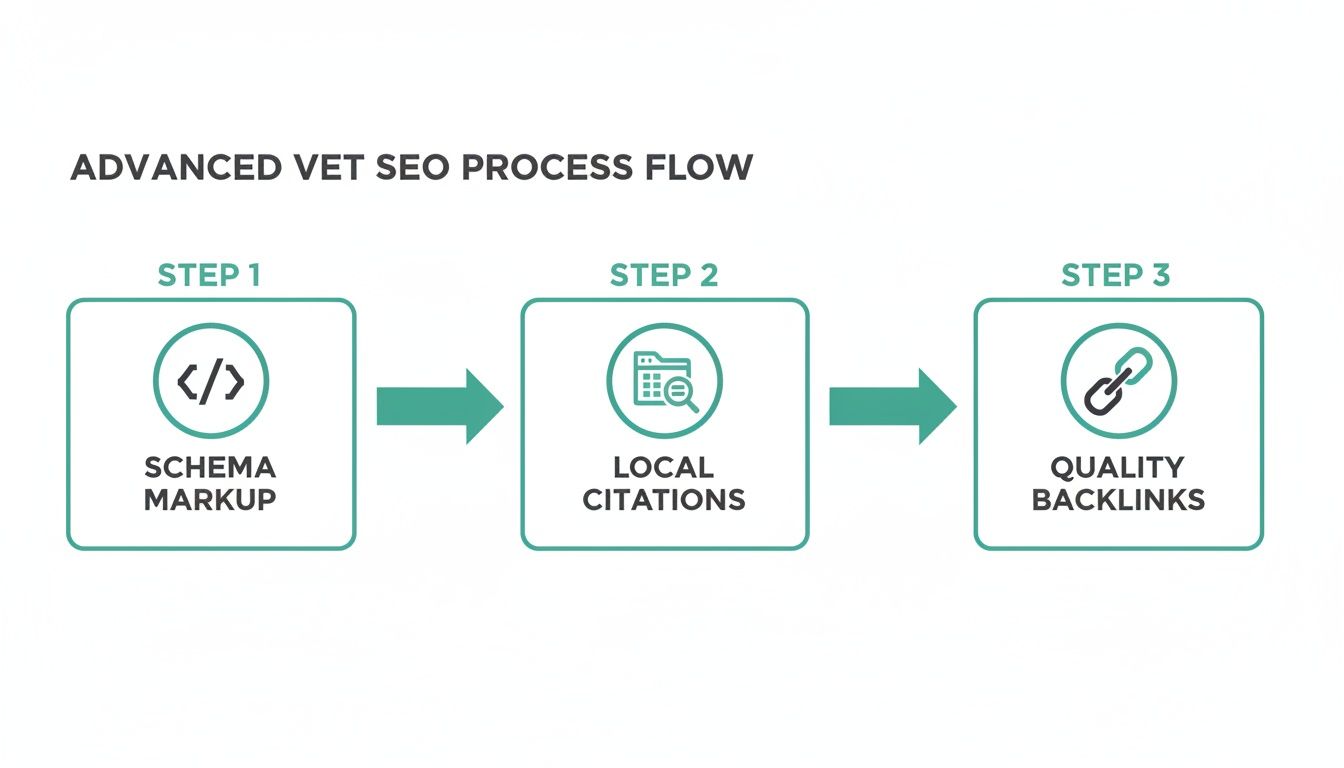
These technical pillars work in tandem to build a rock-solid foundation for local search authority. When a multi-location vet group masters each one, it can systematically lift the visibility of all its branches.
Your Top Questions About Vet SEO, Answered
When I talk to practice owners about stepping up their online game, a few questions always come up. Let's tackle them head-on, because understanding the what, why, and how long is key to committing to a strategy that actually works.
Is All This SEO Stuff Really Worth It for a Vet Clinic?
The short answer? Yes, absolutely. Think about it: when a pet owner is in a panic, where do they turn? Google. In fact, 93% of all online experiences start right there in a search bar.
Showing up in that moment of need isn't just marketing—it's how you connect with the clients who need you most. Good SEO isn't an expense; it's a direct pipeline to new patient appointments.
SEO is a long-term strategy that builds on itself. The work you do today to improve your rankings and online reputation will continue to attract new clients for months and even years to come, making it one of the most sustainable marketing efforts for your practice.
Okay, So How Long Until I Actually See Results?
I get it, you want to see a return. SEO is a marathon, not a sprint. While you might see some small wins in the first month or two, you should plan on three to six months before you see a real, tangible impact on your call volume and appointment bookings.
Things like how long your website has been around, how fierce your local competition is, and how consistently you work on it will all affect your timeline. But the momentum builds over time, and the results stick.
Can I Just Do This SEO Myself?
You definitely can. This guide is designed to give you a solid playbook to run with, and tackling the basics yourself is a great start.
But let's be realistic—SEO is a full-time job, and the goalposts are always moving. Most practice owners find their time is better spent focusing on patient care and running the clinic. Partnering with a specialist means you have someone whose sole focus is staying ahead of Google's latest algorithm updates and keeping you ahead of the clinic down the street. That dedicated attention is often the difference between just showing up and truly dominating your local market.