

When we talk about SEO for physical therapy, we're not just talking about technical mumbo-jumbo. We're talking about a straightforward process: optimizing your clinic's online presence so you show up at the top of Google when a local patient needs help.
The entire goal is to dominate searches like "physical therapy near me" and turn that visibility into a booked-up schedule.
Why SEO Is Your Clinic’s Most Powerful Growth Tool
Think about it. Someone in your neighborhood pulls a muscle or gets a sports injury. What's the first thing they do? They pull out their phone and search. Where does your clinic show up?
With 77% of patients researching online before booking an appointment, that digital first impression is everything. The old days of relying purely on doctor referrals are over. Your real growth engine today is being found on Google.
SEO has become the single most important driver for patient acquisition. When a potential patient is in pain and searching for a solution, being in Google's local "Map Pack" is the moment you win or lose their business. If you’re not there, you’re invisible to the vast majority of people who start their healthcare journey online.
The Modern Patient Journey
The path from injury to appointment is no longer complex; it's a direct line powered by search. A patient feels pain, they search online, they find a top-rated clinic nearby, and they book. It's that simple.
This visual breaks down exactly what that looks like today.
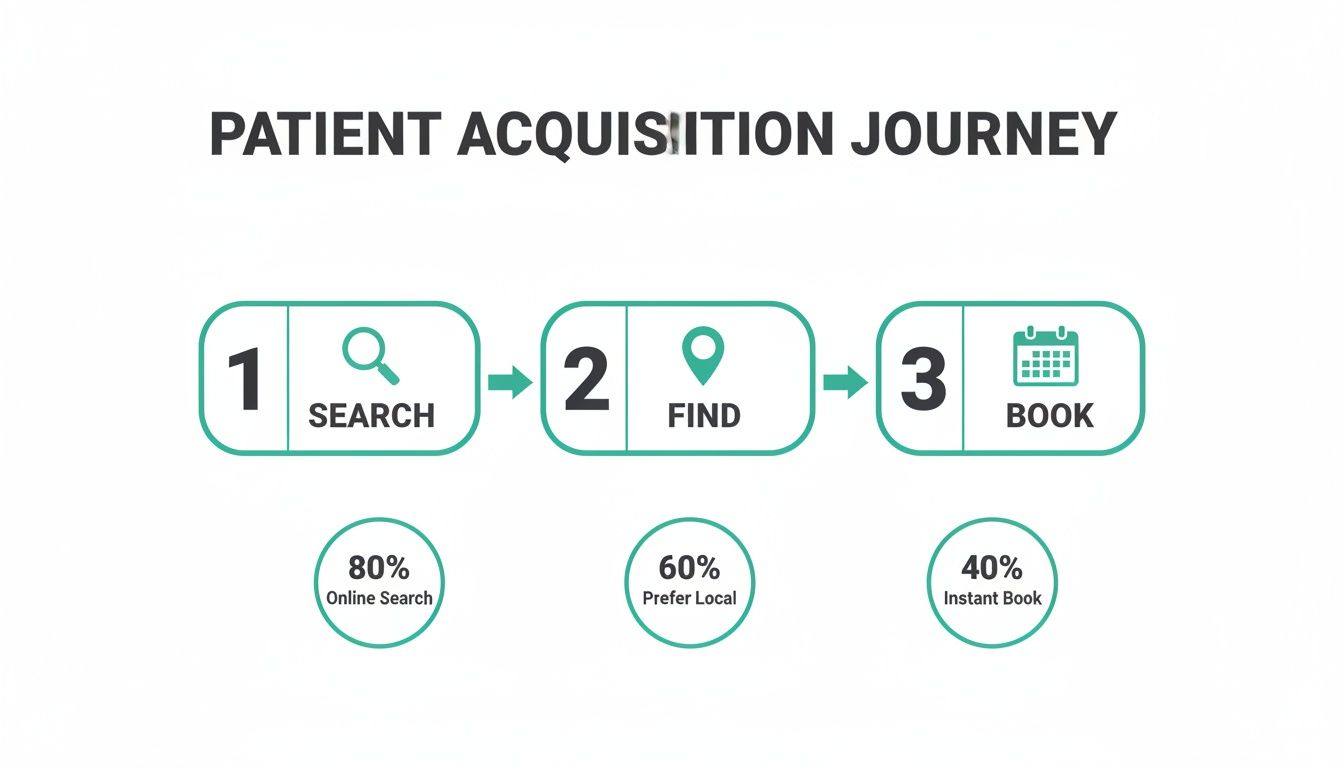
The takeaway is clear: discovery and decision-making happen in an instant. Your ranking on Google Maps isn't just a vanity metric—it's the biggest factor determining whether your schedule stays full.
I’ve heard it said that the best place to hide a dead body is the second page of Google. It's harsh, but it's true. If your clinic isn't on the first page, especially in those top map results, patients will never find you.
In the hyper-competitive physical therapy space, local SEO is how you win. Keyword research consistently shows that 'physical therapy near me' and 'physical therapist near me' are the top high-intent searches, driving massive volumes every month. These aren't just casual browsers; these are people with an immediate need. As my friends over at Therapro360 have pointed out, mastering "near me" searches is critical.
This guide is your playbook for turning those urgent online searches into loyal, long-term patients.
Optimize Your Google Business Profile to Win Patients
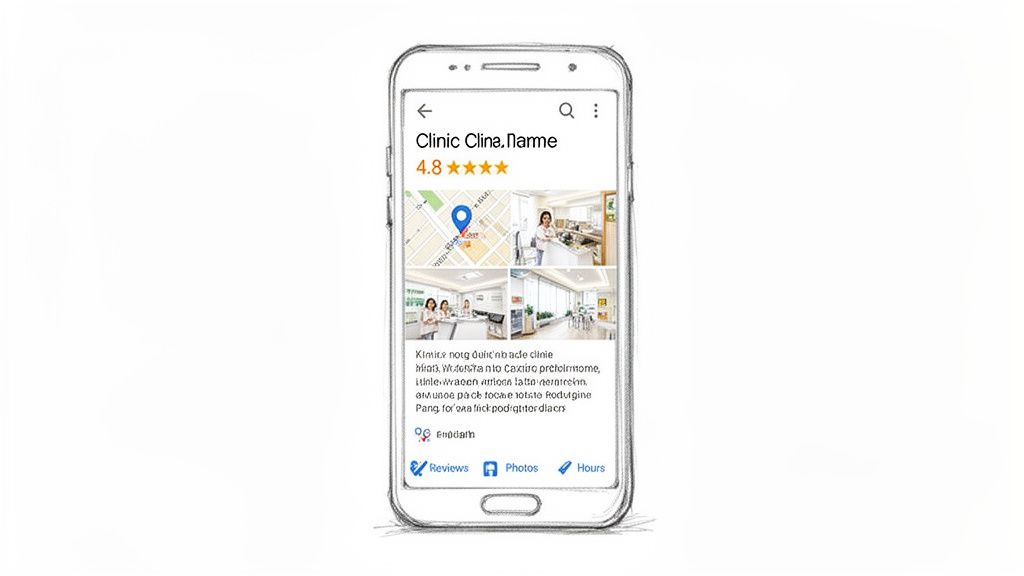
Your Google Business Profile (GBP) is your clinic's digital front door. Seriously.
When a potential patient searches for care nearby, your profile is often the first thing they see. It’s their first interaction with your brand, making it a cornerstone of your SEO for physical therapy strategy. A sparse, half-filled profile screams neglect. A rich, detailed one builds instant trust.
Think of it as your virtual office. High-quality photos are non-negotiable. Ditch the stock images and show off your actual clinic, the smiling faces of your therapists, and the specific equipment you use. This kind of authenticity helps patients picture themselves getting care with you, making them feel more comfortable before they even pick up the phone.
Nail the Foundational Details
Details matter—a lot—in local search. Start with your primary category. Choosing "Physical Therapy Clinic" is the obvious first step, but don't stop there. Go deeper with secondary categories that highlight your specializations.
- Got a lot of athletes coming through? Add Sports Medicine Clinic.
- Offer clinical Pilates? Use Pilates Studio.
- Is massage a core part of your practice? Add Massage Therapist.
These extra categories give Google a much clearer picture of what you do, helping it match your clinic with more specific searches. This initial setup is just the beginning; for a full deep-dive, check out our guide on how to optimize Google Business Profile listings from scratch.
Your business description is another piece of prime real estate. Weave in keywords naturally, talking about the conditions you treat (like "sciatica relief" or "post-surgery rehab") and the specific neighborhoods you serve. This helps both Google and potential patients quickly understand if you're the right fit for them.
Engage Proactively to Build Trust
A static profile is an invisible one. You need to use Google’s built-in features to create a dynamic presence that actively helps and engages people looking for care.
Your GBP isn't just a listing; it's a conversation starter. Proactively answering questions and sharing updates turns a passive searcher into an engaged potential patient.
Google Posts are perfect for this. Share clinic news, patient success stories, or special offers for initial consultations. Each post acts like a mini-blog that shows up right in your search listing, keeping your profile fresh and signaling to Google that you're active.
The Q&A section is another goldmine that most clinics ignore. Don't wait for patients to ask questions. Seed it yourself by posting and answering the common queries you get every single day:
- "Do I need a doctor's referral to book an appointment?"
- "What insurance plans do you accept?"
- "What should I expect during my first visit for back pain?"
By tackling these questions upfront, you remove friction and doubt. You position your clinic as a helpful authority, building the confidence someone needs to finally book that first appointment.
Find Keywords That Attract Ready-To-Book Patients
Effective SEO starts with speaking your patient’s language. It's about digging into the exact words and phrases people use when they’re in pain, scrolling through their phone, and actively looking for a solution. This isn't guesswork; it's about getting inside their head and understanding what they truly need.
There’s a massive difference between a casual search and one with real intent. Someone typing "sore back" is probably just browsing. But a person searching for "sciatica relief physical therapy in Brooklyn" isn't just looking for information—they're looking to book an appointment. That's the patient you want to find.
Your job is to meet them right at that moment of need.
Moving Beyond Generic Terms
First things first: forget about broad keywords like "physical therapy." While it seems like the obvious choice, it’s incredibly competitive and casts a net so wide you end up with a mix of students, job seekers, and people who aren't even in your city.
Instead, your entire focus should be on high-intent, condition-specific keywords. These are the phrases that signal someone is ready to pick up the phone.
And the best place to find these keywords isn't a fancy tool—it's your own treatment room. Listen to your patients during their initial consultations. What specific words do they use to describe their pain? How do they talk about what they want to achieve?
- Are they saying "rotator cuff surgery rehab" or just "shoulder recovery"?
- Do they mention "runner's knee treatment" or something vague like "knee pain"?
- Are they looking for a "pelvic floor specialist" or "help after having a baby"?
These phrases are keyword gold. They’re less competitive, highly specific, and carry a much higher chance of turning into a booked appointment because they perfectly match the searcher's problem.
Think like a patient in pain, not a clinic owner. Your website content needs to be the direct answer to their desperate, middle-of-the-night Google search. That’s how you build trust before they even walk through your door.
This focused approach pays off big time. We've seen clinics that nail their condition-specific SEO get dramatically higher conversion rates. For instance, terms like 'back pain physical therapy' or 'knee injury rehabilitation' pull in a combined 30,300 searches every month. Targeting 'sports injury therapy' (6,600 searches) or 'shoulder pain physical therapy' (5,400 searches) lets you rank for queries that scream urgency, often converting at rates 2-3x higher than generic pages. You can find more data behind these kinds of SEO strategies for physiotherapists on causalfunnel.com.
To help you get started, we've broken down how to think about keywords based on what a potential patient is trying to accomplish.
Physical Therapy Keyword Intent Matrix
This table breaks down different keyword types with real-world examples to help guide your content strategy. Think of it as a roadmap for matching your web pages to a patient's specific needs at each stage of their search.
| Keyword Type | Patient Intent | Example Keyword | Best Content Type |
|---|---|---|---|
| Informational | Learning about a condition or symptom. Not ready to book. | "what causes runner's knee" | Blog Post, FAQ Page |
| Navigational | Trying to find a specific clinic they already know. | "renew physical therapy NYC" | Homepage, About Us Page |
| Commercial | Comparing different treatment options or clinics. | "best sports rehab therapist near me" | Service Pages, Testimonials |
| Transactional | Ready to book an appointment now. | "physical therapy for sciatica brooklyn" | Location-Specific Service Page |
By understanding these different intents, you can create content that not only attracts search traffic but also guides potential patients from initial research all the way to booking their first visit.
Putting Keywords Into Action
Once you have a solid list of patient-focused keywords, it's time to put them to work. The most critical step is creating dedicated pages on your website for each core condition and service you offer.
Whatever you do, don't just lump everything onto a single "Services" page. That’s a huge mistake.
Instead, create a specific, detailed page for each of these:
- Manual Therapy
- Post-Surgery Knee Rehabilitation
- Dry Needling for Sports Injuries
- Pelvic Floor Physical Therapy
Each page needs to be a comprehensive resource. It should break down the condition, detail your unique treatment approach, and answer the most common questions you hear from patients.
By building out these targeted pages, you’re sending a powerful signal to Google that you are an authority on that specific topic. This makes it far easier to rank for those high-intent searches and, most importantly, attract patients who are ready to schedule.
Create Content That Answers Questions and Builds Authority
Your website's content has two jobs. First, it has to answer a potential patient's most urgent questions. Second, it needs to signal your expertise to Google. A smart content strategy is the backbone of great SEO for physical therapy, turning your website into a magnet for people who are ready to book an appointment.
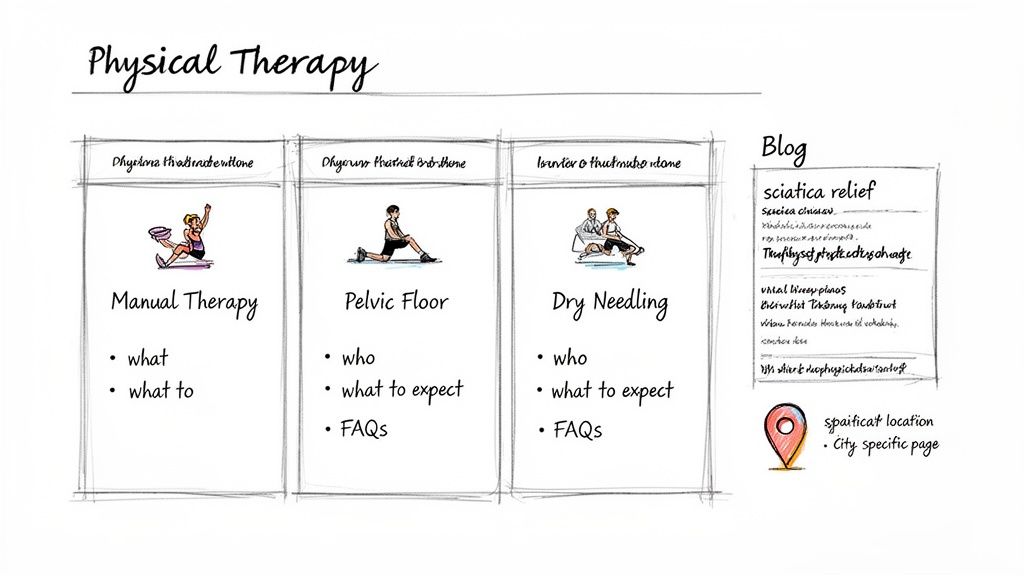
It all starts with your service pages. Forget a generic "Our Services" list. You need a dedicated, in-depth page for every single core treatment you offer. I'm talking about individual pages for 'Manual Therapy,' 'Pelvic Floor Physical Therapy,' 'Dry Needling,' or 'Post-Surgery Knee Rehab.' This is how you tell search engines you’re an authority on these specific treatments.
The Blueprint for a High-Ranking Service Page
Think of each service page as a complete resource for someone in pain or looking for answers. You want to guide them from uncertainty to confidence, and a logical structure is the best way to do that.
Here’s a simple but incredibly effective format I’ve used for years:
- What It Is: Explain the treatment in plain, easy-to-understand language. No medical jargon.
- Who It Helps: Get specific about the conditions and types of patients who are a perfect fit.
- What to Expect: Walk them through the process, from the first evaluation to what a typical session looks like.
- FAQs: Answer the top 3-5 questions you always get from patients about that particular service.
This approach does more than just educate the reader; it naturally weaves in all those valuable, long-tail keywords that people actually type into Google when they're trying to solve a problem.
Your website pages shouldn't just sell. They need to solve an immediate problem by giving people clarity and reassurance. That’s how you build trust before they ever walk through your door.
Handling Content for Multiple Locations
If your practice has more than one clinic, unique content for each location is non-negotiable. Please, don't just copy and paste a service page and swap out the city name. Google sees this as duplicate content, and it can absolutely tank your rankings.
Instead, build out distinct location pages that feel truly local. Talk about nearby landmarks, mention community events you participate in, and—this is a big one—include real photos of your local team and the inside of that specific clinic. This shows both Google and your potential patients that you're a real part of their neighborhood.
Use Your Blog to Prove Your Expertise
Beyond your core service pages, your blog is the most powerful authority-building tool you have. When you consistently publish genuinely helpful articles on common conditions, you establish your clinic as the trusted source of information in your area.
What should you write about? Just think about the questions patients ask you every single day. Those are your blog topics. A post on "5 Stretches to Relieve Sciatica Pain at Home" or "When Should I See a PT for Runner's Knee?" directly targets the searches people are making. This kind of content catches people early in their journey, introducing them to your brand and building that critical foundation of trust.
For Google, this expert-level content is a massive ranking signal, especially in a healthcare field. It proves your clinic has the Experience, Expertise, Authoritativeness, and Trustworthiness (E-E-A-T) that Google demands, cementing your status as a top provider.
A Practical Plan for Reviews, Citations, and Local Links
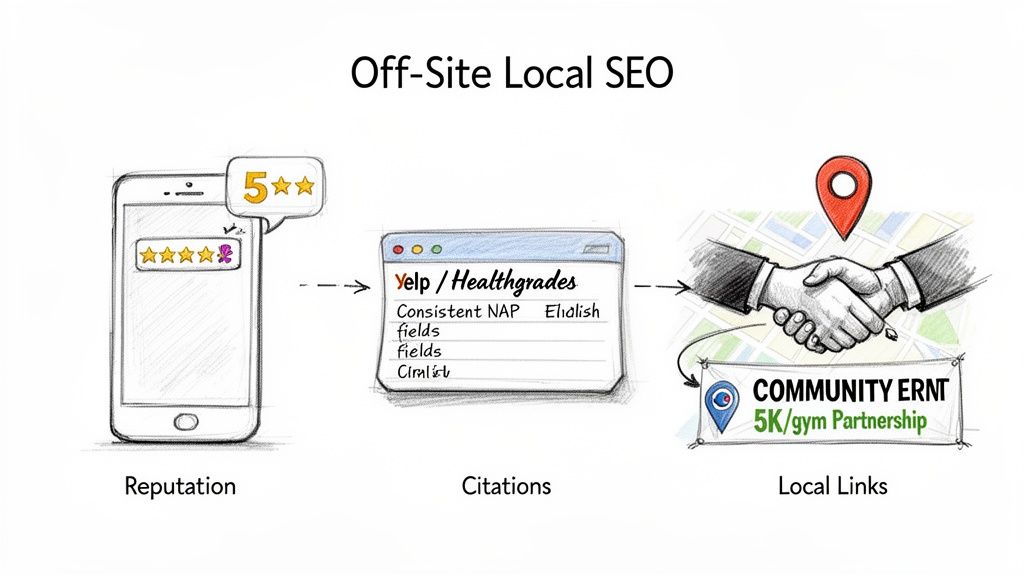
What happens off your website is just as critical for local SEO as what’s on it. Google is constantly looking for external signals to verify that your clinic is legitimate, authoritative, and a real part of the local community. These off-page factors—reviews, citations, and local links—are powerful trust signals that directly influence whether you show up in the coveted Map Pack.
Think of it this way: your website makes a claim ("We're the best PT clinic in town!"), but these off-page signals are what prove it. A steady stream of glowing patient reviews, consistent business info across the web, and links from other local businesses all come together to build a rock-solid digital reputation.
Cultivate a Five-Star Reputation with Reviews
Online reviews are today's word-of-mouth, and they're a massive ranking factor. When a potential patient sees a high star rating and recent, positive feedback on your Google Business Profile, it builds instant trust. The trick is to create a simple, non-aggressive system to encourage your happy patients to share their stories.
The perfect time to ask is after a successful treatment milestone or when a patient is discharged. A quick follow-up email or text with a direct link to your Google review page can work wonders. For a deeper dive, you can learn more about how to get Google reviews compliantly and build your social proof the right way.
Your online reputation is an active asset, not a passive one. Always respond to every review—good or bad. It shows both Google and potential patients that you're engaged and that you care about feedback.
Ensure Consistency with Local Citations
A citation is just an online mention of your clinic’s Name, Address, and Phone number (NAP). You'll find them on directories like Yelp, Healthgrades, and other industry-specific sites. Google crawls these listings to confirm that your location and contact details are correct.
Inconsistency is your enemy here. Even a small variation in your clinic's name or an old address lingering on a forgotten directory can confuse search engines and drag down your rankings. The goal is 100% NAP consistency everywhere your clinic is listed.
Build Authority with Local Link Building
Finally, there’s local link building, which means getting other reputable local websites to link back to your site. This is one of the most powerful off-page signals in all of SEO for physical therapy. A link from a trusted local source is like a direct vote of confidence for your clinic.
This doesn't have to be some complex, technical process. Just think about your real-world community connections:
- Sponsor a local 5K run and ask for a link from the event page.
- Partner with a nearby gym to host a workshop on injury prevention.
- Write a guest article for a local wellness blog.
Each of these activities builds goodwill in your community and, just as importantly, creates a portfolio of high-quality local links that cement your clinic's authority in Google's eyes.
Accelerate Growth with Smart SEO Platforms
Doing SEO by hand is a powerful way to build a foundation, but let's be honest—it's often a slow and steady climb. Smart technology is the catalyst that turns that gradual progress into rapid, measurable growth. SEO platforms like Nearfront give you a competitive edge with insights that old-school, manual methods simply can't provide.
Imagine seeing a live heatmap of your clinic's visibility across Google Maps. You could instantly pinpoint the exact neighborhoods where you're crushing it for terms like "physical therapy near me." More importantly, you'd see the dead zones where competitors are scooping up all the patients.
Seeing Your True Local Rank
This kind of granular data lets you get surgical with your strategy. Instead of guessing where to focus your efforts, you can pour resources into the specific areas that need the most attention.
This visual shows exactly how a platform can map out your clinic's search ranking across an entire city. It transforms abstract data into an actionable battle plan. Suddenly, it’s not about a single ranking; it’s about dominating every corner of the service area where your potential patients live and work.
The best platforms can even generate authentic local engagement signals—the kind of stuff Google loves to see, like organic searches, clicks, and direction requests. This reinforces your clinic's local relevance without ever needing direct access to your Google Business Profile, which is a huge plus for security. To see how different platforms handle this, check out our detailed comparison of the best local SEO tools.
The timeline for SEO success in physical therapy follows a predictable yet powerful trajectory. You'll see initial visibility gains in 3-6 months, which evolve into compounding yearly growth. By 6-12 months, organic traffic often doubles or triples. We've seen clinics jump entire pages in rankings and dramatically ramp up calls in that timeframe. For multi-location brands, tracking profile clicks and direction requests shows this growth in black and white, all without needing GBP access.
At the end of the day, using smart technology isn't about replacing your strategy—it's about amplifying it. It's about working smarter, using data to prioritize high-impact actions, and gaining a real, measurable edge in a crowded market.
Common Questions About SEO for Physical Therapists
Let's tackle a few common questions I hear all the time from physical therapists dipping their toes into SEO. We'll get straight to the point on how fast you can expect results, whether you can go it alone, and how to actually know if your investment is paying off.
How Fast Can I Expect to See Results?
Let's be real: SEO is a long game, not an overnight fix. While you might see a little bump from quick wins—like a fully decked-out Google Business Profile—within a few weeks, the real, meaningful results take time.
You should plan on 3-6 months for Google to really start noticing your efforts and rewarding your content. That’s the initial traction phase. The magic really starts to happen after the six-month mark. It's not uncommon for clinics to see their organic traffic double or even triple between 6-12 months as their key service and location pages start climbing the ranks for those high-value keywords.
Can I Do SEO for My Clinic Myself?
Absolutely. In fact, most PTs start out doing it themselves, and you can make a serious dent by focusing on the fundamentals.
If you’re going the DIY route, just nail these three things:
- Fill out your Google Business Profile to 100% completion. No cutting corners.
- Make a habit of asking for patient reviews and, just as importantly, responding to them.
- Write one genuinely helpful, condition-specific blog post a month.
Just doing that consistently will put you ahead of most of your competition. As you grow, you might want to bring in a specialist or use a platform to handle the more complex stuff, but the basics are completely manageable for a focused practice owner.
The secret to DIY SEO isn't genius-level technical skill—it's consistency. A little bit of focused effort every single month sends a much stronger signal to Google than one big push once a year. It shows you're active, reliable, and in the game.
How Do I Measure SEO Return on Investment?
You have to know if your marketing is actually making you money. Forget the fuzzy "vanity metrics" and focus on what translates directly to your bottom line.
Track these three KPIs like a hawk:
- New Patients from Organic Search: This is the gold standard. Just add a simple "How did you hear about us?" question to your intake forms.
- Phone Calls from Google: Your GBP dashboard shows you exactly how many people clicked the "call" button from your profile. These are often your hottest leads.
- Direction Requests: Another metric right inside your GBP insights. Someone asking for directions is about as high-intent as it gets—they're literally planning to walk through your door.
When you tie these actions back to actual patient revenue, you can calculate the ROI of your SEO efforts with confidence.
Ready to accelerate your clinic's growth? Nearfront turns local searches into booked appointments. See how our AI-powered platform can get you seen on Google Maps and drive more patients to your door. Learn more about Nearfront.