Before you dive into any new local marketing strategy, you've got to know your starting point. You need a crystal-clear picture of where your business stands right now. This means running a quick, thorough audit to find those easy wins and fix the hidden problems that are holding you back. Think of it as shoring up the foundation; it makes sure that when new customers do find you, everything they see is accurate, trustworthy, and makes them want to walk through your door.
Conducting Your Local Marketing Health Check
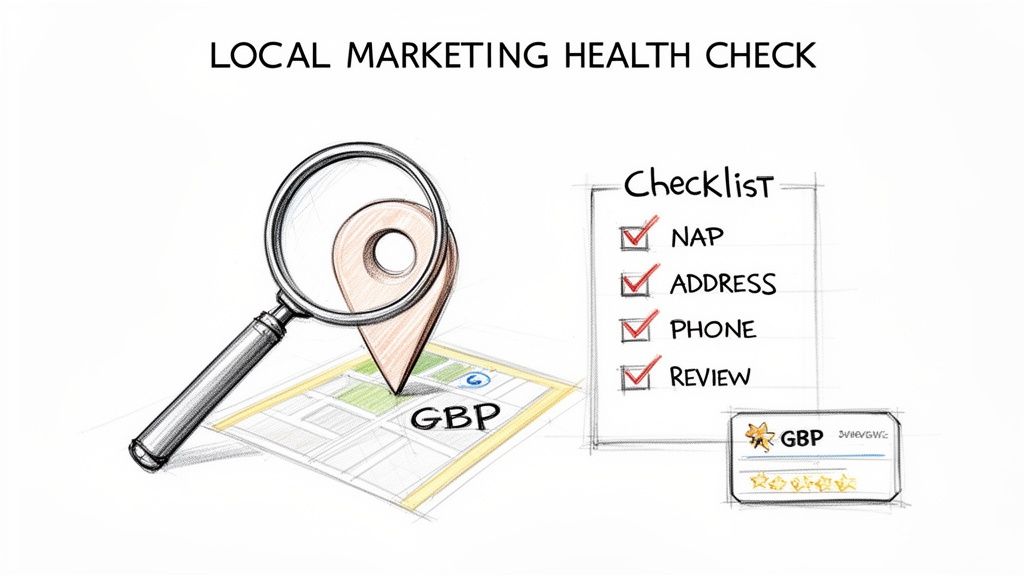
Jumping into advanced tactics without this initial audit is like trying to drive across a new city without a map. Sure, you’re moving, but you have no idea if you’re heading in the right direction. This health check is your map. It shows you the low-hanging fruit and stops you from pouring time and money into strategies that are doomed to fail until your foundation is solid.
This first look focuses on three core areas that have a massive impact on how customers find and perceive your business online. Get these right, and you can see an almost immediate boost in visibility.
Assess Your Google Business Profile
Your Google Business Profile (or GBP) is often the very first impression a potential customer has of your business. Does it look good? The best way to find out is to search for your own business on Google and Google Maps, just like a customer would.
Keep an eye out for these common slip-ups:
- Incomplete Information: Are all the sections actually filled out? I'm talking about your business description, services, photos, and especially the attributes. An empty-looking profile just screams neglect.
- Outdated Hours: Nothing frustrates a customer faster than showing up to a closed door because you forgot to update your holiday hours. It's a tiny detail that makes a huge difference.
- Unanswered Questions: That Q&A section on your profile is a goldmine for engaging with curious customers. Leaving questions hanging just makes it look like you're not paying attention.
For instance, a local coffee shop might realize their profile is missing key attributes like "Free Wi-Fi" and "Outdoor Seating." Adding those takes two minutes and can be the deciding factor for someone looking for a place to work for an hour.
Hunt Down Inconsistent NAP Data
Your business's Name, Address, and Phone number (NAP) is its digital fingerprint. When that information is different across the web—on Yelp, your Facebook page, Apple Maps, or other local directories—it confuses both customers and search engines. Google sees conflicting info as a red flag for unreliability, and that can tank your rankings.
A consistent NAP across all major online directories is a foundational signal of trust for search engines. Even a small discrepancy, like using "St." on one site and "Street" on another, can dilute your local authority.
Start by just Googling your business name and then your phone number separately. Make a list of every directory that pops up and check each one for consistency. A local hardware store I worked with discovered their old address was still live on a small directory they’d forgotten about. Fixing that one entry cleared up confusion and gave their entire online presence a lift.
Analyze Your Online Review Landscape
Finally, take a hard, honest look at your reviews. Your reputation is one of your most powerful local marketing assets. What story are your current reviews telling people?
Ask yourself these questions as you look through your profiles:
- Overall Rating: What’s your average star rating on Google, Yelp, and other key sites?
- Review Volume: How many reviews do you actually have? A business with 150 reviews just looks more established and trustworthy than one with five.
- Review Recency: When was your last review? A steady stream of recent feedback shows that your business is active and people are still talking about you.
- Response Rate: Are you responding to reviews? And I mean both the good and the bad ones. Engaging with feedback shows you actually value what your customers have to say.
If you spot a problem here—like a string of unanswered negative reviews from six months ago—you've found a clear quick win. Taking the time to professionally respond to that old feedback immediately shows new customers that you care and are committed to doing better.
Optimize Your Google Business Profile to Dominate Local Search
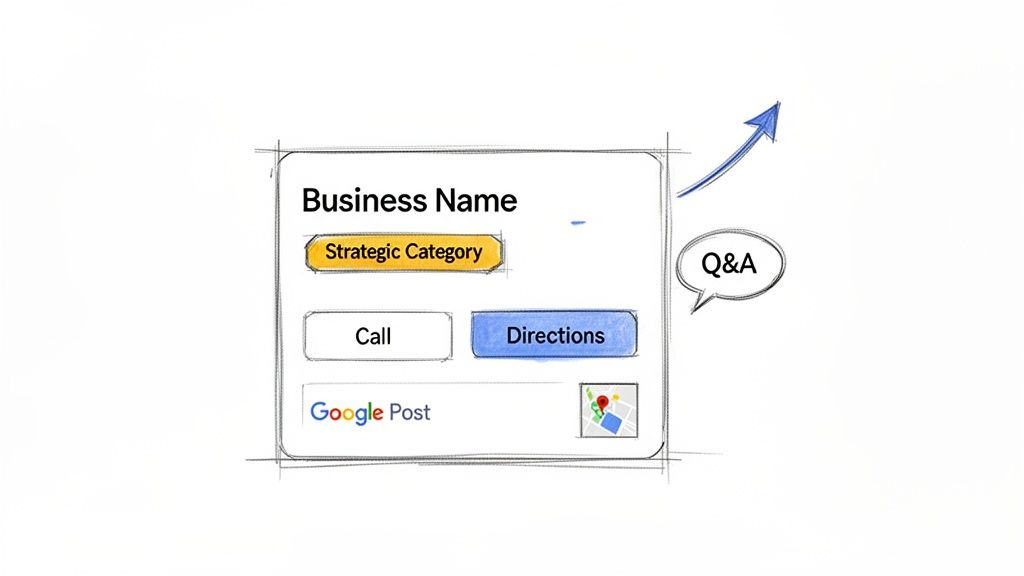
Think of your Google Business Profile (GBP) as your digital storefront. When someone searches for "best coffee near me," your GBP is the first impression that can turn a quick search into a new customer walking through your door.
Honestly, mastering this one tool is probably the single most impactful thing you can do for your local marketing. It's ground zero.
We're going to move beyond just having your name and address listed. The real goal is to fine-tune every detail to dominate the Google Map Pack and transform your static listing into an active, engaging hub that builds trust instantly.
The data backs this up. Local SEO is the entire game for small businesses, with a staggering 73% of U.S. small and medium-sized businesses (SMBs) now actively using Google Business Profiles to get seen. This isn't just a good idea—it's how modern customers find and choose who to buy from.
Write a Business Description That Actually Converts
Your business description is prime real estate. So many businesses waste it with keyword-stuffed jargon or a dry, corporate overview. Don't do that.
Treat it like a super-condensed "About Us" page. The very first sentence needs to tell people exactly who you are and what problem you solve for them.
A local bike shop shouldn’t just write, "We sell bikes and accessories." That's boring. Try something like this instead: "Your neighborhood hub for expert bike repairs, custom fittings, and trail-ready gear for every rider, from beginner to pro." See the difference? It’s specific, it speaks to different types of customers, and it feels personal.
And yes, you should naturally weave in your main local keywords here. Mentioning your city or neighborhood alongside your core services helps Google connect you to those critical "near me" searches.
The Strategic Power of Categories
Picking the right primary category is mission-critical, but most businesses stop there. That's a huge mistake. Google lets you add a bunch of secondary categories, and this is where you can get a serious competitive edge.
Your primary category should be the best, most accurate, high-level description of your business. For example, "Italian Restaurant."
But the secondary categories are where the magic happens. They let you show up for much more specific searches. That same Italian restaurant could (and should) add:
- Pizza Restaurant
- Catering
- Pasta Shop
- Wine Bar
This strategy tells Google you're relevant for a much wider range of searches. A customer looking for "pizza delivery" might completely miss you if you're only listed as a generic "Italian Restaurant." Dig into all the available category options and pick every single one that accurately reflects what you offer. For a deeper dive on this, check out our guide on how to optimize your Google Business Profile.
Your Google Business Profile is a living entity, not a set-it-and-forget-it task. The more you engage with its features—posting updates, answering questions, adding photos—the more positive signals you send to Google's local ranking algorithm.
Activate Every Feature for Maximum Engagement
A complete profile is a trusted profile. It’s that simple. Google rewards businesses that use all the tools it provides because it creates a better, more helpful experience for searchers. Don't leave anything on the table.
Google Posts are like free mini-ads that show up right on your profile. Use them to announce special offers, show off new products, or highlight upcoming events. A post only stays live for seven days, so updating it consistently is a clear signal that your business is active.
The Q&A Section is a direct line to your potential customers. Be proactive here. Ask and answer your own frequently asked questions. Think about what people always call to ask: "Do you offer gluten-free options?" or "Is parking available?" Answering these upfront removes friction and makes it easier for someone to choose you.
Products and Services let you build out a detailed catalog right on your profile. Take the time to add high-quality images, good descriptions, and even prices if it makes sense. This turns your profile from a simple listing into a functional menu or product showcase.
Your Google Business Profile Optimization Checklist
To keep things simple, here’s a checklist to make sure you've covered all your bases. The "Impact on Ranking" gives you a sense of what to prioritize first.
| Feature | Action Item | Impact on Ranking |
|---|---|---|
| Core Info | Verify Business Name, Address, Phone (NAP) are 100% consistent everywhere. | High |
| Categories | Select the most specific Primary Category and add all relevant Secondary ones. | High |
| Business Description | Write a compelling, keyword-rich description (750 characters max). | High |
| Photos & Videos | Add at least 10 high-quality photos (exterior, interior, team) and a video. | High |
| Reviews | Actively request reviews and respond to all of them, good and bad. | High |
| Google Posts | Publish a new Post at least once a week (offer, event, update). | Medium |
| Q&A Section | Pre-populate with your top 5-10 FAQs and monitor for new questions. | Medium |
| Products/Services | Build out a complete list with descriptions, photos, and prices. | Medium |
| Messaging | Enable the messaging feature and respond to inquiries within a few hours. | Low |
| Attributes | Add all relevant attributes (e.g., "Woman-owned," "Wheelchair accessible"). | Low |
By fully using every feature, you're not just filling out a form. You're building a comprehensive resource that makes it incredibly easy for customers to find you and choose you over the competition.
Winning with Local SEO and Hyperlocal Keywords
Let’s be honest: effective local SEO is all about getting inside your customer’s head. To really win, you have to stop thinking about generic keywords and start obsessing over the exact, hyperlocal phrases people tap into their phones when they need something right now. This is the whole game for a small business—showing up in that precise moment of need.
It's about understanding that someone in one part of town searches completely differently than someone just a few miles away. Your goal is to find these high-intent phrases and weave them into your digital footprint, proving to search engines that you're the best local answer.
Think Like a Customer on a Mission
The biggest shift in local search has been the explosion of "near me" and neighborhood-specific queries. Nobody just searches for a "plumber" anymore. They search for "emergency plumber in oak hill" or "best coffee shop near downtown station." These searches are dripping with intent. The person has an immediate problem and is ready to buy.
Your job is to dig up these phrases for your specific business and service areas. Start by putting yourself in your customer's shoes:
- What’s the problem? Think about the specific pain point. It's not just "plumber," it's "leaky faucet repair austin."
- How do they qualify their search? People want the best. They use adjectives like "top-rated family dentist lincoln park."
- Where are they, exactly? They use their immediate surroundings as a reference, like "takeout pizza south lamar."
This simple brainstorm gets you a starting list of words that real people actually use, not just a bunch of industry jargon.
Weaving Keywords into Your Digital Fabric
Once you have your list of hyperlocal keywords, it’s time to integrate them naturally across your website. This isn’t about stuffing keywords wherever they’ll fit. It’s about creating genuinely useful content for someone in that specific location.
Location Pages Are Your Secret Weapon
If you serve more than one neighborhood or city, you absolutely need a dedicated page for each. A generic "Our Services" page just won't cut it anymore. You need pages like "Landscaping Services in Georgetown" and "Lawn Care in Round Rock."
On each of these pages, make sure you include:
- Hyperlocal Content: Drop in local landmarks, street names, or community events to show you’re a true local. For example, "We're just a block from the Georgetown library, making it easy to…"
- Specific Services: List the services you offer in that area, using the keywords you found.
- Local Testimonials: Nothing works better than social proof from a neighbor. Feature reviews from customers in that exact neighborhood.
Write Blog Posts That Solve Local Problems
Your blog is the perfect place to target longer, more specific hyperlocal phrases. A roofer in a storm-prone area could kill it with a post titled, "What Dallas Homeowners Should Do After a Hailstorm." This is incredibly relevant, shows you're an expert, and catches people searching with an urgent need.
This level of detail isn't just busywork—it pays off. Every $1 invested in local SEO delivers an average $13 return on investment, blowing many other channels out of the water. For brick-and-mortar brands, tools that track live rankings on Google Maps can literally skyrocket your Map Pack positions, turning searches into calls, directions, and foot traffic. Find out more about these small business marketing benchmarks and insights.
Seeing What Your Customers See
So, how do you know if any of this is actually working? Old-school rank trackers that give you a single, generic ranking for your city are useless now. Your visibility can change dramatically from one street to the next.
This is where ranking heatmaps are a game-changer. These tools show you exactly how you're ranking on Google Maps for a specific keyword across dozens of points in your service area.
Instead of one number, you get a visual map that instantly reveals:
- Your "strong zones" where you're crushing the Map Pack.
- Your "weak spots" where competitors are beating you.
- Untapped opportunities in neighborhoods you might be ignoring.
For example, a restaurant could find out they rank #1 for "best tacos" right outside their door but disappear completely ten blocks west. That's a powerful insight. It tells them exactly where to focus their efforts—maybe with some geo-targeted ads or content aimed specifically at that western neighborhood. It takes the guesswork out of local SEO and lets you put your resources where they’ll actually make a difference.
Building an Unbeatable Five-Star Reputation Online
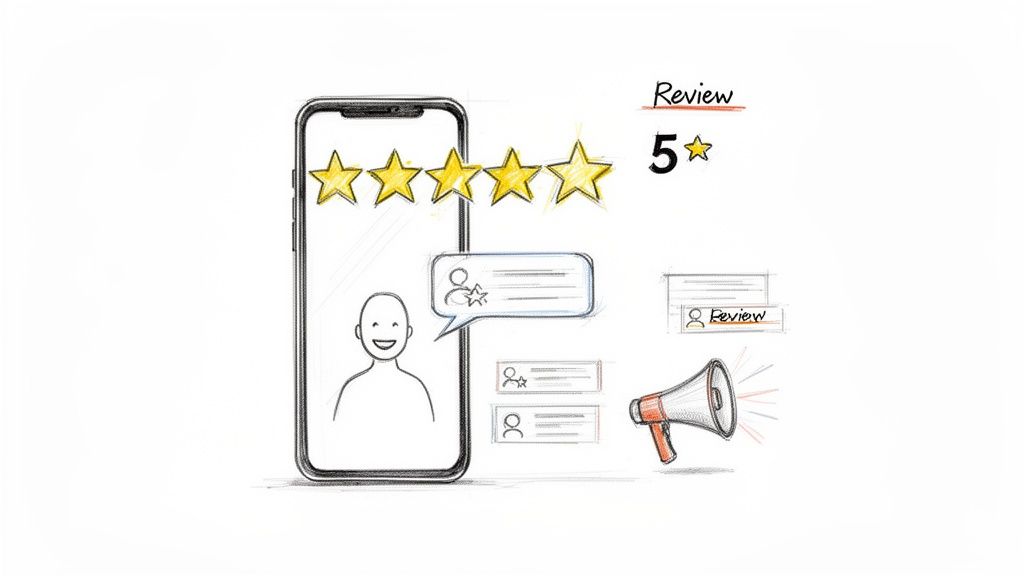
When you're marketing a small business locally, your online reputation isn't just a nice-to-have. It’s the bedrock of trust. Before a potential customer ever sets foot in your door, you can bet they're looking for social proof. They want to see what their neighbors are saying, and your online reviews are that digital word-of-mouth.
Think of it this way: a steady stream of glowing, recent reviews is one of the most powerful marketing assets you can build. It tells both Google and future customers that you’re the real deal, making it a critical piece of your entire local visibility puzzle.
Make It Effortless for Happy Customers to Share
Let’s be honest, the biggest reason you don't have more reviews isn't because your customers are unhappy—it's because they're busy. Life gets in the way. Your job is to make leaving feedback so ridiculously simple that it feels like the natural last step of a great experience.
The secret is timing. You have to ask when the positive feeling is at its peak, right after you’ve delivered amazing service or a fantastic product.
Here are a few proven ways to nail the ask:
- A Simple Text Message: A quick text with a direct link to your Google review page is insanely effective. Something like, "Thanks for stopping by today! If you have a moment, we'd love to hear how it went. You can leave your feedback here."
- QR Codes In-Store: Put a small, scannable QR code at your checkout counter or on receipts. It lets customers scan and review on their phone before they’ve even left your parking lot.
- The Follow-Up Email: A day after a purchase, send a brief, personal email. Always lead with gratitude—thank them for their business first—then gently ask for their thoughts.
Want to go deeper on this? We put together a complete guide on how to get Google reviews compliantly so you can build a system without breaking any rules.
Respond to Every Single Review—No Exceptions
Your work isn't over when a review pops up. Responding to feedback, both good and bad, is absolutely non-negotiable. It shows you’re listening and that you actually care what your customers think.
For the good ones, a simple "Thank you so much for the kind words!" is perfect. But for negative reviews, your response is even more critical.
A professional and empathetic response to a bad review can win you more future customers than a dozen five-star ratings. It demonstrates accountability and a real commitment to getting it right, which builds massive trust.
When you get a critical review, always reply publicly. Acknowledge their experience without getting defensive, and then offer to take the conversation offline to fix it. This shows everyone else reading that you take problems seriously.
Turn Your Best Reviews into Social Proof
Your best reviews are marketing gold. Don't just let them sit on Google or Yelp collecting dust. You need to actively repurpose them across every channel you have.
- Website Testimonials: Create a dedicated spot on your homepage or service pages to showcase your most compelling reviews. Let your customers do the selling for you.
- Social Media Graphics: Turn a fantastic quote into a clean, shareable image for Instagram or Facebook. If you can, tag the customer to show your appreciation.
- In-Store Signage: Displaying positive feedback right in your physical location reinforces a customer’s decision to choose you. It tells them they made the right call.
When you actively manage and showcase your reputation, you turn happy customers into your most effective sales team. This creates a powerful feedback loop: great service leads to great reviews, which attracts new customers and fuels your local growth.
Turning Clicks into Footsteps
A slick online presence is great, but it’s only half the battle. The real magic happens when you turn those digital impressions into actual people walking through your front door. Think of your online marketing as the spark, but it's the offline and in-store experiences that really fuel customer loyalty and keep them coming back.
This is about closing the loop—creating a seamless journey from an Instagram ad or a Google Maps search right to your checkout counter.
You want to weave your business into the very fabric of your community, making it a familiar and trusted presence in your customers' daily lives. And don't think old-school tactics are dead. While social media (54%) and search engines (44%) are discovery powerhouses, a surprising 29% of people still respond to direct mail. It's proof that a blended strategy works best. You can dig into more of these small business marketing trends and insights to see how the landscape is shifting.
Forge Powerful Local Partnerships
One of the fastest ways to build credibility and tap into a new audience is to team up with other local, non-competing businesses.
Ask yourself: who else serves my ideal customer? A high-end pet groomer could run a joint promotion with a nearby veterinarian. A local bookstore could host a pop-up event with the coffee shop next door. These partnerships are a win-win.
You’re not just getting in front of their audience; you’re getting a warm introduction from a business they already know and trust. This is authentic, community-driven marketing at its absolute best.
A few ideas to get you started:
- Cross-Promotions: Offer a small discount to customers who show a receipt from your partner business. Have them do the same for you. Simple and effective.
- Joint Events: Co-host a workshop, a charity drive, or even just a small block party. You'll pool your resources, share the workload, and double your reach.
- Referral Programs: Create a simple, formal system that rewards partners for sending new customers your way.
Bring Your Brand into the Real World
Hosting or sponsoring local events puts a real human face on your brand. It transforms you from just a name on a screen into a tangible part of the neighborhood. This doesn't have to be a huge, expensive affair.
A hardware store could host free DIY workshops on Saturday mornings. A fitness studio could offer a free yoga class in the local park. These events provide genuine value, build incredible goodwill, and give you a low-pressure way to meet potential customers face-to-face.
A booth at the neighborhood farmer's market or street fair can be more impactful than a month's worth of social media ads. It gives you the chance to have real conversations, get honest feedback, and build relationships that digital channels simply can't replicate.
Encourage Action Inside Your Store
Don't forget that your physical space is one of your most powerful marketing assets. Don't let a customer walk in and out without giving them a reason to connect with you again. Use simple, smart in-store signage to bridge that gap back to your digital world.
A small sign with a QR code at your register can prompt customers to follow you on Instagram or sign up for your email list. A well-placed sticker on your front door encouraging Google reviews can turn a happy customer into a powerful online advocate.
Try these simple in-store tactics:
- "Check-In" Deals: Offer a small discount or a freebie to customers who check in on social media while they're at your location.
- Review Prompts: Add a friendly reminder on receipts or at the point of sale asking for a quick review on Google or Yelp.
- Email Sign-Up: Offer an exclusive in-store discount to customers who join your email list right there on the spot.
By weaving these offline strategies into your plan, you create a powerful, self-reinforcing loop. A strong online presence drives foot traffic, a great in-store experience encourages online reviews and engagement, and your community involvement builds the brand awareness that fuels the entire cycle.
Measuring What Matters in Your Local Marketing
Throwing marketing tactics at the wall to see what sticks is a recipe for wasted time and money. Real growth comes from data. If you aren't tracking your results, you're just guessing—and you can't build a predictable business on guesswork.
The goal is simple: stop obsessing over vanity metrics and start measuring the actions that actually lead to new customers. You need to know, without a doubt, which efforts are making the phone ring and which ones are bringing people through your door. Your measurement strategy isn't just a report card; it's your roadmap for making smarter decisions.
Decoding Your Google Business Profile Insights
Your Google Business Profile (GBP) is a goldmine of customer data, and the built-in Insights dashboard is the first place you should be looking. It’s a free, no-nonsense look at how people are actually interacting with your business online.
For any local business, it really boils down to three core metrics:
- Direction Requests: This is a direct signal of foot traffic intent. If you see a spike here after running a local ad or promotion, you know it's working. It’s one of the clearest indicators of offline conversion.
- Website Clicks: This tells you how many people were intrigued enough by your profile to take the next step and learn more. It’s a crucial bridge between discovery and conversion.
- Phone Calls: For service businesses, this is often the most important metric of all. A steady stream of calls means your profile is successfully turning searchers into hot leads.
This whole process is about connecting online discovery to offline action. A customer finds you online, engages with your profile, and ultimately walks into your store.
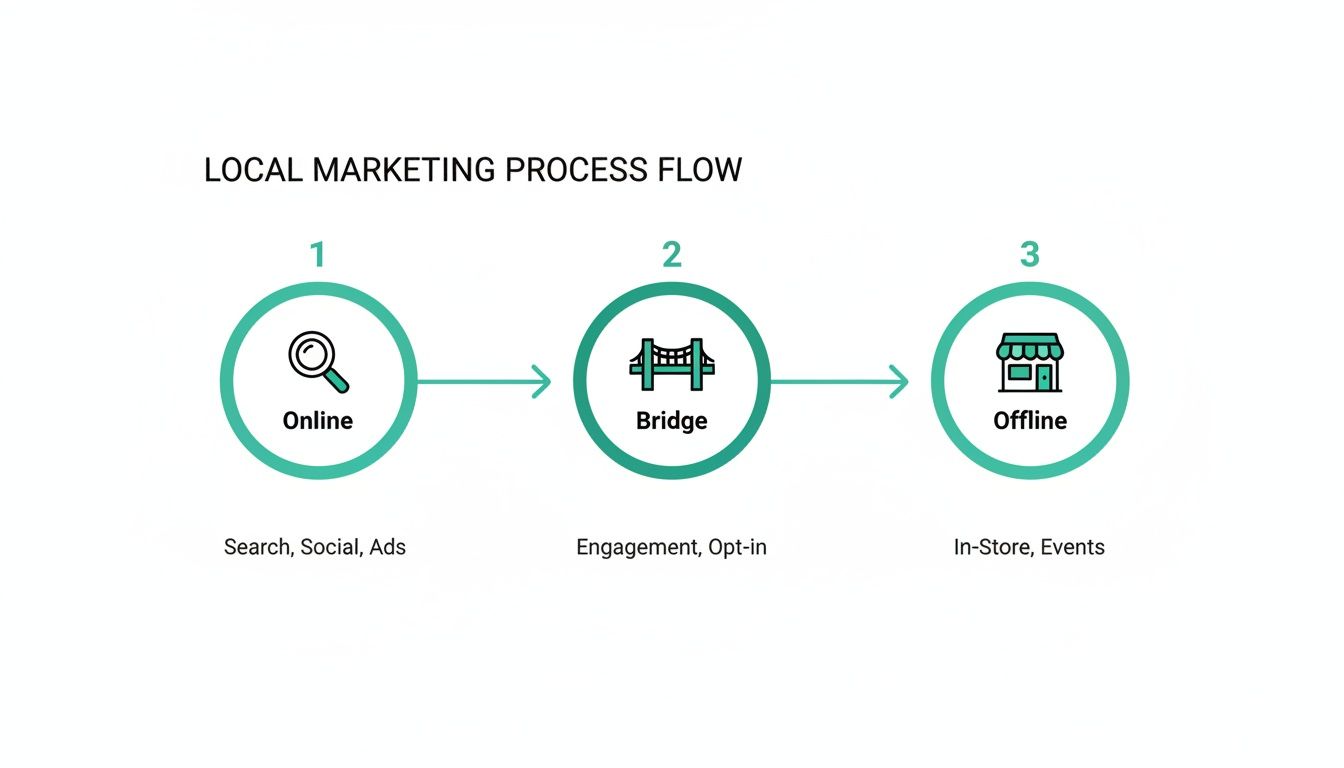
By checking these numbers regularly, you start to connect the dots. Did adding those new photos lead to more website clicks? Did that Google Post about a weekend sale actually drive more calls? The data has the answers.
Visualizing Your Rank and Outsmarting Competitors
GBP Insights are powerful, but they don't tell you the whole story. They don't show you how visible you are from one neighborhood to the next, or where a competitor is eating your lunch just a few blocks away.
To get that kind of clarity, you need to see your rankings from your customers' perspective. This is where more advanced tools come into play. For instance, using a specialized local search rank tracker can generate visual heatmaps of your search performance. Suddenly, you can see your ranking strength block by block, instantly spotting your strong zones and highlighting the weak spots where you’re losing to the competition.
This is the kind of granular data that lets you build a real, prioritized action plan. It shows you exactly where to focus your resources to get the biggest bang for your buck, helping you outmaneuver competitors one neighborhood at a time.
Got Questions? We’ve Got Answers.
Even the best local marketing plan comes with a few head-scratchers. Let's tackle some of the most common questions that pop up for business owners diving into local SEO.
How Long Until I Actually See Results from Local SEO?
It’s the million-dollar question, isn't it? While some tweaks to your Google Business Profile—like updating your hours or adding a few new photos—can give you a little bump in a matter of weeks, real, lasting results take a bit longer.
You should plan on seeing significant, measurable improvements in your local search rankings and actual foot traffic within 3 to 6 months. Why? Because consistency is everything. Google rewards businesses that consistently publish content, build local citations, and, most importantly, gather fresh reviews. It's that steady drumbeat of activity that builds momentum.
Think of it like planting a garden. You'll see sprouts pretty fast, but the real harvest comes after months of consistent watering and care. Quick fixes get you noticed; a long-term strategy makes you the go-to spot in town.
What’s the Single Most Important Thing for Local Search Rankings?
If only it were that simple. It’s not just one thing, but a powerful combination of three core pillars that Google's local algorithm is built on:
- Proximity: This one's straightforward—how close is your business to the person searching? You can't move your store, but you can make damn sure your address is listed correctly and consistently everywhere online.
- Relevance: How well does your online presence actually match what someone is looking for? This is where using hyperlocal keywords and getting your business categories dialed in makes a huge difference.
- Prominence: Think of this as your online street cred. It’s a mix of how many reviews you have (and how good they are), backlinks from other local websites, and just your overall digital footprint. The more talked-about you are, the more Google trusts you.
Do I Need a Physical Storefront to Do Local Marketing?
Not at all. In fact, local marketing is mission-critical for service-area businesses (SABs)—think plumbers, mobile dog groomers, or cleaning services who travel to their customers.
Instead of a pin on a map, you’ll define a specific service area right in your Google Business Profile. This tells Google the exact neighborhoods, towns, or zip codes you cover. That way, you show up in local searches for customers right in your target locations, even without a brick-and-mortar shop for them to visit.
Ready to stop guessing and see exactly where you stand in your community? Nearfront gives you the live ranking heatmaps and competitive insights needed to own your local market. See how our AI-powered platform turns local searches into real customers at https://nearfront.com.