
In today's competitive landscape, the battle for customers is won on the ground, neighborhood by neighborhood. For multi-location and brick-and-mortar brands in retail, cannabis, and wellness, mastering your local digital footprint isn't just an option-it's the core of sustainable growth. The disconnect between a brand's physical presence and its online visibility creates a significant gap where potential customers are lost. Traditional marketing often misses the hyperlocal nuances that drive real-world actions like store visits, calls, and direction requests. This article cuts through the noise to deliver a prioritized roundup of essential location based marketing strategies, each designed to translate digital visibility into measurable foot traffic.
We'll move beyond generic advice, providing actionable steps and real-world examples to help you dominate local search, engage nearby customers, and build a marketing engine that turns proximity into profit. You will learn specific tactics for implementation, not just high-level concepts.
Inside, you'll find a comprehensive guide covering critical areas such as:
- Dominating Local Search: Advanced Google Business Profile optimization and Local Pack ranking tactics.
- Hyper-Targeted Engagement: Leveraging geofencing, proximity marketing, and location-based mobile advertising.
- Building Local Authority: Strategies for citation building, review management, and hyperlocal content creation.
- Measuring Real-World Impact: Connecting digital efforts to in-store visits, calls, and revenue with advanced analytics.
Each strategy is presented with clear, practical steps to help you prioritize your efforts and start driving tangible results immediately. Let's dive into the tactics that will transform your physical locations into your most powerful marketing assets.
1. Google Business Profile Optimization & Local Pack Rankings
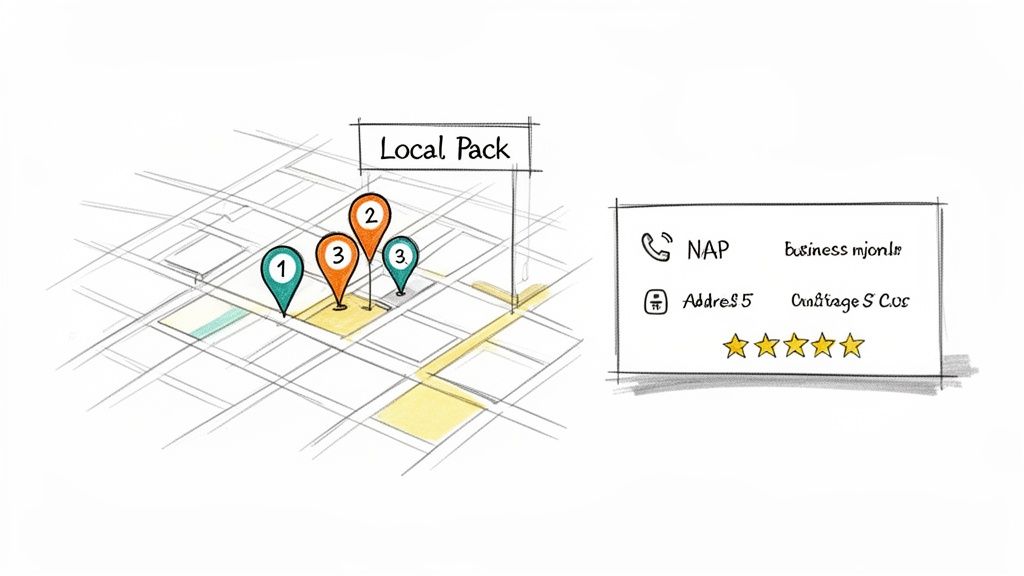
Your Google Business Profile (GBP) is the digital storefront for your physical location. It’s the foundational element of any effective location-based marketing strategy, directly influencing your visibility in Google Maps and the coveted "Local Pack" search results where the top three local businesses are featured. Optimization involves meticulously managing your business information, from name and address to photos and reviews, to build trust with both customers and Google’s algorithm.
For multi-location brands, maintaining absolute consistency across all profiles is non-negotiable. This consistency signals reliability to search engines, boosting ranking performance across all your storefronts. Neglecting this crucial step is like giving your competitors a free pass to the top of local search results.
Why It's a Foundational Strategy
A well-managed GBP provides a direct line to customers actively searching for products or services like yours nearby. It’s a zero-cost tool that drives high-intent traffic, phone calls, and in-store visits. For example, a local dispensary can use high-quality photos in its GBP to showcase its product selection and inviting store layout, while a multi-location wellness brand can centrally manage and respond to reviews across 50+ locations to maintain a stellar reputation.
Actionable Implementation Tips
To maximize your local search presence, focus on these critical actions:
- Ensure NAP Consistency: Your Name, Address, and Phone number (NAP) must be identical across your website, GBP, and all online directories. Even small variations can hurt your rankings.
- Upload Location-Specific Photos: Add high-quality, authentic photos and videos for each physical location. Showcase your storefront, interior, products, and team to give customers a real sense of your business.
- Actively Manage Reviews: Encourage customers to leave reviews and make it a priority to respond to all of them, both positive and negative, within 24-48 hours. This demonstrates excellent customer service.
- Utilize Google Posts: Share updates, promotions, events, and new product announcements directly on your profile using Google Posts to keep your listing fresh and engaging.
For a step-by-step guide to enhance your profile, explore this comprehensive Google Business Profile optimization checklist.
2. Geofencing & Proximity Marketing
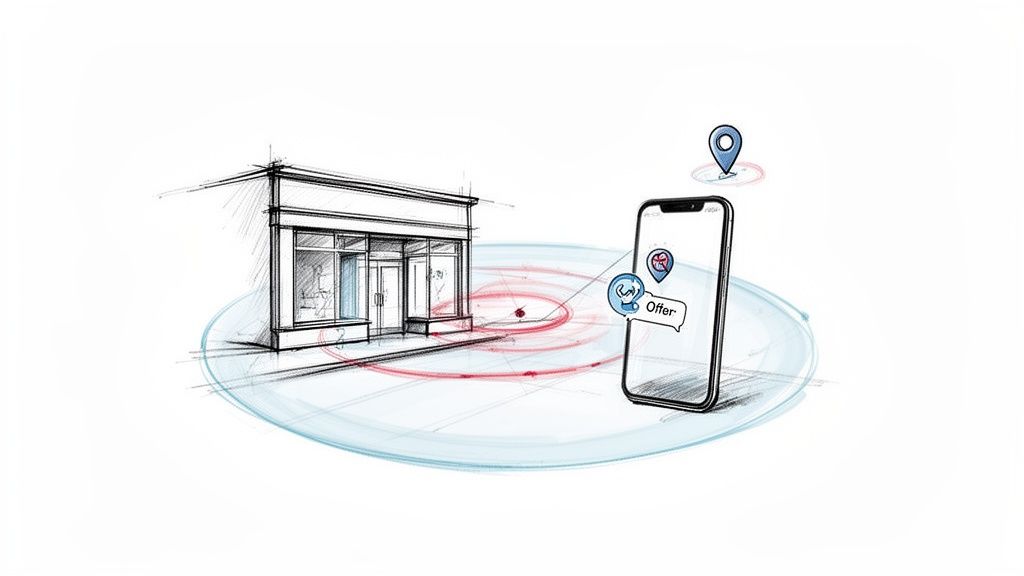
Geofencing creates virtual perimeters around physical locations, triggering targeted ads or notifications on mobile devices when users cross these boundaries. This powerful location-based marketing strategy allows businesses to engage customers with hyperlocal, timely messages, converting proximity into action. It's a proactive way to drive foot traffic, intercept customers near competitor locations, and re-engage visitors who didn't make a purchase.
For multi-location brands, geofencing is exceptionally effective for executing coordinated, store-specific campaigns at scale. A retail chain can simultaneously promote a flash sale to users near all its mall locations, or a wellness franchise can target individuals around nearby gyms and health food stores to drive new patient sign-ups across its entire network.
Why It's a Foundational Strategy
Geofencing transforms a user's physical location into an immediate marketing opportunity. It enables brands to deliver the right message at the perfect moment, such as when a potential customer is just steps away. For example, a cannabis dispensary can set a geofence around a rival’s storefront and push a "20% Off Your First Purchase" ad to users in that zone, directly influencing their buying decision. This precision targeting leads to higher engagement rates and a measurable increase in in-store visits.
Actionable Implementation Tips
To launch a successful geofencing campaign, focus on precision and relevance:
- Define Your Radius Carefully: Start with a tight radius of 100-200 meters around your target locations. A smaller fence ensures you're reaching people with immediate intent and high potential to visit.
- Segment Entry vs. Exit Triggers: Create distinct messages. Welcome users entering your zone with an enticing offer, and retarget those who leave without visiting with a "come back soon" incentive.
- Offer Immediate Value: Your ads should feature time-sensitive offers, like a "happy hour" discount valid for the next hour, to encourage immediate action rather than delayed consideration.
- Track Foot Traffic Lift: Use your ad platform’s conversion tracking to measure the direct impact on in-store visits. This data is crucial for proving ROI and optimizing future campaigns.
3. Local Citation Building & Directory Management
Local citations are online mentions of your business's name, address, and phone number (NAP) on third-party websites, directories, and apps. These mentions act as digital verifications of your physical presence, serving as powerful trust signals for search engines like Google. Consistent and accurate citations across relevant platforms are critical ranking factors that directly support your local SEO efforts.
For multi-location brands, managing citations is a non-negotiable discipline. Each accurate listing on directories like Yelp, Apple Maps, or industry-specific sites reinforces your legitimacy, while inconsistencies create confusion for both customers and algorithms, damaging your search visibility. This foundational strategy ensures your business information is correct wherever potential customers might find you.
Why It's a Foundational Strategy
A robust citation profile broadens your digital footprint beyond your website and Google Business Profile, making your brand discoverable on platforms where customers are already searching. It’s a core component of off-page local SEO that builds authority and corroborates the information you provide to Google. For example, a cannabis dispensary must be accurately listed on Weedmaps and Leafly to reach its target audience, just as a wellness studio needs a presence on Mindbody and ClassPass to attract new clients.
Actionable Implementation Tips
To build a powerful and consistent citation profile, focus on these key actions:
- Conduct a Citation Audit: Begin by identifying all existing online mentions of your business. Use a tool to find inconsistent or incorrect NAP information that needs to be corrected.
- Prioritize High-Authority Directories: Focus your initial efforts on major directories like Google, Apple Maps, and Yelp, followed by hyper-relevant, industry-specific platforms where your target audience is most active.
- Maintain Absolute NAP Consistency: Your Name, Address, and Phone number must be identical across every single listing. This includes formatting details like "St." vs. "Street" or "Suite" vs. "#".
- Use Citation Management Tools: For multi-location businesses, platforms like Yext or BrightLocal are essential for efficiently building, monitoring, and updating listings across dozens of directories at scale.
- Enhance Directory Profiles: Go beyond just NAP. Add location-specific photos, business descriptions, hours of operation, and links back to your local landing pages to enrich your listings.
4. Location-Based Keyword Research & Ranking Tracking
Location-based keyword research is the process of identifying the specific search terms customers in a particular geographic area use to find businesses like yours. Paired with ranking tracking, it allows you to monitor exactly where each of your storefronts appears in search results for those valuable keywords, often down to the neighborhood level. This granular insight is fundamental for any multi-location brand aiming to dominate its local markets.
Without this data, you're essentially flying blind, unable to see how one location performs against another or pinpoint underperforming areas. For instance, a retail chain might discover that while "shoe store downtown" is a top keyword for its city center location, a suburban branch gets more traffic from "kids sneakers near me". This intelligence is the key to creating highly relevant and effective location based marketing strategies.
Why It's a Foundational Strategy
This strategy moves beyond generic keyword performance and provides a true, street-level view of your SEO efforts. It reveals which search terms actually drive in-store visits and online conversions for each specific location, enabling you to allocate marketing resources with precision. For a multi-location dispensary, this could mean discovering that 'cannabis delivery' is the top-performing keyword in one zip code, while 'dispensary deals' is more critical in another, allowing for tailored ad campaigns and landing page content.
Actionable Implementation Tips
To effectively leverage local keyword data, implement these focused actions:
- Focus on High-Intent Local Keywords: Prioritize terms that signal immediate intent, such as those including "near me," specific neighborhood names, or zip codes.
- Track Rankings at a Granular Level: Use tools that offer neighborhood-level visibility, like live ranking heatmaps, to see how your rankings change from one block to the next. Platforms like Nearfront specialize in this multi-location, hyperlocal tracking.
- Analyze Performance vs. Foot Traffic: Connect your keyword ranking data to actual in-store visits and conversion metrics to understand which search terms have the most significant business impact.
- Segment Keywords by Search Intent: Group keywords based on user goals, such as finding directions, checking reviews, looking for product availability, or comparing prices, to better inform your content strategy.
5. Review Generation & Reputation Management
Reviews are a cornerstone of modern location-based marketing strategies, serving as powerful social proof that directly influences both customer decisions and local search rankings. A systematic review generation campaign encourages satisfied customers to share their experiences on platforms like Google, Yelp, and Apple Maps. For multi-location brands, managing reputation consistently across dozens or hundreds of storefronts is essential for building widespread trust and credibility.
The velocity and sentiment of new reviews are critical signals to search engines and potential customers alike. A steady stream of positive feedback validates your business quality, while a thoughtful response to negative feedback demonstrates your commitment to customer service. This constant dialogue builds a resilient online reputation that drives foot traffic.
Why It's a Foundational Strategy
Online reviews are the digital equivalent of word-of-mouth marketing, and their impact is massive. More than 90% of consumers read reviews before visiting a business, making a strong profile a direct driver of revenue. For example, a cannabis dispensary can use its high ratings to stand out in a competitive market, while a wellness studio can leverage glowing testimonials in its ads to attract new members. Actively managing this feedback loop is non-negotiable for local success.
Actionable Implementation Tips
To build a five-star reputation that attracts customers, focus on these key actions:
- Request Reviews at Optimal Touchpoints: Ask for feedback at the peak of customer satisfaction, such as immediately after a successful purchase, a completed appointment, or a positive in-store interaction.
- Simplify the Process: Make it effortless for customers to leave a review. Use QR codes in-store or send one-click links via SMS or email that direct them straight to your preferred review platform.
- Respond to All Reviews Promptly: Aim to reply to every review, both positive and negative, within 24-48 hours. This shows that you value all customer feedback and are actively engaged.
- Monitor and Analyze Trends: Use review management software to track review velocity, average ratings, and recurring themes across all locations. This data can reveal operational strengths and areas for improvement.
To ensure your review acquisition methods are effective and compliant, discover these proven techniques for how to get more Google reviews.
6. Hyperlocal Content Marketing & Location Pages
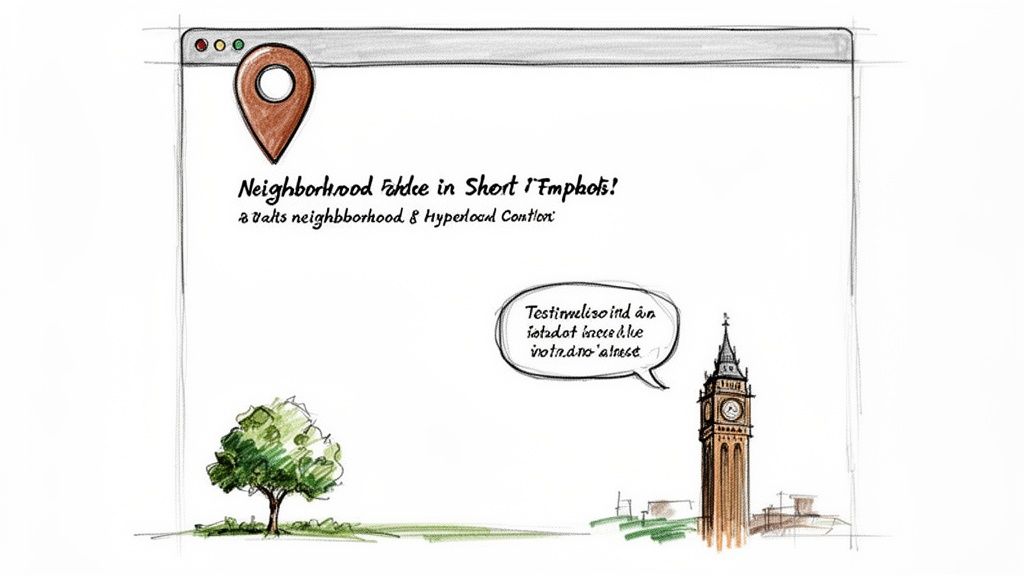
Hyperlocal content marketing moves beyond your Google Business Profile to create dedicated, highly-relevant pages on your own website for each specific location you serve. This involves developing unique landing pages, blog posts, and service pages tailored to the local nuances of each city or neighborhood. By enriching these pages with local keywords, customer testimonials, and area-specific details, you create powerful assets that resonate with both local customers and search engine algorithms.
For brands with multiple storefronts, these location pages are not just an option; they are a competitive necessity. They act as individual digital hubs for each community, providing a tailored user experience that generic corporate websites simply cannot match. This approach is a cornerstone of effective location-based marketing strategies, turning your website into a powerful tool for local customer acquisition.
Why It's a Foundational Strategy
Dedicated location pages allow you to capture long-tail, "near me" search traffic that a single homepage cannot. They provide the specific, relevant information customers are looking for, such as local hours, in-store inventory, and neighborhood promotions, directly improving user experience and driving conversions. For instance, a cannabis dispensary can create neighborhood pages highlighting locally popular strains, while a wellness clinic can feature practitioner bios and patient testimonials from that specific community, building immediate trust and relevance.
Actionable Implementation Tips
To build location pages that rank and convert, implement these key tactics:
- Create Unique, Rich Content: Avoid thin, duplicated content. Each page should feature unique copy about the neighborhood, local landmarks, store-specific photos, and testimonials from local customers.
- Optimize for Local Keywords: Naturally weave in the city, neighborhood, and relevant local terms throughout the page title, headers, body copy, and image alt text to signal geographic relevance to search engines.
- Structure URLs Logically: Use a clean, consistent URL structure that helps both users and search engines understand your site's hierarchy, such as
example.com/locations/neighborhood-name. - Include Location-Specific Details: Ensure each page clearly displays the unique NAP (Name, Address, Phone number), hours of operation, an embedded Google Map, and any local promotions or events.
7. Location-Based Mobile Advertising & Mobile Optimization
Location-based mobile advertising delivers highly relevant ads to users based on their real-time location or past location history, capitalizing on immediate intent. With the vast majority of local searches happening on smartphones, a mobile-first approach is no longer optional. This strategy encompasses everything from mobile search ads to ensuring your website provides a seamless user experience on any device, directly influencing both online conversions and offline store traffic.
For any brick-and-mortar business, neglecting mobile optimization is like closing your doors to over three-quarters of your potential local customers. This aspect of location based marketing strategies bridges the digital and physical worlds, ensuring that a customer searching on their phone can effortlessly find and visit your store.
Why It's a Foundational Strategy
Mobile advertising allows you to reach customers at the precise moment they are looking for a solution nearby. It’s a powerful tool for driving immediate action, whether that's a phone call, a request for directions, or an online order for pickup. For instance, a cannabis dispensary can serve click-to-call ads to users searching "dispensary near me," while a wellness studio can run mobile app install campaigns targeting health-conscious individuals within a five-mile radius.
Actionable Implementation Tips
To effectively leverage mobile advertising and optimization, focus on these critical actions:
- Prioritize Mobile UX: Ensure all your local landing pages are mobile-responsive, load in under three seconds, and feature a clean, intuitive design. Complicated navigation will cost you customers.
- Implement Mobile-First CTAs: Add prominent click-to-call buttons so phone numbers are tappable. Also, include "Get Directions" buttons that open directly in Google Maps or Apple Maps.
- Craft Location-Specific Ad Copy: Use dynamic ad copy that includes the user's city or neighborhood and creates urgency, such as "Visit our downtown store, open until 9 PM."
- Optimize for Voice Search: Structure your content to answer common conversational queries that customers might ask Siri or Google Assistant, like "Where can I find the best yoga studio near me?"
- Track Mobile-Specific Metrics: Analyze mobile conversion data separately from desktop to understand user behavior. Track calls, direction requests, and mobile-initiated store visits to measure ROI accurately.
8. Local Link Building & Community Partnerships
Local link building is the practice of acquiring hyperlinks from other websites within your specific geographic area. These hyperlocal backlinks from community blogs, local news outlets, neighborhood directories, and nearby businesses act as powerful trust signals for search engines like Google. They validate your business’s physical connection to the community, boosting your local search authority.
For multi-location brands, this strategy extends beyond pure SEO. Forging community partnerships and engaging in local events generates these valuable links organically while simultaneously building brand recognition and goodwill. This approach integrates digital marketing with genuine, on-the-ground community involvement, creating a powerful synergy that online-only competitors cannot replicate.
Why It's a Key Strategy
Local links are a critical ranking factor for local SEO because they provide geographic relevance that generic backlinks cannot. When a respected local source links to your business, it tells Google you are a legitimate and important part of that community. For instance, a wellness studio that partners with local health food blogs and nutritionists for reciprocal links gains not only SEO value but also direct referrals from a highly relevant audience. Similarly, a cannabis dispensary featured in a neighborhood guide reaches potential customers who live and work nearby, driving immediate foot traffic.
Actionable Implementation Tips
To build a strong local backlink profile, focus on community engagement:
- Sponsor Local Events: Get involved in community festivals, charity runs, or farmers' markets. Sponsorships almost always include a link from the event’s website, a highly relevant local signal.
- Join Business Associations: Become a member of your local Chamber of Commerce or other business improvement associations. These memberships typically come with a listing and link in their directory.
- Partner with Complementary Businesses: A local retail boutique could partner with a nearby salon for a joint promotion, with each business linking to the other’s website as a recommended partner.
- Create Newsworthy Stories: Pitch local news outlets and bloggers about your grand opening, a community involvement initiative, or a unique product launch. A featured story can generate a high-authority local link.
9. Multi-Location Performance Analytics & Attribution Modeling
Data is the backbone of effective location-based marketing strategies, especially for multi-location brands. Multi-location performance analytics involves tracking how each individual store performs across all marketing channels, from local search to social media. Attribution modeling then connects online actions like searches, clicks, and calls to valuable offline outcomes such as foot traffic and in-store sales, revealing the true ROI of your digital efforts.
For organizations with dozens or hundreds of locations, this isn't just a best practice; it's a necessity. Centralized dashboards that aggregate performance across all storefronts while still allowing for location-level drill-downs are essential. This visibility allows you to identify top-performing locations, troubleshoot underperformers, and uncover successful tactics that can be scaled across the entire brand.
Why It's a Foundational Strategy
Without robust analytics and attribution, your marketing decisions are based on guesswork. You can’t know which locations need more budget, which strategies are driving actual store visits, or why one location outranks another for the same target keywords. For example, a retail chain might discover that specific locations drive 5x more foot traffic from Google Maps and can reallocate ad spend accordingly. Similarly, a wellness studio franchise can identify a high-performing location's GBP strategy and replicate it to boost appointments at other studios.
Actionable Implementation Tips
To turn raw data into strategic insights, focus on these critical actions:
- Standardize Your KPIs: Create a standardized Key Performance Indicator (KPI) dashboard that tracks metrics like local pack rankings, GBP clicks, direction requests, phone calls, and store visits for every location.
- Track Frequently: Move beyond monthly reports. Track performance on a weekly or bi-weekly basis to identify and react to changes quickly, such as a sudden drop in rankings or a spike in negative reviews.
- Connect Online to Offline: Set up conversion tracking for all key location-based actions. Use tools that measure store visits to attribute foot traffic directly to specific digital marketing campaigns.
- Foster Internal Competition: Share performance reports with individual location managers. This drives accountability and helps identify local best practices that can be shared across the organization.
For a deeper dive into the necessary tools, explore this guide on local SEO reporting tools for multi-location brands.
10. Voice Search & AI Assistant Optimization + Local Email Marketing & Customer Retention
The rise of voice assistants like Siri, Alexa, and Google Assistant has fundamentally changed how consumers search for local businesses. This strategy prepares your brand to be the answer to conversational queries like "Where's the best yoga class near me?" while simultaneously using location-specific email marketing to nurture and retain the customers you attract. It's a two-part approach that captures high-intent voice traffic and then builds long-term loyalty.
By optimizing for the natural, question-based language people use when speaking to their devices, you position your business to be found in crucial, screen-less moments. This is then powerfully combined with email campaigns segmented by a customer's preferred or most-visited location. This ensures that your follow-up communication is hyper-relevant, driving repeat visits and reinforcing brand affinity.
Why It's a Foundational Strategy
This dual strategy connects the dots between initial discovery and long-term customer value. Voice search is often the first touchpoint for a customer with an immediate need. For instance, a wellness studio that appears in a voice search for "emergency yoga class near me" can capture a new member. Following their visit, a location-specific email with that studio’s unique class schedule and instructor bios creates a personalized experience that encourages them to return. This integrated approach ensures you don’t just acquire customers; you build a loyal local community.
Actionable Implementation Tips
To capture voice search traffic and boost local retention, implement these tactics:
- Target Conversational Keywords: Structure your website content, especially FAQ pages, around full-question keywords people actually speak (e.g., "What time does [Your Store Name] in [City] close?").
- Optimize for 'Near Me' Queries: Ensure your Google Business Profile and local landing pages are meticulously optimized with accurate address and service area information to rank for implicit and explicit "near me" searches.
- Build Location-Based Email Segments: Use your POS or CRM data to segment your email list based on which physical location a customer has visited. This is a cornerstone of effective location-based marketing strategies.
- Personalize Email Content: Send hyper-targeted promotions, event invitations, and operational updates relevant only to a specific store's audience. A subject line like "A Special Offer for our Downtown LA Visitors" is far more effective than a generic blast.
10-Point Location-Based Marketing Comparison
| Strategy | 🔄 Implementation Complexity | 💡 Resource Requirements | 📊⭐ Expected Outcomes | ⚡ Key Advantages |
|---|---|---|---|---|
| Google Business Profile Optimization & Local Pack Rankings | 🔄 Moderate — ongoing updates & multi-location consistency | 💡 Low cost; time for photos, reviews, dashboard management | 📊⭐ Higher Map Pack visibility; more calls/directions; profile actions | ⚡ Direct local visibility; free to maintain; actionable insights |
| Geofencing & Proximity Marketing | 🔄 High — geo-setup, permissions, campaign ops | 💡 Moderate–high: ad spend, location data, creative, platforms | 📊⭐ Immediate foot-traffic lifts; measurable attribution | ⚡ Hyperlocal, moment-driven targeting; strong conversion potential |
| Local Citation Building & Directory Management | 🔄 Medium — audits, submissions, cleanup | 💡 Low–medium: listing tools, manual updates, time | 📊⭐ Improved local trust and rankings; broader directory presence | ⚡ Foundation for local SEO; supports voice and map lookups |
| Location-Based Keyword Research & Ranking Tracking | 🔄 Medium — tool setup and ongoing analysis | 💡 Medium: specialized tracking tools, analyst time | 📊⭐ Data-driven keyword priorities; neighborhood-level insights | ⚡ Prioritizes optimizations; uncovers local intent opportunities |
| Review Generation & Reputation Management | 🔄 Medium — compliant automation + response workflows | 💡 Low–medium: review platforms, staff for replies | 📊⭐ Higher ratings, social proof; ranking and conversion uplift | ⚡ Strong impact on purchase decisions; high ROI potential |
| Hyperlocal Content Marketing & Location Pages | 🔄 High — content scale, unique page creation | 💡 High: content production, SEO, design, maintenance | 📊⭐ Better local SERP relevance; improved engagement & conversions | ⚡ Tailored UX per location; long-term organic growth |
| Location-Based Mobile Advertising & Mobile Optimization | 🔄 Medium — ad builds + mobile UX work | 💡 Medium–high: ad spend, mobile dev, analytics | 📊⭐ Increased mobile conversions, calls, and direction requests | ⚡ Captures on-the-go intent; click-to-call and fast actions |
| Local Link Building & Community Partnerships | 🔄 High — outreach and relationship building | 💡 Low–medium: outreach time, sponsorships, events | 📊⭐ Local authority signals; referral traffic and PR mentions | ⚡ Builds trust and community-driven links; local credibility |
| Multi-Location Performance Analytics & Attribution Modeling | 🔄 High — integration, tracking, and modeling complexity | 💡 High: analytics platforms, tracking pixels, analysts | 📊⭐ Actionable insights; optimized budget allocation; location benchmarking | ⚡ Enables scalable, data-driven decisions and reporting |
| Voice Search & AI Assistant Optimization + Local Email Marketing & Customer Retention | 🔄 Medium–high — conversational content + segmented email flows | 💡 Medium: schema, content, email tools, data segmentation | 📊⭐ Better voice visibility; increased repeat visits and retention | ⚡ Captures conversational queries; drives personalized repeat business |
From Strategy to Action: Building Your Local Marketing Engine
You now have a comprehensive playbook of the most effective location based marketing strategies available today. We've navigated the foundational pillars of local SEO, like optimizing your Google Business Profile and managing citations, and explored advanced tactics such as geofencing, hyperlocal content, and sophisticated attribution modeling. The journey from a curious local searcher to a loyal in-store customer is mapped, measured, and influenced by these very techniques.
The overarching theme is clear: success in local marketing is not about a single campaign or a one-time optimization. It's about building a sustainable, interconnected engine. Your GBP listings, review management, location pages, and targeted ads aren't isolated efforts; they are gears in a machine, each one turning the next. A powerful review on Google reinforces the click-through rate from your Local Pack ranking, which is supported by consistent citation data and validated by hyperlocal content on your website.
Weaving the Threads: Prioritization and Implementation
Embarking on all ten strategies simultaneously can feel overwhelming. The key is strategic, phased implementation. Your immediate priority should be establishing a flawless foundation.
-
Phase 1: The Non-Negotiable Foundation. Before you spend a dollar on ads, master your owned assets. This means meticulous optimization of every Google Business Profile, a full audit and cleanup of your local citations for NAP consistency, and implementing an automated system for review generation. This is your digital storefront; it must be pristine.
-
Phase 2: Active Engagement and Content. With your foundation solid, shift focus to creating signals of local relevance. Develop your hyperlocal content strategy by creating unique location pages that speak to each community. Begin building local links through partnerships and community involvement. This phase is about proving to search engines and customers that you are an authentic part of the neighborhood.
-
Phase 3: Amplification and Precision Targeting. Now, you're ready to amplify your presence. Introduce location-based mobile advertising like geofencing campaigns to capture competitor foot traffic or target specific event attendees. Refine your analytics to connect digital actions to physical visits, moving from basic metrics to true attribution modeling. This is where you scale your successes and optimize your budget with surgical precision.
The True Value of a Local-First Approach
Adopting these location based marketing strategies does more than just boost rankings or drive foot traffic. It fundamentally changes the relationship between your brand and the communities you serve. You move from being a generic option to a recognized local staple. You're not just a "retail store near me"; you become the trusted neighborhood spot for your product or service.
Key Takeaway: A successful local strategy is a continuous feedback loop. You implement tactics based on data, measure their impact on a location-specific basis (tracking calls, clicks, and store visits), and then use those insights to refine your approach. This cycle of implementation, measurement, and optimization is what separates market leaders from the competition.
By building this engine, you create a defensible competitive advantage that is incredibly difficult for less-focused brands to replicate. You're not just winning a search query; you're winning the neighborhood. You are building a resilient business that thrives by creating genuine connections, one location, one customer, and one positive interaction at a time. The path forward is clear: start with your foundation, measure what truly matters, and never stop optimizing for the local customer.
Ready to stop guessing and start measuring the true impact of your local marketing? Nearfront provides the neighborhood-level analytics you need to see which of these location based marketing strategies are actually driving calls, clicks, and in-store visits for each of your locations. See exactly what’s working and where to focus your efforts by visiting Nearfront to learn more.