Local marketing isn't about shouting your message to the entire world. It's the art of becoming the obvious choice for the people right around the corner who are already looking for what you sell.
Think of it as focusing your efforts on customers within a specific, intentional radius of your shop or service area. It’s about being the first name that comes to mind when someone nearby needs you.
Why Local Marketing Is Your Untapped Superpower
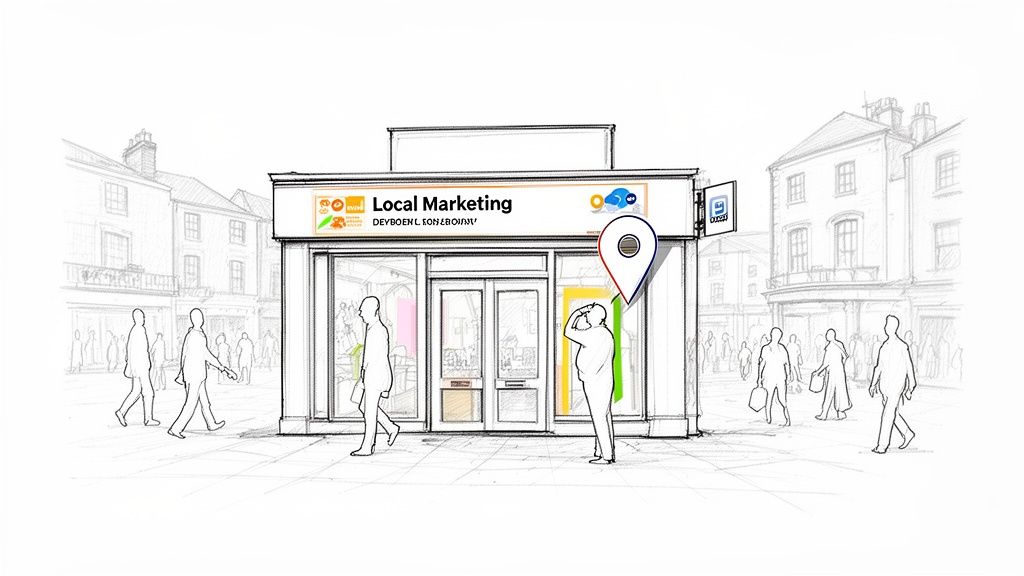
Imagine your perfect customers walking past your digital front door every single day without ever realizing you're there. That's exactly what happens when a small business ignores its local marketing. This guide is here to turn what feels like a chore into your most powerful tool for attracting real, ready-to-buy customers.
Your business's online presence is like setting up shop in a busy town square. To draw people in, you need clear signs, a great location, and a reputation people trust. Without them, you’re practically invisible.
Connecting With Customers Next Door
At its core, local marketing is about showing up where it matters most: in your own backyard. It’s the difference between casting a huge, expensive net into the open ocean and using the perfect bait to catch the fish swimming right off your dock. These customers are more likely to convert because they're close by and often need a solution now.
This has never been more critical. Around 80% of consumers use search engines to find local information, and a jaw-dropping 46% of all Google searches have local intent. That's nearly half of all searchers looking for nearby businesses, creating a massive pool of potential customers actively trying to find you.
Local marketing isn't just about being found; it's about being chosen. It builds the kind of trust and community rapport that big national brands can only dream of.
Building Your Local Foundation
To win, you have to nail a few core principles that make you the go-to choice in your neighborhood. This article is your playbook for making your business visible, trusted, and ultimately, preferred by the customers who actually drive your revenue. We’ll walk through exactly how to build a dominant presence by mastering the essentials of marketing a small business locally.
The Three Pillars of Local Online Visibility
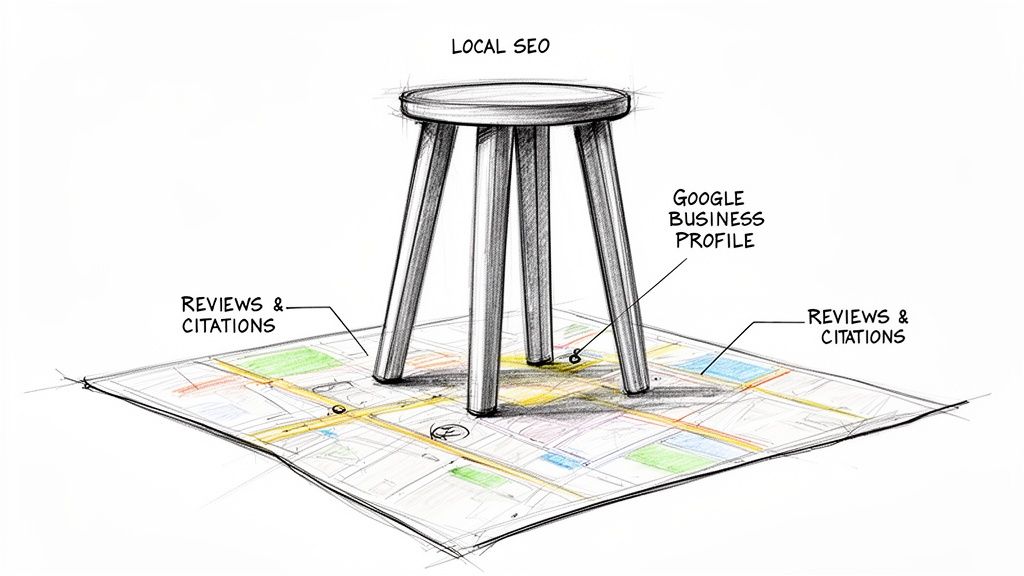
To really dominate your local market, you need a strong foundation. I like to think of a successful local strategy as a three-legged stool—if one leg is wobbly or missing, the whole thing comes crashing down.
These three pillars are your Local SEO, your Google Business Profile (GBP), and your Online Reviews & Citations. Getting them to work together is the secret sauce to becoming the first and only choice for customers searching nearby.
Let's break down exactly what each one does and why it's so critical.
Pillar 1: Local SEO – Your Digital Signpost
Local SEO is how you get found by people who are actively looking for what you offer, right in your neighborhood. It's the digital version of putting up a massive, well-lit sign on a busy street corner that points straight to your door. You’re telling search engines like Google, “Hey, I’m right here, and I’m the best answer for this service in this area.”
When someone searches for "plumber near me" or "best coffee shop downtown," local SEO is what gets your business to show up in those top results. Without it, you’re basically invisible to the people who are ready to buy. This all comes down to using location-specific keywords on your website and making sure all your online info matches your physical address perfectly.
A bakery in Brooklyn, for instance, would weave phrases like "Brooklyn birthday cakes" or "artisan sourdough Red Hook" into its website. This sends a crystal-clear signal to Google that they don't just sell bread; they serve a specific local community. That's what gets them in front of the right eyes.
Pillar 2: Google Business Profile – Your Digital Storefront
If you only focus on one thing, make it your Google Business Profile. It is, without a doubt, the single most powerful tool in your local marketing arsenal. This is the free, interactive business card that shows up in Google Search and on Google Maps, and it’s often a customer's very first impression of you.
Think of it as your digital storefront window.
It’s where potential customers find everything they need in a single glance:
- Your address and phone number, so they can find and call you.
- Your hours of operation, so they don’t show up to a locked door.
- Photos of your business, your products, and your team.
- Customer reviews that provide instant social proof.
A neglected GBP is like a shop with a broken sign and dusty windows—it just screams "don't come in." But a well-managed, fully optimized profile is inviting. It gives customers the confidence they need to call, get directions, or visit your website.
Pillar 3: Online Reviews & Citations – Your Digital Word-of-Mouth
The third pillar is all about building trust and credibility across the entire internet. This is your digital reputation, built on two key components: online reviews and citations.
Citations are simply mentions of your business's name, address, and phone number (often called NAP) on other websites like Yelp, TripAdvisor, or industry directories. The key here is consistency. Every matching citation is another vote of confidence that tells Google you are a legitimate, established local business.
Reviews, especially on Google, are absolute gold. A steady stream of positive, recent reviews directly impacts your ranking and is often the final nudge a potential customer needs to choose you over a competitor. Let's be real—how often do you choose a local business without first checking the reviews?
These pillars aren't islands; they're deeply connected. Great local SEO sends searchers to your optimized Google Business Profile, where your glowing reviews seal the deal. It’s a powerful feedback loop that builds momentum, solidifies your authority, and makes you the go-to choice for local customers.
To make this even clearer, here's a quick breakdown of how these essential pieces fit together.
Core Components of a Local Marketing Strategy
| Pillar | Primary Function | Key Action Item |
|---|---|---|
| Local SEO | Increases visibility in geographically-specific searches. | Optimize your website's pages with location-based keywords (e.g., "HVAC repair in Miami"). |
| Google Business Profile (GBP) | Serves as your primary digital storefront on Google Search & Maps. | Fully complete every section of your profile, add high-quality photos, and use Google Posts weekly. |
| Reviews & Citations | Builds trust, credibility, and verifies your business information. | Create a simple, repeatable process for asking every satisfied customer to leave a Google review. |
Nailing these three areas is non-negotiable for any small business that wants to win locally. They are the engine of your customer acquisition efforts.
Your Channel-by-Channel Local Marketing Playbook
Okay, you’ve built a solid foundation with the three pillars of local visibility. Now it’s time to put that strategy into action. This is where the theory stops and the real work begins—channel by channel, tactic by tactic.
The goal isn't to be everywhere at once. It's about picking the right channels and running simple, high-impact plays that get real results, whether that’s more foot traffic or a ringing phone.
Weave Your Business into the Community with Local Content
Local content isn't about churning out generic blog posts. It’s about becoming a genuinely useful local resource and embedding your business into the community’s story. You’re not just in a town; you are part of the town.
Your content needs to answer the questions and reflect the interests of your specific neighborhood. This sends a powerful signal to both customers and search engines that you are deeply, undeniably relevant to the area.
Here are a few ideas to get you started:
- Create a Community Events Calendar: Write a monthly blog post or build a dedicated page highlighting the best local events, from the weekend farmers' market to high school football games.
- Spotlight Other Local Businesses: Interview the owner of that popular coffee shop next door or feature a business that complements yours. This builds goodwill and, just as importantly, valuable local backlinks.
- Develop Neighborhood-Specific Guides: A real estate agent could create a guide to the "Best Parks in the Northgate Neighborhood." A restaurant might write about "The Perfect Date Night Itinerary in Downtown."
This approach transforms your website from a simple brochure into a go-to hub for local info, attracting exactly the kind of nearby customers you want.
Engage Your Neighbors on Local Social Media
For a local business, social media works differently. Your goal isn’t to go viral worldwide; it's to become a familiar, trusted face in your community. Forget massive follower counts—what matters is real engagement with people who can actually walk through your door.
This takes a shift in mindset. You're hosting a digital block party, not giving a global press conference.
The key is to be a good neighbor online. Jump into local conversations, celebrate community wins, and give people a place to connect. Your social media should feel like an extension of your storefront—welcoming, helpful, and genuinely part of the neighborhood.
Start with these simple tactics:
- Join and Participate in Local Facebook Groups: Get active in your town's community groups. Answer questions, offer helpful advice (without a hard sell), and become a recognized local expert.
- Run Geo-Targeted Promotions: Use Instagram or Facebook ads to run a special offer exclusively for people within a 5-mile radius of your business.
- Partner with Local Influencers and Organizations: Team up with a local food blogger or sponsor a Little League team, then share the partnership across your social channels.
Drive Repeat Business with Targeted Email and SMS
Email and SMS are your direct lines to your most loyal customers. While other channels focus on attracting new people, these are all about nurturing the relationships you already have and driving repeat visits. When a customer gives you their email or phone number, they're trusting you with direct access—don't waste it.
This is where you can use your knowledge of local interests and seasonality to your advantage. A generic email blast falls flat, but a location-specific offer feels personal and valuable.
For example:
- An HVAC company could email its local list right before the first summer heatwave, offering a discount on AC tune-ups.
- A retail boutique can text its VIP list about a flash sale happening this weekend only at their physical store.
- A cafe can email customers a coupon for a free coffee on a rainy Tuesday to drive some mid-week foot traffic.
This targeted approach deepens your connection to the community and delivers immediate, measurable results.
Amplify Your Reach with Local Paid Advertising
Organic efforts are your foundation, but targeted paid advertising can give you a serious boost when you need it. Small business owners are getting more confident here; in fact, 63% plan to increase their marketing budget in the next year. It makes sense, as 82% of small businesses agree that using multiple channels gets better results, and paid ads are a huge part of that mix.
Don’t think of paid ads as a massive expense. Think of them as a tool for precision targeting. Instead of wasting money on a broad audience, you can focus your budget on people in specific zip codes who have already shown interest in services like yours. You can explore our complete guide on how to leverage Google Ads for local business to see exactly how to get started.
Finding and Fixing Your Local Visibility Gaps
Ever wonder why a competitor just a few blocks away seems to own the local search results, while your business is practically invisible? It’s a frustratingly common problem, and it points to what we call search visibility gaps.
These gaps are specific neighborhoods, or even city blocks, where potential customers just don't see you when they search. You might be #1 for "best tacos" when someone is standing on your doorstep, but completely off the map for someone searching a mile down the road. This isn't a glitch; it's exactly how Google's hyper-local algorithm is designed to work.
Why Local Visibility Is Not a Blanket
Think of your online visibility less like a blanket covering the whole city and more like a series of spotlights. Right around your physical address, that spotlight is bright and intense. But the farther you get, that light dims or disappears entirely, creating pockets of darkness where customers can't find you.
Your competitor might have a brighter spotlight in those dark zones—not because they're a better business, but because they've done a better job sending strong "local relevance" signals to Google from those specific areas. Closing these gaps is one of the most powerful ways to get a real leg up on the competition.
Diagnosing Your Invisibility with a Heatmap
First things first: you have to see where you're actually showing up. Guessing is a waste of time and money. What you need is a visual map of your search rankings across your entire service area, and that’s where a local rank heatmap becomes your best friend.
Picture a map of your city painted in colors. Green means you’re ranking high, yellow means you're on the bubble, and red means you’re invisible. This isn't just a pretty chart; it's your strategic battle plan. It shows you exactly where you're losing customers and where your marketing dollars need to go.
This kind of visualization shows you the opportunities hiding in plain sight.
With a heatmap, you can stop wasting resources on areas where you're already strong and start zeroing in on your weakest zones. You can learn more about how a local SEO ranking checker helps pinpoint these exact gaps.
Closing Gaps with Hyper-Local Engagement Signals
Okay, so you've found your red zones. Now what? The key is to generate authentic, hyper-local engagement signals that prove to Google you're a relevant player in those specific neighborhoods.
Google's algorithm is smart—it watches user behavior like a hawk. When people in a certain area consistently interact with your business online, it tells Google you're a popular and trusted choice for that community.
The goal is to create a digital footprint that mirrors real-world customer activity from your target neighborhoods. You need to simulate the online behaviors of local customers to convince Google of your relevance there.
These are the signals that really move the needle:
- Searches for Your Brand: People in a target neighborhood searching directly for your business name.
- Profile Clicks: Users in that area clicking on your Google Business Profile from the Map Pack.
- Phone Calls: Customers calling you right from your profile.
- Direction Requests: People clicking the "Directions" button to get a route to your location.
Generating these signals from your weak zones sends a powerful message to Google: "Hey, people from this neighborhood are interested in this business." Do that consistently, and you'll watch those red zones on your heatmap turn yellow, and then green.
A Practical Playbook for Fixing Gaps
Fixing these gaps isn’t about general SEO; it requires a deliberate, geographically-focused strategy. It's about micro-targeting your efforts where they'll make the biggest difference.
- Identify Your Top 3 "Red Zones": Use a heatmap tool to find the three most valuable neighborhoods where your visibility is lowest. Don't boil the ocean; start small.
- Create Neighborhood-Specific Content: Write a blog post like "Our 5 Favorite Lunch Spots in the Arts District." This creates a direct digital connection between your brand and that location.
- Run Geo-Fenced Ads: Launch a small social media ad campaign that targets users only within the zip codes of your red zones. The goal of the ad isn't just brand awareness; it's to drive clicks to your Google Business Profile.
- Generate Authentic Engagement: Use a platform like Nearfront to simulate authentic user engagement signals originating from these specific geographic areas. This is the most direct way to influence how Google perceives your relevance in those zones.
By systematically finding and fixing these visibility gaps, you stop competing on a level playing field and start creating an unfair advantage. You're no longer just hoping to be found; you're strategically ensuring you're the top choice in every neighborhood that matters.
Measuring The Metrics That Actually Matter
There's an old saying: if you can't measure it, you can't improve it. In local marketing, that's the absolute truth. Without clear data, you’re basically just guessing, throwing tactics at the wall and hoping something sticks.
To figure out what’s actually working, you have to cut through the noise. Forget about vanity metrics like social media likes or overall website traffic for a second. They might look nice on a report, but they don't tell you if you're attracting customers who can actually walk through your door.
Your focus should be on the specific actions that prove a nearby customer is ready to pull out their wallet.
Moving Beyond Vanity Metrics
The most important data in local marketing isn't hiding in a complicated analytics report. It's sitting right inside your Google Business Profile insights and your local search rankings. These are the numbers that connect your online presence to real-world customer behavior in your service area.
Tracking the right KPIs lets you create simple before-and-after snapshots of your performance. It makes it dead simple to see your return on investment and justify every minute and dollar you put into your local strategy.
Here are the core metrics you absolutely have to watch:
- Google Map Pack Rankings: Think of this as your visibility score. Are you showing up in the top 3 map results when people search for your most important keywords in the neighborhoods that matter?
- Phone Calls from GBP: This is a direct lead, plain and simple. It counts how many potential customers saw your profile and hit the "call" button, which is a huge sign of purchase intent.
- Driving Direction Requests: This one is a powerful predictor of foot traffic. It shows how many people are actively trying to get to your physical location.
- Website Clicks from GBP: This tracks how many people jumped from your Google profile to your website, likely looking for more information before making a decision.
By focusing on these action-oriented metrics, you shift from hoping for results to actively measuring the behaviors that lead directly to sales. This is the difference between activity and achievement.
Setting Realistic Goals And Tracking Progress
Once you know what to measure, you can start setting real, achievable goals. Maybe your first goal is to boost phone calls from your Google Business Profile by 20% over the next three months. Or maybe you want to crack the top 3 in a specific neighborhood where you're currently invisible.
This data-driven approach helps you make much smarter decisions. If you see a local blog post drove a big spike in website clicks from your profile, you know that’s a play worth running again. If your geo-targeted ads are lighting up your direction requests, you have clear proof to increase your spend.
Key Performance Indicators for Local Marketing
To make it even clearer, this table breaks down the most important local marketing KPIs, what they tell you, and the best tools to keep an eye on them.
| Metric (KPI) | What It Measures | Primary Tool for Tracking |
|---|---|---|
| Local Search Rankings | Your visibility in specific neighborhoods for target keywords. | A local rank tracker like Nearfront Heatmaps |
| GBP Phone Calls | The number of direct leads generated from your profile. | Google Business Profile Insights |
| Direction Requests | The intent of potential customers to visit your physical location. | Google Business Profile Insights |
| Customer Reviews | The quality and quantity of social proof and customer trust. | Google Business Profile |
Ultimately, tracking these specific metrics is how you stop guessing and start proving that your local marketing is a direct driver of business growth. It's how you turn your efforts into a predictable engine for new customers.
Common Local Marketing Mistakes To Avoid
Getting local marketing right often comes down to knowing what not to do. You can have a brilliant strategy on paper, but a few common slip-ups can quietly kill your momentum, costing you visibility and, ultimately, customers.
These mistakes are surprisingly easy to make. The good news? They're just as easy to fix once you know what you’re looking for. Let’s walk through the big ones.
Neglecting Your NAP Consistency
This is one of the most common and damaging mistakes we see: inconsistent NAP (Name, Address, Phone Number) information scattered across the web. Think of your NAP as your business’s digital fingerprint. If it looks a little different on your website versus your Google Business Profile, Yelp, or some other random directory, you're sending confusing signals to search engines.
That confusion directly hurts your rankings. Google wants to show searchers businesses it can trust, and consistent data is a massive proof point. An old phone number on one listing or a tiny variation in your business name on another is enough to create doubt and knock you down the search results.
Key Takeaway: Do a quick audit of your most important online listings. Make sure your business name, address, and phone number are absolutely identical everywhere. It's a simple fix that sends a powerful trust signal to Google.
Ignoring Your Online Reviews
Leaving your customer reviews—good or bad—unanswered is like leaving the front door of your shop wide open with nobody inside. A staggering 93% of consumers report that online reviews influence their decisions. When you don't respond, you’re throwing away a free opportunity to manage your reputation and connect with customers.
Replying to positive reviews shows you value your customers and encourages others to chime in. But more importantly, tackling negative feedback head-on, publicly and professionally, shows you're accountable. It can even turn an unhappy customer into a loyal one. Ignoring them just lets the negative story write itself.
Forgetting Who You Are Talking To
Another classic blunder is creating generic content that doesn't speak to your local community. A blog post about a national trend might get a few clicks, but it does absolutely nothing to signal your local relevance to Google or to potential customers in your area.
You have to ground your content in your community.
- Talk about local events: Sponsoring a local 5K? Write a post about it.
- Create neighborhood-specific guides: A local roofer could write a guide to "Choosing the Right Shingles for Colorado Hail Season."
- Highlight other local businesses: Feature a coffee shop you partner with or a supplier you love.
This kind of content proves you’re an active part of the community, not just another faceless business. That's a huge differentiator that both customers and search engines reward. True local marketing means joining the local conversation.
Your Top Local Marketing Questions, Answered
Jumping into local marketing always brings up a few key questions. Let's tackle the ones we hear most from business owners so you can move forward with a clear plan.
How Long Does It Take to See Results?
This is the big one, isn't it? While you can get some quick wins in just a few weeks (like more calls from an optimized Google Business Profile), building real, lasting visibility is more of a marathon than a sprint. Climbing the search rankings in a competitive area usually takes 3 to 6 months of consistent work.
The key word here is consistency. Where you're starting from, how tough your industry is, and who you're up against all play a role. The important thing is to track your progress from the start so you can see the momentum building.
Do I Need a Physical Storefront?
Not at all. Local marketing is a powerhouse for service-area businesses—think plumbers, consultants, or mobile pet groomers. Instead of listing a storefront address, you simply define your service area right in your Google Business Profile.
Your goal is exactly the same: show up when customers in your territory search for what you do. You're just targeting a geographic region instead of a single brick-and-mortar spot.
How Much Should a Small Business Budget?
There's no single magic number, but a good rule of thumb is to put 7-10% of your revenue toward marketing. That said, you can get started with a much smaller budget or even by just investing your own time.
If you're just starting out, focus on the high-impact stuff that doesn't cost a dime:
- Completely fill out and optimize your Google Business Profile.
- Make it a habit to ask every happy customer for a review.
- Create one new piece of locally-focused content each month.
The most important thing is to just get started. Measure what's working, and then double down on the strategies that bring a real return for your business.
Ready to stop guessing and see exactly where you stand in the neighborhoods that matter most? Nearfront gives you the tools to spot your visibility gaps and generate the engagement signals you need to close them. Discover how our platform can accelerate your local marketing results.