
Think of your business less like a shelf in some massive, anonymous supermarket and more like a stall at a vibrant farmer's market. That's the essence of local business lead generation. It's the art of getting in front of people right around the corner who are already looking for what you sell. Forget casting a wide, national net. This is all about proximity, community trust, and driving immediate action.
What Is Local Business Lead Generation
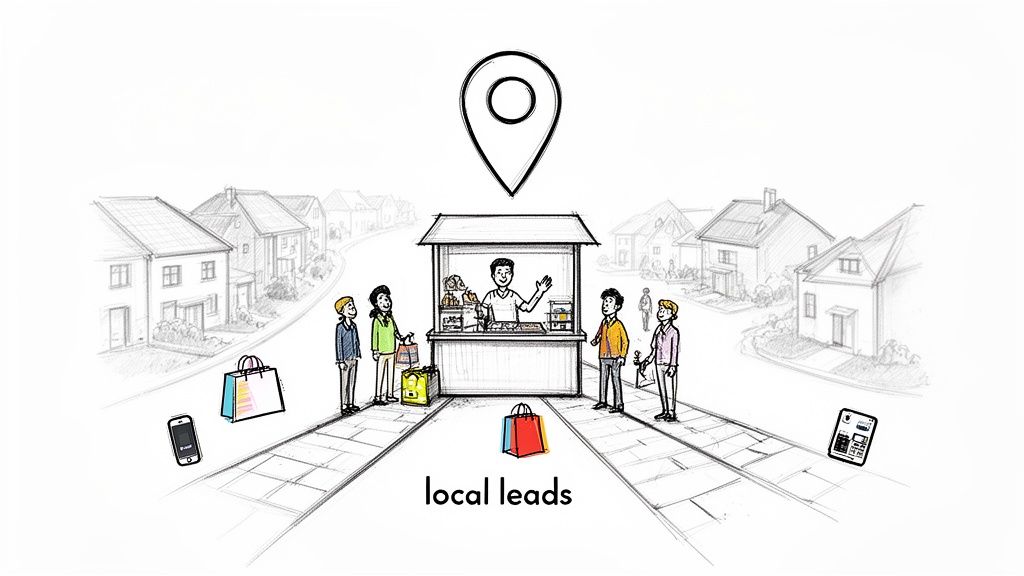
In a nutshell, local business lead generation is any marketing move you make to pull in potential customers from a specific geographic area. We could be talking about a single neighborhood, a whole city, or a defined service radius around your shop. It's about building a digital storefront that perfectly mirrors your physical one, making sure you’re the first one people see when they need you now.
The goal here isn't just brand awareness; it's about sparking real actions from people who can actually walk through your door or book your service. A national e-commerce brand can chase website traffic from anywhere. But a local plumber? They need calls from homeowners right in their service area. That crucial difference is what makes local lead gen its own unique, vital discipline.
The Three Pillars of Local Success
To really nail lead generation in your own backyard, your strategy needs to stand on three pillars. If one is shaky, the whole thing gets wobbly, and you'll start losing potential customers through the cracks. They all work together to build an unmissable local presence.
- Dominating Local Search: This is all about showing up at the top when someone searches "plumber near me" or "best coffee in downtown." It means dialing in your online profiles—especially Google Maps—to grab those high-intent searchers right when they're ready to buy.
- Creating Neighborhood-Focused Content: This is marketing that speaks the local language. You go beyond generic service descriptions and create content about community events, neighborhood guides, or case studies featuring local clients. You become part of the local conversation.
- Building Community Ties: This is where digital meets the real world. Sponsoring a little league team, partnering with the bakery next door, or getting active in neighborhood Facebook groups. It’s about building trust and becoming a familiar, reliable name.
The real magic of local lead generation is that it takes you out of the running against global competition. A new restaurant owner wants to hire a local web designer who gets the city’s vibe and regulations, not some faceless national firm. You instantly become the insider.
Why Local Intent Matters
The game-changer for local marketing is search intent. Someone frantically Googling "emergency roof repair" is in a completely different headspace than someone browsing "DIY roofing tips." Local lead generation is built to capture that urgent, high-intent audience.
These people aren't just window shopping; they need a solution, and they need it fast. The data doesn't lie: local searches convert at a ridiculously high rate. In fact, a huge percentage of "near me" searches lead to a store visit within just 24 hours. That immediacy is the engine that drives local business growth, turning online searches into actual foot traffic and revenue. This guide will show you exactly how to build that engine.
Winning the Neighborhood with Local SEO
If local business lead generation is the goal, then Local SEO is the engine that gets you there. It’s all about making your business impossible to miss in location-based searches.
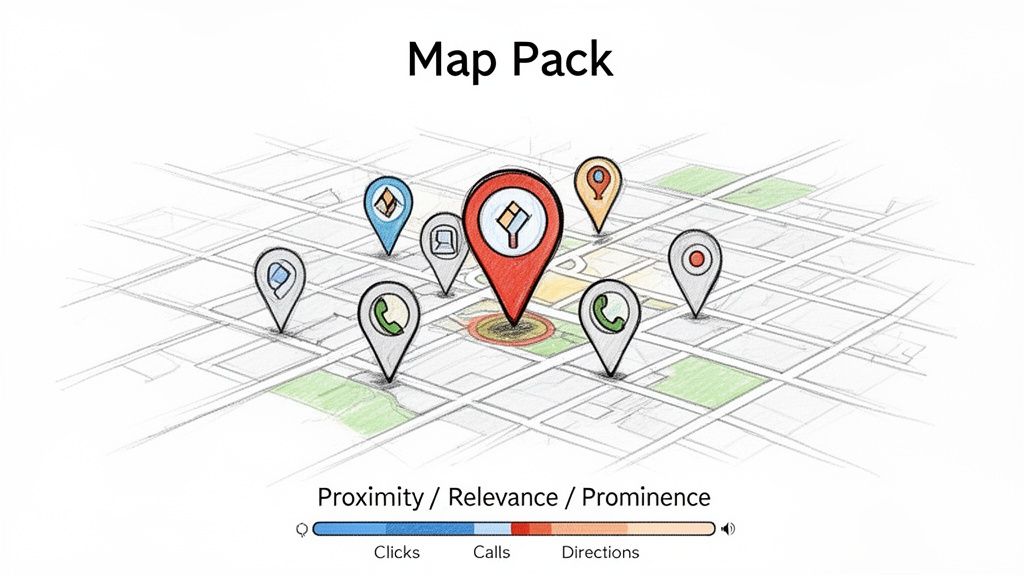
Think of Google's Map Pack—that coveted box of three listings at the top—as the digital main street of your city. Earning a spot there isn't about luck. It’s about proving you are the most trustworthy and relevant answer to a local customer's immediate need.
And this isn't just a "nice-to-have." For 27% of marketers, organic search is their number one source for generating leads. The reason is simple: it works. SEO leads have a remarkable 14.6% close rate, completely dwarfing outbound marketing's meager 1.7%. For any brick-and-mortar business, it's the most direct path from a search to a sale.
To win that prime digital real estate, you need to master the three core signals Google’s algorithm uses to rank local businesses.
The Three Pillars of Local Search Visibility
Google’s job is to give searchers the best possible answer. For local searches like "best coffee near me" or "emergency plumber," "best" is defined by a blend of three key factors. Get these right, and you've laid the foundation for a killer local lead gen strategy.
- Proximity: This one’s pretty straightforward. How close is your business to the person searching? Google uses the searcher's location to prioritize businesses that are physically nearby.
- Relevance: How well does your business match the search? If someone looks up "vegan bakery," Google scans your Google Business Profile, website, and reviews for those exact keywords to make the connection.
- Prominence: How well-known and trusted is your business around town, both online and off? This is Google’s measure of your authority, factoring in the number and quality of your reviews, mentions in local blogs, and links from other neighborhood businesses.
Think of it like asking a friend for a recommendation. You want someone who is close by (Proximity), does exactly what you need (Relevance), and has a great reputation (Prominence). Google is just trying to be that helpful friend, but for everyone, all at once.
Uncovering Your Local Ranking Blind Spots
Here’s where many businesses get it wrong: they assume their ranking is the same everywhere. But a search for your services from three miles north can show completely different results than one from two miles south.
Your competitors might be dominating one neighborhood while you're invisible just a few blocks away. These are "ranking blind spots"—areas where you're losing leads without even knowing it.
To generate leads consistently, you have to see your visibility on a block-by-block basis. This is where tools with ranking heatmaps become essential. They show you exactly where you’re strong and, more importantly, where competitors are eating your lunch. This intel turns guesswork into a clear, actionable roadmap.
From Visibility to Action: Driving Real Engagement
Ranking high is only half the battle. The real goal is to turn that visibility into actual customer actions. Google doesn't just see where you rank; it watches how people interact with your listing.
These are the engagement signals that prove you’re the right choice:
- Clicks to Website: A user sees you in the Map Pack and clicks through to your site.
- Phone Calls: A potential customer hits the "call" button right from your Google Business Profile.
- Direction Requests: A high-intent user asks for directions, signaling they're on their way.
Every one of these interactions is a vote of confidence. When Google sees a steady stream of them, it reinforces your authority and relevance, which in turn helps solidify and even boost your rankings.
The foundation for all this is a perfectly tuned online presence, and your Google Business Profile is command central. A well-maintained profile drives these actions, creating a powerful cycle where high visibility drives engagement, and that engagement drives even higher visibility. You can learn more about exactly how to optimize Google Business Profile for local growth in our guide.
Creating Content That Connects with Your Community
If Local SEO is the engine behind your local business lead generation strategy, then great content is the fuel that makes it go. This isn't about churning out generic blog posts that could work in any city. It's about creating resources that speak directly to the neighborhoods you serve, building real trust one block at a time.
Think of your website as your digital storefront. Does it actually reflect the unique vibe, challenges, and interests of the people you want as customers? A generic "Our Services" page just doesn't hit the same way as one that speaks to a specific neighborhood's needs.
Good local content shows you get it. It proves you understand the community you're a part of and turns your business from a faceless company into a trusted, familiar neighbor. That's how you build a connection that lasts way beyond a single sale.
From Broad Topics to Hyper-Local Resources
The secret to killer local content is getting specific. You have to zoom in from a city-wide view right down to the neighborhood level. This means translating your services and expertise into resources that feel like they were made just for the people in a particular area.
So instead of one broad page for "HVAC Repair," you could create multiple, highly targeted pages. This lets you show up for those super-specific, high-intent searches that your competitors are probably missing.
Here’s what that hyper-local content looks like in the real world:
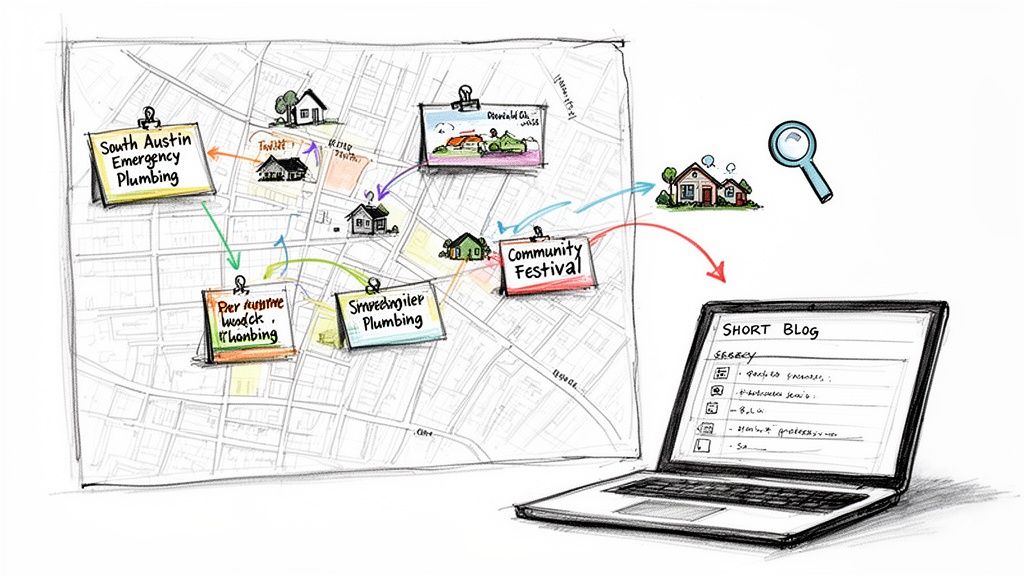
- Service-in-Location Pages: Forget one-size-fits-all. Create dedicated pages like "Emergency Plumbing in South Austin" or "Rooftop Deck Installation in Lincoln Park."
- Neighborhood Guides: A real estate agent could write "The Ultimate Guide to Family-Friendly Activities in the Heights," highlighting local parks, schools, and coffee shops.
- Local Event Recaps: Did you sponsor the local farmer's market or a charity 5K? Write a blog post about it with photos. It shows you're involved and creates content people in the community will actually want to share.
This strategy doesn't just get you more traffic; it gets you the right traffic. You start attracting people who not only need your service but are located exactly where you can help them.
Finding Keywords That Signal Local Intent
To make this content work, you need to know what your local customers are actually searching for. This means going beyond broad industry terms and digging into the specific phrases people use when they're looking for help nearby. The goal is to find keywords that scream "I'm ready to buy."
These keywords usually mix a service with a location. Think "best coffee shop downtown" or "pediatric dentist near Washington Park." Finding these gems is absolutely critical for a successful local lead generation plan.
Your best keyword research tool is often just listening to your customers. What questions do they ask? What neighborhood landmarks do they bring up? That’s the authentic language you need to weave into your website.
The numbers back this up—it’s not just a theory. Content marketing is the undisputed king of local lead gen, powering over 51.5% of leads. It also triples the results of outbound marketing at 62% less cost. For local businesses, this means creating optimized neighborhood guides or service pages can directly drive a huge chunk of your organic leads. You can discover more about how content drives local growth and what marketers are planning for 2025.
Connecting Content to Customer Action
At the end of the day, every piece of content needs a job to do. It should guide the reader toward a specific action, whether that's calling your office, filling out a form, or getting directions to your shop.
Each hyper-local page you build is another digital doorway into your business. When you tailor the content and the call-to-action to the specific needs of that neighborhood, you massively increase the odds of turning a visitor into a lead. That direct line from content to conversion is what transforms your website from a simple online brochure into a powerful, automated lead machine.
Turning Community Engagement into Leads
Sure, digital channels like SEO and content are heavy hitters, but don't ever underestimate the power of showing up in the real world. A smart local business lead generation plan doesn’t just live on your website; it thrives in the community. It’s about being a neighborhood partner, not just another service provider.
This isn't about chasing vanity metrics like likes and shares. It's about building genuine relationships. When you get actively involved in your community, you create powerful "local signals"—real-world proof that you're relevant and prominent. Search engines eat that stuff up. Authentic local engagement isn’t just a nice-to-have; it's a critical, and often forgotten, piece of a modern lead generation strategy.
Use Social Media to Spark Local Conversations
Social media is the new town square. It gives you a direct line to your community, letting you jump into conversations, figure out what people need, and build a solid reputation. The trick is to be a participant, not a megaphone.
Stop just posting promotions. Start connecting. Ask questions, give a shout-out to other local businesses, and highlight community events. This shifts your social media from a boring advertisement to a valuable local hub.
Social media has been a game-changer for local lead gen. In fact, 66% of marketers pull in solid leads by spending just six hours a week on platforms like Facebook and Instagram. For local B2B businesses, like franchises or clinics, LinkedIn is the undisputed king—a massive 80% of B2B leads start there. Even just organic social efforts can drive a huge chunk of your best leads, proving these platforms are incredible at connecting neighborhood-specific content with people ready to buy. You can dig into more of these social media lead generation statistics and trends to get the full picture.
Forge Partnerships with Local Businesses
One of the fastest ways to grow your local footprint is to team up with other businesses that serve the same customers you do, but aren't direct competitors. Think of it as building a local referral network where everybody wins.
A gym could partner with a health food store for a joint promotion. A wedding planner could collaborate with a local florist and photographer to create a bundled package. These cross-promotions get your brand in front of a new, highly relevant audience that already trusts your partner.
The best local partnerships are built on mutual benefit. When you help another local business win, they'll be eager to send new customers your way. It’s all about creating a community of businesses that lift each other up.
These partnerships can look like a few different things:
- Joint Webinars or Workshops: A financial advisor and an accountant could co-host a workshop on "Tax Strategies for Small Business Owners."
- Referral Programs: Offer a small kickback or a discount to complementary businesses that send qualified leads to you.
- Shared Content: Feature a partner business in your blog or newsletter, and have them return the favor.
Sponsor Events That Matter to Your Customers
Sponsoring a local event—whether it’s a little league team, a charity 5K, or a neighborhood block party—is a fantastic way to build brand recognition and goodwill. It shows you’re invested in the community for more than just profit.
The key is picking sponsorships that actually line up with your brand and what your customers care about. An eco-friendly cleaning service sponsoring an Earth Day cleanup? Perfect fit. A family-friendly restaurant supporting the local school’s bake sale? It sends a clear, positive message.
This kind of involvement also sparks priceless word-of-mouth marketing and positive online mentions. When people see your logo at events they care about, it builds a deep sense of trust and loyalty. That loyalty often leads to customers picking you over a competitor, even if you cost a little more. And that trust? It directly translates into more positive reviews, which are absolutely essential for your online reputation. If you need some pointers, check out our guide on how to get Google reviews compliantly to build that social proof the right way.
How to Scale Your Strategy Across Multiple Locations
So you've cracked the code for one location. Great. But taking that winning formula from one storefront to ten, or even a hundred? That's a completely different game. The real challenge is creating a consistent brand experience that still lets each location feel like it belongs to the neighborhood.
You need a master recipe—your core brand strategy—but you have to let local managers add their own ingredients. This is where so many multi-location brands trip up.
Go full-on corporate, and you lose the local touch. Give every manager free rein, and your brand becomes a chaotic mess. The sweet spot is centralizing the big-picture stuff while letting the local teams own their turf. It’s the only way to feel both professional and personal, a combo that builds serious trust and drives growth.
Centralize the Core, Localize the Execution
To scale without losing your mind, you need a clear playbook. Define what corporate handles and what the local teams run with. This creates a smooth, consistent operation that doesn't kill the local vibe customers love.
Here’s a simple way to think about it:
-
Centralized Control (The Master Recipe):
- Brand Guidelines: Your logo, messaging, and overall voice. These are non-negotiable and must be the same everywhere.
- Core Website & Tech Stack: The main website, analytics, and marketing platforms should be managed from HQ. This keeps things secure and high-quality.
- Performance Tracking: Use one dashboard to see how every location is doing. This is for high-level analysis and strategy tweaks.
-
Decentralized Execution (The Local Ingredients):
- Community Engagement: Let local managers sponsor the Little League team, run neighborhood-specific social media contests, and partner with the coffee shop next door.
- Google Business Profile Management: While corporate can set up the basics, local teams should be in charge of responding to reviews, adding photos from last weekend's event, and posting updates.
- Local Content Creation: Encourage your managers to share things only a local would know on a location-specific blog or social page.
This flow shows exactly how those local, on-the-ground efforts—campaigns, partnerships, events—feed directly into your sales pipeline.
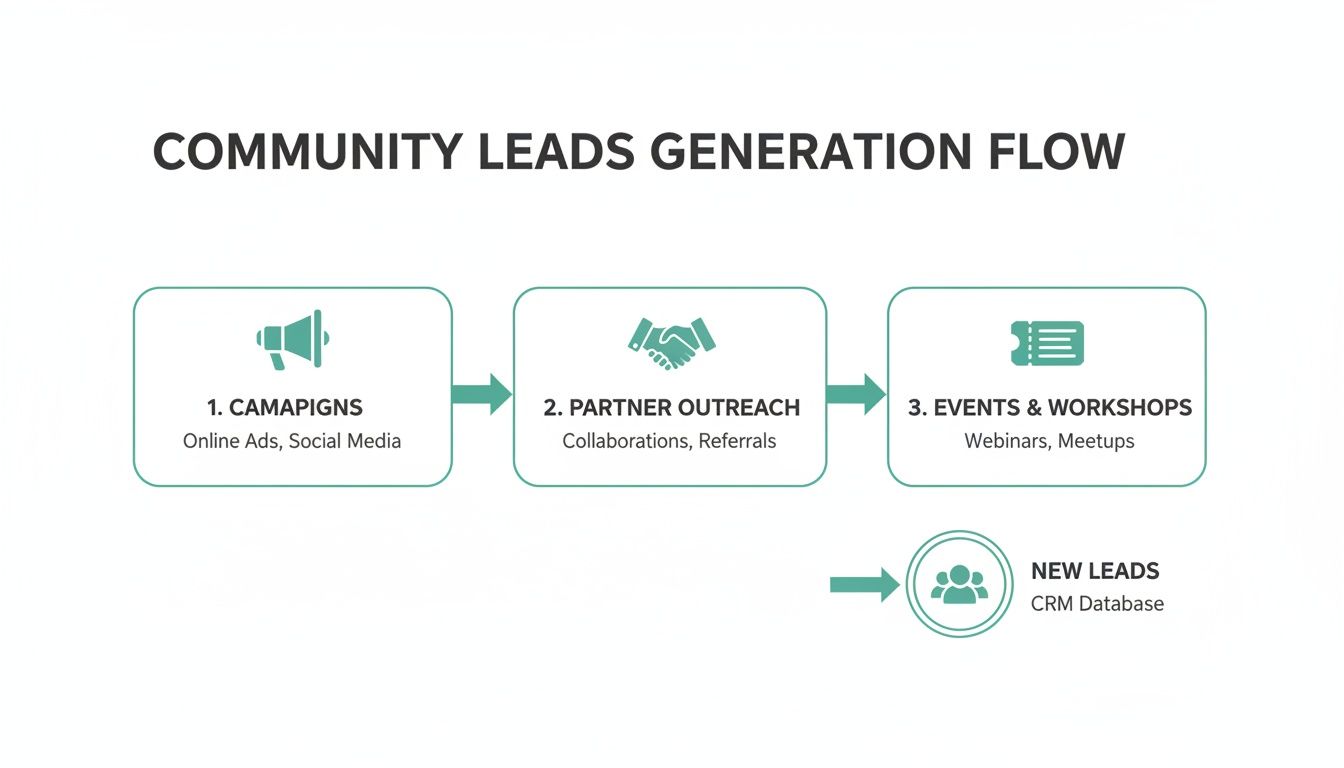
Every local handshake and community event creates a ripple effect, building trust that turns into real, qualified leads for your business.
Unify Your Data with a Multi-Location Dashboard
You can't fix what you can't see. For any brand with more than one location, trying to track performance with a mess of spreadsheets is a nightmare waiting to happen. A centralized, multi-location dashboard isn't a "nice-to-have"—it's essential.
A unified dashboard transforms data from a scattered liability into a strategic asset. It allows you to move from guessing which locations are performing well to knowing exactly why they are—and how to replicate their success elsewhere.
This single source of truth lets you see how different cities or regions are performing, side-by-side. You can spot which locations are crushing it with phone calls, which are getting the most direction requests, and which ones need a little help. That clarity is everything when it comes to making smart decisions for your entire brand. For a deeper look, our guide to local presence management breaks down the tools you need to manage a growing footprint.
Allocate Resources for Maximum Impact
Once you have clean, comparable data, you can start spending your marketing budget with surgical precision. A multi-location dashboard will show you things you’d never find otherwise.
For example, you might see that the keyword "emergency pediatric clinic" is driving 80% of leads in a suburban location but is a total flop downtown. Boom. That's a clear signal to shift ad spend and content to double down on what’s working in each market.
It’s about making smart bets on proven winners instead of spreading your budget thin on a generic strategy that helps no one. This targeted approach ensures every dollar you spend is working as hard as it can to bring you the highest possible return.
Measuring the Metrics That Actually Matter
A brilliant local business lead generation strategy is useless if you can't prove it works. To get a real sense of your success, you have to look past vanity metrics like website traffic or social media followers and zero in on the key performance indicators (KPIs) that signal a customer is ready to act.
Think of it this way: website traffic is like counting how many people walk past your storefront. It’s interesting, but what you really care about is how many people opened the door, asked a question, or pulled out their wallet. Action-oriented data is the only thing that tells that story.
Shifting from Vanity to Actionable KPIs
For any local business, the most valuable metrics are the ones that connect an online search to a real-world interaction. These KPIs prove your marketing is turning digital visibility into actual leads. They draw a straight line from a search query to a potential sale.
Chasing website traffic alone is a recipe for wasted effort. The goal isn’t to attract everyone; it’s to attract the right people in your service area and push them to take that next step.
When you’re measuring local lead gen, these are the high-impact actions to obsess over:
- Phone Calls from Your Google Business Profile: This is a five-alarm fire of a lead. Someone needs your services, and they need them now. It's one of the highest-intent signals you can get.
- Requests for Driving Directions: When someone hits that "directions" button, they're planning a visit. This is a massive indicator of incoming foot traffic and in-store sales.
- Clicks to Your Website (from Local Search): General website traffic can be a smokescreen. But clicks coming straight from your Google Business Profile or the Map Pack are gold. These users have already seen your location and what you offer, making them incredibly qualified.
Tracking and Demonstrating Clear ROI
Properly tracking these KPIs is how you show a clear return on investment (ROI). By setting up conversion tracking, you can tie specific customer actions directly back to the marketing channels that drove them. This lets you walk into any meeting and show stakeholders—whether it's your boss or your clients—exactly how your work is hitting the bottom line.
For instance, you can connect a surge in phone calls directly to the recent optimizations you made on your Google Business Profile. This data-driven approach kills the guesswork and proves your value.
The conversation shifts from, "I think our SEO is working," to "Our Local SEO work generated 45 qualified phone leads this month."
This level of insight fuels a cycle of constant improvement. By seeing which strategies deliver the goods, you can double down on what works and cut what doesn't. You end up putting your time and budget only into the channels that generate the most valuable customer actions, creating a powerful, self-improving lead generation engine.
Frequently Asked Questions
Let's dig into some of the most common questions that pop up when businesses start getting serious about winning customers in their own backyard.
How Is Local SEO Different from National SEO?
I love the fishing analogy for this one.
National SEO is like casting a giant net into the open ocean. You’re trying to catch as many fish as possible, and you don’t really care where they come from. It's a volume game.
Local SEO, on the other hand, is like fly-fishing in your favorite local stream. You know exactly what kind of fish live there, what they bite on, and where to stand. You’re not trying to catch all the fish, just the right ones nearby.
With local, you're laser-focused on signals that Google cares about for "near me" searches, like proximity and how well-known you are in the community. The whole point is to show up in the Google Map Pack and get people to either walk through your door or book your service. National SEO is way broader—it's about ranking for general keywords and pulling in website traffic from anywhere and everywhere.
How Long Does It Take to See Results?
This is the big one, and the honest answer is: it depends. You can get some quick wins right away, especially by cleaning up your Google Business Profile. But real, lasting results? That's a long game.
Most businesses start seeing a meaningful uptick in their rankings and leads within three to six months.
What affects that timeline? A few things:
- How cutthroat your local market is.
- The shape your online presence is in right now.
- How consistently you stick to the plan.
Building up trust and authority with Google and local customers doesn't happen overnight. It’s the result of consistent effort—getting reviews, posting fresh content, and engaging with your community—that builds momentum over time.
What Is the Most Important First Step?
If you only have time to do one thing today, make it this: claim and fully optimize your Google Business Profile (GBP). Seriously.
Think of your GBP as your digital storefront. It's the single most powerful asset you have for getting seen in local search.
Go through and fill out every single section. Add a bunch of high-quality photos. Write a detailed business description packed with local keywords. Double-check that your hours are perfect. And most importantly, start asking every happy customer for a review. A well-built GBP is the foundation for everything else, and it's the fastest way to get in front of customers searching nearby.
Ready to stop guessing where you rank and start winning the neighborhood? Nearfront provides the live ranking heatmaps and competitive insights you need to turn local searches into real customers. See how it works and get started today!