Think of internet marketing for a local business as the digital version of putting up a big, bright "OPEN" sign and rolling out the welcome mat for your neighbors. It’s all about making sure that when someone in your community pulls out their phone to find what you offer, your business is the first, best, and most obvious choice.
Why Local Businesses Must Win Online to Thrive Offline
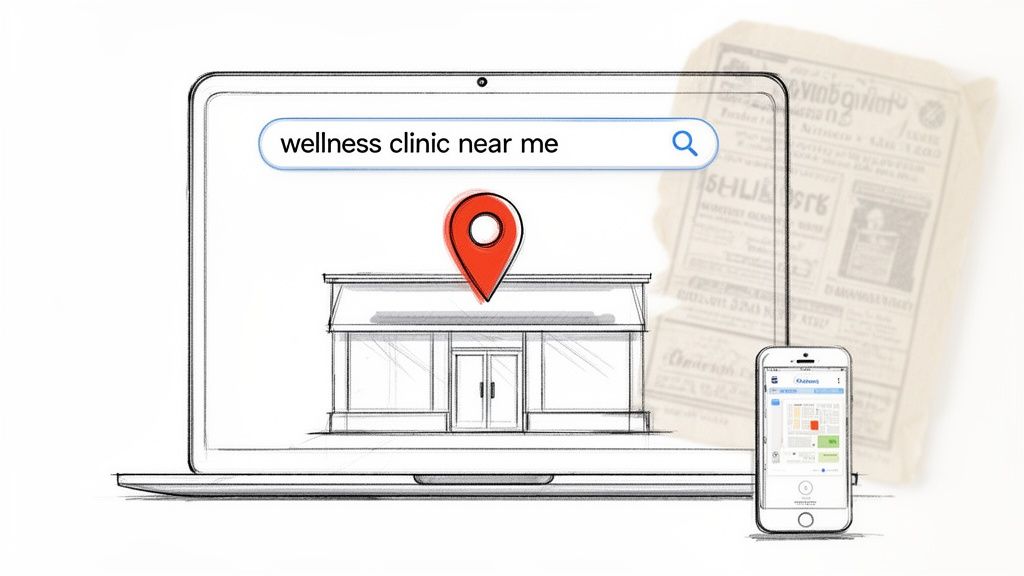
For a local business today, being invisible online is like having a shop with no sign on the door. It just doesn't work. Your digital presence—your Google profile, your reviews, your website—is now the primary entrance for most new customers.
The modern customer journey almost always starts with a simple search, whether it’s "wellness clinic near me" or "dispensary open now." These aren't just casual browsers, either. They are high-intent customers ready to walk in and make a purchase. An unoptimized online profile is the equivalent of having a disconnected phone line—potential customers are trying to reach you, but they just can't get through.
The Shift from Flyers to Clicks
Let’s be honest, the days of relying solely on flyers and local newspaper ads are long gone. The modern marketplace has moved to Google Maps, online reviews, and social proof. This isn't a threat; it's a massive opportunity for businesses ready to adapt.
The proof is in how people behave. Their phones are their new yellow pages, and the data is staggering.
The Digital Shift for Local Businesses
The numbers tell a clear story. Customers have fundamentally changed how they find and choose local businesses.
| Statistic | Impact on Your Business |
|---|---|
| 99% of consumers have used the internet to find a local business. | Nearly every potential customer is looking for you online first. |
| 88% of local searches on a mobile device result in a call or visit within 24 hours. | An optimized mobile presence directly translates to next-day foot traffic. |
| 4 in 5 mobile searches for local information convert into a purchase. | These aren't just searches; they are buying signals with immediate ROI. |
This isn't just a trend; it's the new standard. If you want to dive deeper, you can explore more data on these local search trends to see the full picture.
For today’s consumer, your Google Business Profile is your storefront. It’s where they form their first impression, read reviews, and decide whether to give you their business.
The New Customer Handshake
Great local business internet marketing is what closes the gap between someone's digital search and their physical visit. It’s about being the most relevant, trusted, and visible answer right when someone in your neighborhood needs what you sell.
It really boils down to four key goals working together:
- Visibility: Showing up at the top of local search results and on maps. No exceptions.
- Trust: Building a rock-solid reputation with authentic customer reviews and accurate, consistent info everywhere online.
- Engagement: Actually talking with your community online to build real relationships and loyalty.
- Conversion: Turning all that online interest into real-world foot traffic, phone calls, and sales.
Ultimately, winning online isn't optional anymore. It’s the foundation for a thriving offline business. It’s how you make sure that when your community is looking, your business is the one they find.
Understanding the Core Pillars of Local Marketing
If you want to build a winning strategy, you first need to understand the blueprint. The world of local business internet marketing can feel like a tangled mess, but it really boils down to four foundational pillars.
Think of it like building a sturdy table—if one leg is wobbly or missing, the whole thing falls apart. For your business to stand strong and consistently pull in customers, all four of these pillars have to work together.
Let's break down each one.
Pillar 1: Local SEO – Your Digital Welcome Mat
Local Search Engine Optimization (SEO) is all about making your business impossible to miss in local Google searches. When someone down the street searches for a product or service you offer, local SEO is what gets you to show up, especially in that all-important Google Map Pack at the top of the page.
Think of local SEO as the digital welcome mat you place right at your front door. It’s the very first thing a potential customer sees online, telling them they’ve found the right place. Without it, people might walk right past you, completely unaware you have exactly what they’re looking for. Good local SEO makes you unmissable.
Pillar 2: Google Business Profile – Your Digital Storefront
Your Google Business Profile (GBP) is that detailed info box that pops up in Google Search and on Maps. It’s where your address, hours, photos, services, and reviews all live. Honestly, it’s one of the most powerful tools you have.
If SEO is your welcome mat, your GBP is your digital storefront. It’s the beautifully arranged window display that makes people want to come inside. This is their first real impression of your business. A neglected profile with blurry photos and unanswered questions is like a dusty, forgotten shop window—it signals that you’re not paying attention and sends customers straight to your competitor.
Your Google Business Profile is where 73% of all local search engagement happens. If you’re ignoring it, you’re basically invisible to most of your potential customers.
Pillar 3: Online Reviews – Your Community’s Trust Signal
Reviews on sites like Google, Yelp, or even niche industry pages are today's word-of-mouth. They offer real, unbiased proof to potential customers that your business is the real deal.
Think of online reviews as a trust signal from your community. Every good review is like a neighbor leaning over the fence and saying, "You have to check this place out!" That kind of social proof is incredibly powerful because it feels authentic—way more trustworthy than a flashy ad. A steady flow of recent, positive reviews builds a rock-solid reputation that directly sways buying decisions and, as a bonus, gives your local search rankings a serious boost.
Pillar 4: Local Ads & Social Media – Your Megaphone
While the first three pillars build your foundation for people already looking for you, local ads and social media give you a megaphone. This is how you proactively reach out and grab attention. We’re talking about everything from geo-targeted ads on Facebook and Instagram to Google's Local Services Ads, which can plant you right at the very top of the search results.
SEO, your GBP, and reviews make sure you’re there when people come looking. But this last pillar lets you shout your message across the neighborhood. Use it to announce a sale, show off a new service, or just remind everyone you exist. It’s the quickest way to drive immediate awareness and foot traffic, perfectly complementing the long-term growth you get from your other efforts.
Alright, let's move from theory to action.
Dominating local search isn't about some secret, complex formula. It’s about executing a handful of proven tactics with precision and consistency. This is your playbook for winning the coveted Google Map Pack—the holy grail for any local business.
The game plan is simple: optimize your digital storefront, get your address straight across the web, earn your community's trust, and constantly signal your local relevance to Google.
This flowchart breaks down the core process, showing how SEO, your Google Business Profile, reviews, and ads all feed into one another.
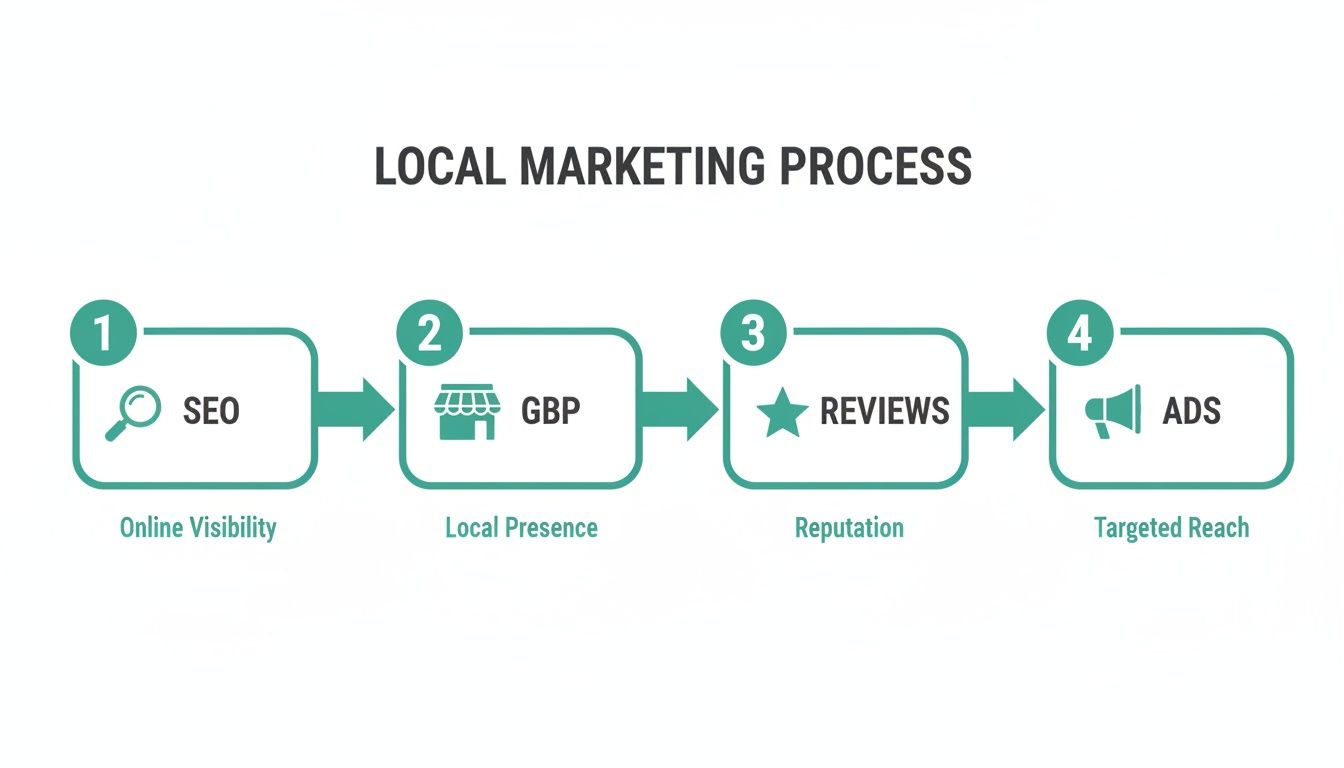
You can see it’s a cycle. Foundational SEO supports your Google Business Profile, which gets amplified by reviews and then accelerated by paid ads. It's a continuous loop of growth.
Master Your Google Business Profile
Your Google Business Profile (GBP) is the single most important weapon in your local marketing arsenal. Think of it less as a simple listing and more as a dynamic mini-website that lives right on Google's search results page. A half-finished profile is a major red flag for both customers and search engines.
To really stand out, you have to go way beyond just your name and address. A fully fleshed-out profile signals authority and trustworthiness, which Google rewards with higher rankings. For a deep dive into every single field and feature, our guide on how to optimize your Google Business Profile walks you through it step-by-step.
Here’s a quick checklist to make sure every part is pulling its weight:
- Services and Products: Get specific. Detail everything you offer with keyword-rich descriptions that match exactly what your local customers are typing into the search bar.
- Photos and Videos: Upload recent, high-quality images of your storefront, your team, and your products in action. A business with photos gets 42% more requests for driving directions than one without.
- Google Q&A: Don't wait for people to ask. Proactively add and answer the most common questions yourself. This lets you control the narrative and give people the info they need instantly.
- Google Posts: Use this feature to share updates, promotions, and events. Consistent activity shows Google your business is alive, active, and engaged with its community.
Build Consistent Citations Across the Web
Once your GBP is dialed in, the next step is to make sure your business information is identical everywhere else online. These listings are called citations, and they are all about your Name, Address, and Phone number (NAP).
Imagine you moved but only told the post office—your friends, bank, and Amazon packages would all go to the wrong place. Citations work the same way for your business. Google cross-references directories like Yelp, Apple Maps, and industry-specific sites to confirm you are who and where you say you are. Mismatched info creates confusion, erodes trust, and tanks your rankings.
Consistent NAP information across the web is a foundational trust signal for Google's algorithm. It confirms your physical location and legitimacy, acting as a digital verification of your business's existence.
The goal is a clean, consistent digital footprint. Start by auditing your existing citations and fixing any errors, then focus on building new ones on reputable local and industry-specific directories.
Develop a Powerful Review Strategy
Reviews are the lifeblood of local search. Period.
They are a powerful signal of trust, not just for potential customers but for Google's algorithm, too. A business with a steady stream of recent, positive reviews will almost always outrank one with just a few old ones.
But a great review strategy is about more than just begging for five-star ratings.
- Actively Request Reviews: Don't be passive. Make it ridiculously easy for happy customers to leave feedback by sending them a direct link via email or text right after a purchase.
- Respond to Every Single Review: This is non-negotiable. Thank people for positive feedback, and address negative comments professionally and quickly. Responding shows you're engaged and that you actually care.
- Incorporate Keywords Naturally: Encourage customers to mention the specific service or product they used. Reviews containing relevant keywords can directly boost your visibility for those search terms.
We're talking about a massive opportunity here. 80% of local searches lead to an actual purchase. A well-optimized Google Business Profile can pull in over 1,200 views a month and drive more than 100 website visits. More importantly, customers are 2.7 times more likely to trust and choose a business with a completely filled-out profile.
Create Hyper-Local Content
Finally, you need to prove to Google that you are an active, authoritative part of your local community. One of the best ways to do this is by creating hyper-local content.
This means writing blog posts, creating guides, or even shooting videos about topics directly tied to your specific service area.
- A wellness clinic could write about the best running trails in the neighborhood.
- A CBD retailer might create a guide to all the local farmers' markets.
- A multi-location retailer can highlight community events happening near each of its stores.
This kind of content anchors your business to a specific geographic area, sending powerful relevance signals to Google. It proves you're not just in the community—you're part of it.
Accelerating Growth with Paid Ads and Social Media
While a rock-solid local SEO strategy builds your long-term foundation, sometimes you need results now. That’s where paid channels come in.
Think of it like this: SEO is like planting a garden that will feed you for years to come. Paid advertising is like ordering a hot pizza that shows up at your door in 30 minutes. Both have their place, but they solve very different problems.
A smart investment in paid ads can seriously accelerate your growth, putting your business directly in front of motivated customers the second they start looking.
High Intent Meets High Visibility with Google Ads
When someone’s pipe bursts, they aren’t browsing for a plumber—they’re searching for “emergency plumber near me” and hiring the first reputable company they see. They are ready to buy, and Google Ads puts your business right at the top of the list, capturing that immediate need.
Google’s ad platform is packed with powerful tools for local businesses. You can target customers by zip code, city, or even draw a one-mile radius around your shop, making sure every dollar you spend is laser-focused. It's an indispensable tool for driving immediate traffic, filling appointment slots, or getting the word out about a last-minute promotion.
If you’re ready to master this channel, we break down how to create effective Google Ads campaigns for local businesses in our detailed guide.
Building Community with Geo-Targeted Social Media
While Google Ads is great for capturing active searchers, social media platforms like Facebook and Instagram let you build awareness and connect with your community before they even know they need you.
Imagine a retailer running a weekend sale across several locations. They can run geo-fenced Instagram ads targeting only people who are physically near one of their stores. Suddenly, a generic promotion becomes a personal, timely invitation that drives real foot traffic through the door.
Social media’s real strength is building a local community. It’s less about the hard sell and more about becoming a familiar, trusted name in the neighborhood—fostering the kind of loyalty that pays off for years.
Paid and Organic: A Powerful Synergy
The real magic happens when your paid and organic strategies stop working in silos and start feeding each other. They aren't separate channels; they're two sides of the same coin, creating a powerful feedback loop.
Your paid ad campaigns are basically a real-time testing lab. The data tells you which keywords actually convert, what ad copy gets people to click, and which offers generate the most buzz. This isn't just useful for tweaking your ads—it’s pure gold for your long-term SEO and content strategy.
Here’s how this powerful synergy plays out:
- Discover Winning Keywords: Test keywords with a small ad budget to see which ones drive actual calls and sales before you invest months trying to rank for them organically.
- Refine Your Messaging: A/B test ad headlines and descriptions to see what language actually motivates customers. Then, use that proven messaging on your website and Google Business Profile.
- Understand Your Audience: Ad analytics give you deep insights into the demographics and interests of your best local customers, helping you create way more relevant blog posts and social content.
By using paid ads to accelerate your learning, you make smarter, data-driven decisions that sharpen your entire organic game. This integrated approach ensures your local business internet marketing becomes more effective and efficient, delivering both immediate results and sustainable growth.
Solving the Multi-Location Challenge with Smart Technology
Running a solid internet marketing plan for one storefront is hard enough. But what happens when you have to do it for ten, fifty, or even hundreds of locations? The complexity explodes.
A one-size-fits-all strategy just doesn't cut it. Each store has its own neighborhood, its own customer base, and its own set of competitors. This is the massive headache that franchises and multi-location brands face every day.
Trying to manually create a unique, hyper-local strategy for every single location is a recipe for burnout. It's practically impossible. That's where smart technology, especially AI-powered platforms, comes in to solve the problem of scale.
From Manual Guesswork to Automated Precision
Imagine being the dedicated marketing manager for every single store in your network. You’d have to figure out which neighborhoods are underperforming for your downtown branch while simultaneously diagnosing why the suburban location isn't getting enough phone calls. Good luck with that.
AI-powered local SEO platforms essentially act as that tireless, always-on marketing manager for every single location, all from one dashboard. Instead of blasting out a generic strategy, these systems build a unique, hyper-local game plan for each storefront. They focus on what really moves the needle for local rankings: generating authentic engagement signals.
These platforms work by stimulating the kind of real-world user activity that Google’s algorithm is built to notice and reward. We’re talking about actions like:
- Geo-located searches from specific, nearby neighborhoods.
- Clicks on your Google Business Profile from those local searches.
- Requests for driving directions right to your front door.
- Phone calls made directly from your profile.
This process builds a powerful case for each location's relevance in its immediate area, pushing visibility up exactly where it matters most. For brands juggling a wide portfolio, mastering local SEO for multiple locations is the only way to unlock consistent growth across the board.
Visualizing Your Local Dominance with Heatmaps
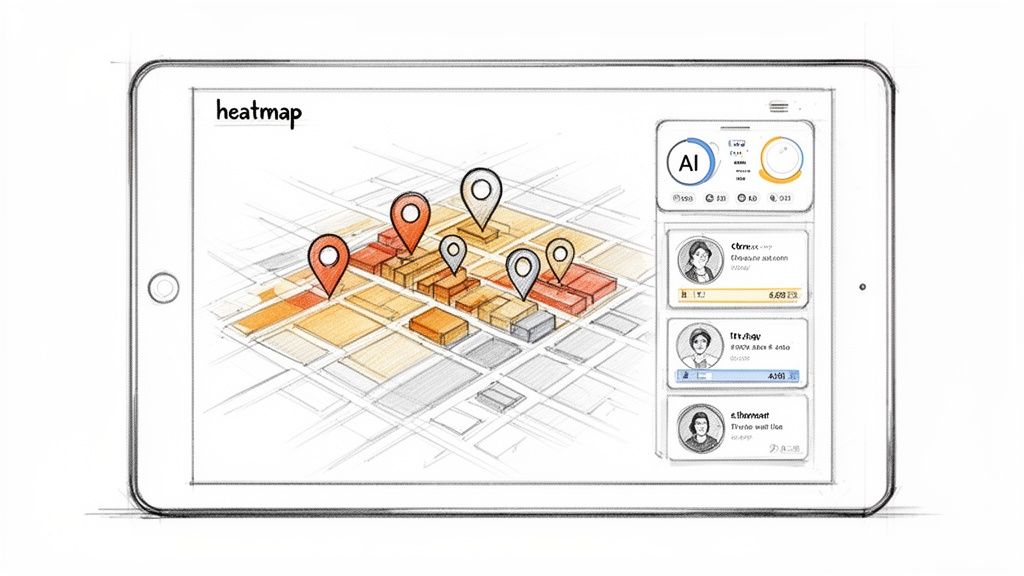
One of the coolest tools these modern platforms offer is the live ranking heatmap. Forget just knowing your general city-wide rank for a keyword. A heatmap shows you, block by block, exactly where you’re visible—and more importantly, where you’re not.
Think of it as a weather map for your online presence. Red zones show where you’re crushing the search results, while blue zones are cold spots where competitors are winning over your potential customers. This level of detail is a complete game-changer.
With a ranking heatmap, you can pinpoint specific underperforming neighborhoods for each store and deploy targeted strategies to improve visibility exactly where it's needed, turning guesswork into a precise, data-driven operation.
This technology finally lets marketing managers see which locations need the most support and allocate their budget and effort effectively, ensuring no store gets left behind.
The difference between wrestling with spreadsheets and using a purpose-built AI platform is night and day. It’s about trading manual labor for intelligent automation.
Traditional vs. AI-Powered Local SEO Management
| Feature | Traditional Manual Approach | AI-Powered Platform (Nearfront) |
|---|---|---|
| Strategy | One-size-fits-all, applied broadly | Hyper-local, tailored to each location's specific market |
| Execution | Manual updates, slow to implement changes | Automated, real-time adjustments and signal generation |
| Performance Tracking | Basic rank tracking, often city-wide and delayed | Live, block-by-block heatmaps showing true visibility |
| Engagement | Manual review responses, inconsistent posting | Automated review replies and content scheduling |
| Scalability | Extremely difficult and resource-intensive | Effortlessly manages hundreds of locations from one dashboard |
| Reporting | Disparate data sources, hard to synthesize | Centralized dashboard with clear, actionable insights |
Ultimately, AI-driven platforms give you back your most valuable asset: time. You can stop chasing down data and start focusing on the bigger picture—growing your brand.
The Power of Authentic Engagement Signals
Across major markets in the US, UK, Canada, and Australia, this hyper-local approach is delivering some seriously impressive results. For instance, dispensary chains using AI-driven heatmaps can literally watch phone calls and direction requests spike as their profiles light up with these real engagement signals.
The best part? It’s all done safely and securely, without ever needing direct access to your Google Business Profile. The data shows that high-performers who adopt these dedicated strategies see incredible success, with 94% of them outperforming industry averages by a huge margin.
This isn’t just a new tool; it's a completely new, more scalable, and secure way of doing things. It allows growing brands to finally move past generic tactics and truly dominate every single market they serve by proving their local relevance, one neighborhood at a time.
Your Top Local Internet Marketing Questions, Answered
Getting into local internet marketing can feel like a maze, so it's normal to have a few questions. I've heard them all. This section tackles the most common ones I get from business owners, breaking them down with straight-up, actionable answers. The goal here is to cut through the noise and give you the clarity you need to push your strategy forward.
Let's get right into it.
How Long Does It Take to See Results from Local SEO?
This is the big one, and the honest-to-goodness answer is: it depends. But, you can still bank on a general timeline. While you might see some quick wins from tuning up your Google Business Profile in just a few weeks, a solid local business internet marketing strategy really starts to deliver significant, lasting results in about 3 to 6 months.
Think of it less like flipping a switch and more like getting a flywheel spinning. The first push is the hardest (optimizing your profile and website). Then, you keep adding momentum (building citations, creating content, getting reviews). That consistent effort is what creates real, self-sustaining growth in traffic and calls.
A few things can speed this up or slow it down:
- Your Starting Line: A brand-new business is starting from a dead stop, while an established one might already have some momentum.
- The Competition: Trying to rank for "plumber in New York City" is a different beast than "boutique bakery in a small town."
- Your Consistency: SEO isn't a one-and-done task. It's an ongoing process, and sporadic efforts will only get you sporadic results.
While organic local SEO is all about building that long-term, sustainable foundation, don't forget that paid ads can give you that instant visibility. It's a great way to get the phone ringing while your organic efforts are getting up to speed.
What Is the Most Important Factor for Ranking on Google Maps?
If you had to put all your chips on one thing, it would be a perfectly optimized and consistently active Google Business Profile (GBP). Hands down, it's the single most critical piece of the puzzle for ranking in the Google Map Pack. Think of your GBP as your digital storefront—it's the main source of truth Google uses to understand who you are, what you do, and whether you deserve to be shown to local searchers.
And I'm not just talking about listing your name and address. A truly dialed-in profile includes:
- Spot-On Categories: You have to choose the most specific primary and secondary categories to tell Google exactly what kind of business you are.
- A Deep Bench of Photos: Show off everything—your storefront, your products, your team in action. This builds incredible trust and gets people to engage.
- A Steady Flow of Good Reviews: Actively encourage and (always) respond to customer reviews. This signals to Google that you're an active business and provides powerful social proof.
Now, proximity to the searcher is a huge factor you can't really control. But you can control how relevant you appear to a wider area. You do this by creating hyper-local content and, even more importantly, by generating real user engagement signals—like clicks, photo views, and direction requests—from people in the surrounding neighborhoods you want to attract.
Do I Really Need to Respond to Online Reviews?
Yes. 100%. Responding to every single review, good and bad, is completely non-negotiable for any serious local business today. It's one of the highest-impact things you can do, and it takes minimal effort.
Responding to reviews is a clear signal to potential customers that you're engaged, you listen, and you care. That alone can be the tipping point that makes someone choose you over a competitor who ignores their feedback.
For Google, seeing you consistently reply shows that your business is active and customer-focused, which can give your local rankings a nice little bump. When you reply to positive reviews, you're building loyalty and turning happy customers into advocates. And when you handle negative feedback professionally, you can defuse a bad situation and show everyone else watching that you're committed to getting it right.
How Can an AI Platform Help if It Doesn't Access My GBP?
This is a great question that gets to the heart of security and strategy. The fact that a platform like Nearfront doesn't need your sensitive login information is actually one of its biggest strengths. Instead of logging in to make direct edits, these platforms work from the outside-in, influencing the external signals that Google's algorithm pays the most attention to.
It works by stimulating authentic, real-world user engagement from a massive network of everyday mobile apps. This creates a stream of legitimate local search activity that Google is built to reward.
Here’s a quick look at how it happens:
- Geo-Located Searches: The platform triggers searches for your target keywords from real mobile devices physically located in the neighborhoods you want to dominate.
- Authentic Clicks: Those searches lead to real people tapping on your GBP listing in the map results.
- Real Engagement: The interaction doesn't stop there. It continues with actions like direction requests and click-to-calls, all coming from your key service areas.
Google sees all this organic, real-world activity and interprets it as a powerful sign of your business's relevance and popularity in those specific areas. It’s like creating genuine, word-of-mouth buzz around your digital storefront, which naturally pushes you up the rankings where it matters most—all without ever handing over your keys.
Ready to stop guessing and start seeing real, measurable growth in your local markets? Nearfront uses advanced AI to generate the authentic local engagement signals that Google rewards, boosting your visibility on Google Maps and driving more customers to your door.