Staring at an empty storefront while your phone stays stubbornly silent is a modern-day nightmare for any business owner. The problem isn't a lack of customers. The problem is they're looking for you in a place where you might be completely invisible: online.
Winning at local business digital marketing is simple in theory but tough in practice. It’s about being the first, most trusted answer that pops up when someone in your neighborhood searches for exactly what you sell.
Why Local Businesses Must Win the Digital Race
Think of the Google Map Pack as today's town square. It’s the bustling, digital main street where customers decide where to eat, shop, and get services in a matter of seconds. If you're not there, it's like having your shop's windows boarded up on the busiest street in the city. Your best customers are walking right past, and they don't even know you exist.
This guide is here to flip that script. It’s a no-fluff blueprint for turning your online ghost town into a thriving digital hub that drives real-world foot traffic, phone calls, and sales. We're skipping the jargon and getting straight to the steps you need to claim your spot in that digital town square.

The Shift from Foot Traffic to Finger Taps
The journey to your front door doesn’t start on the sidewalk anymore. It starts with a few taps on a smartphone.
A customer searching for a "coffee shop near me" or an "emergency plumber in downtown" expects instant, reliable answers. If your business doesn't show up in those first few critical moments, you've already lost. They've moved on to your competitor.
The line between an online search and an offline action is incredibly short. Nearly half of all Google searches—a staggering 46%—are for local information. This isn't just window shopping, either. A whopping 88% of people who search for a local business on their phone will either call or visit within 24 hours. Even better, around 30% of those local searches lead directly to a purchase. You can dive deeper into how local searches drive real-world results with these comprehensive studies from BrightLocal.
Today's customers vote with their clicks and taps long before they ever vote with their wallets. Your digital visibility is the new curb appeal, and it determines whether a potential customer even bothers to find your door.
This makes a powerful local marketing strategy non-negotiable. It’s not just about having a website anymore; it’s about aggressively competing for attention where it matters most.
Key Goals of Your Local Digital Strategy
To get real results, your efforts need to be sharp and focused. A smart local marketing plan is built to hit a few core goals that all work together to fuel your growth.
- Increase Local Visibility: The main goal. You need to show up in the Google Map Pack and top local search results when people are looking for what you offer.
- Build Trust and Credibility: Use online reviews, accurate business info, and real community engagement to position yourself as the go-to expert in your area.
- Drive Actionable Leads: Turn that online attention into things that actually make the register ring: phone calls, requests for directions, website visits, and most importantly, people walking through your door.
The Three Pillars of Local Marketing Success
Trying to build a digital marketing plan for a local business can feel like you're staring at a machine with a thousand moving parts. But once you look under the hood, it all really comes down to three big ideas that work together to bring people through your door.
Think of them as the legs of a sturdy stool—if one is weak, the whole thing gets wobbly.
These pillars are Visibility, Reputation, and Engagement. Get these three right, and you'll build a powerful, customer-generating engine that drives consistent growth for your brick-and-mortar business. Let's break down what each one actually means.
Pillar 1: Visibility (Can They Find You?)
First things first: if customers can't find you, nothing else matters. Visibility is all about showing up when someone nearby is searching for what you offer. This is the world of Local SEO.
Picture the local search results on Google as a busy highway. Your goal is to have the biggest, brightest, and most helpful sign on that road. When someone types "best tacos near me" or "emergency plumber in downtown," you need to be one of the first names they see.
To make that happen, you have to optimize every signal you send to search engines.
- Google Business Profile (GBP) Optimization: This is your digital storefront. A complete, accurate, and keyword-rich GBP is the single most important factor for showing up in the Google Map Pack.
- Local Keyword Targeting: You need to know the exact phrases your customers are typing into Google. Weaving those keywords into your website and GBP is critical.
- On-Page SEO Signals: Make sure your website's title tags, headers, and content clearly tell Google who you are, what you do, and where you do it.
Visibility is just about making it dead simple for search engines and customers to connect their problem with your solution.
Pillar 2: Reputation (Can They Trust You?)
Okay, so they found you. The very next question in their mind is, "Is this place any good?" This is where your digital reputation takes over. It's today's version of word-of-mouth, built almost entirely on online reviews, ratings, and consistent business info across the web.
Think of it like this: Visibility gets you on the customer's shortlist, but your reputation is what convinces them to pick you over the other guys. A recent study showed that 98% of consumers read online reviews for local businesses. It's not optional anymore.
Your star rating is the new front door. A strong collection of positive, recent reviews builds instant trust and turns a curious searcher into a paying customer.
Building a killer reputation comes down to a few key actions:
- Proactively Requesting Reviews: Don't just hope for reviews. Systematically ask your happy customers to share their feedback on Google, Yelp, or wherever your audience hangs out.
- Responding to All Reviews: Engaging with both glowing and critical feedback shows you care. It tells potential customers you’re committed to great service.
- Ensuring NAP Consistency: Your business Name, Address, and Phone number (NAP) must be identical everywhere online. Mismatched info confuses customers and hurts your search rankings.
Pillar 3: Engagement (Will They Come Back?)
Engagement is what turns a one-time transaction into a loyal customer. This pillar is all about connecting with your local community and sharing content that keeps your business top of mind. Visibility gets you found and reputation gets you chosen, but engagement is what keeps people coming back for more.
This is where you show you’re more than just a business—you’re a part of the neighborhood.
It’s about building relationships, not just processing sales. When you create local content and interact with the community, you prove you’re an active, contributing member, not just some faceless company.
Here’s how you can drive engagement:
- Local Content Creation: Write blog posts about neighborhood events, create guides to local attractions, or share news that your community actually cares about.
- Social Media Interaction: Jump into conversations in local Facebook groups, respond to comments on your posts, and run promotions aimed at your specific geographic area.
- Community Involvement: Sponsor the local little league team, set up a booth at a neighborhood festival, and make sure to share photos of it online.
To wrap your head around how these pillars work together, here’s a quick summary.
The Core Components of Local Digital Marketing
| Pillar | Core Channels | Key Goal |
|---|---|---|
| Visibility | Local SEO, Google Business Profile, On-Page SEO | Get found by new customers in your service area. |
| Reputation | Online Reviews, Star Ratings, Directory Listings (NAP) | Build trust and convince searchers to choose you. |
| Engagement | Local Content, Social Media, Community Events | Create loyalty and keep customers coming back. |
These three pillars are totally interconnected. Great reviews (Reputation) will literally boost your search rankings (Visibility). Useful local content (Engagement) helps you rank for more keywords, which also improves your Visibility. When you work on all three at once, you create a powerful, self-reinforcing cycle of local marketing success.
How to Dominate the Google Map Pack
For any local business, landing in the Google Map Pack is like getting a storefront on the busiest corner in town, but digitally. It's that all-important block of three businesses you see at the top of the search results, complete with a map, reviews, and a direct line to your phone.
Getting one of those spots isn't about luck. It's about understanding what Google wants to see.
Think of Google's local algorithm as a super-smart concierge. Its only job is to give searchers the absolute best, most trustworthy recommendation. To pull this off, it weighs three main signals above all else: Proximity, Relevance, and Prominence. Getting a handle on these three pillars is the first real step to building a winning local marketing strategy.
This whole process boils down to a simple, powerful loop: you build visibility, which helps you earn a solid reputation, which in turn drives real customer engagement. That engagement then feeds right back into your visibility.
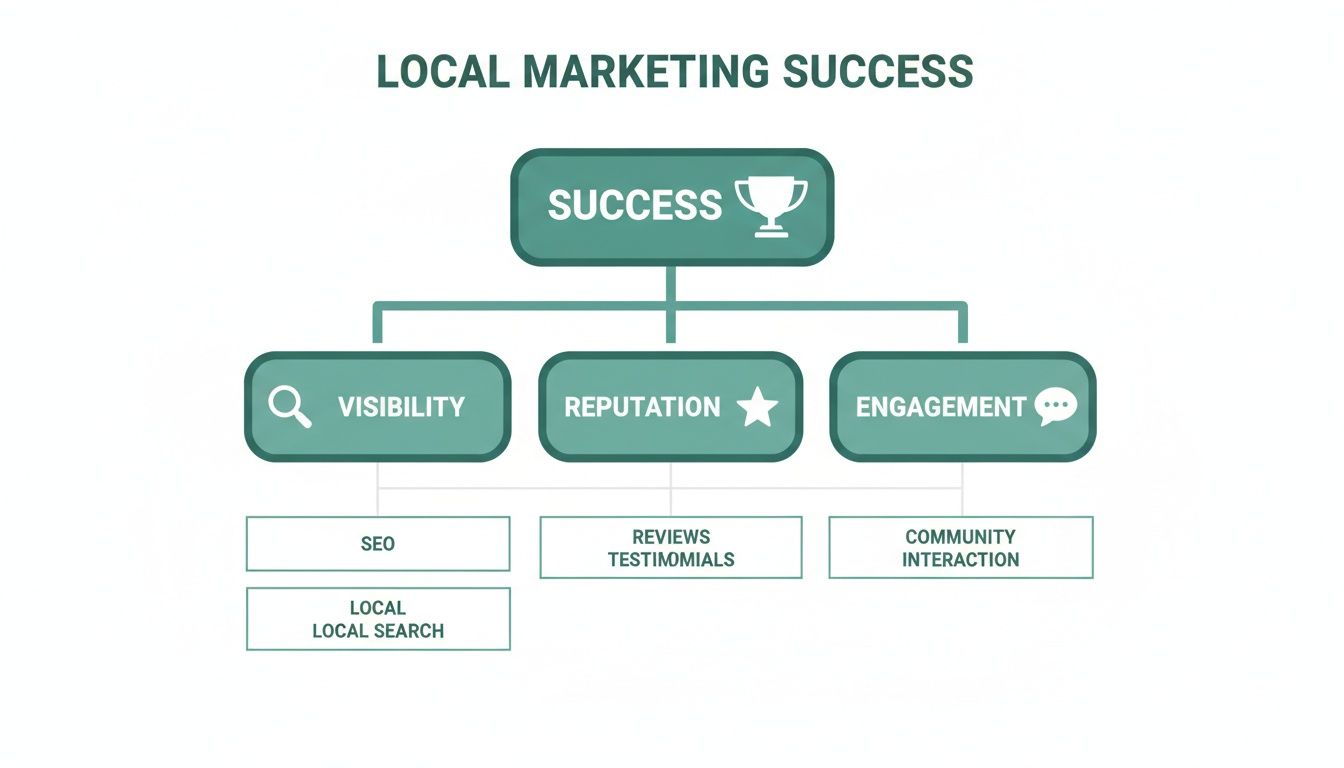
When you get this cycle spinning, you create a powerful flywheel that pushes you to the top of the Map Pack and keeps you there.
Understanding the Three Local Ranking Factors
First up, Proximity. This one's pretty simple: how close is your business to the person searching? You can't just pick up your shop and move it, but you can make sure your service area is perfectly defined in your Google Business Profile (GBP). This is non-negotiable for any business that travels to its customers, like a plumber or an electrician.
Next is Relevance. This is all about how well your business fits what the searcher is actually looking for. You have to speak Google's language. If you're a roofer, your GBP, your website, and your online content should be peppered with the exact terms people are searching for—"roof repair," "emergency leak fix," "new roof installation." Leave no doubt in Google's mind about what you do.
Finally, there's Prominence. Think of this as your local fame or street cred. How well-known is your business around town, both online and off? Google figures this out by looking at your online reviews, how often you're mentioned on other local blogs or news sites, and the overall authority of your website.
Prominence is your digital word-of-mouth. A steady stream of great reviews and mentions in the local press tells Google you're a trusted, popular choice—making you a much safer bet to recommend to its users.
Your Google Business Profile Checklist
Your Google Business Profile is ground zero for all your local SEO efforts. An incomplete or sloppy profile is like having a "Closed" sign hanging on your front door 24/7.
It's shocking how many businesses drop the ball here. While 80-90% of customers are online looking for local spots, a staggering 56% of local businesses haven't even claimed their GBP listing, let alone optimized it.
Don't be one of them. Run through this checklist to make sure your profile is a magnet for the Map Pack.
-
Claim and Verify Your Profile: This is step zero. If you haven't done this, stop reading and do it right now. It's the only way to take control of your business's information online.
-
Perfect Your NAP (Name, Address, Phone): Your core business info must be 100% identical everywhere it appears online—your website, GBP, Yelp, Facebook, you name it. A tiny inconsistency like "St." vs. "Street" is enough to confuse search engines and hurt your ranking.
-
Choose the Right Categories: Be specific. Your primary category should be the most accurate description of your business ("Plumber," "Mexican Restaurant"). Then, add every other relevant secondary category you can think of ("Emergency Plumbing," "Water Heater Repair," "Taco Tuesday," "Margaritas").
-
Write a Keyword-Rich Business Description: You get 750 characters—use them all. Talk about what you do, who you help, and why you're the best choice. Weave in the top keywords your customers would use to find a business like yours.
-
Upload High-Quality, Geo-Tagged Photos: Show people what you're all about. Add great photos of your storefront, your team in action, your products, and your happy customers. Geo-tagging those photos with your location coordinates is a slick way to send another strong proximity signal to Google.
-
Turn On Messaging & Build Out Q&As: Make it dead simple for customers to get in touch. You should also proactively load up the Q&A section with answers to your most frequently asked questions. It saves everyone time.
-
Use Google Posts Weekly: Share updates, promotions, events, or new products using Google Posts. This signals to Google that your business is active and engaged, and it gives searchers fresh, relevant content right in your profile.
By systematically dialing in every one of these elements, you're building an undeniable case for why your business belongs at the top. For a deeper dive, check out our complete guide on how to improve your rankings in the Google Local Map Pack. A perfectly optimized profile is the foundation for everything else you'll do.
Strategies for Multi-Location Businesses
Running the digital marketing for a single local business is a full-time job. Trying to scale that success across five, fifty, or even five hundred locations? That's an entirely different beast. The goals are the same—visibility and reputation—but getting there requires a completely new playbook built around centralization and scale.
Franchises and multi-location brands are constantly performing a tough balancing act. You have to keep the brand experience consistent everywhere, but you also need to empower each location to connect with its own community. A one-size-fits-all strategy just doesn't work when "local" in downtown Manhattan is nothing like "local" in a quiet suburb.
This creates a messy web of challenges. How do you track performance across every single store without drowning in spreadsheets? How do you figure out which locations actually need more marketing spend? The secret is to stop managing individual outposts and start orchestrating a network.
Centralize Your Data and Insights
The very first step to scaling successfully is creating a single source of truth. Without a central dashboard, you're flying blind. You can't spot trends, flag underperforming locations, or figure out what your top stores are doing right so you can replicate it. This is where a unified view becomes your most powerful asset.
Think about it: you wouldn't try to gauge your company's financial health by looking at one store's P&L statement. It's impossible. The same logic applies to your digital presence. You need a tool that pulls in data from all your locations and lets you see how they stack up, side-by-side.
This centralized view needs to track the metrics that actually matter for every single storefront, including:
- Local Keyword Rankings: Which search terms are actually bringing eyeballs to each store?
- Map Pack Performance: How often is each location showing up in the top 3 map results for its most valuable keywords?
- Review Volume and Velocity: Are all locations consistently getting fresh, positive reviews?
- Customer Actions: Which stores are driving the most calls, direction requests, and website clicks from their Google Business Profile?
When you consolidate all this information, you can instantly spot the outliers—both the rockstars and the ones that need help—and start making smart, strategic decisions instead of just putting out fires.
Prioritize Efforts with Precision
Not all of your locations are created equal, and neither is their local competition. A shop in a packed urban core is playing a different game than one in a sleepy suburban town. A truly smart multi-location strategy is about putting your time and budget where they’ll make the biggest dent.
Start by sorting your locations into tiers based on their current performance and future potential. You could group them into simple categories like:
- High-Priority: Underperforming locations in hyper-competitive markets that have a ton of revenue potential. These need your full attention.
- Maintenance Mode: Your top-performing spots that just need a steady hand to keep them on top.
- Growth Opportunity: Stores in less-crowded areas where a small, focused marketing push could deliver huge ranking gains.
This tiered system lets you allocate your resources way more effectively. You can go all-in on the high-priority stores while using automated or lighter-touch tactics for the others. You can dive deeper into building these frameworks by exploring advanced strategies for multi-location local SEO that help make this whole process more efficient.
Visualize Performance with Ranking Heatmaps
One of the sneakiest challenges for multi-location brands is understanding what "local" actually looks like on the ground. A store might rank #1 for "coffee shop" when someone searches from across the street, but be totally invisible to a customer just a half-mile away. Old-school rank trackers almost always miss this critical, block-by-block detail.
Ranking heatmaps solve this problem. They give you a visual, color-coded map of your search visibility across a specific geographic area. You can see, literally street by street, where you’re winning and where your competitors are eating your lunch.
This technology is a complete game-changer for local marketing. Instead of a single, often misleading ranking number for a whole city, you get a detailed map showing you the real picture. Green zones are where you dominate the Map Pack; yellow and red zones show you exactly where you're weak or non-existent.
For a brand with dozens or hundreds of locations, this is gold. You can generate a heatmap for every single store, compare them, and instantly get a data-driven roadmap for what to do next. This insight helps you pinpoint the exact neighborhoods that need more love, allowing you to run surgical campaigns that fix performance gaps and drive real growth across your entire portfolio.
Using AI to Automate Your Local Growth
What if you had a marketing assistant working for you 24/7, tirelessly boosting your visibility in the neighborhoods that actually matter? That’s the real-world power of artificial intelligence in local business digital marketing. Today’s platforms are handing small businesses a competitive edge that, until recently, was only available to massive corporations.
This isn't about finding risky shortcuts or trying to game the system. It’s about smart, ethical automation. Modern AI tools can safely and effectively generate the exact local engagement signals that Google's algorithm is designed to reward.
Think of these signals as the digital version of a busy storefront with a line out the door. They include things like brand searches from within your service area, clicks on your Google Business Profile, requests for driving directions, and even simulated in-person visits. By automating these activities, you’re consistently telling Google that your business is a relevant, popular choice for local customers.
Save Time, Outrank Competitors
The most immediate benefit is the insane amount of time you get back. Manually running a local marketing campaign—especially if you have more than one location—can easily eat up dozens of hours every single month. AI takes over the repetitive, signal-generating work, freeing you up to focus on what you do best: running your business.
This automation gives you a direct competitive advantage. While your rivals are still manually updating their listings or just hoping for new reviews, your AI-powered strategy is constantly proving your local authority to Google. This is what pushes you higher in the coveted Map Pack, getting you seen when it counts.
By automating the creation of key engagement signals, you're not just saving time—you're actively building digital proof of your local relevance. This consistent activity is what helps you climb the rankings and stay there.
The impact is real and measurable. Businesses that plug into these platforms see a clear spike in phone calls, website clicks, and most importantly, actual foot traffic. It's a straight line from automated digital activity to real-world revenue. To see how this works under the hood, check out our full guide on AI and the future of Local SEO.
Unlock Insights You've Never Seen Before
Beyond simple automation, AI brings a new level of sophisticated analytics to local marketing. One of the most powerful tools in this arsenal is the predictive ranking report. Instead of just showing where you rank today, these reports use data trends to forecast your visibility in the future.
Imagine seeing where your rankings will likely be in 30, 60, or 90 days based on your current momentum. This insight lets you be proactive instead of reactive. You can spot potential ranking drops before they happen and double down on the strategies that are clearly paying off.
This kind of forward-looking analysis delivers a few key advantages:
- Smarter Resource Allocation: Focus your budget and effort on the locations or keywords that show the most promise for growth.
- Proactive Strategy Tweaks: If the forecast looks weak for a key service area, you can ramp up your efforts there now, not after your leads have already dried up.
- Clearer ROI Measurement: Predictive reports help connect today's actions with tomorrow's results, making it far easier to prove the long-term value of your marketing.
By combining consistent engagement signals with these advanced insights, AI is completely rewriting the playbook for local marketing. It levels the playing field, allowing any determined local business to build a dominant online presence efficiently and effectively.
Tracking the Metrics That Actually Matter
Impressions and clicks look good in a report, but they don't pay the bills. The real test of any local business digital marketing effort is whether it makes the phone ring and brings people through your door. It’s time to stop chasing visibility for visibility's sake and start focusing on what drives revenue.
This means zeroing in on the handful of key performance indicators (KPIs) that show a customer is taking a real step toward making a purchase. Everything else is just noise.
Focusing on Bottom-Line KPIs
Your goal isn’t to get the most views; it’s to get the most customers. The most valuable data lives right inside your Google Business Profile (GBP) Insights, and these are the numbers that bridge the gap between your online presence and your cash register.
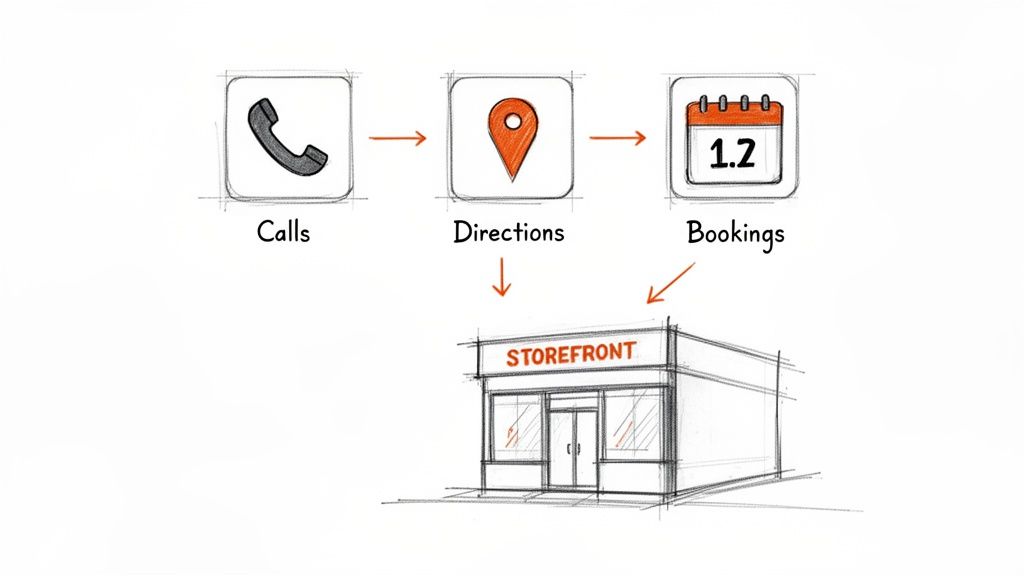
You need to be obsessed with these three actions:
- Phone Calls: This is a direct line to a high-intent lead. When someone hits that "Call" button, they’re past the research phase and ready to make a decision.
- Direction Requests: Think of this as the digital equivalent of someone walking toward your front door. It’s one of the strongest buying signals you can get—after all, 88% of local searchers visit a related store within a day.
- Website Clicks: While not as direct as a call, clicks to high-value pages like your menu, services list, or booking form show a customer is digging deeper and getting serious.
By tracking these numbers week over week, you can draw a straight line from your digital marketing efforts to actual growth. An uptick in direction requests is a tangible sign that your strategy is paying off.
Don't measure your marketing by how many people see you. Measure it by how many people act because they saw you. The difference between visibility and profitability lies in tracking real customer actions.
Visualizing Your Impact with Ranking Heatmaps
While GBP Insights tell you what actions people are taking, they don’t show you where those people are. A generic rank tracker might tell you you’re #2 for "best pizza in Boston," but that's a dangerously misleading average. You could be #1 for searchers a block away but totally invisible to potential customers just a mile down the road.
This is where ranking heatmaps are a total game-changer. They give you a visual, street-by-street breakdown of your search visibility.
These tools lay a color-coded grid over your service area, showing exactly where your business ranks in the Google Map Pack for your most critical keywords. Green zones mean you're dominating. Yellow and red zones instantly reveal weak spots or areas where you’re completely off the map. This level of granular detail lets you connect the dots—you can see how improving your ranking in a specific neighborhood leads directly to more direction requests from that same area. It’s how you make smarter decisions and focus your energy where it will deliver the biggest return.
Quick Answers to Common Questions
Even with the best game plan, a few questions always come up when you start digging into digital marketing for a local business. Here are some straight answers to the most common ones we hear.
How Long Does Local SEO Take to Work?
This is the big one, and the honest answer is: it depends.
You can often see a little bump within a few weeks just by cleaning up your Google Business Profile—getting your categories right, writing a solid description, that sort of thing. But to build real, lasting authority that gets you to the top of the Map Pack, you're usually looking at a 3-6 month runway of consistent work. The more competitive your local market is, the longer that timeline might be.
The biggest variable here is how consistently you're sending positive "engagement signals" to Google. This is where tools that generate authentic local activity can really shorten the timeline. Instead of just waiting for organic traffic to slowly build, they actively show Google that you’re relevant and popular right now.
Do I Need a Physical Storefront?
Absolutely not. Local marketing is a must-have for service-area businesses (SABs)—think plumbers, mobile dog groomers, or IT consultants who go to their clients. The strategy has a few tweaks, but the core goals are the same.
In your Google Business Profile, you simply hide your physical address and define the specific towns or zip codes you serve. This tells Google exactly where you operate, so you can show up in the Map Pack for those areas without customers ever needing to visit you. It's all about getting seen where your customers are.
Should I Do This Myself or Hire Help?
For most business owners, tackling the basics is completely doable. Optimizing your Google profile and making it a habit to ask for customer reviews are foundational moves that you can, and should, start with. They're the bedrock of any good local strategy.
But when you're in a tough market, trying to grow quickly, or managing multiple locations, getting help is a game-changer. An agency can do the heavy lifting, but an AI-powered platform often gives you a bigger advantage. These platforms automate the time-sucking tasks—like generating engagement signals—giving you agency-level results without the agency-level price tag.
Ready to automate your local growth and dominate the Map Pack? Nearfront uses AI to generate the authentic engagement signals that get you seen by more local customers. Learn how Nearfront can boost your foot traffic and phone calls.