Before you even think about running a single ad, let’s get one thing straight: successful lead generation for local businesses starts with a rock-solid foundation. It’s about getting a crystal-clear picture of who your ideal local customer is and what they’re searching for. Nail this first, and every dollar you spend later will work ten times harder.
Building Your Foundation for Local Leads
Jumping straight into ad campaigns without a strategy is the fastest way I’ve seen businesses burn through their marketing budget. Effective local lead generation isn't about casting the widest net possible. It's about fishing in the right ponds with the perfect bait.
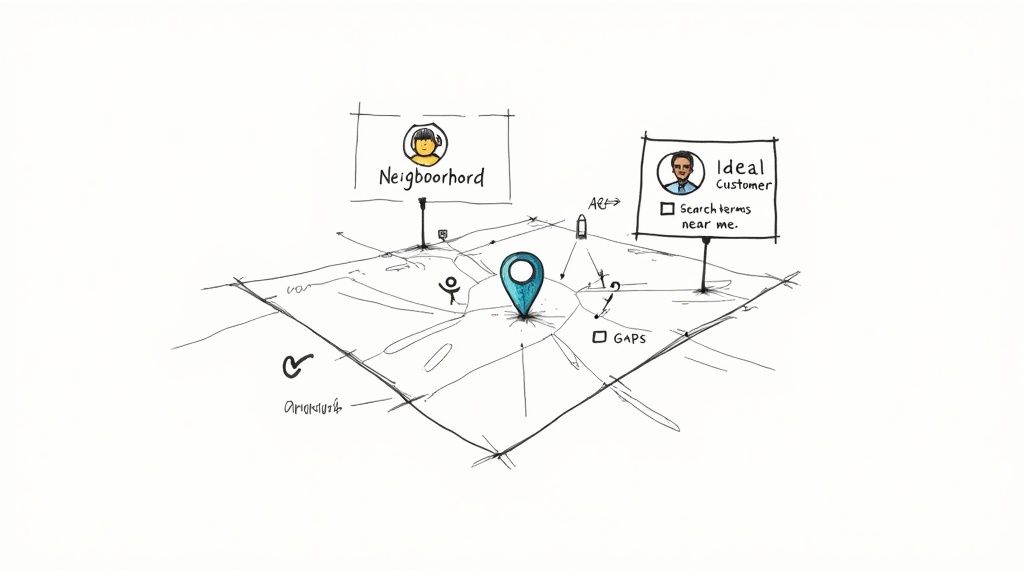
That means we need to take a step back. First, we'll audit your current digital presence to see where you stand. Then, we'll build a precise map of your target customers—right down to the neighborhoods they live in. This is the discovery phase, where you’ll find quick wins and identify the critical gaps in your online footprint.
Defining Your Ideal Local Customer
Forget broad demographics like "women ages 25-54." That’s useless for local marketing. To win, you need to understand the micro-communities within your service area.
Think about a high-end yoga studio in a big city. It might serve two completely different neighborhoods. One is packed with young professionals in luxury apartments who care about convenience and premium amenities. The other is a quieter, suburban area full of families who need childcare and weekend classes.
These two groups need different messaging, different offers, and they’re definitely searching for different things online.
To build out this kind of detailed customer portrait, start asking the right questions:
- Where do they actually live? Get specific with zip codes, neighborhoods, or even major cross-streets.
- What are their local pain points? A downtown commuter’s problems are completely different from a suburban homeowner’s.
- What pushes them to buy? Is it your 5-star Google reviews, a convenient location, or that special offer for new customers?
- What words do they use? Are they searching for "best coffee shop near me" or "quick espresso bar downtown"?
Getting these answers helps you visualize the path from where you are now to launching targeted, effective campaigns.
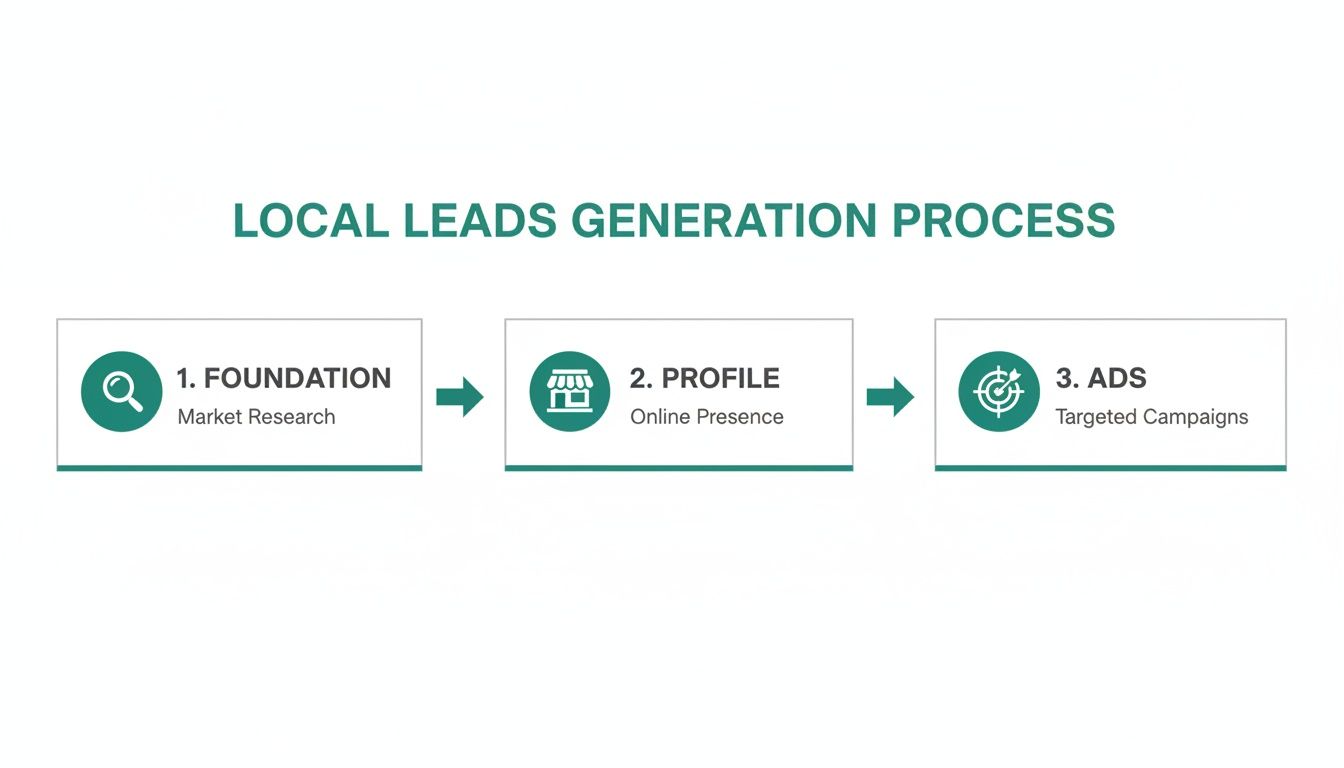
This process is simple but powerful. First, build the foundation. Then optimize your profiles. Only then do you start running ads.
Uncovering High-Intent Local Keywords
Once you know who you're talking to, the next move is figuring out the exact phrases they’re typing into Google. This is where local keyword research becomes your secret weapon. The goal is to find those high-intent, "near me" style searches that signal someone is ready to pull out their wallet.
Don’t just think about your main service. A plumber shouldn’t just try to rank for "plumber." They need to show up for real-world problem searches like:
- "emergency plumber in [Neighborhood Name]"
- "leak detection services [City]"
- "24-hour plumbing repair near me"
- "water heater installation cost [Zip Code]"
These long-tail keywords have less search traffic, sure, but their conversion rates are through the roof. Why? Because they capture people with an immediate, urgent need. The data backs this up, showing that organic search is a goldmine for high-quality leads.
In fact, recent studies show that content marketing drives over 51.5% of all leads. And within that, 35% of marketers reported that their best leads came directly from organic search. It’s a powerful testament to why showing up on Google matters so much. You can find more lead generation statistics and insights in this comprehensive study.
When you connect your services to specific neighborhood keywords, you're not just doing SEO—you're building a strategic map that will guide every marketing decision you make, from your website copy to your ad campaigns.
To make sure you have your bases covered, run through this quick audit.
Local Lead Generation Audit Checklist
This simple checklist will help you quickly assess if your foundational elements are in place before you launch a full-scale campaign.
| Audit Area | Key Action | Success Metric |
|---|---|---|
| Customer Profile | Define 2-3 specific customer personas for your top neighborhoods. | Clear understanding of local needs, pain points, and triggers. |
| Keyword Research | Identify 10-15 high-intent, "near me" keywords for each core service. | A prioritized list of keywords that signal purchase intent. |
| GBP Health | Check for complete and accurate NAP (Name, Address, Phone) across all listings. | 100% consistency across all online directories and profiles. |
| Local Landing Pages | Ensure you have dedicated pages for key service areas or neighborhoods. | Pages are optimized for local keywords and user experience. |
| Review Strategy | Verify you have a system in place to consistently request new reviews. | A steady stream of new, positive reviews each month. |
Going through this checklist ensures you’re not building your marketing efforts on a shaky foundation. Get these right, and you're ready for the next step.
Optimizing Your Digital Storefront to Attract Customers
Okay, with your keyword and neighborhood research locked in, it's time to focus on your digital storefront. Think of your online profiles—especially your Google Business Profile—as the front window of your business. If it’s messy, out-of-date, or just plain uninviting, potential customers will walk right on by.
A fully optimized online presence is a magnet for local leads. This goes way beyond just having the correct name, address, and phone number (NAP). It’s about creating an active, engaging hub that answers questions, builds trust, and makes it incredibly easy for someone searching nearby to become your next customer. This is the bedrock of effective lead generation for local businesses.
Mastering Your Google Business Profile
For local search, your Google Business Profile is arguably the most critical piece of digital real estate you own. It's often the very first interaction a potential customer has with your brand. A poorly managed profile can kill a lead before it even has a chance.
Just having the basics down isn't enough. While accurate business hours and a correct address are non-negotiable, the real wins come from leaning into all the interactive features Google gives you. These are the tools that transform a static business listing into a dynamic lead-gen machine.
Here's how a well-oiled profile gives customers everything they need at a glance.
This shows just how much elements like photos, reviews, and your map pin influence a user's decision. A complete and active profile doesn't just inform; it persuades.
To really get an edge, focus on these often-neglected features:
- Google Posts: Use these to share updates, promotions, or new product announcements directly on your profile. They're temporary, which creates a nice sense of urgency and, more importantly, shows Google and your customers that you're active.
- Q&A Section: Don't wait for people to ask questions. Get in there and proactively populate this section by asking and answering the most common questions yourself. This lets you control the narrative and handle objections before they even come up.
- High-Quality Photos and Videos: Make it a habit to regularly upload new images of your storefront, your products, your team, and happy customers. Visuals build a ton of trust and give people a real feel for what to expect.
If you want to go deeper, our comprehensive guide on how to optimize your Google Business Profile breaks down every single detail.
Building High-Converting Local Landing Pages
While your GBP is your digital front door, your website is your showroom. Sending all that valuable local traffic to a generic homepage is a huge missed opportunity. What you really need are dedicated local landing pages for each key neighborhood or service area you're targeting.
And no, these are not just copies of your homepage with the city name swapped out. A truly powerful local landing page is a conversion tool, finely tuned for a specific audience. It should speak directly to their needs, reference their community, and make it absolutely effortless for them to take the next step.
Your goal is to make the user feel, "This business is for me, right here in my neighborhood." This localized approach dramatically increases the chances of a user picking up the phone or filling out a form.
A successful local landing page has to include these key ingredients:
- Neighborhood-Specific Keywords: Weave the local keywords you identified earlier into your page headings, body copy, and meta descriptions. This is a huge relevance signal for both users and search engines.
- Hyperlocal Social Proof: Nothing works better than testimonials from customers in that exact neighborhood. A review from "Jane S. in South Park" is infinitely more powerful than a generic one.
- Clear, Actionable CTAs: Make your "Call Now" or "Get a Quote" buttons impossible to miss. On mobile, these must be "tap-to-call" to eliminate any friction.
- Mobile-First Design: The vast majority of local searches happen on a smartphone. Your page has to load fast and be dead simple to navigate on a small screen. No excuses.
By combining a perfectly optimized Google Business Profile with a network of conversion-focused local landing pages, you create a powerful one-two punch. You attract nearby customers searching on Google and then guide them to a webpage designed specifically to turn their interest into a qualified lead.
Running Hyperlocal Campaigns That Actually Convert
Alright, your digital storefront is polished and ready for business. Now it's time to swing the doors open and invite people in. This is where we shift gears from building a solid foundation to actively getting in front of customers where they live, work, and spend their time online.
The goal here isn't just to get clicks; it's to drive real-world actions. We want phone calls, direction requests, and actual foot traffic. Effective lead generation for local businesses is all about precision—ditching the broad, city-wide ad-blasting in favor of tight, neighborhood-level campaigns that resonate with the communities you serve. This approach doesn't just feel more authentic; it makes your marketing budget work a whole lot smarter.
Master Geo-Targeting on the Big Platforms
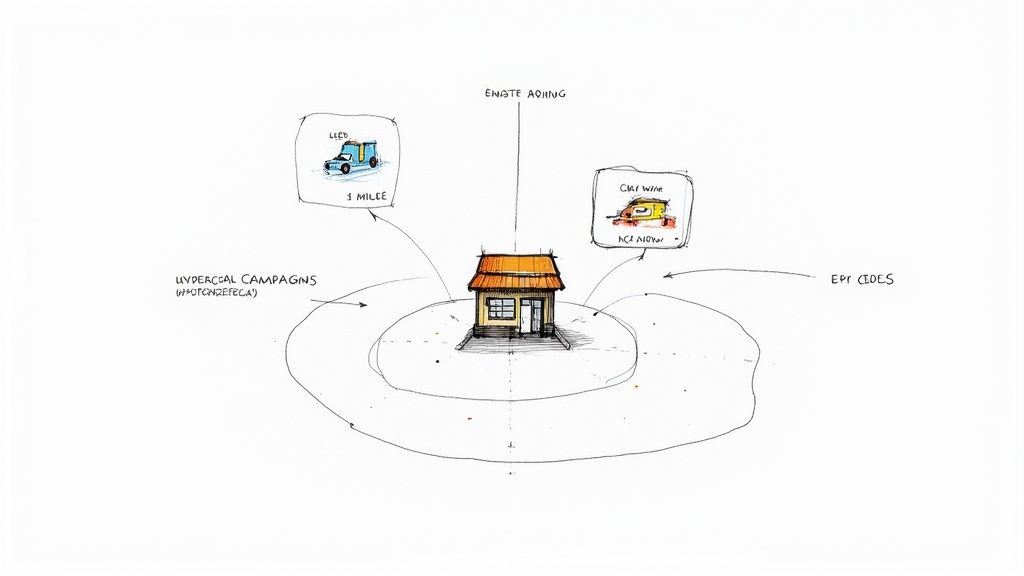
Both Google Ads and Facebook Ads have incredibly powerful geo-targeting tools. Forget blanketing an entire city; you can dial it down to a few specific city blocks. This is your secret weapon against bigger, less nimble competitors.
Imagine a coffee shop in a busy downtown district. They could run a campaign targeting only the office buildings within a half-mile radius, specifically between 7 AM and 10 AM. Or a local plumber could target a handful of zip codes known for older homes, instantly connecting with homeowners more likely to need their services.
The whole point is to get the right message to the right person, in exactly the right place. Here’s how to set it up:
- Radius Targeting: The simplest approach. Just draw a circle around your business—say, a 1-mile or 5-mile radius—to capture your most immediate audience.
- Zip Code Targeting: Perfect for when you know which parts of town your best customers come from. Just plug in the zip codes you identified in your initial audit.
- Neighborhood Targeting: This is as granular as it gets. Some platforms let you target specific, named neighborhoods, which is ideal for creating ultra-relevant ad copy.
This level of control ensures every dollar you spend is aimed at someone who can actually walk through your door, eliminating wasted spend on people outside your service area.

If you really want to go deep on this, our guide on Google Ads for local business walks you through the entire setup, step-by-step.
Craft Ad Copy That Speaks "Local"
Once your targeting is dialed in, your ad copy has to do the heavy lifting. Generic, corporate-sounding messages just get ignored. Your ads need to feel like they came from a neighbor, not a national chain.
This is where you can build an instant connection. Weave in local references that only a resident would get. For instance, a restaurant could run a Facebook ad that says, "Tired of the construction on Main Street? Swing by for a free coffee with any lunch order this week!" It’s a small touch, but it immediately shows you’re part of the community and understand their day-to-day.
The key is making your audience feel seen. Mentioning a local park, a recent high school football game, or a well-known landmark signals that you’re a true local business. That’s how you build trust and relevance instantly.
Here are a few angles that always work well:
- Reference Local Landmarks: "We're just around the corner from the old town theater."
- Tie into Local Events: "Heading to the farmer's market this weekend? Stop by for a cold brew!"
- Acknowledge Community Pride: "Proudly serving the families of the Rosewood district for over 20 years."
Think Beyond Paid Ads: Organic & Retargeting Plays
Paid ads are great for immediate traffic, but don't stop there. Smart retargeting and organic community engagement are where you can really amplify your results.
A classic, effective strategy is to partner with a non-competing business in your area for a joint promotion. A boutique fitness studio could team up with a nearby health food cafe, for example, to offer discounts to each other's customers. It’s a win-win that builds local goodwill.
And you absolutely have to re-engage people who've shown interest but haven't pulled the trigger yet. This is where you can combine retargeting ads with social proof. Imagine someone visits your website, leaves, and then sees an ad on Facebook featuring a glowing testimonial from one of their neighbors. That’s powerful stuff. This approach builds major credibility and gives hesitant prospects the nudge they need to become a customer.
How to Generate Authentic Local Engagement Signals
Having optimized profiles and hyperlocal ads is a great start—it gets you on the screen. But Google’s algorithm is looking for something more. It wants proof that you're an active, trusted part of the local community.
That proof comes from authentic engagement signals. Think of them as the digital version of real-world buzz.
These are the small but mighty actions that real customers take: leaving a review, clicking your call button, or asking for directions. Driving these interactions is at the heart of effective lead generation for local businesses. It’s what shows search engines you’re not just a listing, but a destination people actually choose.
Build a Culture of Reviews
Online reviews are the most powerful form of social proof a local business has. A steady flow of recent, positive reviews tells both Google and future customers that you deliver a great experience.
But you can't just sit back and hope they roll in. You need a simple, repeatable process for asking.
The secret is timing. Ask right after a positive interaction—a successful service call, a happy comment at the counter, or in a follow-up email. The goal is to make it dead simple for them to share their feedback while the good feelings are still fresh.
Here’s how to make it easy:
- Ask in person. A simple, “We'd love it if you shared your experience on Google!” can work wonders. You can even place a small sign with a QR code at your checkout counter.
- Send a quick follow-up. A day after a purchase or service, send a short, friendly text or email with a direct link to your review profile.
- Use your receipts. Add a quick note at the bottom of receipts or invoices asking for feedback.
Getting this right is a game-changer, but you have to play by the rules. We put together a complete guide on how to get Google reviews compliantly that breaks down all the dos and don'ts.
Respond to Every Single Review
Getting reviews is only half the job. Responding to them—both good and bad—is where you truly build trust and show you’re paying attention.
When a potential customer sees you thanking people for their praise and professionally handling criticism, it sends a clear message: you care.
For positive reviews, a simple, personalized "thank you" is all you need. Ditch the generic, copy-paste replies. Mention something specific from their review to show you actually read it.
Negative reviews are higher stakes. Always respond calmly, professionally, and publicly. Acknowledge their issue, apologize that their experience wasn’t perfect, and offer to take the conversation offline to fix it. This shows accountability not just to that one person, but to everyone else reading.
Prompt High-Value Customer Actions
Beyond reviews, you want to encourage other key engagement signals that Google tracks. These actions show that people aren't just seeing your profile; they're actually using it.
The goal is to gently nudge customers toward actions that signal real-world intent. This could be as simple as adding a line to your email signature or putting a small sign on your front counter.
Think about the actions that matter most for your business and find creative, low-friction ways to encourage them:
- Customer Photos: If you have a visually appealing business (like a restaurant, salon, or retail shop), encourage customers to upload photos of their experience. You could even run a "photo of the month" contest on social media to get the ball rolling.
- Click-to-Call: Make sure your phone number is prominent and tappable on your website and in your email signature. Sometimes, just adding a line like "Call us for a free quote!" is enough to prompt the action.
- Direction Requests: If you're hosting an in-store event or promotion, explicitly say, "Get directions to our workshop!" in your marketing materials.
By actively cultivating these signals, you create a powerful feedback loop. You strengthen your local authority, build customer trust, and ultimately, drive more qualified leads right through your door.
Measuring Your Local Performance and Planning What’s Next
Running campaigns is only half the job. Real growth comes from digging into the results, figuring out what’s actually working, and knowing where to double down. If you can't measure it, you can't improve it—and honestly, this is where most businesses drop the ball. They get distracted by vanity metrics like website traffic instead of the data that actually puts money in the bank.
This phase is all about creating a smart, data-driven feedback loop. We're going to look at how to track the actions that really matter—phone calls, direction requests, and customer locations—and use that intel to make better decisions. This is how you stop guessing and start building a predictable system for growth.
Track the Metrics That Actually Matter
Forget about generic website analytics for a minute. For a local business, the most valuable data points are knowing what made your phone ring and where your best customers are coming from.
A simple call tracking system is a fantastic place to start. Services like CallRail or even the built-in tools in Google Ads can assign unique phone numbers to different campaigns. This gives you crystal-clear attribution. You’ll know with certainty whether that inbound call came from your new Google Ad, a Facebook promo, or that Google Business Profile update you just posted.
This simple setup completely removes the guesswork.
When you know which channels are driving high-quality calls, you can confidently shift your budget to what's proven to work. It’s the difference between blindly spending money and making calculated investments.
Another game-changer is a customer heatmap. By plotting your customer addresses on a map, you can instantly see where your high-value clients are clustered. This insight is pure gold. It tells you exactly which neighborhoods to hit next with your hyperlocal ads or where to focus your next round of local SEO efforts.
How to Prioritize Your Next Moves
With this data in your hands, you can build a simple but powerful framework for continuous improvement. The idea is to get into a monthly or quarterly rhythm of analyzing performance and deciding what to do next. This is your strategic feedback loop.
Here's a straightforward way to approach it:
- Review your KPIs: At the end of each period, pull your core local metrics. Don't get lost in the weeds; just focus on the big picture.
- Identify wins and losses: What worked surprisingly well? Did a specific Google Post drive a ton of direction requests? Did your ads targeting that new zip code totally flop?
- Ask "Why?": Dig into the reasons. Maybe the successful ad mentioned a local landmark, creating a stronger connection. Perhaps the failed campaign targeted an area with the wrong customer demographic.
- Decide what’s next: Based on your analysis, pick one or two clear priorities for the next cycle. That might mean scaling the budget for a winning ad campaign or building a new local landing page for a promising neighborhood you found on your heatmap.
This structured approach keeps you from getting sidetracked and makes sure every move you make is based on real performance data, not just a hunch. For businesses with multiple locations, this becomes even more critical.
Scaling Success Across Multiple Locations
If you're managing more than one storefront, a multi-location dashboard is a non-negotiable. It lets you see how all your locations are performing at a glance. You can spot which ones are crushing it and which ones are lagging behind.
By comparing this data, you’ll start to see patterns. For instance, you might find that your strategy for generating reviews is working wonders at one location but falling flat at another. This allows you to diagnose the problem—maybe the staff at the underperforming branch needs better training—and apply the winning tactics from your top performers across the board.
This cycle of measurement, analysis, and iteration is what separates the businesses that grow steadily from those that stagnate. It’s also where you can make a huge dent in your bottom line.
After all, the cost per lead isn't trivial. Nailing this process helps you bring in more sales-qualified leads for less money. In fact, nurturing prospects effectively can boost the likelihood of a purchase by about 47%, and companies with a strong nurturing game often see a 33% reduction in their cost per lead. You can find more insights on lead generation costs and strategies over at seoprofy.com.
Before we move on, let's summarize the key metrics you should be keeping a close eye on.
Key Metrics for Local Lead Generation
Tracking the right numbers is crucial for understanding what's driving real-world results. Here's a breakdown of the metrics that truly matter for any local business.
| Metric | What It Measures | Why It's Important for Local Businesses |
|---|---|---|
| Phone Calls | The number of direct calls from your Google Business Profile, local pages, or call extensions. | The clearest indicator of high-intent interest. A phone call is often from someone ready to book or buy. |
| Direction Requests | The number of times users clicked the "Directions" button on your Google Business Profile. | This is a direct signal of foot traffic. Someone asking for directions is very likely on their way to your door. |
| Website Clicks | Clicks to your website from your Google Business Profile or local search results. | Shows engagement and a desire to learn more. Tracks how well your local presence drives online discovery. |
| Review Volume & Rating | The total number and average score of your customer reviews on platforms like Google. | Builds trust and social proof, which directly impacts your ranking and how many people choose you over a competitor. |
| Local Search Rankings | Your business's position in Google Maps and the Local Pack for key target keywords. | Higher rankings mean more visibility to nearby customers actively searching for your products or services. |
| Cost Per Lead (CPL) | The total marketing spend divided by the number of leads generated. | Measures the efficiency of your campaigns. A lower CPL means you're acquiring customers more profitably. |
Focusing on these metrics gives you a clear, actionable picture of your local marketing performance, helping you make smarter, data-backed decisions to grow your business.
Frequently Asked Questions About Local Lead Generation
Even with a solid playbook, questions always come up. Here are straightforward answers to some of the most common challenges I see local business owners face when trying to generate leads.
How Much Should I Spend on Local Ads?
This is the million-dollar question, but the answer isn't some fixed number you pull out of thin air.
My advice? Start small and let performance be your guide. For a single-location business, something like $15-$30 per day on Google Ads or Facebook is a perfectly reasonable starting point.
The key is to obsess over your return on investment. Once you see a campaign consistently bringing in calls and form fills at a cost that makes sense for your business, that's your signal to scale. Double down on what works, and don't be afraid to kill what doesn't. Your budget should be a living thing, growing right alongside your success.
Is Local SEO a One-Time Thing?
Absolutely not. Thinking of local SEO as a "set it and forget it" task is one of the most common—and costly—mistakes I see.
Your competitors are always working to outrank you, and Google’s algorithm is in a constant state of flux. Staying visible requires consistent, ongoing effort.
But it doesn’t have to be a huge time-suck. A simple monthly checklist can keep you on track:
- Check your GBP: Jump in and respond to all new reviews and questions.
- Publish one Google Post: Share a quick update, a new offer, or a team photo.
- Add new photos: Upload at least 2-3 fresh images of your work, your team, or your storefront.
- Glance at your rankings: Briefly monitor where you stand for your top 3-5 local keywords.
This keeps your profile fresh and signals to Google that you're an active, relevant business worth showing to searchers.
What Is the Fastest Way to Get Local Leads?
When you need leads right now, paid advertising is your best bet. A well-targeted Google Ads campaign can start driving phone calls within hours of going live because you're getting in front of people who are actively searching for what you do.
Organic local SEO, on the other hand, is a long-term investment. It can take months of consistent effort to build the authority you need to rank in those top spots.
The best strategy uses both. Use paid ads for immediate, predictable lead flow while you build up your organic presence through SEO. This gives you short-term wins and long-term stability.
Do I Need a Different Strategy for Each Business Location?
Yes, but you don't need to reinvent the wheel every single time. Start with your core strategy—the messaging and offers that you know work best—and then tweak it for the unique character of each neighborhood or city.
For example, a plumbing company might discover that ads focused on "emergency repairs" kill it in an area with older homes. But in a newer, eco-conscious suburb, ads promoting "high-efficiency water heaters" are what really resonate.
Dig into the local keyword data and customer demographics for each spot. A little customization, like referencing local landmarks in your ad copy or creating a neighborhood-specific landing page, can make a massive difference in your conversion rates.
Ready to see where your business truly ranks across every neighborhood? Nearfront provides AI-powered heatmaps and multi-location dashboards that turn local search data into actionable insights, helping you increase calls, foot traffic, and revenue. Find out how it works at https://nearfront.com.