When people look for a business nearby, they don't pull out the Yellow Pages anymore. They pull out their phone and search on Google Maps.
Google Map SEO is the art and science of making sure your business is the one they find. It’s a specialized strategy focused entirely on boosting your visibility in Google Maps and the coveted "3-Pack"—that short list of top results that appears for local searches.
It's about turning a search like "wellness studio near me" into a new client walking through your door.
Think of Google Maps as Your Digital Storefront
Imagine Google Maps as the new Main Street. Every time someone searches for a local product or service, they’re walking down this bustling digital street, looking for the best shop to visit. Getting a top spot here is like having the most inviting storefront on the busiest corner in town.
Google Map SEO services are what get you that prime real estate. This isn't just about dropping a pin on a map. It’s about strategically positioning your business to be seen as the most relevant, trustworthy, and obvious choice for people who are ready to buy right now. For businesses with multiple locations, like retail chains, wellness studios, or dispensaries, mastering this is no longer optional—it's essential.
Why the Google Map 3-Pack Is Everything
The most valuable piece of digital real estate on this new Main Street is the Google Map 3-Pack. It’s that little box with three top local businesses that Google shows directly in the search results, and landing there is a total game-changer.
For multi-location brands, winning this space has become a core part of their growth strategy. In fact, these larger brands now occupy a massive 33.4% of all 3-Pack spots for competitive keywords. That's a huge jump from just 23.8% back in 2022, proving just how powerful a focused Google Maps strategy can be for scaling visibility.
Being in the 3-Pack isn't just for bragging rights. Businesses featured there get 126% more traffic and an incredible 93% more customer actions—like phone calls, direction requests, and website clicks—than the businesses ranked just a few spots below them.
The data doesn't lie: showing up in the Map Pack directly translates into real customers and real revenue.
By mastering your presence, you're not just climbing a ranking; you're building a powerful and predictable channel for customer acquisition. Next, we'll dive into how to dominate the Google local map pack and turn those map views into paying customers.
The Foundational Pillars of a Winning Google Maps Strategy
Getting noticed on Google Maps isn't a one-and-done task. It's a strategic effort built on a few core pillars that all have to work together. Think of it like building a house—if the foundation is cracked, everything else you build on top of it will be unstable. The same goes for Google Maps SEO services; a winning strategy needs a balanced mix of an optimized profile, smart keyword targeting, and consistent trust signals.
This is all about turning digital visibility into real-world action: getting more people through your door, more calls, and more direction requests.
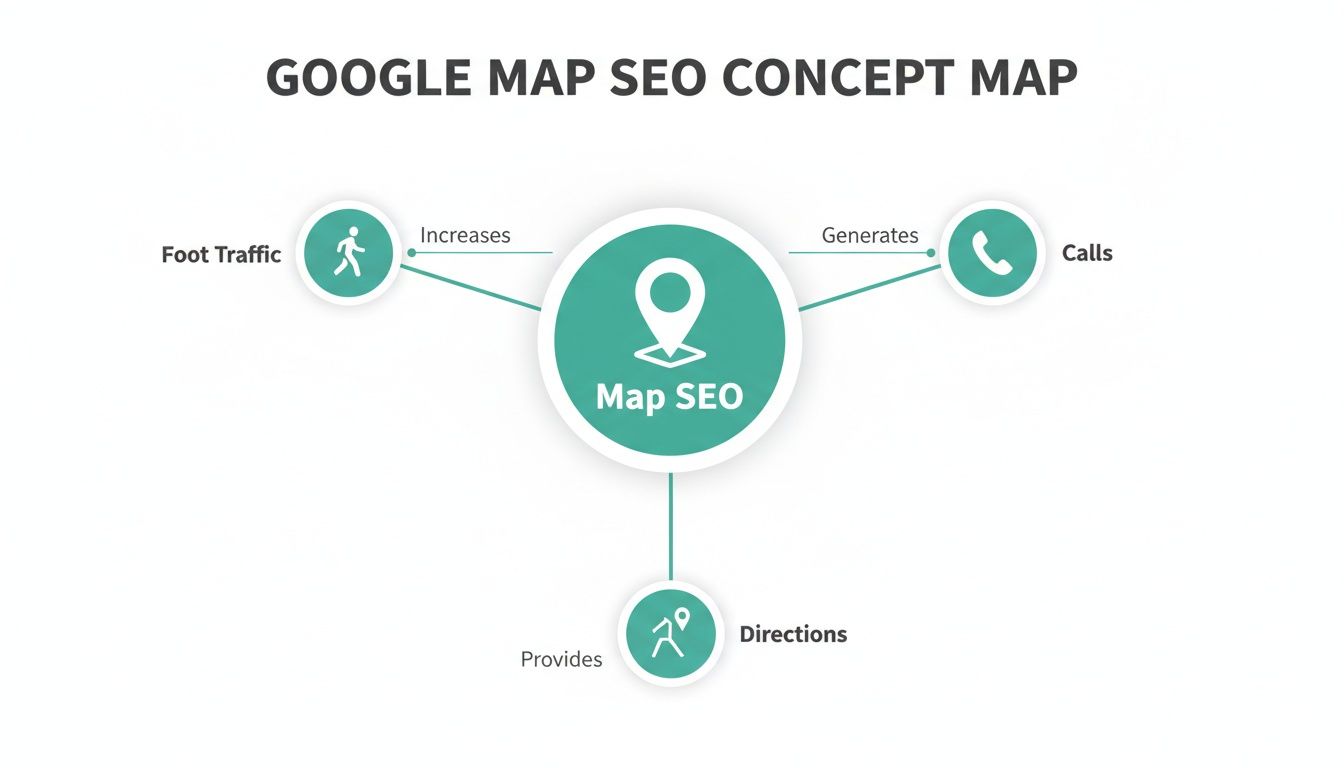
Let's break down the essential tactics that drive these results. The table below outlines the core components, the specific actions involved, and how they directly impact your local search performance.
Essential Google Maps SEO Tactics and Their Impact
| Tactic | Key Actions | Primary Impact |
|---|---|---|
| GBP Optimization | Selecting precise categories & attributes, uploading high-quality photos/videos, using GBP Posts. | Establishes relevance and trust, directly influencing your position in the Map Pack. |
| Local Keywords | Researching terms like "near me" or "in [city]," integrating them into your profile and content. | Tells Google exactly what local searches your business should appear for. |
| Citations (NAP) | Ensuring your Name, Address, and Phone number are consistent across all online directories. | Builds authority and trust with search engines, verifying your location and contact info. |
| Reviews & Engagement | Generating a steady stream of positive reviews and responding to all feedback (good and bad). | Signals popularity and customer satisfaction, heavily weighting rankings. |
| Website & On-Page SEO | Creating local content, ensuring mobile-friendliness, and adding local schema markup to your site. | Reinforces your geographic authority and expertise to Google. |
Each of these tactics plays a crucial role. Neglecting one can undermine your efforts in another, which is why a holistic approach is so important for sustainable growth on Google Maps.
1. Your Google Business Profile: The Center of Your Universe
Your Google Business Profile (GBP) is the absolute foundation of your Maps presence. It’s not just a listing; it's a dynamic hub that acts like a mini-website right inside Google’s search results. A completely filled-out, active profile is the single most important factor in local search rankings and your ticket into the coveted Map Pack.
This goes way beyond just getting your name and address right. It's an ongoing process of refinement and engagement. If you want to go deep, check out our full guide on how to optimize your Google Business Profile and turn it into a customer-generating machine.
Here's what a top-tier GBP optimization checklist looks like:
- Nail Your Categories: Picking the most specific primary category is non-negotiable. A "Neapolitan Pizza Restaurant" will always outrank a generic "Restaurant" for relevant searches.
- Leverage Every Attribute: Attributes like "Outdoor seating," "Serves cocktails," or "Woman-owned" are powerful filters that help you show up in more granular, high-intent searches.
- Show, Don't Just Tell: Visuals are a massive trust signal. We've seen that profiles with at least 20 high-quality photos get dramatically more views and clicks.
- Stay Active with Posts: Use the "Updates" feature for weekly specials, events, or news. This signals to Google that you're an active, engaged business worth showing to users.
2. Local Keywords and Consistent Citations: Building Trust and Relevance
Next up is understanding exactly what your local customers are typing into that search bar. Local keyword research uncovers phrases like "emergency plumber near me" or "best coffee shop downtown." Weaving these terms naturally into your GBP description, services, and website content is how you tell Google you're a perfect match for those searches.
Beyond keywords, Google craves consistency. A citation is any online mention of your business's Name, Address, and Phone number (often called NAP). When your NAP information is identical across high-authority sites like Yelp, Apple Maps, and other directories, it acts as a powerful vote of confidence.
Inconsistent NAP data is a major red flag for search algorithms. If Google finds different addresses or phone numbers for your business scattered across the web, it creates confusion, erodes trust, and can absolutely tank your map ranking potential.
Making sure your NAP is perfectly consistent everywhere is a simple but incredibly powerful way to build the digital trust that Google’s algorithm rewards.
3. Reviews and Website Signals: Proving Your Prominence
The final pieces of the puzzle are social proof and your own website. Customer reviews are a huge signal of prominence. Google's algorithm doesn't just look at your average star rating; it also analyzes the quantity, velocity (how recent they are), and the actual content of your reviews.
Encouraging happy customers to leave detailed feedback can give you a massive ranking boost, especially when those reviews naturally contain relevant keywords. Just as important is responding to all reviews—good and bad—to show that you're engaged and care about customer service.
Finally, your website's health is directly tied to your Maps ranking. Google views the site linked in your GBP as an extension of your profile. A mobile-friendly, fast-loading website with local content and proper schema markup reinforces your authority. On-page SEO isn’t separate from Maps SEO; it’s a critical component that fuels your entire local presence.
How Modern Platforms Accelerate Your Maps Ranking
Traditional google map seo services often feel like a constant, manual grind. You tweak your profile, chase down reviews, and squint at ranking reports, but the whole process is slow, clunky, and disconnected from how customers actually find you on the street. It’s like navigating a new city with a folded paper map—you’ll get to the right neighborhood, but you’ll miss all the crucial block-by-block details that matter.
Modern platforms, on the other hand, throw out the old playbook. They work more like a live GPS with real-time traffic updates, carving out a faster, smarter path to local visibility. This new breed of tools zeros in on the one thing Google’s algorithm cares about most: authentic, real-world user engagement.
Visualizing Your True Local Footprint
One of the biggest blind spots with standard SEO tools is their failure to show you how you really rank across a city. A single ranking for a zip code doesn’t tell the full story, because your visibility can plummet from one street to the next.
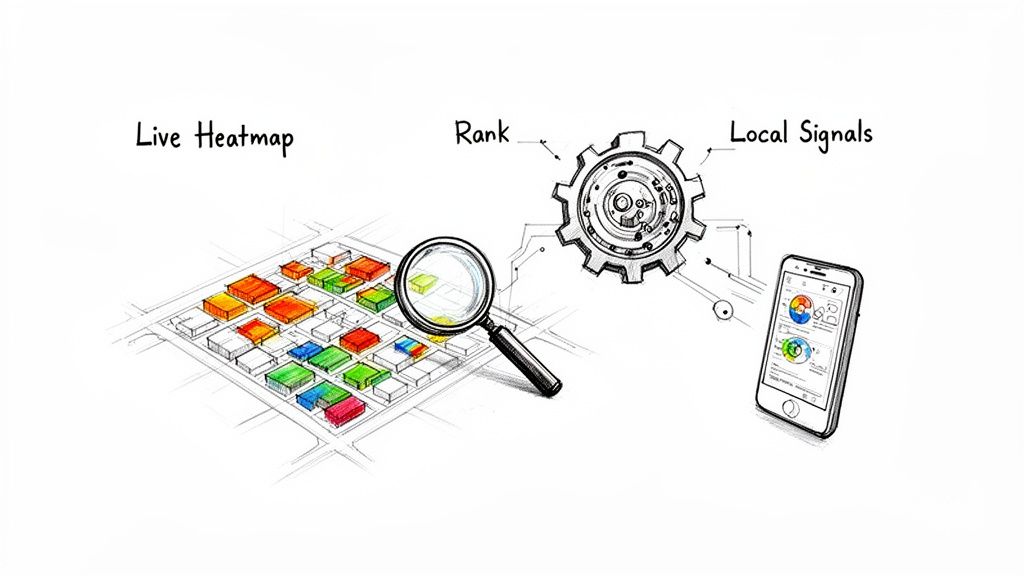
This is where live ranking heatmaps completely change the game. Instead of a generic report, you get a visual, color-coded map showing your exact ranking position on every single block. This gives marketing managers the power to spot weaknesses and opportunities with surgical precision.
- Green Zones: These are the areas where you dominate the Map Pack.
- Yellow Zones: Neighborhoods where you’re visible but could easily be knocked off by a competitor.
- Red Zones: Critical areas where you’re completely invisible to potential customers searching right now.
This level of detail moves your strategy from guesswork to data-driven action, showing you exactly where to focus your efforts.
Generating Authentic Engagement Signals at Scale
Google's algorithm rewards businesses that look popular in the real world. The proof? Engagement signals—actions that real users take to interact with your business profile. Trying to generate these signals manually is a losing battle. It’s just not scalable. But modern platforms have cracked the code.
Platforms like Nearfront are plugged into a massive ecosystem of everyday mobile apps. By integrating with these apps, they can generate the very signals Google looks for, creating a powerful feedback loop that builds your authority and trust with the algorithm.
The interesting part is this all happens without ever needing direct access to your Google Business Profile. It influences your ranking from the outside-in by simulating the natural discovery and interaction patterns of thousands of real, local users.
The result is a consistent flow of the most valuable local ranking signals, all generated authentically and at a scale that old-school methods simply can’t touch.
Making Predictive and Strategic Decisions
For any brand with more than one location, managing local SEO is a massive headache. Modern platforms solve this with centralized dashboards and predictive analytics, turning raw data into a clear roadmap for growth.
Imagine being able to compare the performance of your Chicago and Miami locations side-by-side. You could see which keywords are driving the most direction requests in one city and immediately apply those learnings to the other.
This technology finally lets you:
- Identify High-Impact Keywords: Pinpoint which search terms are actually making the phone ring or bringing people through the door for each location.
- Benchmark Against Competitors: Track how your visibility stacks up against your direct rivals in specific neighborhoods over time.
- Predict Performance: Use data trends to forecast which strategies will deliver the fastest ranking improvements and the best ROI.
By using these advanced capabilities, you’re no longer just reacting to last month’s performance data. You’re proactively shaping your local search destiny, making sure your business is the first one customers find, every single time.
Measuring the KPIs That Actually Drive Business Growth
Getting your business to show up on Google Maps is only half the job. The other half is proving it’s actually working. Real google map seo services go beyond feel-good numbers like profile views and zero in on the Key Performance Indicators (KPIs) that directly translate to money in the bank.
It’s all about connecting the dots between your local search strategy and real-world results. You need to know which of your efforts are making the phone ring, bringing people through your door, and ultimately, driving revenue. This is how you prove the true return on your investment.
Tracking Customer Actions That Matter
Your Google Business Profile is a goldmine of data, giving you a direct window into how customers engage with your listing once they find you. These aren't just abstract numbers; they’re clear signs of high-intent customer actions.
Focus on tracking these core engagement metrics:
- Phone Calls: How many times did someone tap the "Call" button right from your profile? This is a hot lead from a customer who’s ready to talk.
- Direction Requests: This shows how many people asked for directions to your physical address, signaling a strong intention to visit in person.
- Website Clicks: Clicks from your GBP often come from users who need a little more info before they decide to buy.
- Message Volume: For businesses with messaging turned on, this tracks direct inquiries and shows proactive customer interest.
By monitoring these specific actions, you shift the conversation from "how many people saw us?" to "how many potential customers did we attract?" This data gives you concrete proof that your Maps visibility is generating valuable leads.
Measuring Visibility and Ranking Improvements
Beyond direct actions, you have to measure how your visibility is expanding across your entire service area. A single ranking in one spot is nice, but it doesn't give you the full picture. You need a comprehensive view of your local search footprint.
This is where sophisticated tracking comes in. The goal is to see how your rank for key money-making terms changes over time and across different neighborhoods. Are you becoming more visible to customers a few miles away who previously couldn't find you? Answering that question is crucial.
You can get a precise, block-by-block view of your local search performance with a specialized Google Maps ranking checker that uses heatmaps to visualize your visibility. This level of detail helps you spot your strengths and weaknesses in a single glance.
Connecting Data to Business Outcomes
The final step is tying everything back to your bottom line. Google Maps is far more than a simple navigation tool—it's become a massive revenue engine. In 2023, it generated a staggering $11.1 billion, with a huge chunk coming from local ads and promoted pins that connect online searches to offline sales. This economic power highlights just how valuable your organic performance is. For a deeper look, you can explore more Google Maps statistics.
To prove the real-world impact of your Google Map SEO services, connect your KPIs to business results. For instance:
- Increased Foot Traffic: Correlate a jump in direction requests with your in-store sales data.
- Higher Call Volume: Link the number of calls from your GBP to new appointments or sales inquiries logged by your team.
- Lead Generation: Follow the website clicks from your profile all the way through to form submissions or online purchases.
By making these clear connections, you can confidently show how better local search visibility isn't just a marketing win—it’s a fundamental driver of business growth.
How to Choose the Right Google Map SEO Partner
Picking a partner to manage your local presence is a big decision. The right one can open the floodgates to new local customers. The wrong one just burns through your budget and leaves you with missed opportunities.
This isn't about finding the cheapest option. It’s about finding a true partner who gets your growth goals and has a clear, transparent plan to hit them.
Think of it like hiring a contractor to build your dream home. You wouldn’t hire someone without seeing their portfolio, understanding their blueprint, and knowing exactly how they'll measure progress. The same logic applies here. You need someone with a proven method, solid analytics, and a strategy that fits your local market like a glove.
Evaluating Potential Service Models
Not all providers are built the same. The world of local SEO is filled with different types of partners, and understanding their models is the first step to finding the right fit, especially if you manage multiple locations.
Here’s a breakdown of the usual suspects:
- Full-Service SEO Agencies: These are the general contractors of the digital marketing world. They’ll handle everything from your Google Business Profile to website SEO and content creation. It's a great all-in-one solution, but they might lack the deep, specialized focus needed for hyper-competitive local markets.
- Specialized Local SEO Firms: These folks are laser-focused on local search. They live and breathe Google Maps and are experts in citations, reviews, and local link building. They bring deep expertise to the table but probably won't cover your broader marketing needs.
- Modern SEO Platforms: This is a newer, tech-first approach. Platforms like Nearfront use AI and automation to generate authentic engagement signals—like searches and direction requests—that push your rankings higher. This model is often used to accelerate existing SEO efforts without needing direct access to your profiles.
Key Questions to Ask Any Potential Partner
Once you know the type of provider you’re looking for, it’s time to start digging. Your goal is to separate the real experts from the ones who just talk a good game. A confident, capable partner will have clear, data-backed answers to these questions.
Come to the conversation prepared.
A partner who can't clearly explain their strategy in simple terms probably doesn't have one. Vague promises of "getting you to the top" are a massive red flag. Demand specifics on how they plan to improve your visibility and drive real customer actions.
Here are the essential questions you need to ask:
- What is your core methodology for improving Map Pack rankings? You're looking for answers that go way beyond basic GBP optimization. They should be talking about strategies for building local relevance and prominence.
- How do you measure and report on performance? They need to talk about KPIs that actually matter—phone calls, website clicks, and direction requests—not just vanity metrics like profile views. Ask to see a sample report.
- What is your experience in my industry and with multi-location businesses? A strategy that works for a single pizza shop won't work for a national retail chain. They have to prove they understand the unique challenges of your business model.
- How do you stay up-to-date with Google's algorithm changes? Local search changes fast. A good partner can talk about recent updates, like the "Vicinity Update," and explain exactly how their strategy has adapted.
Understanding Common Pricing Models
Finally, you need to understand how you'll be investing. Pricing for google map seo services usually falls into a few common buckets. Knowing the difference helps you budget and align the cost with the value you expect to get.
- Monthly Retainer: This is the most common model. You pay a flat fee each month for ongoing services. It’s predictable, but make sure the scope of work is crystal clear.
- Project-Based Fee: This is a one-time fee for a specific task, like an initial GBP setup or a big citation cleanup. It’s great for getting started but doesn’t cover the ongoing optimization that drives long-term results.
- Subscription Model (SaaS): This is common for technology platforms. You pay a recurring fee for access to tools and data, like ranking heatmaps and performance dashboards. This gives you powerful insights, but you might be on the hook for executing the strategy yourself.
Choosing the right partner comes down to finding the perfect blend of strategy, transparency, and experience. By asking the right questions and understanding the different ways to engage, you can confidently pick a provider who will act as a true extension of your team and drive meaningful growth.
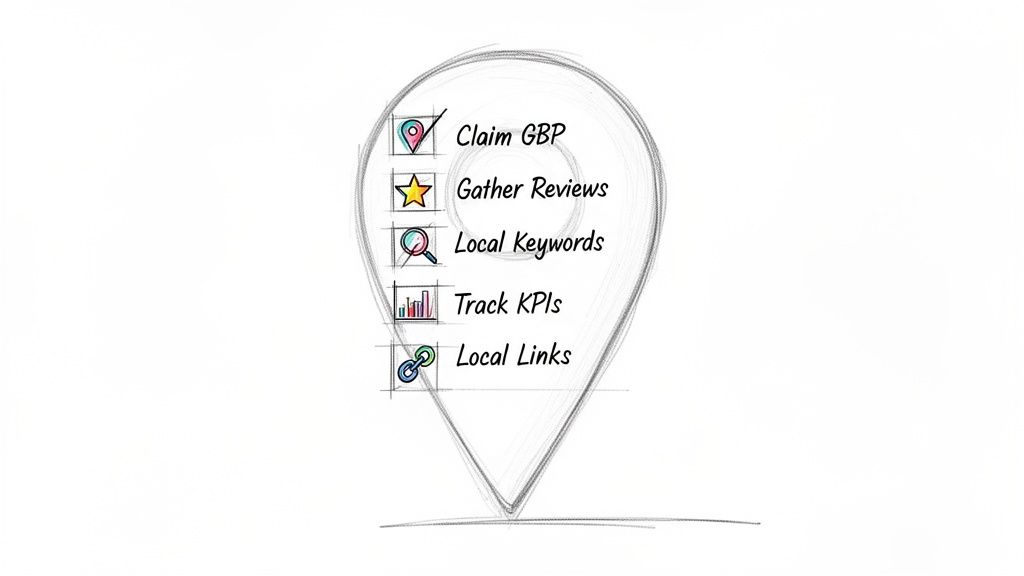
Alright, theory is one thing, but action is what gets you results. Let's pull all this together into a practical checklist you can start using today. Think of it as your roadmap to either audit what you're already doing or kick off a Google Maps SEO strategy from scratch.
Follow these steps to systematically build your local presence. We've laid it out to get you moving fast, starting with the absolute must-haves and building up to the tactics that create long-term growth.
Phase 1: The Foundational GBP Setup
This is the non-negotiable starting line for any google map seo services push. Nailing these details sets the stage for everything else.
- Claim and Verify Your Profile: First things first, get full control of your Google Business Profile. Use video or mail verification to prove you own the place.
- Complete Every Single Section: Don't get lazy here. Fill out your business description, services, hours, attributes (like "woman-owned" or "wheelchair accessible"), and drop in your website link. A 100% complete profile is a massive trust signal to Google.
- Pick Hyper-Specific Categories: Get as granular as you can with your primary category—think "Neapolitan Pizza Restaurant" instead of just "Restaurant." Then, add relevant secondary categories to show up in more searches.
- Upload High-Quality Visuals: Add at least 20 high-res photos and videos. Show off your storefront, the inside of your shop, your team, and your products. This builds confidence and gets people to engage.
Phase 2: Ongoing Optimization and Engagement
Once the foundation is solid, the game shifts to constant improvement and interaction. These are the activities that signal to Google that your business is active, popular, and relevant right now.
Consistency is everything. Random efforts won't move the needle in a competitive market. You have to dedicate time each week to these tasks to build real momentum and hold onto your local authority.
- Generate a Steady Stream of Reviews: Make it a habit to ask happy customers for reviews. You're aiming for a consistent flow of new feedback every week, because review velocity is a known ranking factor.
- Respond to All Reviews (Good and Bad): Engage with everyone. It shows you actually care about what your customers think. A smart, professional response to a negative review can often win you more business than a dozen 5-star ones.
- Publish Weekly Google Posts: Use the "Updates" feature to post about specials, company news, or events. This keeps your profile from looking stale and tells Google you're an active business.
- Answer Questions in the Q&A Section: Don't wait for people to ask. Add your own FAQs and answer them yourself. It's a great way to help customers and control the narrative.
Phase 3: Advanced Growth and Tracking
With the basics humming along, it's time to focus on scaling your reach and measuring what's actually working. These are the advanced steps that help you pull away from the competition and prove your ROI.
- Build Local Citations and Links: Make sure your business Name, Address, and Phone number (NAP) are identical across all the major online directories. Go after backlinks from other local businesses or community sites to boost your authority.
- Track Your Key Performance Indicators (KPIs): Keep a close eye on your GBP Insights. You need to know how many phone calls, direction requests, and website clicks you're getting. More importantly, connect that data back to your sales to measure the real impact of your local SEO.
Got Questions About Google Map SEO? We Have Answers.
If you're thinking about investing in a local search strategy, you probably have a few questions. That's smart. Understanding how long it takes, what's involved, and whether you can tackle it yourself is key to setting realistic goals and getting the results you want.
Let's clear up a few of the most common questions businesses ask before diving into Google Maps SEO.
How Long Does It Take to See Results?
This is the big one, right? While every market is different, you can usually expect to see some real, positive movement within 3 to 6 months. We're not talking about a #1 ranking overnight, but you'll start to see more customer actions—phone calls, requests for directions, and clicks to your website, all coming directly from your Google Business Profile.
Now, grabbing a top spot in the 3-Pack for your most competitive keywords? That’s going to take more time. It all depends on how crowded your industry is, the shape your profile is in today, and how consistently you work on it. The good news is that the foundational work often delivers tangible wins long before you hit the very top.
What Is the Difference Between Local SEO and Google Map SEO?
Think of it like this: Local SEO is the entire concert, and Google Map SEO is the lead guitarist. It’s the star of the show, but it needs the rest of the band to sound great.
- Local SEO is the whole shebang. It’s the broad strategy to make your business more visible in a specific geographic area. This covers everything from optimizing your website's content and building local links to managing your business info across all the online directories that matter.
- Google Map SEO is a laser-focused part of that strategy. It’s all about getting your business to rank higher and show up more often right inside Google Maps and the coveted "Map Pack" you see in regular search results. Frankly, it's the most valuable piece of any local marketing campaign today.
Bottom line: A killer Google Map SEO plan is the core of any successful local SEO effort.
But don't make the mistake of thinking they're the same. If you ignore the broader parts of local SEO, you'll hamstring your Google Maps potential. Google looks at signals from your website and other online mentions to figure out how authoritative and prominent your business really is.
Can I Do Google Maps SEO Myself?
Absolutely. You can definitely handle the basics on your own. Things like claiming and completely filling out your Google Business Profile, uploading great photos, and encouraging customers to leave reviews are all things any business owner can (and should) do. These first steps are incredibly effective.
But once you get into a competitive industry or have to manage multiple locations, the complexity and the sheer amount of work can become overwhelming. That's when partnering with a pro or using a specialized platform becomes a necessity. Experts bring sophisticated tools and proven systems that are tough to replicate on your own, which ultimately means you get bigger results, faster.
Ready to accelerate your local growth and dominate the Map Pack? Nearfront uses AI to generate the authentic engagement signals Google loves, pushing your locations to the top without ever needing access to your GBP. Discover how Nearfront can boost your visibility and drive more customers to your door.