So, what exactly is a Google Map SEO service? Think of it as a specialized game plan designed to get your business seen in Google's local search results, especially in that all-important Map Pack. The whole point is to make sure your brick-and-mortar spot shows up front and center when people nearby are looking for what you offer, turning those searches directly into foot traffic, phone calls, and website clicks.
Why Your Business Needs a Google Map SEO Service
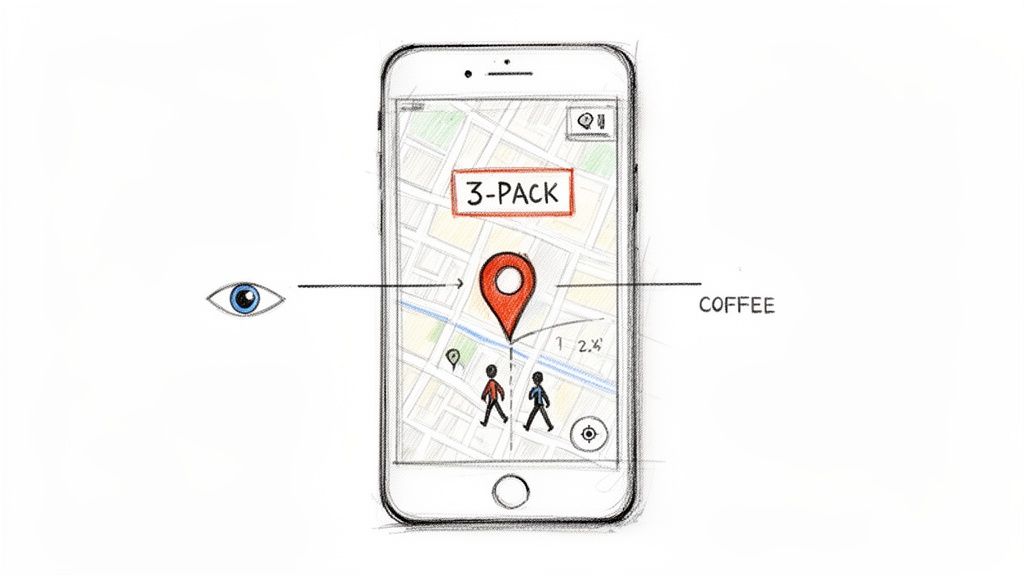
Picture this: someone pulls out their phone and types in "coffee shop near me." They aren’t about to scroll through a long list of websites. Their eyes are glued to the map that pops up at the top of the screen. This prime digital real estate, known as the Google 3-Pack, is where buying decisions happen in a matter of seconds.
For any business with a physical address, winning these "near me" moments is no longer just a nice-to-have—it's absolutely critical for growth. Today's customers are local and visual. They want fast, convenient answers, and Google Maps delivers exactly that.
The Shift from Search Engine to Answer Engine
Google isn't what it used to be. It has moved beyond showing a simple list of links and now provides direct answers. When a search has local intent, that answer is almost always a map. This makes your position on Google Maps the single most important factor for bringing in nearby customers.
Think of it like this: traditional SEO gets you on a long list of blue links. A Google Map SEO service, on the other hand, is laser-focused on getting you on the shortlist that customers see first. This visibility is incredibly powerful because it comes with built-in trust signals like star ratings and proximity, which encourages people to act immediately.
The data backs this up. A staggering 88% of people rely on Google Maps to find local businesses. For multi-location brands, getting into that coveted Google 3-Pack is even more crucial, as 42% of local searchers click directly on these Map Pack listings, often skipping the traditional organic results altogether. You can explore more local SEO statistics to get the full picture.
To help you understand the moving parts, here’s a quick breakdown of what a modern service should cover.
Key Components of a Modern Google Map SEO Service
| Service Component | Primary Goal |
|---|---|
| Google Business Profile (GBP) Management | Maximize profile completeness, accuracy, and relevance for target keywords. |
| Local Citation & Directory Building | Ensure consistent Name, Address, and Phone (NAP) data across the web to build trust. |
| Review Generation & Reputation Management | Increase the quantity and quality of reviews to improve social proof and rankings. |
| Local On-Page SEO & Content Creation | Optimize your website with location-specific content that signals local authority. |
| Engagement & Behavioral Signal Generation | Drive user interactions (clicks, calls, direction requests) that Google values. |
These pillars work together to build a strong local presence that Google's algorithm can't ignore.
It's More Than Just a Profile
A lot of business owners think that just claiming their Google Business Profile is enough. That’s a good first step, but it’s like putting a sign on your shop's door without telling anyone where the street is. A dedicated google map seo service is what actually drives targeted traffic to that door.
It's a continuous, strategic effort that involves:
- Optimizing every last detail of your profile for local relevance.
- Building local authority through consistent citations and positive reviews.
- Generating real engagement signals that prove to Google that you're a popular choice.
Let's be blunt: in today's market, if your business isn't visible on the map, you're effectively invisible to most of your potential customers. A smart approach to Google Maps is the bridge that connects a local searcher to a new customer walking through your door.
How the Google Maps Ranking Algorithm Works
Getting your business to show up on Google Maps is one thing. Securing a top spot in the coveted 3-Pack? That's a whole different game. To win, you have to understand how Google's local search algorithm thinks. It’s not about finding a secret trick; it's about proving your business is the best, most helpful answer for a real person's immediate needs.
Think of the algorithm as a highly efficient librarian. When someone asks for a specific type of book, the librarian doesn’t just grab the first one they see. They use a sophisticated process to find the perfect match, which mirrors Google's three core ranking pillars: Proximity, Relevance, and Prominence.
A google map seo service is designed to optimize your entire online footprint to score high marks in all three of these areas at once. Let's break down each one.
Proximity: The Closest Shelf
This one’s the most straightforward. How close is your business to the person searching? If someone types in "emergency vet," Google’s main job is to show them the nearest options, not one across the country. The searcher's physical location—or the location they type in their query (like "plumber in downtown Denver")—sets the map's boundaries.
You can't move your building, but you can influence how Google sees your service area. This is where professional help makes a difference, ensuring your profile and website clearly signal all the neighborhoods and regions you serve. Done right, you can show up in searches even if you aren't literally on the next block.
Relevance: The Right Book Title
Relevance is all about how well your business profile matches what someone is looking for. The librarian isn’t going to hand you a history book when you’ve asked for a sci-fi novel. In the same way, Google scans your Google Business Profile (GBP) to see if you’re a good fit for the search term.
Google looks at a few key spots to figure this out:
- Business Category: Your primary and secondary GBP categories are huge. Choosing "Pizzeria" as your primary category is way more effective than the generic "Restaurant."
- Keywords in Your Profile: The words you use in your business name, description, services, and even in your customer reviews help Google connect the dots.
- Services and Products: Listing out specific services (e.g., "residential window cleaning" instead of just "cleaning") creates a much stronger signal for what you actually do.
By meticulously filling out every single section of your profile with accurate, detailed information, you're basically giving Google a crystal-clear table of contents for your business. It makes it dead simple for the algorithm to match you with customers who are ready to buy.
Prominence: The Most Popular Book
Prominence is Google’s way of measuring how well-known and respected your business is, both online and off. Think of this as the librarian recommending the book that everyone is talking about—the one with glowing reviews that’s always being checked out. It’s how Google gauges your authority and credibility in the real world.
Prominence is the most complex pillar, and it's where a dedicated google map seo service can deliver the biggest wins. It’s built from a wide range of signals that, together, paint a picture of your business's standing in the local community.
Key signals that build prominence include:
- Review Signals: This is a massive one. Google looks at your total number of reviews, your average star rating, how often you get new reviews, and whether you're responding to them. A business with 150 four-star reviews looks much more prominent than one with only 5 five-star reviews.
- Citation Consistency: Citations are just mentions of your business's Name, Address, and Phone number (NAP) across the web on directories like Yelp, Apple Maps, and other industry-specific sites. When your NAP is consistent everywhere, it builds trust and confirms your location is legit.
- Website Authority: The strength of the website linked to your GBP matters. A well-optimized, mobile-friendly site with great local content and backlinks from other reputable local businesses tells Google you’re a serious player.
- Engagement Signals: This is all about user behavior. When people are constantly clicking to call your business from your profile, asking for directions, or visiting your website, it signals to Google that you're a popular and valuable local spot.
Getting a handle on these concepts is the first step toward a local strategy that actually works. You can dive deeper into how these signals are weighted by exploring our guide on the most important local SEO ranking factors. Mastering these three pillars—Proximity, Relevance, and Prominence—is the key to climbing the ranks and dominating the Google Map Pack.
Inside the Workflow of a Google Map SEO Service
So, what actually happens when you hire a professional Google Maps SEO service? It’s not about flipping a switch or finding some secret loophole. It's a disciplined, multi-layered campaign designed to turn your business from a digital ghost into a local landmark. Let’s pull back the curtain and look at the step-by-step workflow a real expert uses to get you ranked.
It all starts with a deep-dive audit. No reputable service starts making changes blindly. They first need a clear baseline—a full local SEO audit and a close look at what your competitors are doing. This initial phase maps out your current strengths, critical weaknesses, and the specific opportunities your rivals are missing, creating a precise roadmap for everything that follows.
Meticulous Google Business Profile Optimization
With a strategy locked in, the focus shifts immediately to your single most valuable local asset: your Google Business Profile (GBP). This is so much more than just listing your hours and phone number. True optimization is a meticulous, field-by-field enhancement designed to max out your relevance for the keywords that matter.
Every little detail gets fine-tuned for performance:
- Primary and Secondary Categories: This is about selecting the most precise categories that tell Google exactly what you do. Choosing "Pizzeria" instead of the generic "Restaurant" is a small change with a huge impact.
- Services and Products: A pro will build out detailed lists of your offerings, using the exact language your customers are typing into the search bar.
- Business Description: They'll craft a compelling, keyword-rich summary that sells your unique value without ever sounding spammy.
- Visuals: High-quality, geotagged photos and videos are uploaded to showcase your business, team, and work. Good visuals can boost engagement by over 40%.
Building Authority with Citations and Reviews
Once your GBP is dialed in, the next job is to build "prominence"—Google's word for how well-known and respected your business is. Two tactics are mission-critical here: strategic citation building and proactive review management. Citations are simply mentions of your business's Name, Address, and Phone number (NAP) on other sites like Yelp, Apple Maps, and industry-specific directories.
Consistency is everything. Even a tiny discrepancy, like using "St." on one site and "Street" on another, can confuse Google and water down your authority. A professional service uses specialized tools to hunt down and fix these inconsistencies, ensuring Google sees a single, unified, trustworthy signal.
At the same time, they'll implement a system for generating a steady stream of positive customer reviews. Fresh, frequent reviews are a massive ranking signal. They build incredible social proof that influences both the algorithm and the real people looking to buy.
The following process flow breaks down how Google's algorithm combines factors like these to rank local businesses.
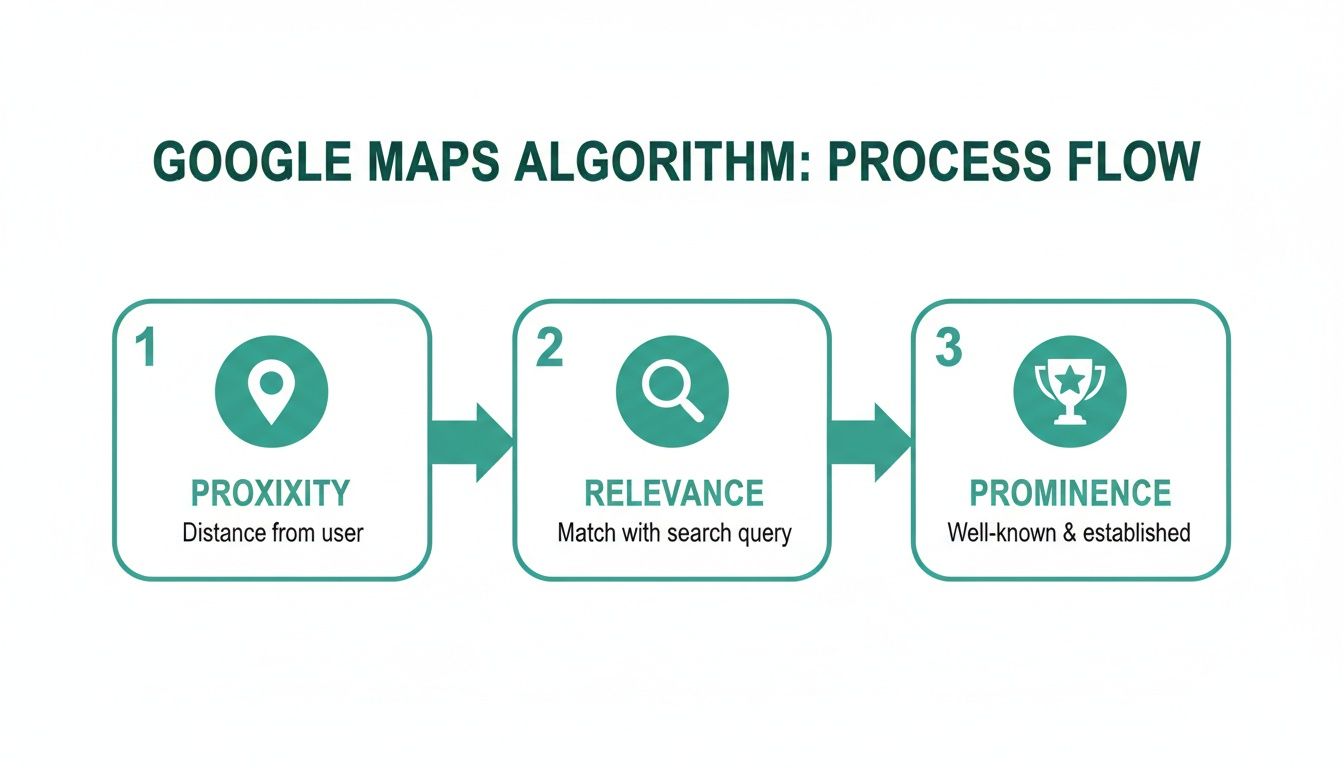
As you can see, proximity gets you in the game, but relevance and prominence are what ultimately decide who wins the top spots.
Connecting Your Website and Driving Engagement
A top-tier Google Maps SEO service knows your map presence and your website are two sides of the same coin. They’ll perform localized on-page SEO, creating content on your website that reinforces your local authority. This might mean building out location-specific service pages or writing blog posts about community events you're involved in. This strategy forges a powerful link, telling Google that your website is a vital resource for the local area, which feeds right back into your map rankings.
The final—and most advanced—phase is all about generating authentic engagement signals. Google watches how users interact with your profile very closely. A robust service will actively work to increase the valuable interactions that signal your business is a popular local choice.
These are the signals that really move the needle:
- Clicks-to-Call: Users tapping the "call" button directly from your profile.
- Direction Requests: People asking Google Maps for directions to your storefront.
- Website Clicks: Searchers clicking through to your website to learn more.
- Profile Interactions: Any action like viewing photos, reading Q&As, or saving your location.
By systematically optimizing your GBP, building external authority, connecting it to your website, and driving real user engagement, a comprehensive service creates a powerful feedback loop. Each step builds on the last, creating the kind of sustained momentum that pushes your business to the top of the map—and keeps it there.
Choosing the Right Service for a Multi-Location Business
Managing Google Maps SEO for a single storefront is one thing. But trying to get ten, fifty, or even hundreds of locations to rank is a completely different ballgame. The strategies that work for one shop just don't scale.
For marketing managers overseeing multi-location brands, it's a tricky balancing act. You need to keep the brand's look and feel consistent everywhere, but you also need to let each individual store shine in its own local market. This requires a specialized google map seo service or a platform built to handle that kind of complexity.
Beyond Single-Location Tactics
Think about the operational nightmare of managing dozens of Google Business Profiles by hand. Manually updating holiday hours across 100+ listings? It’s not just tedious; it’s a recipe for mistakes. Trying to track keyword rankings city by city becomes a blur, and figuring out which stores are falling behind requires a level of data that basic tools just can't provide.
This is where your standards for a service provider have to get a lot higher. You aren't just looking for an agency to tweak a profile. You need a partner who can give you a central command center for your entire local footprint.
The right partner gets the unique headaches you're facing. A deep dive into local SEO for multiple locations shows that winning strategies have to be customized for each market while still sticking to the main brand guidelines—a job that’s impossible without sophisticated tools.
Essential Features for Scaling Local SEO
When you're vetting a service or platform for your multi-location business, some features are simply non-negotiable. These are the tools designed to solve the exact problems that pop up when you start multiplying your locations.
Look for a solution that offers:
- Centralized Management: A single dashboard is a must. You need to be able to update core info—like business name, categories, and services—across every single location at once. This is how you guarantee brand consistency.
- Location-Specific Analytics: You need the power to drill down and see how each individual store is performing. Which locations are getting the most calls? The most direction requests? The most clicks to your website?
- Performance Heatmaps: These visual tools are game-changers. They show you exactly where you're ranking in different neighborhoods for each location, helping you pinpoint geographic weak spots.
A heatmap can show you in an instant that your downtown Chicago store is #1 for "best pizza" within a two-mile radius, but completely invisible just three miles north. That's the kind of granular insight you need to run smart, targeted local marketing campaigns.
Asking the Right Questions Before You Commit
Picking the right partner is a serious business decision. Before you sign on the dotted line, you need to grill them on their ability to handle scale. Don't be afraid to dig in with some tough questions about their tech and their process.
Here are a few key questions to get you started:
- How do you handle bulk updates and ensure NAP consistency across all our locations? Their answer better involve automation and specialized software, not a team of people doing manual data entry.
- What kind of reporting will we receive? Can you break down performance data by individual location, by region, and for the entire brand? Vague, rolled-up reports won't cut it. You need detailed, store-level data.
- How do you help us manage reviews and respond to Q&As at scale? Look for a system that gives you central oversight but also allows local managers to jump in.
Choosing a google map seo service for a multi-location business is about finding a solution that can grow with you. The right partner gives you the tech to make operations smooth, the data to make smart decisions, and the strategic guidance to turn your physical footprint into a massive competitive advantage on the map.
How AI Platforms Amplify Your Map SEO Results
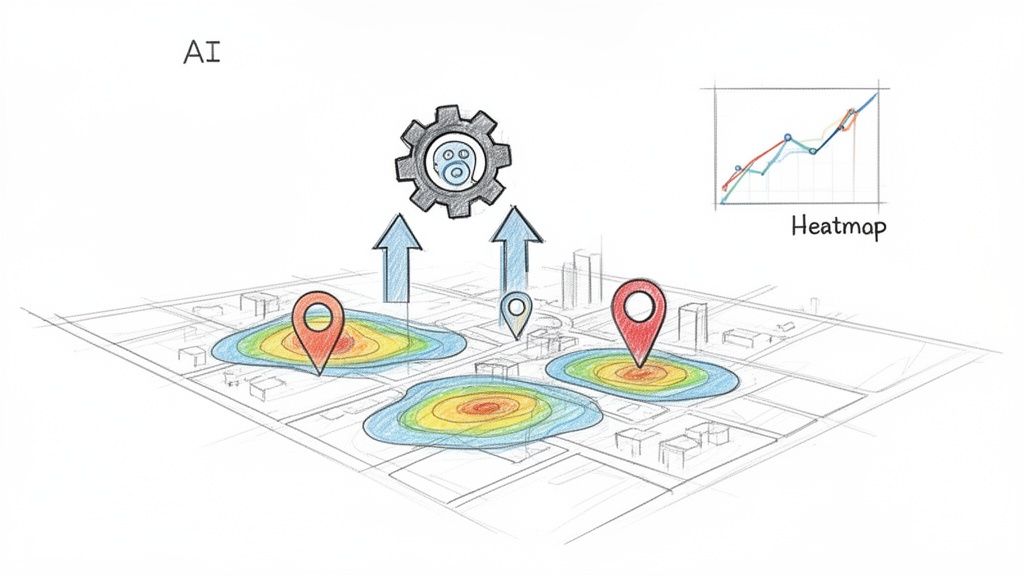
While the fundamentals of local SEO haven't changed—it’s still all about proximity, relevance, and prominence—the tools we use have completely transformed. A standard google map seo service often gets bogged down by manual work and periodic spot-checks. Modern AI-powered platforms are a different beast entirely, acting as a force multiplier for your entire local strategy.
These platforms automate the grind and swap guesswork for hard data. Instead of someone spending hours checking rankings from different street corners, an AI can instantly create dynamic visibility heatmaps. These maps show you, block by block, exactly where you’re visible for your most important keywords, exposing blind spots and opportunities you’d never find on your own.
This isn't just a small upgrade. It flips your entire strategy from being reactive to proactive, letting you see the whole playing field in real-time.
From Manual Tasks to Intelligent Automation
Think of a traditional agency like a skilled mechanic tuning your engine by hand—effective, but slow. An AI platform is like giving that mechanic a full diagnostic computer that not only flags existing problems but predicts future performance and tells you exactly what to fix for the biggest impact.
It’s this combination of human expertise and machine intelligence that drives real growth, fast.
Here are a few of the manual chores AI takes over and improves:
- Rank Checking: Forget tedious spot-checks. AI delivers comprehensive, always-on heatmaps that visualize your true local visibility, not just a few random data points.
- Keyword Research: Static keyword lists are a thing of the past. AI uses predictive analytics to pinpoint high-intent, location-specific search terms that are actually driving calls and foot traffic right now.
- Competitor Analysis: Instead of quarterly audits, AI watches your competitors 24/7, alerting you the moment their rankings shift or their strategy changes.
The real magic is in the machine’s ability to process massive amounts of local data at a scale no human team could ever dream of. It finds patterns and opportunities invisible to the naked eye, giving you a serious competitive edge.
Generating Authentic Engagement Signals at Scale
One of the hardest parts of any modern google map seo service is creating the behavioral signals that fuel the "Prominence" ranking factor. Google's algorithm is smart—it watches how users interact with your profile. Are they clicking to call? Requesting directions? Visiting your website? These actions prove your business is a popular, trusted local choice.
But you can't fake this stuff, at least not at scale. This is where AI platforms like Nearfront come in. They can generate thousands of authentic local search interactions that look just like real customer behavior.
Think of things like:
- Performing location-based searches for your target keywords.
- Clicking on your Google Business Profile in the search results.
- Initiating direction requests or clicks-to-call.
This process directly feeds Google's algorithm positive engagement data, boosting your prominence without ever touching risky, spammy tactics. And because the best platforms can do this securely without needing direct access to your Google Business Profile, your account's integrity is always protected. To see how this works, check out how AI and automation are rewriting the local SEO playbook.
The Future of Local SEO Strategy
Let's be clear: AI doesn't replace good strategy. It makes it more powerful. By handling all the repetitive, data-heavy lifting, it frees up human experts to focus on what they do best—high-level planning, creative content, and improving the customer experience.
This partnership creates a smarter, faster, and more effective way to own your local market.
For multi-location brands, this technology is nothing short of a game-changer. It provides the centralized control and granular insights you need to manage hundreds of storefronts without losing your mind. By pairing a skilled google map seo service with a powerful AI platform, you unlock a level of local visibility that simply wasn't possible before.
Measuring the ROI of Your Google Maps Investment
So, how do you know if your investment in a google map seo service is actually paying off? High rankings and more profile views are nice vanity metrics, but they don't directly deposit cash into your bank account. The real proof is in the outcomes—the actions that connect your visibility on the map to actual revenue.
It's all about looking past the surface-level data and zeroing in on the Key Performance Indicators (KPIs) that signal real customer intent. These are the clicks that show someone is ready to buy, giving you a straight line from a local search to a potential sale.
Tracking the KPIs That Matter
Your Google Business Profile (GBP) Insights dashboard is a goldmine. It's the first place you should go for hard evidence that your strategy is delivering results. Forget getting bogged down in impressions; you need to be laser-focused on the metrics that prove a user is moving down the funnel.
These are the KPIs that truly count:
- Phone Calls: This is as direct as a lead gets. Someone found your profile and was motivated enough to immediately pick up the phone.
- Direction Requests: This is the closest digital equivalent to tracking foot traffic. A request for directions shows a strong intent to visit you in person.
- Website Clicks: A user who clicks through to your website is a highly qualified lead. They're actively digging for more information on your products, services, or location.
These three metrics are the bedrock of your ROI calculation. They represent real, tangible interactions from potential customers who found you on Google Maps.
Building a Clear ROI Narrative
Once you're tracking these core actions, you can start to tell a compelling financial story. By assigning a dollar value to each action, you can translate your GBP performance into a clear monetary return. And no, this doesn't need to be complicated.
To figure out a simple ROI, first determine the average lifetime value of a new customer. Then, estimate your conversion rate for each channel (calls, website form fills, etc.). This simple framework lets you put a concrete dollar value on every single lead your Google Maps presence generates.
For instance, if you know that one out of every five calls from GBP turns into a customer, and your average customer is worth $300, then each call is effectively worth $60 in potential revenue.
Putting It All Together
With this data, you can build a straightforward report that shows undeniable value. Your google map seo service provider should be sending you regular reports highlighting these trends, but you can easily track them yourself right inside your GBP Insights.
Here’s a simple formula to get started:
- Track Monthly Growth: Note the month-over-month increase in calls, direction requests, and website clicks.
- Assign Value: Apply the value you calculated for each lead type.
- Calculate Total Value: Add up the total value generated from all actions.
- Compare to Cost: Subtract the cost of your SEO service from the total value to find your net return.
Following this framework shifts the conversation from, "Are we getting more views?" to "How much revenue did our map presence generate this month?" It’s a data-backed approach that proves the investment is directly impacting your bottom line.
Common Questions About Google Maps SEO
Getting started with local search always brings up a few key questions. Here are some straight answers to the things businesses ask us most often when they're thinking about a google map seo service.
How Long Until I See Real Results?
Think of Google Maps SEO like planting a garden, not flipping a light switch. You won't shoot to the top of the rankings overnight.
Typically, you can expect to see some positive movement within 60 to 90 days. But the real, lasting results—the kind you can build on—usually start showing up around the six-month mark.
A few things can speed this up or slow it down:
- How tough your market is: Ranking in downtown Manhattan is a different beast than ranking in a small town.
- Your starting line: A brand-new business profile has more ground to cover than one that’s been around for a while.
- How aggressive your strategy is: A comprehensive, all-in approach will obviously get you there faster.
Is This a One-Time Thing?
Not even close. Local SEO is a constant process of tweaking, monitoring, and adapting. Your competitors are always trying to get ahead of you, and Google is always changing its algorithm.
It's like having a storefront on a busy street. You wouldn't set up your window display once and just leave it for years, right? You have to keep it fresh and relevant to keep people coming in. Consistent effort is what keeps you on top.
Can I Just Do This Myself?
Sure, you can definitely handle the basics on your own—like claiming your profile and making sure your hours are correct. But a professional google map seo service brings specialized tools, years of experience, and the firepower to execute advanced strategies that actually move the needle.
For any business with more than one location, professional help is pretty much a necessity. It’s the only way to manage consistency across all your listings, analyze what's working in different markets, and generate the kind of engagement that gets you noticed across hundreds of local searches at once.
Ready to stop guessing and start ranking? Nearfront uses an AI-powered platform to put your business on the map, driving the calls and foot traffic you need to grow. See how we can amplify your local presence by exploring our solutions at https://nearfront.com.