Think of digital marketing for a local business as your online handshake, storefront, and megaphone all rolled into one. It’s how you show up when someone in your neighborhood is actively looking for what you offer, turning a quick phone search into real foot traffic, a ringing phone, and more sales.
It’s all about using online channels to connect with people in a specific geographic area.
Why Digital Marketing Is Crucial for Local Success
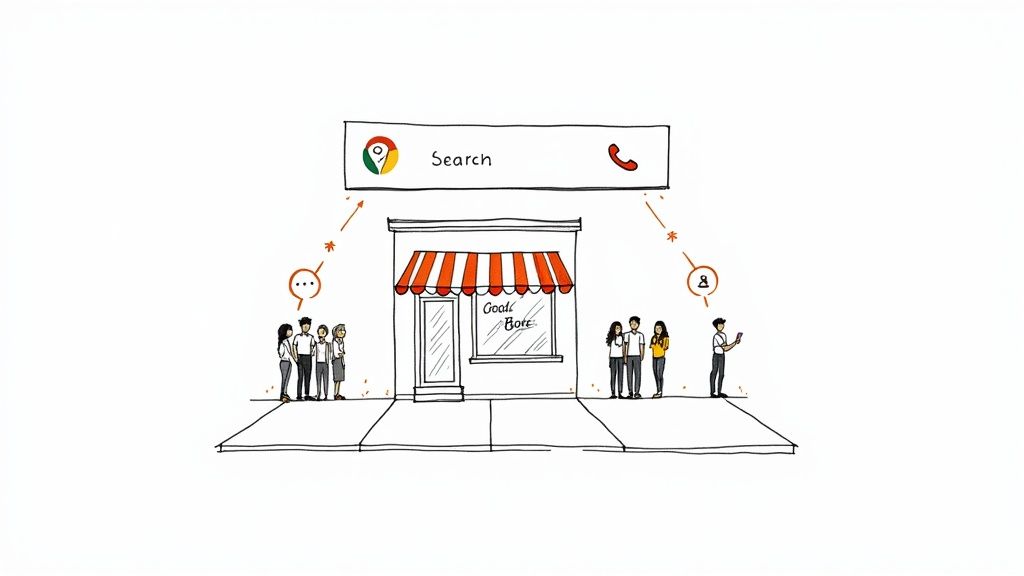
Let's be real—the days of leaning on a Yellow Pages ad or a sidewalk sign are over. Your customers, the people right down the street, live online now.
When they need a plumber, a haircut, or a dinner spot, their first move isn't to ask a friend. They pull out their phone and search. This isn't a trend; it's a fundamental shift in how people find and choose local businesses. A strong online presence is no longer a "nice-to-have"—it's non-negotiable.
Your digital presence is your new storefront window. It's the first impression you make, and it’s open 24/7. Without it, you’re basically invisible to most of your potential customers.
The Power of Local Intent
The data tells a pretty clear story here. A massive 46% of all Google searches have local intent. That means nearly half of the billions of searches happening every day are from people looking for something nearby.
Even better? 28% of those local searches lead to a purchase. This shows a direct, powerful line between being found online and making money. You can learn more about these compelling local marketing statistics to see the full picture.
The modern customer journey almost always starts online. In fact, nearly 97% of users check a business's online footprint before deciding to visit in person. Your reviews, photos, and website are your digital handshake, directly influencing whether someone walks through your door or drives to a competitor.
Before we dive into the specific tactics, it's helpful to see how the different pieces fit together. Each channel plays a unique role in attracting and converting local customers.
Key Digital Channels and Their Local Impact
| Channel | Primary Goal for Local Businesses | Key Metric to Watch |
|---|---|---|
| Local SEO (Google Maps) | Show up in the "Local Pack" for relevant searches | Clicks to Website, Direction Requests, Phone Calls |
| Local Content | Build authority and answer local customer questions | Organic Traffic, Keyword Rankings for "near me" terms |
| Online Reviews | Build trust and social proof | Average Star Rating, Number of New Reviews |
| Local Paid Ads | Drive immediate, targeted traffic from specific areas | Cost Per Click (CPC), Conversion Rate |
| Social Media | Engage with the community and build a loyal following | Engagement Rate, Local Follower Growth |
This table is just a starting point, but it highlights how a multi-channel approach works together to build a strong local presence.
Making Every Marketing Dollar Count
For most local businesses, budgets are tight. Every dollar has to pull its weight. This is where digital marketing really outshines traditional methods like flyers or local radio ads. It offers incredible targeting and measurement.
Here’s why it’s so effective:
- Hyper-local Targeting: You can show ads specifically to people within a few miles of your shop. This means your budget is only spent on the most relevant audience.
- Measurable Results: You can track exactly how many people called your business, requested directions, or visited your website directly from your marketing efforts. No more guessing.
- Building Community: Use social media to talk directly with local customers, share community news, and build a following that sees you as part of the neighborhood, not just another business.
A smart digital marketing strategy isn't about being everywhere online. It's about being in the right places, at the right times, right when your local customers are looking for you.
Mastering Your Google Business Profile and Local SEO
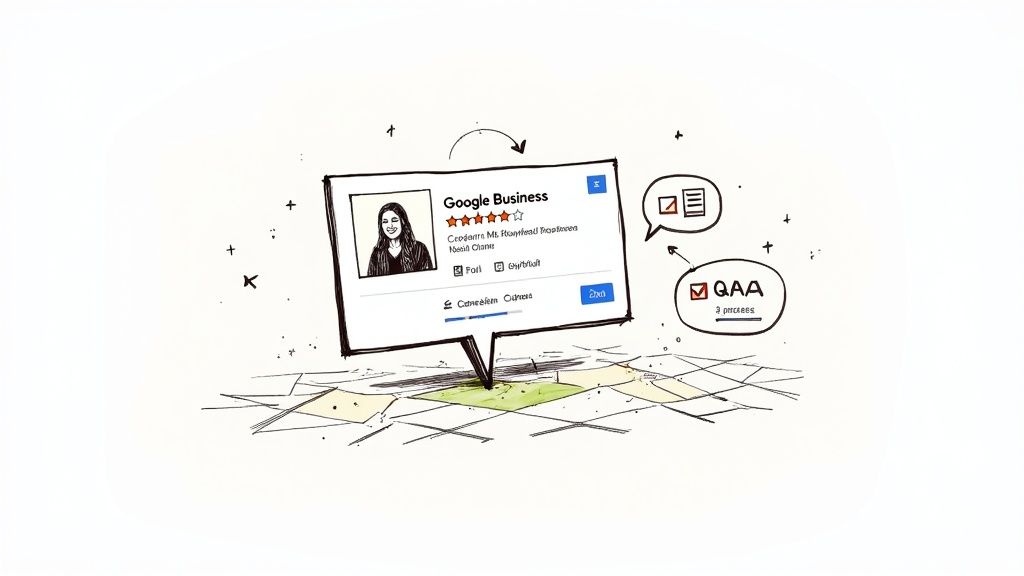
Think of your Google Business Profile (GBP) as the digital front door to your business. It's often the first thing a potential customer sees, making it the most powerful free tool in your local marketing arsenal.
Getting this right isn't just about filling out a form. It's about strategically positioning your business to show up in the coveted "Local Pack"—that box of three map listings at the top of local search results. Landing here can fundamentally change your business's growth.
Go Beyond the Basic Information
Most business owners stop after entering their name, address, phone number, and hours. That's table stakes. To actually stand out, you need to use every single feature Google gives you.
Your business description is prime real estate. Don't just write a generic sentence. Craft a compelling narrative that weaves in relevant local keywords. A plumber in Denver shouldn't just offer "plumbing services." They should get specific, mentioning neighborhoods they serve with phrases like "emergency pipe repair in Capitol Hill" or "certified Denver plumber."
Choose Your Categories Wisely
Selecting the right categories for your GBP is critical. Your primary category should be the most accurate, high-level description of what you do—think "Italian Restaurant" or "Auto Repair Shop."
But don't stop there. Google lets you add multiple secondary categories, which is your chance to capture more specific, long-tail searches.
- Primary Category: A bakery would choose "Bakery."
- Secondary Categories: They should also add "Cake Shop," "Coffee Shop," and "Wedding Cakes" if those services are offered. This simple move helps them appear for searches like "wedding cakes near me," even if "bakery" is their main business.
This one adjustment dramatically expands the number of searches you can rank for. For a more detailed walkthrough, check out our guide on how to optimize your Google Business Profile, which breaks down every section for maximum impact.
A fully optimized Google Business Profile receives, on average, 7 times more clicks than an incomplete one. The effort you put into filling out every detail—from accessibility options to service attributes—sends strong trust signals to both Google and potential customers.
The continued investment in this space proves its importance. The global digital marketing and advertising market hit roughly $667 billion and is projected to reach $786 billion by 2026. This shows that businesses are doubling down on platforms like GBP to win local customers. You can dig into more insights on this powerful market growth.
Engage Proactively with Q&A and Posts
The Questions & Answers section on your profile is a goldmine for proactive customer service. Don't wait for people to ask. Seed this section yourself with your most common questions and provide clear, keyword-rich answers.
For instance, a local gym could preemptively ask and answer:
- "Do you offer childcare services?"
- "What are the non-peak hours?"
- "Is parking available on-site?"
This not only helps customers find information quickly but also lets you control the narrative.
Likewise, Google Posts are free mini-ads that show up directly on your profile. Use them to announce special offers, highlight new products, or promote upcoming events. A post is only live for seven days (unless it's an event), so posting consistently keeps your profile fresh and active—something Google's algorithm rewards.
Build Trust with Consistent Citations
Now, let's talk about something that happens off your profile but heavily impacts your ranking: citations. A citation is any online mention of your business's Name, Address, and Phone number (NAP). These pop up on directories like Yelp, industry-specific sites like TripAdvisor, or local chamber of commerce pages.
Consistency is everything. Your NAP has to be identical everywhere. A small variation like "St." versus "Street" or "Co." versus "Company" can confuse search engines and erode trust in your location data, directly harming your rankings.
Managing Your NAP Consistency
Trying to manage citations manually is tedious and a recipe for error. It's often worth using a citation management service to clean up existing listings and push your correct information across dozens of relevant directories.
Think of each consistent citation as a vote of confidence for your business. The more consistent votes you have from reputable sources, the more confident Google becomes in showing your business to local searchers. It's a foundational piece of local SEO that builds a solid, long-term advantage over competitors who ignore it.
Create Content That Turns Neighbors Into Customers
If you want to win at local marketing, you have to stop thinking like a national brand and start acting like the most helpful neighbor on the block. Generic, one-size-fits-all content just doesn't connect. Your content needs to speak the language of the specific communities you serve, mentioning the landmarks, the pain points, and the little details only a local would know.
The goal here isn't just to sell—it's to become a trusted local resource. When a homeowner in a specific part of town searches for a solution you offer, your website needs to be the most relevant, authoritative answer they can find.
Build Hyperlocal Landing Pages
The single most effective way to do this is by creating dedicated landing pages for each neighborhood or service area you cover. And no, I don't mean just copying your homepage and swapping out the city name. These need to be unique, genuinely valuable pages built specifically for that micro-location.
Let's say you run a landscaping company in Austin, Texas. Instead of one generic "Services" page, you could build out pages like:
- Drought-Tolerant Landscaping in Tarrytown: This page would showcase photos from projects you actually completed in Tarrytown, feature testimonials from residents there, and even discuss the specific soil conditions common to that area.
- Modern Garden Design for Zilker Homes: Here, the content would be all about designs that complement the unique architectural style of homes in the Zilker neighborhood, again backed up with real case studies and local imagery.
By creating hyperlocal content, you are essentially telling Google, "I am the most relevant expert for this service in this specific place." This geographic relevance is a massive factor in how Google ranks businesses in the local map pack.
These pages build incredible authority. They signal to search engines that you have deep, proven expertise within a defined geography and let you target long-tail keywords like "best lawn care for Mueller yards"—queries that have way less competition and much higher purchase intent.
What to Include on Your Local Landing Pages
For these pages to work, they have to feel authentic. A simple list of services won't cut it. You have to prove you're part of the community.
A simple interactive map, for example, can visually anchor your business right in the neighborhood. You can configure it to pinpoint your business or even highlight a specific service area, adding immediate geographic context for anyone who lands on the page.
A truly effective local landing page should have a mix of these elements:
- Neighborhood-Specific Keywords: Weave in names of local streets, parks, schools, or well-known landmarks naturally.
- Local Project Photos: Showcase your work with geo-tagged images from jobs you've done in that exact area. A photo of a finished roof on "Elm Street" is infinitely more powerful than a stock photo.
- Community Testimonials: Get reviews from customers who live in that neighborhood. If they're comfortable with it, mention their location to add another layer of trust.
- Embedded Local Map: Visually show your service area or the location of past projects on an interactive map.
Brainstorming Relevant Content Ideas
Don't stop at landing pages. Your blog content should also be a direct resource for your local audience. Just think about the common questions your customers ask you every day and turn the answers into helpful articles. This is how you establish your business as the go-to expert.
A local HVAC company, for instance, could write articles like:
- "A Homeowner's Guide to Winterizing Pipes in [City Name]"
- "Is Your AC Ready for a [State Name] Summer? A 5-Point Checklist"
- "Our Favorite Local Parks for a Family Weekend" (This one isn't a direct sales pitch, but it builds a powerful community connection.)
This kind of content does so much more than just attract traffic; it builds genuine trust. When you give away valuable information without asking for anything in return, you become the first business people think of when they finally do need to make a purchase. It’s a long-term play that turns your website from a simple brochure into a true community hub.
Run Paid Ads That Reach Customers Around the Corner
Let's be honest: paid advertising can feel like a money pit, especially when you're watching every dollar. But for a local business, hyper-targeted ads aren't an expense—they're one of the fastest ways to get feet through the door. This is where you can truly connect with customers at the exact moment they're searching for what you offer.
Think about a local bakery pushing ads for fresh bread to people within a five-block radius right before their evening commute. Or a hardware store promoting snow shovels to homeowners in a specific zip code the day before a big storm. That's the kind of precision that makes every ad dollar count.
Successful local marketing isn’t about just one thing. It's the combination of dedicated local pages, authentic photos, and community-focused testimonials all working together to build trust.
Choosing the Right Platform for Your Goals
Not all ad platforms are built the same, particularly for local businesses. The two giants, Google Ads and Facebook (Meta) Ads, serve very different functions. Your choice really boils down to a simple question: are you trying to capture existing demand or create new awareness?
Google Ads is fantastic for capturing intent. You’re reaching people who are already looking for a solution you provide—think "emergency plumber near me" or "best coffee shop in downtown." These searches are red-hot, meaning the user is often ready to make a decision right now.
On the other hand, Facebook and Instagram Ads are better for generating demand. You can target users based on their interests, demographics, and location, even if they aren't actively searching for your service. This is perfect for more visual businesses or those that rely on impulse buys, like a new restaurant showing off a lunch special or a boutique promoting a weekend sale.
Choosing the right platform is half the battle. To help you decide where to put your budget, here's a quick comparison of the top ad platforms for local businesses.
Local Paid Ad Platform Comparison
| Platform | Best For | Targeting Strength | Typical Cost |
|---|---|---|---|
| Google Ads | Capturing high-intent searchers ready to buy. | Keyword and location-based targeting. | Higher CPC, but higher conversion rates. |
| Meta (Facebook/Instagram) | Building brand awareness and reaching passive customers. | Demographic, interest, and behavior-based targeting. | Lower CPC, good for top-of-funnel marketing. |
| Nextdoor | Reaching verified neighbors in specific communities. | Hyper-local neighborhood targeting. | Varies, but highly targeted for local services. |
| Yelp Ads | Driving traffic from people looking for local reviews. | Category and location-based, targeting review-seekers. | Can be expensive, but attracts ready-to-buy users. |
Each platform has its place, but for immediate results, Google and Meta are typically the best places to start.
Hyper-Targeting Your Local Audience
The real power of local paid ads is in the targeting. Forget paying for a billboard that everyone sees but few act on. Now, you can zero in on the exact people who are most likely to become customers.
Here are a few key targeting strategies I always recommend:
- Radius Targeting: This is the go-to. Draw a circle around your business—as tight as a single mile—and show ads only to people inside that zone.
- Zip Code Targeting: Perfect for service-area businesses like contractors or cleaners who operate within specific postal codes.
- Demographic Layering: This is where it gets really powerful. Combine location with demographics like age, interests, or behaviors. A local toy store could target parents with young children within a 10-mile radius, ensuring their message hits the right audience.
This level of precision is critical. In fact, 76% of people who search for something nearby on their smartphone visit a related business within a day. That shows just how immediate the impact of well-targeted local ads can be.
Pro Tip: Don't just set your ads and forget them. The most successful local ad campaigns I've seen involve constant testing. Try different ad copy, experiment with various images, and adjust your location targeting to see what drives the most calls, direction requests, and in-store visits.
Crafting Ads That Resonate Locally
Once you know who you're targeting, your ad creative needs to speak their language. Generic, corporate-sounding ads will get ignored. Your copy and visuals need to feel like they come from a neighbor, not a faceless company.
Here’s how to make your ads feel distinctly local:
- Mention Local Landmarks: Use phrases like "Located just two blocks from City Park" to ground your business in a familiar context.
- Use Authentic Photos: Ditch the stock photos. Seriously. Use high-quality images of your actual storefront, your team, and your products. People connect with realness.
- Create Local-Specific Offers: Instead of a generic discount, tie your promotion to a community event. Something like, "15% off for all attendees of the downtown farmer's market!" instantly builds a local connection.
This approach makes your ad feel more relevant and trustworthy. A well-crafted campaign can be a game-changer, and our guide on using Google Ads for your local business dives deeper into setting up campaigns that deliver real results without breaking the bank. By combining precise targeting with authentic, localized messaging, you can turn your ad spend into a predictable source of new customers.
Your Online Reputation is Your New Word-of-Mouth
In local marketing, your online reviews are everything. They're the social proof that tips a potential customer from just browsing to actually picking up the phone or walking through your door—instead of heading to your competitor down the street.
A steady stream of positive feedback is a massive asset. It directly impacts your local search ranking and, more importantly, builds the trust you need to grow your business.
Don't Wait for Reviews—Ask for Them
You can't just sit back and hope customers leave feedback. The best way to get reviews is to create a simple, repeatable process to ask for them.
It can be as straightforward as a follow-up email or text after a service is completed. A simple, "We'd love to hear your feedback on your recent experience with us!" is often all it takes to get the ball rolling.
Turn Every Review into an Opportunity
Responding to every single review—good, bad, or indifferent—is non-negotiable.
When a customer leaves a glowing five-star review, a personalized thank you reinforces their great experience and shows you're paying attention. This simple act of engagement builds loyalty and makes your happy customers feel seen.
But how you handle negative feedback is where you can really win. A thoughtful, professional response to a bad review can often win over more future customers than a dozen positive ones. It shows you're listening, you care, and you're committed to making things right. This kind of transparency builds immense trust with prospects who are watching how you react.
My Two Cents: Responding to a negative review isn't about winning an argument. It's about demonstrating your commitment to customer service for everyone else who's reading. Acknowledge the issue, apologize sincerely, and always offer to take the conversation offline to find a resolution.
Simple Scripts to Get You Started
You don't need a complicated system to start generating more reviews. The key is making it dead simple for your customers.
Here are a couple of templates you can steal and adapt for your business:
- For Email: "Hi [Customer Name], thank you for choosing us! We hope you had a great experience. If you have a moment, we'd be grateful if you could share your feedback on our Google profile. It helps other locals find us!"
- For Text Message: "Thanks for stopping by today, [Customer Name]! We value your opinion. Would you mind leaving us a quick review here? [Link to review site]"
By making the request personal and providing a direct link, you remove all the friction and make it much more likely you'll get that valuable feedback. For a deeper dive, our guide on how to get Google reviews compliantly lays out more strategies for building a strong review portfolio without running afoul of platform policies.
Remember, your reputation is also shaped by how accessible you are. Mobile advertising is projected to account for 70% of total ad spend by 2028, which just hammers home how critical mobile is for local businesses. Most people will read your reviews and your responses on their smartphones, so make sure everything is mobile-friendly.
When you actively manage your online reputation, you turn your most satisfied clients into your most powerful marketing asset.
Measure What Matters for Your Local Business
https://www.youtube.com/embed/mPiWWnJsVGw
So, how do you know if any of this is actually working? It’s incredibly easy to get bogged down in a sea of data, but for a local business, success isn't about vanity metrics like impressions or a flood of website visitors. It's about actions that lead directly to a customer walking through your door or picking up the phone.
You need to zero in on the key performance indicators (KPIs) that signal someone is ready to engage with you. These are the numbers that truly matter to your bottom line.
Tracking High-Intent Local KPIs
Instead of chasing broad, feel-good metrics, I always tell clients to concentrate on tracking a handful of high-value actions. Think of these as the digital equivalent of a customer asking for your business hours or trying on a product.
Your primary focus should be on:
- Phone Calls: A call coming straight from your Google Business Profile is one of the hottest leads you can possibly get. They're ready to talk, now.
- Direction Requests: This is a crystal-clear signal that someone is planning an immediate trip to your physical location.
- Website Clicks (from GBP): This shows a user wants more detailed information, which often leads to them filling out a form or calling you directly from your site.
- Contact Form Submissions: A direct inquiry from a local landing page is an unmistakable sign of interest in your products or services.
You can find all of these metrics right inside your Google Business Profile Insights dashboard. I recommend checking them weekly. It gives you a real-time pulse on what’s driving actual customer behavior without needing to get lost in complex analytics software.
The goal isn't just to be seen online; it's to be chosen. Tracking these specific actions helps you understand which of your marketing efforts are turning local searchers into paying customers.
Scaling Your Efforts for Multiple Locations
Now, what if you're managing more than one location? Consistency is your best friend, but so is local flavor. The real challenge is maintaining a cohesive brand identity while tailoring your approach to the unique vibe of each neighborhood.
A successful multi-location strategy involves centralizing your core brand message while empowering local managers to adapt. This means standardizing your brand voice and your main offers, but customizing things like local content, Google Posts, and ad campaigns to reflect community events or what customers in that specific area are looking for.
This balancing act ensures your brand feels both professional and authentically local, which is everything when it comes to building trust in each market.
The investment in this kind of targeted digital marketing just keeps climbing for a reason. In the U.S. alone, digital ad spending jumped 12% in the past year, with a heavy focus on search and social campaigns. You can dig into more of these digital advertising trends on your own. For local businesses trying to capture nearby customers, this trend shows a clear path forward.
Your Top Questions About Local Digital Marketing
Diving into local marketing always brings up a ton of questions. It's easy to feel like you're drinking from a firehose, but honestly, the most common hurdles have pretty straightforward answers. Let's tackle a few of the big ones I hear all the time.
How Much Should I Actually Spend on This?
There’s no magic number here, but a solid rule of thumb is to set aside 5-10% of your total revenue for your marketing budget. If you're a new business and really need to make a splash, pushing that closer to 12% can give you the initial traction you're looking for.
The real key is to start small and then scale what actually works. Kick things off with a modest budget for some local Google Ads or a boosted Facebook post. Track your results like a hawk, and once you see which channels are bringing in real calls and customers, double down on them.
Okay, But How Long Until I See Results?
This one totally depends on where you're putting your money and effort. Paid advertising, for instance, can bring in leads almost instantly—I've seen campaigns start generating calls within a few hours of going live.
Local SEO, on the other hand, is a long game. It’s all about building trust and authority with Google through great content and consistent business listings, and that just takes time. You should expect to see real, meaningful movement in your local search rankings within 3-6 months of consistent work. Patience and persistence are your best friends here.
Which Social Media Platform Is Best for My Business?
My best advice? Don't try to be everywhere at once. The "best" platform is simply where your customers are already spending their time.
- Facebook & Instagram: A no-brainer for visual businesses like restaurants, boutiques, and salons. Their hyper-local ad targeting is fantastic for running promotions and just connecting with your community.
- LinkedIn: This is the spot for B2B service providers. If you're an accountant, lawyer, or marketing agency trying to connect with other local professionals, this is your playground.
- Nextdoor: You can't beat this for reaching a verified, neighborhood-specific audience. It’s gold for home service businesses—think plumbers, electricians, and landscapers.
Get really good at one or two of these channels before you even think about expanding. A strong, active presence on the right platform will always beat a weak, scattered presence on all of them.
Ready to see exactly where your business ranks on Google Maps across every neighborhood you serve? Nearfront provides live ranking heatmaps and keyword tracking to show you what's working and where to focus your efforts. See how you stack up against the competition and turn local searches into real foot traffic. Discover the power of true local visibility at https://nearfront.com.