Digital local marketing is all about showing up online when a customer just around the corner needs what you sell. It’s the art and science of being the most visible, most helpful answer right when someone in your neighborhood is ready to buy.
What Is Digital Local Marketing and Why It Matters Now
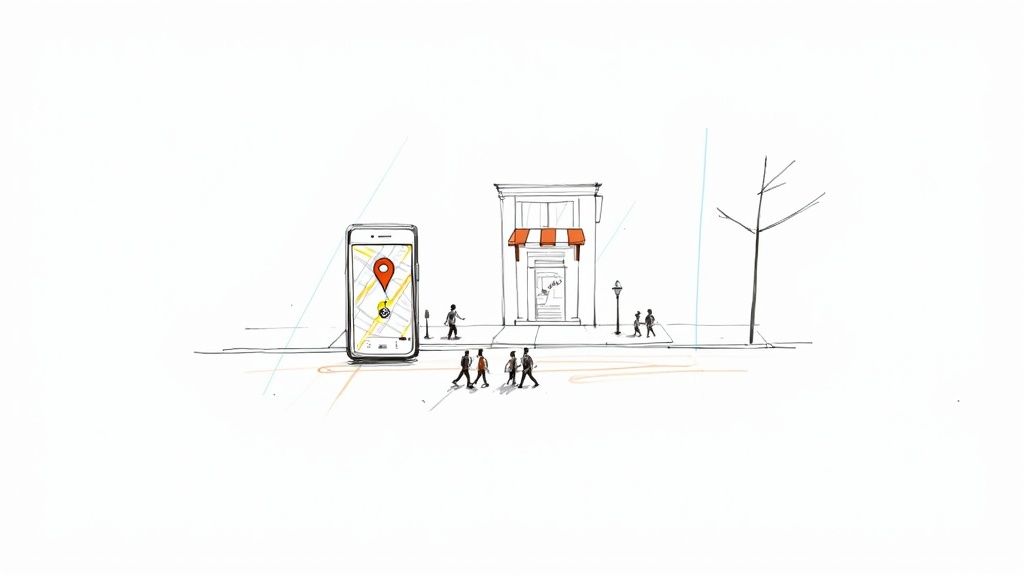
Think of it like this: your business used to need a bright, welcoming sign on Main Street. Today, that sign needs to be on Google Maps, at the top of local search results, and popping up in neighborhood social media feeds. It’s a laser-focused strategy designed to grab the attention of people searching for solutions "near me."
And this matters more than ever because how we find things has completely changed. People don't just browse anymore; they search with a specific, immediate need. They're on their phone looking for the "best coffee shop nearby" or asking a smart speaker to find a "local plumber." If you're not there in that exact moment, you're invisible.
The Power of Local Intent
The whole game is about connecting an online search to an in-person visit. The data shows this connection is ridiculously powerful. A staggering 46% of all Google searches have local intent, which means nearly half the time someone opens Google, they're looking for something close by.
And those searches turn into real-world action—fast.
Research shows that 76% of people who conduct a local search on their smartphone visit a business within 24 hours. Even better, 28% of those searches result in a purchase. This isn’t just about getting seen; it’s about directly fueling foot traffic and sales. You can explore more about the impact of digital marketing for local businesses to see just how big the opportunity is.
When you focus on local signals—your address, hours, photos, and customer reviews—you’re not just broadcasting to a general audience. You are speaking directly to motivated buyers who are close enough to walk through your door today.
Your Digital Main Street Presence
To win, your business needs to be active across a few key digital touchpoints. Each one acts as a different doorway for local customers to find you. The table below breaks down the core pillars of a solid local marketing foundation. We'll dive deep into each of these throughout this guide.
The Core Pillars of Digital Local Marketing
This table summarizes the essential channels and what they're meant to accomplish. Getting these right is non-negotiable for local visibility.
| Pillar | Primary Goal | Key Channels |
|---|---|---|
| Local SEO & Google Business Profile | Appear in "Map Pack" results for "near me" searches. | Google Maps, Google Search |
| Hyper-Targeted Paid Ads | Reach specific local demographics with paid promotions. | Google Ads, Facebook Ads |
| Listings & Citation Management | Ensure business information is accurate everywhere online. | Yelp, Apple Maps, Industry Directories |
| Localized Social Media | Build community and engage with local customers. | Instagram, Facebook, Nextdoor |
| On-Site Local Content | Create specific web pages for each location or service area. | Location Pages, Local Blog Posts |
Mastering these pillars ensures that no matter where a local customer is looking, your business is there waiting for them.
Mastering the Five Key Channels of Local Marketing
Think of great local marketing less like a single magic bullet and more like a well-coordinated ground game. It’s about showing up consistently in all the digital places your customers already are, creating multiple, well-lit signposts that all point back to your door.
To really own your local market, you need to master five essential channels. They don’t work in isolation; they feed each other to build visibility, trust, and most importantly, drive real-world foot traffic. Each one plays a different role, from grabbing attention on Google Maps to building a loyal community on social media.
Let's break down exactly how they work together to make your business the obvious choice for anyone nearby.
Winning the Map Pack with Local SEO
If there’s one non-negotiable foundation for modern local marketing, it's Local SEO. And the heart of Local SEO is your Google Business Profile (GBP). This is your ticket to getting featured in the coveted "Map Pack"—that little box with a map and three business listings that pops up for searches like "coffee near me" or "best tacos in Austin."
Getting into that box is like snagging the best real estate on the digital main street. Your GBP profile acts like a mini-website right on Google, showing customers your hours, address, photos, and—critically—your reviews. A well-tended profile sends strong signals to Google that you’re a relevant, active, and trustworthy business worth showing to searchers. For a deep dive, our guide breaks down exactly how to optimize Google Business Profile for maximum impact.
Precision Targeting with Local Paid Ads
While Local SEO builds your organic presence for the long haul, local paid ads give you a direct, immediate line to specific customers. Platforms like Google Ads and Facebook Ads let you get incredibly specific, targeting people in a certain zip code, a neighborhood, or even within a one-mile radius of your front door.
It's the digital version of putting a flyer directly into the hands of your perfect customer. A local yoga studio could run Facebook ads targeting people aged 25-45 who live within five miles and have shown an interest in wellness. That kind of precision makes sure your ad budget works hard, driving traffic from people who can actually walk in and buy something.
The biggest advantage of local paid ads? Speed. While SEO is a marathon, a sharp paid campaign can start making the phone ring and driving direction requests within hours of launch.
Building Trust Through Business Listings and Citations
Think of your business's name, address, and phone number (NAP) as its digital fingerprint. For search engines like Google to trust your business, that fingerprint needs to look identical everywhere it shows up online. This is where business listings and citations are crucial.
Citations are simply mentions of your NAP on other trusted websites, like Yelp, Apple Maps, and industry-specific directories. Consistency is everything here. A tiny difference, like using "St." on one site and "Street" on another, can create confusion for search engines and water down your local authority.
- Accuracy: Make sure your core business info is 100% correct across the board.
- Consistency: Use the exact same format for your name, address, and phone number on every single platform.
- Relevance: Get listed in directories that matter for your city or industry to send even stronger local signals.
Wrangling these listings can feel tedious, but getting it right builds a web of trust that solidifies your spot in local search results.
Engaging Your Community with Localized Social Media
For a local business, social media isn't about chasing viral fame. It's about building real connections with the people in your neighborhood. This is your chance to show the human side of your brand, share real-time updates, and have actual conversations with your customers.
A local bookstore, for example, could post about an upcoming author event or share a photo of a new neighborhood mural. This kind of content doesn't just sell—it builds relationships and cements your business as a genuine part of the community fabric. The goal is to become a trusted local hub, not just another faceless company.
Creating On-Site Local Content
Finally, your own website is one of your most powerful tools for attracting local customers. The key is creating on-site local content, like dedicated pages for each of your locations or blog posts that talk about local events, news, and topics. These pages need to be packed with location-specific keywords, photos, and useful information.
If you have multiple locations, this means creating a unique page for your "Downtown" shop and another for your "Uptown" one, each tailored with local flavor. This strategy screams to search engines that you are a legitimate, physical presence in that specific area, making you a much better result for anyone searching nearby.
This is more important than ever, as mobile devices now drive 60-65% of all web traffic and are central to how people find businesses. In fact, 88% of mobile users who search for a local business will visit a store within 24 hours. It's a direct line from pocket to storefront, and you can learn more about how mobile and reviews shape local marketing on recurpost.com.
Building a Strategic Framework for Multi-Location Businesses
Scaling digital marketing across dozens—or even hundreds—of locations is a tricky balancing act. How do you keep your brand consistent from a central office while empowering individual stores to connect with their actual neighborhoods?
The secret is a framework that splits the difference: centralized control with decentralized execution.
Think of it like being the head chef for a restaurant chain. You write the core recipes (the brand guidelines and overall strategy), but you need each local chef (the store manager) to add their own local flavor. That's what makes a dish feel special and not like it came off a conveyor belt. This is the core of a multi-location strategy—a system that makes every location feel both part of the brand and authentically local.
This approach stops the classic mistake where a one-size-fits-all message from corporate falls completely flat in diverse local markets. It’s about creating a repeatable playbook that can be adapted, not just copied and pasted.
Establishing a Centralized Foundation
First things first: you need a strong, scalable foundation that you can apply to every single location. This is where you create those "core recipes" that keep the brand tight and operations smooth. The goal is to templatize as much as you can to make new rollouts a breeze and simplify day-to-day management.
Here are the key components of that foundation:
- Master Location Page Templates: Design a high-converting webpage template for your stores. It needs standardized spots for hours, services, and brand messaging, but also flexible sections for local photos, events, and real customer testimonials.
- Centralized Listing Management: Use a single platform to control the core business info—Name, Address, Phone (NAP)—for all locations across the important directories. This is non-negotiable for preventing the data screw-ups that kill local search rankings.
- Brand Guideline Playbooks: Keep it simple. Create clear, easy-to-read guides for local managers on how to talk about the brand, what kinds of photos to post, and how to respond to reviews with the right tone of voice.
Empowering Decentralized Execution
Once that foundation is solid, you can hand the keys to your local teams. This is where the magic happens. Your store managers are your eyes and ears on the ground; they know their community better than anyone at headquarters ever could.
Giving them the right tools and a bit of freedom is how you generate genuine, local engagement.
A successful framework doesn't just dictate actions; it provides the tools and trusts local experts to use them effectively. This hybrid model—central strategy, local execution—is the key to scaling authenticity.
For example, your central system can push out a corporate-approved holiday promotion. But the local manager should be free to post photos on their store's social media showing the team decorating for it. That small touch makes a national campaign feel personal and tied to the community.
The flow below breaks down the core channels that need to be managed within this framework.
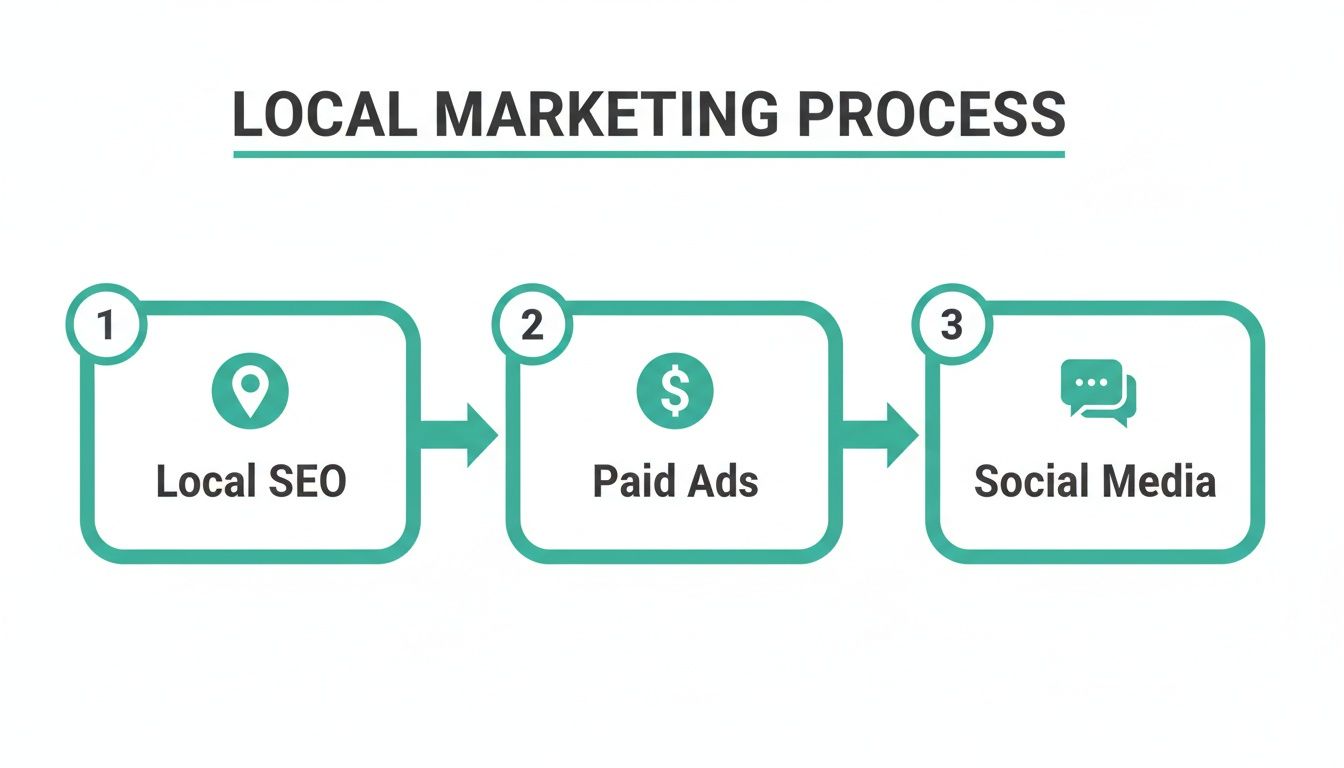
Each step builds on the last, creating a solid digital footprint for every individual location, all flying under the same brand flag.
Leveraging Technology for Scalability
Trying to manage all this by hand is a recipe for disaster. This is where modern platforms become your best friend, turning a logistical nightmare into a streamlined process. A unified dashboard lets you see what’s happening across hundreds of locations at a glance, without getting buried in spreadsheets.
Platforms built for local presence management can automate the tedious stuff—like updating holiday hours across 200 Google Business Profiles or monitoring review sentiment for an entire region.
This frees up your central marketing team to think about big-picture strategy. At the same time, it gives local managers the data they need to make smart, on-the-ground decisions. That combination of automation and oversight transforms a huge challenge into a serious competitive advantage.
Generating Powerful Local Engagement Signals
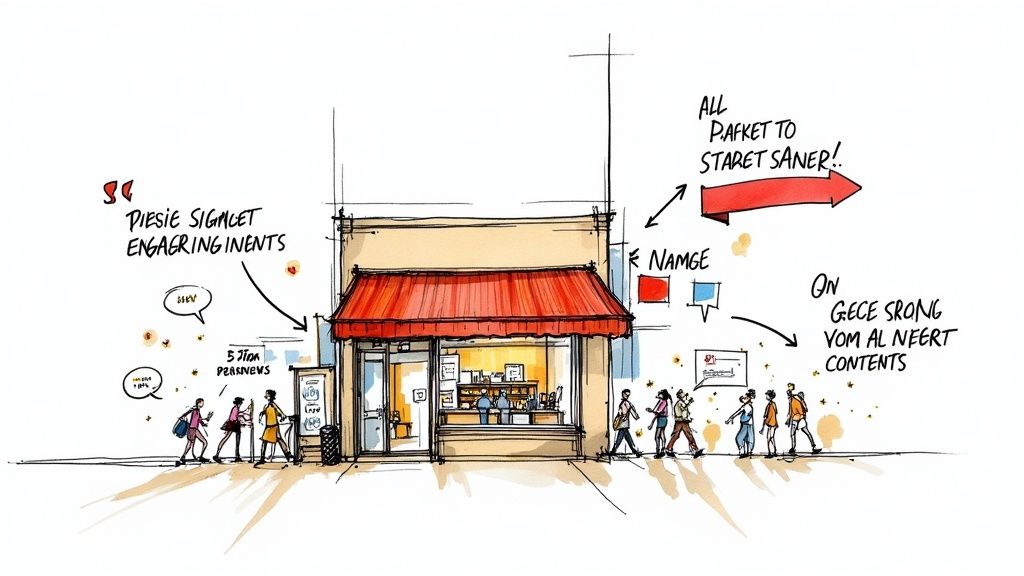
Let’s be clear: a perfectly optimized online profile is just the starting line. If you really want to own your local market, you have to prove you’re an active, trusted part of the community.
This is where local engagement signals come into play. Think of them as the digital equivalent of a bustling storefront with a line out the door.
These signals are real-world interactions that tell search engines your business is alive and kicking. We're talking about customer reviews, social media comments, location check-ins, and even clicks on your "Get Directions" button. When Google’s algorithm sees this buzz, it takes it as proof that you’re a popular, authoritative choice worth showing to other searchers.
This is the difference between having a static online brochure and running a dynamic, community-focused operation. It’s a more advanced piece of digital local marketing that builds real momentum and creates a powerful feedback loop.
Actively Cultivate and Manage Customer Reviews
Customer reviews are, without a doubt, the most powerful engagement signal you can get. They are pure social proof and a massive ranking factor for Google’s Map Pack. A steady flow of new, positive reviews tells the algorithm that you’re consistently delivering great experiences.
But a passive, "hope they review us" attitude just won't cut it. You need a system to proactively encourage feedback and—just as crucial—respond to it.
- Solicit Reviews at the Right Time: Ask for a review right after a positive moment, like a successful purchase or a great service call. You can do this with a quick email, a text message, or even a simple QR code at your checkout counter.
- Respond to Every Single Review: Thank customers for the good stuff and address negative comments with professionalism. This shows both new customers and search engines that you're engaged and actually care about what people think.
Spark Community Interaction with Localized Content
Your content strategy needs to be planted firmly in your local community. This means going way beyond generic posts and creating conversations around shared neighborhood experiences. This turns your brand into a genuine local resource, not just another business trying to sell something.
A local hardware store, for instance, could run a social media photo contest for the best garden in the neighborhood. This generates a ton of user content, gets people sharing, and ties the brand directly to a local passion.
A business becomes a community fixture when its marketing stops being about itself and starts being about the neighborhood it serves. Create content that reflects local values, events, and pride.
Other simple tactics work wonders, too. Write a blog post about a local charity event you're sponsoring or create a guide to the best dog parks in your service area. This kind of content attracts local links and shares, which helps cement your authority in that geographic area.
Forge Partnerships with Other Local Businesses
Building relationships within your local business scene is another fantastic way to generate authentic engagement signals. Teaming up with non-competing businesses can get your brand in front of new, highly relevant audiences and create some killer cross-promotional wins.
Consider a few collaborative ideas:
- Co-Hosted Events or Giveaways: A local coffee shop and a nearby bookstore could run a "Books & Brews" event. They'd promote it together on their social channels, driving foot traffic to both spots.
- Securing Local Media Mentions: Get your business featured in a local blog, online newspaper, or community newsletter. A link or even just a mention from a trusted local source is a high-authority signal that tells search engines you’re legit.
- Cross-Promotion on Social Media: Make a habit of shouting out other local businesses you love. This builds goodwill and often leads to them returning the favor, growing your reach organically.
By actively creating these signals, you're building a defensible moat around your local search rankings. You’re not just tweaking a profile; you're building a reputation that both algorithms and customers can’t ignore.
Measuring Success with the Right Local Marketing Metrics

Putting a great local marketing strategy in motion is one thing. But how do you actually know if it’s working?
Success at the local level isn’t measured with the same yardstick as broad, national campaigns. Chasing vanity metrics like national keyword rankings is like checking the weather in another country—it's interesting, but it doesn’t help you decide what to wear today.
To truly see your impact, you have to shift your focus to the KPIs that reflect how local customers actually behave. These are the numbers that prove your online efforts are making the phone ring, bringing people through the door, and building your reputation right where it matters.
Moving Beyond Vanity Metrics
The first step is to stop obsessing over metrics that are irrelevant to a local business. A high ranking for "best running shoes" across the entire country means absolutely nothing if you have one store in Portland. You’ve got to zero in on KPIs that measure real-world actions from customers in your specific service area.
This means you should live inside the data from your Google Business Profile and other local platforms. These are your direct lines to understanding how potential customers are engaging with your business at the very moment they need you.
The Local KPIs That Actually Drive Business
To get a clear picture of your performance, concentrate on these high-impact local metrics. They’re the ones that provide direct evidence of customer engagement and a clear intent to buy.
- Google Business Profile Actions: This is your goldmine. Track clicks-to-call, website clicks, and requests for driving directions. These aren't just passive views; they are active signals from motivated local customers ready to take action.
- Local Organic Search Rankings: You need to monitor your position for geo-specific keywords like "mechanic in downtown Austin" or "dentist near me." Visibility in these searches is what drives qualified local traffic, period.
- Customer Review Velocity and Rating: Keep a close watch on how many new reviews you're getting each month (review velocity) and your average star rating. A steady stream of positive reviews is one of the most powerful signals of a healthy, trusted business.
- Local Ad Performance: If you're running paid campaigns, look at metrics like local click-through rates (CTR) and cost per store visit. This data shows if your ad spend is actually translating into foot traffic.
This is especially critical now. With digital channels accounting for roughly 72-73% of worldwide ad spend in 2024, local ad auctions are only getting more competitive. Local businesses must invest in paid search and social ads to stay visible. You can read more about the global shift to digital advertising on datareportal.com.
Shifting your focus from broad awareness to specific local actions is the single most important change you can make in your reporting. It turns abstract data into a clear story about how your digital presence drives real-world business.
Local vs. General Marketing Metrics: What to Track
When you're trying to win locally, you need to track the metrics that reflect on-the-ground reality. This table breaks down how to reframe your measurement strategy to focus on what really moves the needle for a local business.
| Goal | General Marketing Metric | Effective Local Marketing Metric |
|---|---|---|
| Increase Visibility | National Keyword Rankings | "Map Pack" Rankings for Geo-Keywords |
| Drive Engagement | Website Page Views | Google Business Profile Clicks-to-Call |
| Generate Leads | Form Submissions (Anywhere) | Direction Requests from Local IP Addresses |
| Build Trust | Social Media Follower Count | New Customer Reviews per Month |
| Measure ROI | Overall Conversion Rate | In-Store Visits Attributed to Ads |
By homing in on these specific, action-oriented KPIs, your reporting will finally tell the story that truly matters: getting more local customers through your door.
Your Blueprint for Local Dominance
Mastering local marketing isn’t about chasing a single silver-bullet tactic. It’s about building a consistent, community-focused presence day in and day out.
Think of it less like a project with a finish line and more like tending a garden. It needs ongoing attention, but the payoff is sustainable growth and a customer base that genuinely sticks with you. The strategies we've covered—from owning your Google Business Profile to sparking real engagement—are your blueprint.
Each piece works together to create a powerful echo chamber. An accurate business listing props up your Map Pack ranking, which gets a boost from positive reviews you collected through a smart follow-up system. That synergy builds a momentum your competitors will find almost impossible to break.
Putting It All Together
This whole journey starts with a simple audit of where you stand online and ends with a dynamic, customer-generating machine.
- Foundation First: Get your business information flawless and consistent across the web. No exceptions.
- Engage Authentically: Stop just broadcasting. Start conversations, respond to every review (good and bad), and become a real part of your neighborhood's digital life.
- Measure What Matters: Ditch the vanity metrics. Focus on what actually translates to foot traffic and sales, like direction requests, phone calls, and website clicks.
Ultimately, winning at local marketing means becoming the most helpful and visible answer for customers right around the corner. It's a constant loop of listening, tweaking, and engaging.
By committing to this blueprint, any local business can transform its digital footprint from a simple line in a directory into its most powerful asset. You’ll boost your visibility, pull in more nearby customers, and plant the seeds for lasting growth in your community.
The tools and tactics are right here. Now it’s time to build your local dominance, one connection at a time.
Local Marketing FAQs
Let's cut to the chase. When it comes to local marketing, a few key questions always come up. How much is this going to cost? And when will I actually see it work? It’s easy to get bogged down in the details before you even start.
Here are some straight answers to the most common questions we hear from business owners. No fluff, just practical advice to help you move forward with confidence.
How Long Does It Take for Local SEO to Show Results?
This is the million-dollar question, and the honest-to-God answer is: it depends. Local SEO isn't like flipping a switch on a paid ad and getting instant traffic. It's more like planting a tree—it takes time to build a strong foundation and see real growth.
Generally speaking, you should expect to see meaningful movement in your local rankings within three to six months. But that timeline can shrink or expand based on a few things:
- Your Market's Competitiveness: If you're in a crowded city packed with established competitors, you're in for a tougher climb. It's just going to take longer.
- Your Starting Point: Are you starting from scratch with a brand-new online presence? Or is your business info a mess across the web? You'll have some foundational work to do before you can expect to leapfrog anyone.
- The Consistency of Your Efforts: This is the big one. Regularly updating your Google Business Profile, actively chasing reviews, and publishing local content will absolutely speed things up.
You might see small wins early on, but the real, sustainable results—the kind that drive consistent foot traffic—come from putting in focused, persistent work over several months.
Can I Do Digital Local Marketing with a Small Budget?
Absolutely. You don't need a massive ad budget to win at local marketing. In fact, some of the most powerful activities you can do are low-cost or even completely free. The trick is to invest your time strategically into the things that actually move the needle.
The beauty of digital local marketing is that consistency and authenticity often outperform a big budget. A well-managed Google Business Profile can drive more qualified traffic than a poorly targeted ad campaign ever could.
If you're on a tight budget, start right here:
- Optimize Your Google Business Profile: This is your single most valuable local marketing asset, and it costs nothing to manage. Fill out every single section, upload high-quality photos often, and use the Q&A feature to answer common questions.
- Focus on Customer Reviews: Get a simple, repeatable process in place for asking happy customers to leave you a review. A strong review profile builds incredible trust and is a huge ranking factor.
- Create Localized Content: Write a blog post about a local event, create a social media series on neighborhood hotspots, or film a quick guide to your area. This signals your local relevance to Google, and it doesn't cost a dime.
What Is the Most Important Part of a Local Marketing Strategy?
If you can only focus on one thing, make it this: the accuracy and consistency of your core business information online. I'm talking about your business name, address, and phone number (what we call NAP). This is the absolute bedrock of your local presence.
Think of your NAP as your business’s digital fingerprint. If that fingerprint is smudged—or worse, looks different on Yelp than it does on Google or Apple Maps—it creates massive confusion for both customers and search engines.
This inconsistency kills trust and torpedoes your ability to rank in local search.
A great review profile is a very close second. But without a consistent, accurate foundation of your business data, even the best reviews won't save you. Nailing your business listings is the non-negotiable first step.
Ready to stop guessing and start seeing exactly where your business ranks in the neighborhoods that matter most? Nearfront provides AI-powered heatmaps to visualize your local visibility, track growth, and automate the engagement signals that get you to the top of Google Maps faster. Discover how our platform can accelerate your local growth.