
A citation clean up is the process of finding and fixing your business's Name, Address, and Phone number (NAP) wherever it appears online. You're hunting down inconsistencies, deleting duplicate listings, and making sure that every customer and search engine sees the exact same, accurate information about you.
Think of it as the foundational plumbing for your local SEO. If the pipes are leaky, nothing else you build on top will hold up.
The Hidden Costs of Inconsistent Business Listings
Bad business listings aren't just a small typo—they're a direct hit to your bottom line and your brand's credibility. The problem isn't a misplaced comma or an old phone number. It’s about the real-world chaos that unfolds when your digital footprint is a mess.
Picture this: a potential customer is excited to visit your shop after reading a great review. They pop your business name into their GPS, which pulls data from some obscure directory you haven't touched in years. They drive 20 minutes across town only to find an empty lot because the app sent them to your old address.
That's not just a lost sale. It's a customer you'll likely never see again.
The Ripple Effect of Bad Data
This problem gets exponentially worse for businesses with multiple locations. When every storefront has a handful of conflicting online profiles, you've created digital anarchy. One listing has the right hours but the wrong phone number. Another has an old address but the right website.
This kind of fragmentation confuses two audiences you absolutely can't afford to confuse:
- Your Customers: They get mixed signals, which leads to frustration, lost sales, and inevitably, negative reviews that tell the world you're unreliable.
- Search Engines: Google and other search engines lose confidence in your data. If they can't trust your information, they won't show you in local search results. It's that simple.
The data backs this up. A staggering 68% of consumers say they would stop using a local business if they found incorrect information online. That's a direct threat to the foot traffic and phone calls that keep your doors open. You can find more stats on this from the folks at Advice Local.
To put it into perspective, here’s a quick breakdown of how these errors cause real damage.
How Common Citation Errors Impact Your Business
| Citation Error Type | Example | Impact on Business |
|---|---|---|
| Incorrect Address | Listing your old location after a move. | Sends customers to the wrong place, resulting in lost sales and negative reviews. |
| Wrong Phone Number | Displaying a disconnected or old number. | Prevents potential customers from calling, costing you leads and appointments. |
| Inconsistent Name | "ABC Inc." vs. "ABC Company" vs. "ABC" | Confuses search engines, dilutes your authority, and makes it harder to rank. |
| Duplicate Listings | Multiple profiles for the same location on one directory. | Splits your reviews and SEO value, confusing both users and search algorithms. |
Ultimately, every one of these errors chips away at the trust you're trying to build.
Key Takeaway: Every incorrect citation is a potential lost customer. Google's algorithm rewards consistency and trust, and a messy digital presence actively works against both.
Why a Citation Clean Up Is Non-Negotiable
A strategic citation clean up isn't just a "nice-to-have" task on your SEO checklist; it's a non-negotiable requirement for any serious local marketing effort. You can't build a strong local presence on a foundation of fractured, unreliable data.
By systematically finding and fixing these errors, you send clear, consistent signals to Google that your business is legitimate, active, and trustworthy. We've actually compiled a list of the most critical small business directories where accuracy is everything.
Getting this right from the start ensures that when customers look for you, they find the right information. Every single time.
Building Your Scalable Citation Audit Framework
Wrangling your business listings across dozens, if not hundreds, of websites can feel like an impossible task. Without a solid process, you’ll drown in spreadsheets and conflicting data before you even start. A scalable audit framework is what turns this chaos into a manageable, step-by-step project.
The goal here is simple: find every single mention of your business online, pinpoint the inconsistencies, and get everything organized so the actual cleanup is fast and painless. It all kicks off with a two-pronged discovery method that blends automation with some good old-fashioned manual digging.
Combining Automated Scans and Manual Searches
Look, the most effective way to map out your entire citation profile is to use automated tools for breadth and manual searches for depth. Automated tools are brilliant for casting a wide net and getting a baseline report in minutes, but they will always miss things.
Start by running a comprehensive scan with a platform like BrightLocal or SEMrush. These tools tap into the major data aggregators and directories, giving you a foundational list of your existing citations almost instantly. They're especially good at flagging the obvious NAP (Name, Address, Phone) screw-ups on high-authority sites.
But no single tool finds everything. This is where you have to roll up your sleeves. Using specific Google search operators is the only way to uncover unstructured citations and listings on niche industry sites that the automated scanners just don't see.
Expert Tip: You have to think like an archaeologist. The most stubborn and damaging errors are usually buried on old, forgotten directories from a previous business owner or a marketing campaign from five years ago. Manual searching is the only shovel that can unearth these digital fossils.
Mastering Manual Discovery with Search Operators
To kick off your manual search, you'll use targeted queries that force Google to show you specific mentions of your business info. This trick helps you find citations that aren't even linked to your website, making them otherwise invisible.
Here are a few of my go-to search operator combos to get you started:
"Business Name" "Street Address" -site:yourwebsite.com: This finds mentions of your name and address anywhere except your own site."Business Name" "Old Phone Number": A lifesaver for hunting down listings still pointing to a disconnected line."Old Business Name" "City": Absolutely essential if your business has ever rebranded or was acquired."Street Address" "Suite Number" -site:yourwebsite.com: This helps sniff out duplicates or weird variations tied to a specific office or unit.
This infographic nails why this matters. Even a single error you uncover can directly lead to a lost customer and crater their trust in your brand.
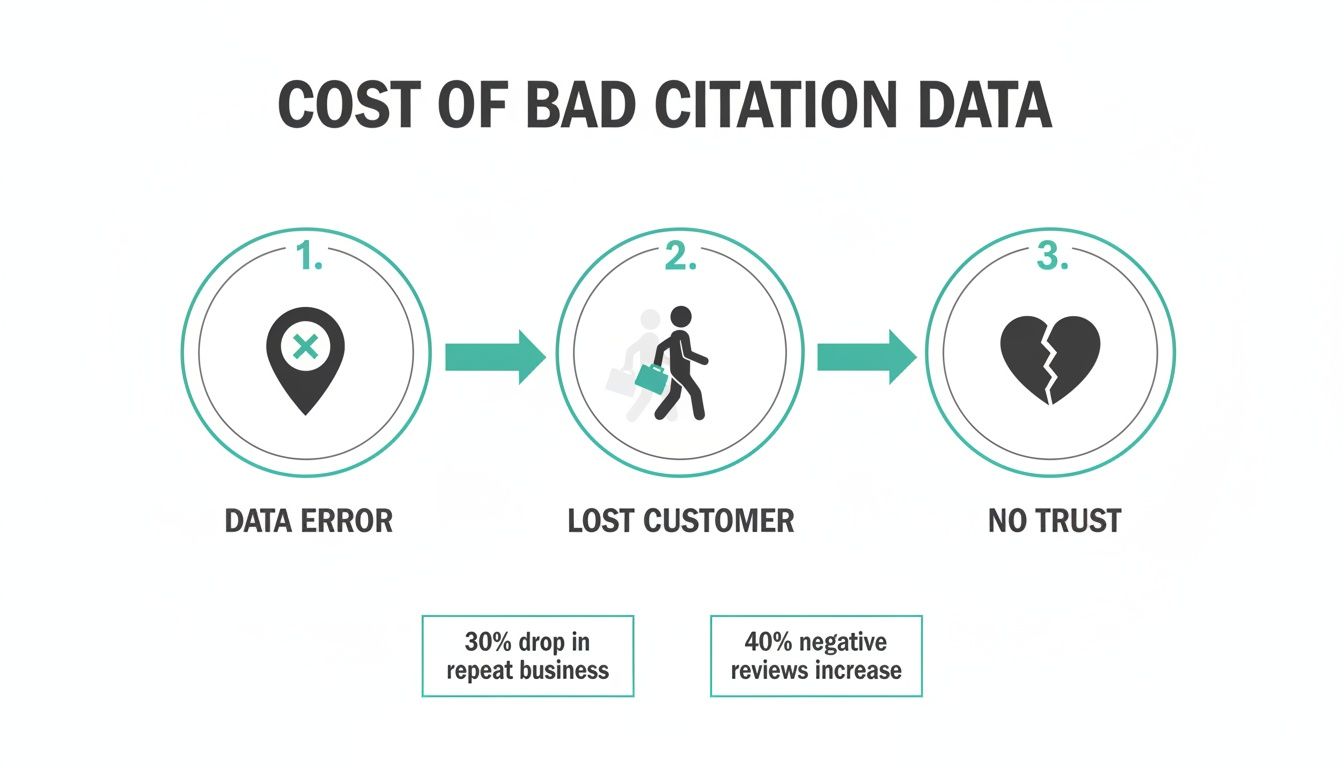
The flow is brutal but simple: a data error creates a bad customer experience, which shatters the trust you need for repeat business and positive reviews.
Creating Your Master Audit Spreadsheet
As you start finding citations, you need a central command center to track it all. A master audit spreadsheet is that command center. This document will hold all your findings, track your progress, and help you decide what to fix first.
To be truly effective, your spreadsheet needs a few key columns.
| Column Header | Purpose | Example |
|---|---|---|
| Directory URL | The direct link to your business listing. | https://www.yelp.com/biz/your-business |
| Live NAP | The Name, Address, and Phone number currently on the listing. | ABC Inc, 124 Main St, 555-123-4568 |
| Correct NAP | Your official, standardized business information. | ABC Company, 123 Main Street, 555-123-4567 |
| Error Type | The specific inconsistency found. | Incorrect Phone, Old Address, Duplicate |
| Status | The current stage of the correction process. | To Do, Submitted, Corrected, Cannot Fix |
| Notes | Any relevant details, like login info or support ticket numbers. | Submitted correction on 10/26. Awaiting review. |
This kind of structured approach is a pillar of effective local presence management, giving you a clear record of your digital footprint and every step you've taken to sharpen it.
Prioritizing Your Fixes for Maximum Impact
Once your audit is done, you’re probably looking at a long, intimidating list of errors. Resist the urge to just start at the top and work down. A strategic prioritization framework helps you tackle the most damaging issues first, delivering much faster results for your local SEO.
Here’s how to prioritize your hit list:
- Directory Authority: Go after the big guns first. That means Google Business Profile, Apple Maps, Yelp, and the core data aggregators (Data Axle, Neustar, Foursquare). Fixes on these heavy-hitters tend to ripple out across the rest of the web.
- Severity of the Error: An incorrect address or a disconnected phone number is infinitely more harmful than a minor name variation (like "Inc." vs. "LLC"). Fix the stuff that directly hurts the customer's ability to find or contact you.
- Referral Traffic: Check your analytics. Which directories are actually sending people to your website? Making sure these high-value listings are 100% accurate should be a top priority.
By using this framework, you turn that daunting to-do list into a clear, actionable plan. You'll solve the most critical problems right away, quickly improving your customer experience and sending much stronger trust signals to search engines.
A Tactical Playbook for Fixing Every Listing Type
Alright, you've got your audit spreadsheet ready to go. Now for the real work: the actual citation clean up. Fixing listings isn't a one-size-fits-all job; different sites demand different tactics. This playbook breaks it all down by listing type so you can apply the right pressure in the right places.
The trick is to work from the top down. Start with the sources that have the biggest influence. Correcting a single data aggregator can automatically fix dozens of smaller directories downstream, which saves an insane amount of time. It's all about working smarter.
Prioritize the Core Data Aggregators
Your first move should always be the core data aggregators. These are the headwaters of business data on the web. Think of massive databases like Data Axle, Neustar/Localeze, and Foursquare. Hundreds of other directories, apps, and even GPS systems pull their info straight from these sources.
Fixing an error at this level creates a massive ripple effect. Industry analysis, like this research from Advice Local, suggests that updating these three feeds can wipe out 60–70% of citation inconsistencies across the web. For multi-location brands, this is a huge win—a few high-impact updates that propagate everywhere.
The process is usually pretty straightforward:
- Find your business on their platform.
- Claim the listing if you don't already own it.
- Submit your correct NAP and business details through their portal.
Pro Tip: Aggregator updates aren't instant. It can take anywhere from a few weeks to three months for the changes to trickle down to all the smaller sites. Track your submissions in your spreadsheet and be patient.
Claim and Correct Major Platforms
Once the aggregators are handled, shift your focus to the big platforms where customers actually find and interact with you. These listings have the most direct impact on your rankings and revenue.
Your hit list should look like this:
- Google Business Profile (GBP): This one is non-negotiable. It's the most important citation you have, period. Log in and make sure every single field is perfect.
- Apple Maps: As the default map app for millions of iPhone users, accuracy here is mission-critical. Use Apple Business Connect to claim and manage your listing.
- Facebook: Your Facebook Business Page is a key citation and a powerful social signal. Make sure the "About" section has the correct NAP, hours, and website.
- Yelp & Bing Places: These are major players in the local search world and often feed data to other niche apps. Don't sleep on them.
For these sites, you'll need to claim ownership of the profile. This usually means verifying your business, often with a postcard mailed to your address or an automated phone call. Once you're verified, you have direct control to edit everything.
Tackle Niche and Industry-Specific Directories
Next up are the directories that carry real weight in your specific industry. They might not have the raw traffic of Google or Yelp, but they send powerful relevance signals to search engines that can give you a competitive edge.
A few examples:
- Lawyers should be on Avvo, FindLaw, and Justia.
- Doctors need accurate profiles on Healthgrades, Zocdoc, and Vitals.
- Home service pros absolutely need to be correct on Angi and HomeAdvisor.
Fixing these usually involves creating an account and submitting an edit request manually. The verification can sometimes be a bit more involved, but the SEO benefit is well worth the effort.
Develop a Process for Stubborn Duplicates
Duplicate listings are the absolute worst. They split your reviews, confuse potential customers, and dilute your authority in the eyes of search engines. You need a methodical approach to get rid of them for good.
Start by gathering your evidence. For every duplicate you find, log this in your spreadsheet:
- The URL of the incorrect, duplicate listing.
- The URL of your correct, primary listing.
- A clear screenshot showing the bad information.
Then, use the directory's built-in reporting tools. Most major platforms have a "Report a duplicate" or "Suggest an edit" feature. Submit your evidence clearly and concisely.
If the automated tools don't work, don't be afraid to escalate to human support. A polite but firm email with all your evidence attached can often solve problems the standard forms can't handle.
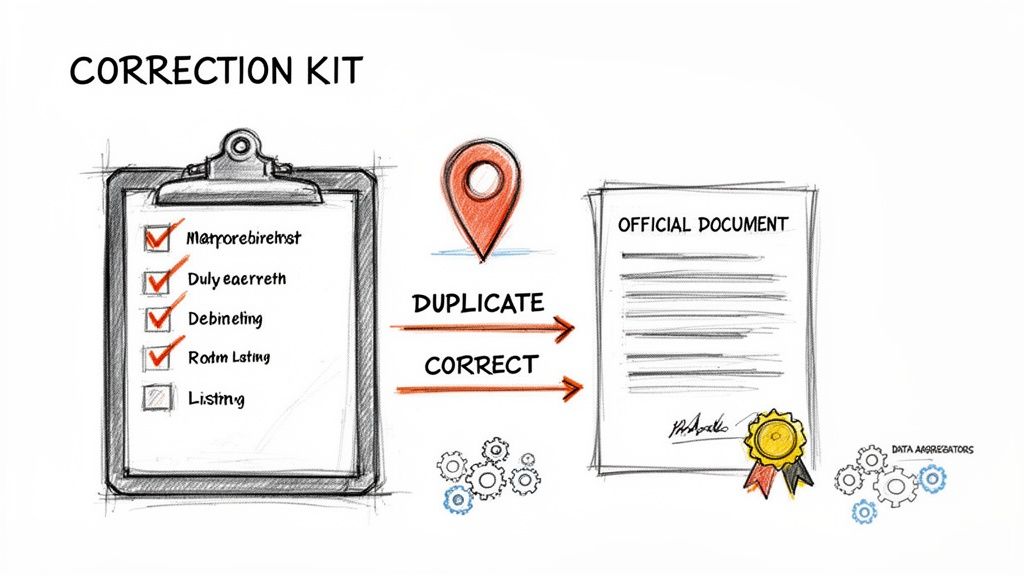
Create a 'Correction Kit' To make this whole process faster, put together a digital "Correction Kit." It's just a folder with official documents that prove your business's correct NAP—things like a recent utility bill, your business license, or even a clear photo of your permanent storefront sign. Having this ready saves you from scrambling for proof every time a directory asks for it.
Choosing Your Tools: Automation Versus Manual Effort
So, you’ve finished your audit and you’re staring at a spreadsheet full of incorrect citations. Now comes the big decision: how are you actually going to fix all this?
Do you roll up your sleeves and tackle it yourself? Do you invest in an automated tool to do the heavy lifting? Or do you hand the whole project over to a managed service?
There’s no single right answer here. The best path depends entirely on your business’s scale, your budget, and how much time your team can realistically spare. Let’s break down the three main approaches so you can figure out what makes the most sense for you.
Comparing Citation Clean Up Methods
Deciding how to manage your business listings is a strategic choice. This table gives you a side-by-side look at the three primary methods to help you pick the right fit.
| Approach | Best For | Pros | Cons |
|---|---|---|---|
| Manual Clean Up | Single-location businesses, new businesses, or teams with more time than budget. | Total control over every listing; no software costs. | Extremely time-consuming; not scalable; prone to human error. |
| SaaS Automation | Multi-location brands, franchises, and agencies managing multiple clients. | Fast, efficient, and scalable; provides ongoing monitoring and protection. | Requires a monthly/annual subscription fee; less personal control. |
| Managed Service | Businesses without in-house expertise or the bandwidth to manage the process. | "Done-for-you" solution; leverages expert knowledge and specialized tools. | Highest cost option; less hands-on involvement for your team. |
Ultimately, the goal is to choose a method that not only fixes your current issues but also sets you up for long-term consistency and growth.
The Case for Manual Citation Clean Up
Going the manual route is exactly what it sounds like: a hands-on, one-by-one process. You’ll use your audit spreadsheet as a guide, logging into each directory, claiming your listings, and submitting corrections.
This approach gives you absolute control over every single detail.
This is often the best fit for:
- Single-location businesses with just a handful of errors to fix.
- New businesses that are building their online presence from scratch.
- Teams with more time than money, where dedicating internal hours is easier than paying for a subscription.
The biggest perk is the cost—it's all sweat equity. The downside? The time commitment can be massive. Every directory has its own quirky submission process and verification steps, which can turn into a real headache. It works, but it’s just not built for scale.
Embracing Automation with SaaS Platforms
For any business with more than one location, the manual approach breaks down fast. It’s just not sustainable. This is where automated Software-as-a-Service (SaaS) platforms become a game-changer.
Tools like BrightLocal, Semrush, or Yext are designed to manage listings at scale.
You just enter your correct NAP (Name, Address, Phone Number) information once, and the platform pushes it out across a huge network of directories and data aggregators. It automatically spots inconsistencies, flags duplicates, and even monitors your listings for unauthorized changes.
While these platforms come with a subscription fee, the efficiency you gain is huge. For a closer look at the options, check out our guide on the best local SEO tools.
For businesses with multiple locations, automation isn't a luxury; it's a necessity. The ability to update hours, addresses, or phone numbers across 50+ sites simultaneously prevents the digital fragmentation that erodes customer trust and harms local rankings.
From a pure ROI perspective, businesses that automate usually see faster results and a lower cost per location. Automated workflows can slash the time it takes to fix listings from months down to just a few weeks. That speed is critical for chains that need to maintain consistency across the US, UK, Canada, and other markets. CitationBuilderPro explains more about how automation speeds up correction timelines.
When to Hire a Managed Service
The third path is to hire a managed service, where an agency or provider like Nearfront handles the entire citation cleanup process for you. This is the "done-for-you" solution.
It's the perfect option for businesses that don't have the in-house expertise or just don't have the time to manage the project.
A good managed service combines powerful software with real human expertise. They’ll run the audit, execute all the corrections, and deal with all the tedious back-and-forth with directory support teams. This frees you up to focus on running your business while the experts make sure your foundational data is perfect.
How to Measure the ROI of Your Clean-Up Efforts
A full-scale citation clean up isn't just about tidying up your digital footprint; it's a strategic investment that pays real dividends. The final, and arguably most important, step is proving that value to your team or your clients. It all comes down to connecting the dots between clean data and actual business growth.
First thing's first: you need a baseline. Before you fix a single listing, take a snapshot of your current performance. This "before" photo is your benchmark, the one thing you'll compare everything against to show undeniable improvement. Without it, your results are just numbers without context.
Your goal here is simple: show how fixing your foundational NAP data directly leads to more phone calls, more website clicks, and more foot traffic. Anything less, and the project is just an exercise in data hygiene. Nail this, and you can easily justify the time and budget spent.
Tracking Foundational and Performance KPIs
The first part of showing ROI is tracking the direct results of your hard work. This means quantifying the cleanup itself and the immediate lift it gives your online presence. These are your foundational KPIs.
Start with the raw data from your audit spreadsheet. How many bad listings did you find? How many duplicates did you nuke? These numbers give a tangible sense of the mess you just cleaned up.
Key metrics to watch here are:
- NAP Inconsistency Rate: What percentage of your listings had errors before you started? Track this number as it plummets toward zero.
- Duplicate Listing Count: Log the total number of duplicate profiles you found and merged or removed. Showing a reduction from 25 duplicates to zero is a powerful, concrete win.
- Directory Score Improvement: Many SEO tools spit out an aggregate "listing accuracy" score. Record it before and after to show a clear percentage-based improvement.
These metrics prove you did the job well. But now you have to connect that work to the numbers your leadership team actually cares about. This is where you pivot from operational wins to real business impact.
A successful cleanup isn't just about hitting 100% NAP accuracy. It's about turning that accuracy into a measurable lift in local search, which ultimately puts more customers in your store or on the phone with your team.
Connecting Clean Data to Business Growth
With your foundational KPIs looking good, it's time to measure what really matters: business outcomes. This is where you look at how clean, consistent citations are influencing customer behavior and your rankings.
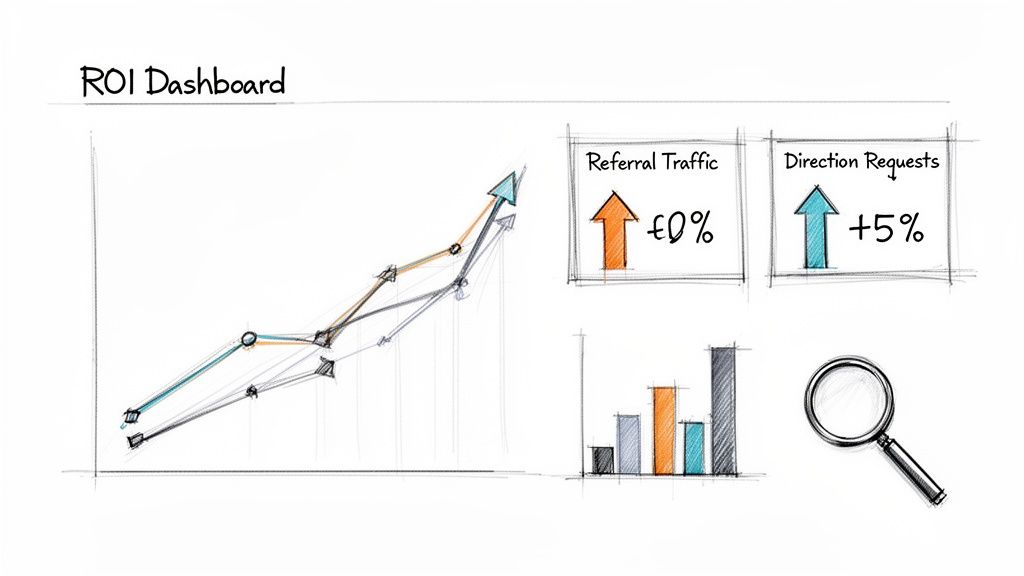
Your best friend here is your Google Business Profile (GBP) Insights. It provides direct evidence of how searchers are interacting with your listing. After a thorough cleanup, you should see a clear jump in key customer actions.
Zero in on these three critical GBP metrics:
- Clicks-to-Call: An increase here is a direct line to new business. It’s one of the purest indicators of a high-intent customer.
- Direction Requests: For any brick-and-mortar business, this is the holy grail. More people asking for directions means more people are planning to visit.
- Website Visits: A bump in clicks from your GBP to your website shows that a more trustworthy, professional-looking profile is driving qualified traffic.
Beyond GBP, you need to dig into Google Analytics. Set up a segment to isolate referral traffic from directories like Yelp, Yellow Pages, and other niche sites. A clear increase in sessions from these sources is hard evidence that your accurate listings are driving discovery.
We see this all the time. Local SEO case studies often show huge gains after a cleanup. It’s not uncommon for businesses to see a 45% increase in listing views and a 30% increase in calls within 12 weeks of a project. You can discover more about how these results unfold over time.
Finally, keep an eye on your local keyword rankings. Use a good rank tracker to monitor your visibility for high-value local terms like "dispensary near me." As Google's trust in your business data grows, you should see your rankings climb in the local pack and on Google Maps.
By pulling these different data points together, you can paint a powerful, undeniable picture of how a citation cleanup directly fueled business growth.
Got Questions About Citation Clean Up? We've Got Answers
Even the most buttoned-up citation strategy can hit a few snags. You're not alone. Let's walk through some of the most common questions that come up once you start digging into a real-world citation project. Getting these straight will save you a ton of headaches down the road.
How Long Does This Actually Take to Work?
This is always the first question, and the only honest answer is: it depends. The timeline really hinges on how big the mess is.
If you're a single-location shop with just a handful of old, wonky listings, you could see a noticeable lift in your local rankings and even customer engagement within 2 to 4 weeks. Big players like Google Business Profile and Apple Maps tend to process corrections pretty quickly.
Now, if you’re a multi-location brand wrestling with years of inconsistent data and duplicate listings haunting you from every corner of the web, you need to play the long game. Expect to see some good momentum in about 4 to 8 weeks, but it might take 3 months or more for the entire digital ecosystem to catch up and stabilize. Just remember, some of those old-school data aggregators and directories move at a snail's pace.
What's the Difference Between Structured and Unstructured Citations?
Knowing the difference here is crucial—it's how you focus your energy on what actually moves the needle.
-
Structured Citations: Think of these as your official business listings. They live on directories like Yelp, Yellow Pages, and industry-specific sites (like Avvo for law firms). Your Name, Address, and Phone number (NAP) are plugged into neat, organized fields. This makes it incredibly easy for search engines to crawl and confirm your details.
-
Unstructured Citations: These are the casual, in-the-wild mentions of your business. You'll find them in blog posts, news articles, or forum comments. For instance, a local food blogger writing, "The carnitas at Joe's Cantina on 123 Main Street are the best in town."
While both are valuable for local SEO, your citation clean up mission should be almost entirely focused on the structured ones. They carry way more authority with Google and are the root cause of the conflicting data that's killing your rankings.
Key Insight: Think of structured citations as the official records for your business—they're the authoritative sources Google checks first. Unstructured citations are more like chatter—good to have, but not the foundation of your digital identity.
I'm Using a Listing Tool, So I Don't Need Manual Clean Up, Right?
Wrong. And this is a super common (and costly) misconception.
Automated listing management tools are fantastic for one thing: pushing out correct data and keeping it consistent from this day forward. They’re your defense against future mistakes.
But they are notoriously bad at fixing deep-seated, historical problems. We're talking about those stubborn duplicate listings from a previous owner, an old agency, or that one marketing campaign from five years ago. These "digital ghosts" require a human touch. Someone has to actually contact support, send proof of ownership, and follow up to make sure the bogus listing is gone for good.
The best-practice workflow is to do a deep, manual audit and clean up before you even think about turning on an automation tool. That way, you're building on a rock-solid foundation, not just painting over a crumbling one.
Can Bad Citations Really Hurt My Local Rankings?
Absolutely. In fact, it's one of the fastest ways to sabotage your own local SEO.
When Google's bots crawl the web and find conflicting details about your business—one address on Yelp, a different one on Bing, and a wrong phone number on some obscure directory—it completely shatters their trust in your data.
This mess creates what we in the SEO world call "entity confusion." Google simply doesn't know which information is the truth, so it gets nervous about showing your business in the local map pack. Why would it? The algorithm's job is to serve users information it can confidently stand behind.
A meticulous citation clean up sends a loud, clear, and consistent signal that reinforces Google's trust. It’s a foundational piece of the puzzle for building the authority you need to rank for those competitive local keywords and get actual customers through your door.
Ready to stop wrestling with inconsistent data and start seeing real results from your local SEO? Nearfront uses AI-powered tools to give you a clear view of your local rankings and drives the engagement signals that matter most to Google. See how you can boost your visibility and get more customers at https://nearfront.com.