Let's be honest, the way people find your dealership or service center has completely changed. Automotive local SEO is all about making sure your business shows up when a potential customer in your area pulls out their phone and searches for what you offer.
It’s the strategy that connects you to someone searching "oil change near me" or "used trucks in Dallas." It’s how you turn that quick search into a new customer walking through your doors.
Why Automotive Local SEO Is Your Most Powerful Engine
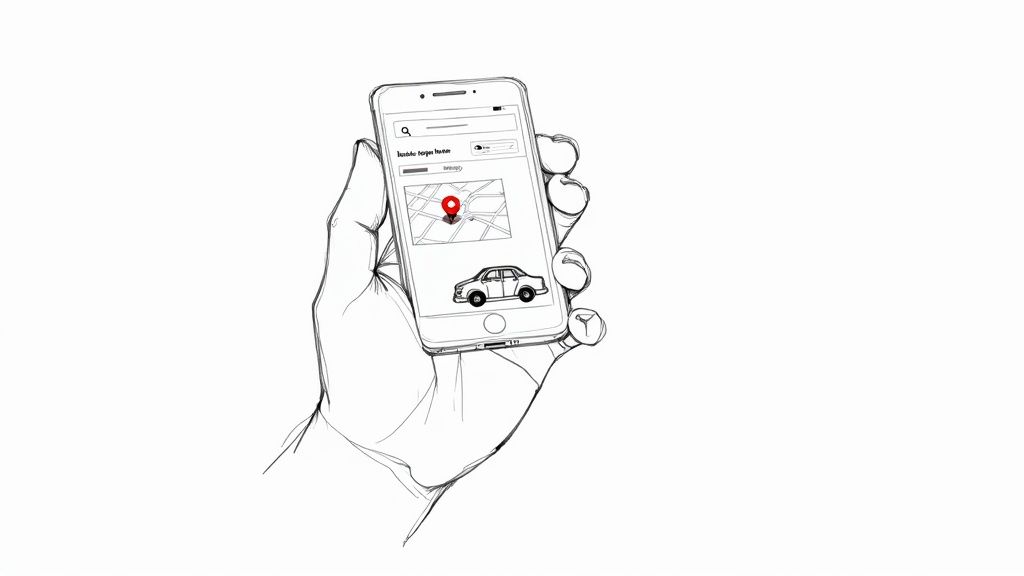
The modern customer journey doesn't start on your lot anymore. It starts on a screen, usually with a problem that needs solving now.
A strange noise from under the hood prompts an immediate "mechanic near me" search. An expiring lease kicks off a hunt for "SUV deals in [Your City]." These aren't just casual browsers—they're high-intent customers ready to make a move.
A smart local SEO strategy is what puts your business right in front of them at that exact moment. This isn't about casting a wide, expensive net. It’s precision-guided marketing, ensuring your shop or dealership is the most obvious, trusted choice for people in your community who need your help.
Connecting with High-Intent Local Buyers
Think about the difference here. A billboard might get thousands of views, but how many of those people are actually in the market for a new car or a brake job today? Local search, on the other hand, is all about capturing people who have already raised their hand and signaled exactly what they need.
The numbers don't lie. Nearly 95% of car buyers begin their search online, which makes automotive local SEO an absolute must for any dealership. And when they search, businesses that show up in Google's local map pack grab a massive 42% of all clicks.
To put it in perspective, the organic traffic a top-ranked dealer gets would force a competitor to spend around $2.94 million annually in paid ads just to keep up. That’s the incredible ROI of a solid local SEO foundation. You can learn more about the latest research on automotive SEO strategies to see the full picture.
The goal is simple: be the first and best answer when a local customer asks Google for help. A robust local SEO plan makes your business not just an option, but the obvious choice.
It's About More Than Just Rankings
Ultimately, a winning local SEO strategy goes way beyond just trying to be #1. It's about building trust and making it incredibly easy for a customer to go from search to sale.
Here’s what that really means for your business:
- More Foot Traffic: By showing up for "near me" searches, you're driving real people to your physical location for test drives, service appointments, and parts sales.
- Higher Quality Leads: Local searchers are deep in the buying funnel. They aren’t just kicking tires online; they're looking for an immediate solution, which means higher conversion rates for you.
- Stronger Brand Trust: A complete, well-managed Google Business Profile with positive reviews and consistent info establishes your credibility before a customer ever clicks through to your site.
- A Real Competitive Edge: So many competitors are still dropping the ball on local SEO. This creates a huge opportunity for you to dominate the local search results and become the go-to authority in your town.
Mastering Your Google Business Profile For Local Dominance
Think of your Google Business Profile (GBP) as your digital showroom and service bay all rolled into one. For a huge chunk of your local customers, this profile is your business—it's their first look, their go-to for quick answers, and the very first step they take before walking through your doors.
Letting your GBP sit there neglected is like having a busted, flickering sign out front. But a well-managed one? That's your single most powerful magnet for customers who are ready to buy or book service right now. This isn't just about plugging in your hours and phone number; it's about transforming a static listing into a dynamic machine that pulls customers in.
Go Beyond The Basic Setup
Most businesses claim their profile, fill in a few boxes, and call it a day. That’s leaving a massive opportunity on the table. To really stand out in the auto world, you need to use every single feature Google gives you, and you need to tune it specifically for car buyers and service customers.
It all starts with getting your categories right—a small detail that trips up so many businesses.
Choosing the correct primary category is absolutely critical. Are you first and foremost a "Used Car Dealer"? Or does "Car Repair and Maintenance" better reflect your main business? Your primary category carries the most weight with Google, so pick the one that drives the most revenue. After that, you can layer in secondary categories to cover everything else you offer, like "Oil Change Service" or "Tire Shop."
Think of your GBP as a living, breathing resume for your business. The more complete, accurate, and active it is, the more Google trusts you and puts you in front of potential customers. An incomplete profile is a huge red flag for both search engines and people.
From there, it's about diving deep into the details that matter to your audience. A fully built-out profile sends Google powerful signals about your authority in the local market. For a complete walkthrough of every optimization step, check out our guide on how to optimize your Google Business Profile.
Using GBP Features To Drive Action
Once your foundation is solid, it's time to start actively engaging customers with fresh content. Google loves to see that your business is alive and kicking, providing real value directly on its platform.
Here's where to focus:
-
Google Posts: Treat this feature like a mini-blog for your business. Announce a weekend sales event, a special on winter tire packages, or put a spotlight on a new master tech who just joined your team. Posts have a limited lifespan, so posting consistently signals to Google that you’re open and active.
-
Products Feature: This is a total game-changer for both sales and service. Dealerships can create listings for specific models on the lot, complete with photos, details, and pricing. Service centers can list common jobs as "products," like a "Synthetic Oil Change Package" or "Brake Pad Replacement." It puts your offerings front and center.
-
Photos and Videos: Ditch the generic stock photos. Show off real pictures of your clean service bays, your comfortable waiting area, and your friendly staff. Post walk-around videos of cars on the lot. This stuff humanizes your business and builds trust before a customer even contacts you.
The data backs this up, big time. In automotive searches, the local map pack is king, with a staggering 44% of all clicks going to the top three businesses. Businesses that get their photo strategy right see 42% more requests for driving directions and 35% higher clicks to their website. A complete profile is also seen as 2.7 times more trustworthy—proof that these details directly convert searchers into customers.
To help you get every detail right, here’s a quick-glance checklist for optimizing your automotive GBP.
GBP Optimization Checklist For Automotive Businesses
A step-by-step checklist to ensure every critical element of your Google Business Profile is fully optimized for maximum local visibility.
| GBP Element | Optimization Action | Why It Matters |
|---|---|---|
| Business Name | Use your exact, real-world business name. No keyword stuffing. | Builds trust and avoids penalties from Google. |
| Categories | Select the most accurate primary category and add all relevant secondary categories. | Directly tells Google what you do and which searches to show you for. |
| Address & Service Areas | Ensure your pin is accurate. Define your service areas if you're mobile or have a delivery radius. | Crucial for "near me" searches and map pack visibility. |
| Hours | Keep standard, holiday, and special hours meticulously updated. | Prevents customer frustration and negative reviews from showing up to a closed door. |
| Phone Numbers | Use a primary, local number with call tracking to measure inbound leads. | Makes it easy for customers to contact you and proves ROI. |
| Website | Link to the most relevant page on your site (homepage for dealers, service page for shops). | Drives qualified traffic and provides a clear path for customers to learn more. |
| Products | Add specific vehicles (for dealers) or service packages (for shops) with photos and descriptions. | Showcases your inventory and services directly in search results. |
| Services | List every service you offer, from "Brake Repair" to "EV Maintenance," with descriptions. | Helps you rank for long-tail service-related keywords. |
| Photos & Videos | Upload high-quality, real photos of your location, team, and work. Add video tours. | Builds trust, increases engagement, and helps you stand out visually. |
| Google Posts | Publish weekly updates: special offers, new inventory, team highlights, or events. | Signals to Google that your business is active and keeps customers informed. |
| Q&A | Proactively add and answer your own frequently asked questions. Monitor for new questions daily. | Controls the narrative and provides instant answers to common customer queries. |
| Reviews | Actively request reviews and respond to every single one, positive or negative. | A massive local ranking factor that builds social proof and trust. |
| Messaging | Enable messaging and respond to inquiries quickly. | Caters to mobile users who prefer texting over calling. |
Ticking every box on this list is a surefire way to send strong positive signals to Google and give customers every reason to choose you over the competition.
An Interactive Hub For Customers
Your GBP isn't just a billboard; it's a two-way street for communication. Enabling features that make it dead simple for customers to connect with you is a non-negotiable part of the game today.
The Q&A feature is a goldmine that most businesses completely ignore. Customers will ask questions here, and if you don't answer them, another customer might—and they could get it wrong. Get ahead of this by populating the section yourself. Ask and answer the most common questions you get: "Do you offer loaner cars?" or "What kind of warranty comes with your used vehicles?"
Finally, turn on the messaging feature. This lets customers chat with you directly from your profile. It’s perfect for the person on their phone who just wants a quick answer without the hassle of a phone call. The key here is to be responsive; Google actually shows customers your average response time. A fast reply can be the single thing that makes a customer drive to your shop instead of the one down the street.
Integrating Local Keywords Into Your Website
Your Google Business Profile is a massive customer magnet, but it’s only half the equation. It works best when it's tethered to an equally strong website that confirms everything your profile claims. This is where on-page SEO comes in, turning your site into a clear, authoritative resource that answers the exact questions local customers are asking.
When your site and GBP are in sync, they create a powerful feedback loop. A well-optimized site doesn't just support your GBP; it amplifies its reach, cementing your spot in the local search results.
It all starts with understanding the specific language your customers use. I'm not talking about guessing. I mean digging into the precise phrases people type into Google when they need automotive help. Your job is to find everything from broad, location-based searches like "used trucks in Dallas" to super-specific, service-related queries like "Honda Civic oil change Austin."
This simple flow shows how to get your local presence firing on all cylinders, starting with the basics and moving toward consistent engagement.
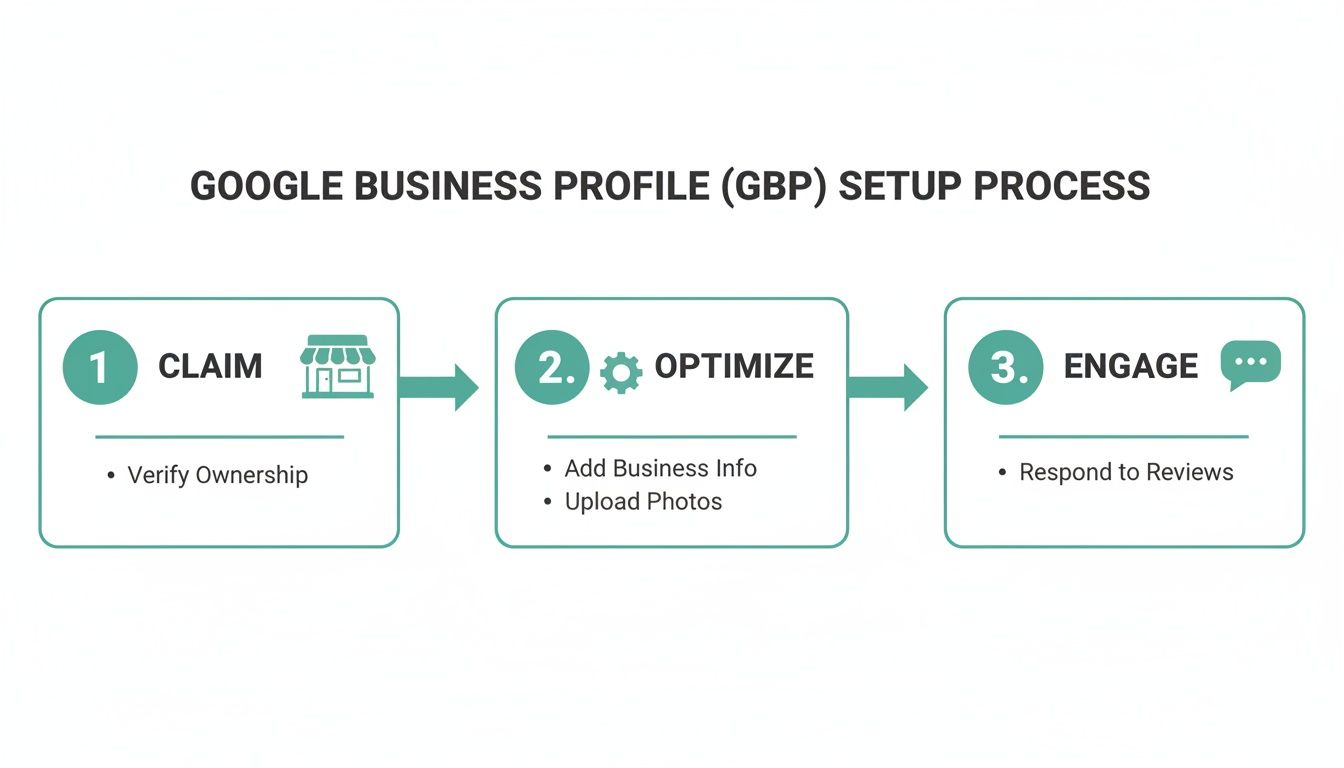
The key takeaway here is that optimization and engagement aren't one-and-done tasks. They're ongoing habits.
Build Dedicated Service and Location Pages
Once you've got a solid list of local keywords, you need to give them a home on your website. Generic pages just won't cut it anymore. If you want to capture high-intent traffic, you absolutely have to create dedicated pages for your most important services and the specific towns you serve. This is the core of any successful automotive local seo strategy.
Put yourself in the customer's shoes for a second. Someone searching for "Ford F-150 service in Houston" doesn't want to land on a generic homepage. They want a page that speaks directly to them, confirming you're the go-to expert for their truck, in their city.
Here are the kinds of pages you should be building right now:
- Service-Specific Pages: Create a unique page for each core service you offer, like "Brake Repair," "Tire Rotation," or "EV Maintenance."
- Location-Specific Pages: If you serve multiple towns, each one deserves its own page. "Car Detailing in Scottsdale" should be a different page from "Car Detailing in Phoenix."
- Model-Specific Pages: For dealerships, this is a goldmine. Pages like "Used Honda CR-V for Sale in Miami" can pull in incredibly targeted buyers ready to make a move.
Each of these pages needs to be fully optimized with the right local keywords in the page title, headings, and throughout the content. To find the highest-impact terms, you'll need the right local keyword research tools to see what your customers are actually searching for.
Weave Keywords Into Your Content Naturally
Okay, so you've built the pages. Now you have to integrate your keywords in a way that feels natural and actually helps the reader. Google is more than smart enough to spot—and penalize—sites that just stuff keywords where they don't belong.
Forget the old tricks. Instead, focus on being genuinely helpful.
When you're writing a page about brake repair in your city, mention local landmarks, nearby neighborhoods, or even common road conditions that wear down brakes. This does two things: it incorporates your keywords organically and signals to Google that you're a real, boots-on-the-ground local business.
Key Takeaway: Always write for the human first. A page that clearly answers a customer's question will almost always outperform a page that’s just a clunky list of keywords.
Add Critical Local SEO Signals
Beyond the words on the page, a few technical elements send powerful local signals to search engines. Think of these as the behind-the-scenes details that build a foundation of trust and authority for your website.
One of the most important is schema markup. By adding AutomotiveBusiness schema to your website's code, you're spoon-feeding Google information about what kind of business you are. This structured data helps search engines understand your services, hours, and location, which can earn you more informative search results, known as rich snippets.
Another no-brainer is embedding a Google Map. Placing a map directly on your contact or location pages gives customers a clear visual and reinforces your physical address with Google. It's a simple move that directly ties your digital presence to your real-world spot—which is the entire point of local SEO.
Building Local Trust And Authority
A perfectly polished website and Google Business Profile are a great start, but they don't operate in a bubble. To really own the local search results, you have to prove your authority outside of your own digital properties. It’s about sending strong, consistent signals from all over the web that confirm you are who you say you are, and more importantly, that the local community trusts you.
These external signals—citations, reviews, and local backlinks—are the true foundation of your online reputation. When you get them right, they tell both Google and potential customers that your dealership or service center is a legitimate, respected, and active part of the neighborhood. This is a non-negotiable part of any winning automotive local seo strategy.
Solidify Your Digital Footprint With Citations
A citation is simply any online mention of your business's name, address, and phone number (NAP). Think of them as digital breadcrumbs scattered across the web. When they're all the same, they create a clear, easy-to-follow trail right back to your front door.
But inconsistencies? They’re a huge red flag. An old address on Yelp or the wrong phone number on a car enthusiast forum sends mixed signals that confuse search engines and erode trust. Google’s main job is to provide reliable information, and conflicting NAP data makes your business look less than reliable.
Your first job is to get your NAP 100% identical everywhere it appears. That means auditing:
- Core Directories: Yelp, Bing Places, Apple Maps.
- Automotive-Specific Sites: Cars.com, Edmunds, RepairPal, CarFax.
- Social Media Profiles: Facebook, Instagram, LinkedIn.
Even tiny variations like "St." versus "Street" or "Suite 100" versus "#100" can throw a wrench in the works. Hunt down those discrepancies and clean them up now.
A consistent NAP isn't just a technical SEO task; it's the foundation of your local authority. Every accurate citation is another vote of confidence telling Google you're a stable, real-world business at a specific physical location.
Turn Customer Feedback Into A Ranking Factor
Online reviews are easily the most powerful form of social proof for any local business. A steady stream of positive, recent reviews directly impacts your map pack ranking and massively sways customer decisions. It's no surprise when you hear that 97% of consumers use the internet to find local businesses—and you can bet they’re reading reviews.
You can't just sit back and hope for good feedback. You need a proactive system for generating and managing it.
Start by making it dead simple for happy customers to leave a review. A quick follow-up text or email right after a service appointment or vehicle purchase with a direct link to your Google review page is incredibly effective.
Here’s a simple script to try:
"Hi [Customer Name], this is [Your Name] from [Dealership/Shop]. Thanks again for choosing us today! If you have a moment, we'd be grateful if you could share your experience on Google. It helps us a lot! [Direct Link to GBP Review]"
Just as important is how you respond to negative feedback. A thoughtful, professional reply to a bad review can often turn a bad situation around. It shows other potential customers that you actually listen and care.
Earn Links That Cement Community Ties
While citations confirm your location, local backlinks signal your importance within the community. A backlink is just a link from another website to yours. When a reputable local site links to you, it's like a digital endorsement, passing authority and relevance right back to your website.
Forget about chasing complex, high-volume link building campaigns. For local SEO, the goal is to focus on authentic, community-based opportunities that are a natural fit for an automotive business. These tactics don't just boost your SEO; they build genuine goodwill.
Local Link Building Tactics For Dealerships
Here's a breakdown of some of the most effective local link building strategies. Notice that the tactics with the highest impact often involve real-world community engagement.
| Tactic | Difficulty Level | Potential SEO Impact | Example |
|---|---|---|---|
| Local Event Sponsorship | Low | High | Sponsor the local high school's football team for a link from their website. |
| Host a Free Workshop | Medium | High | Host a "Car Care 101" event and get links from local news and community calendars. |
| Business Partnerships | Medium | Medium | Cross-promote with a local auto detailer and link to each other as "trusted partners." |
| Join a Local Association | Low | Medium | Join the Chamber of Commerce or a local business group for a link from their member directory. |
| Offer a Local Scholarship | High | High | Create a scholarship for a local high school and get a link from the school's .edu website. |
These types of local links are pure gold because they're so contextually relevant. A single link from the local chamber of commerce is worth far more for your local SEO than a dozen random links from unrelated blogs. They firmly root your business in the local digital ecosystem, sending a powerful signal to Google that you are a trusted community authority.
Creating Hyper-Local Content for Mobile Searchers

Let's be real: your customers aren't sitting at a desk when they need you. They're on their phones—in a parking lot with a dead battery, on their lunch break trying to schedule an oil change, or pulled over on the side of the road with a flat tire.
This simple fact changes everything. Your content strategy has to be built for the small screen and the immediate, location-based problems that mobile searchers are trying to solve.
Forget the generic sales pitches and bland corporate blog posts. To win in local search, you have to create genuinely helpful content that speaks directly to the unique challenges of drivers in your community. This is a non-negotiable part of a modern automotive local SEO plan.
Brainstorm Genuinely Local Topics
The trick is to think like a local. What are the common driving conditions, frustrations, and events in your specific area? When you answer those questions with your content, you stop being just another business and start being a trusted expert.
Instead of writing a generic post about "winter tires," a dealership in Denver should be publishing "A Guide to Winter Tire Performance on Colorado's I-70 Corridor." A service center in Phoenix? Create something like, "Top 5 Signs Your Car's AC is About to Fail in the Arizona Heat."
This approach builds instant trust and, more importantly, attracts highly relevant local traffic.
Here are a few ideas to get the wheels turning:
- For Dealerships: "The Top 3 Family-Friendly SUVs for Navigating [Your City]'s School Zones."
- For Service Centers: "When to Switch to All-Season Tires in [Your State]'s Climate."
- For Parts Retailers: "Finding the Right Wiper Blades for [Your Region]'s Intense Rainy Season."
See the pattern? Each topic is specific, helpful, and directly tied to a place, making it far more likely to show up when a local customer needs help.
Your content's job is to answer a local driver's question before they even have to ask it. Address community-specific needs, and you become the default, trusted resource for automotive advice in your town.
Optimize for the Mobile Experience
Creating great local content is only half the battle. If your website is slow, clunky, and impossible to read on a phone, even the best article is useless.
Your mobile site needs to be built for speed and easy navigation. Every piece of hyper-local content you create should lead to an immediate action, but that can't happen if the page takes forever to load. A delay of just a few seconds is all it takes for a potential customer to hit the back button and call your competitor.
The numbers here are staggering. Mobile devices now drive 84% of all local queries, and this trend is growing 50% faster than overall searches. Even more critical, 76% of people searching for automotive services visit a business within 24 hours. You can dig into more of these local search stats to see just how urgent these mobile searches are.
Turn Mobile Views Into Immediate Leads
To capitalize on this high-intent mobile traffic, your site must make it ridiculously easy for users to take the next step. Every page, especially your local content, should be a direct path to a conversion.
Make sure these elements are locked in:
- Click-to-Call Buttons: Your phone number should be in a prominent, fixed header, always visible as the user scrolls. And it absolutely must be a clickable link that opens the phone's dialer.
- Easy-to-Find Directions: Embed a Google Map and make sure your address is crystal clear. A big "Get Directions" button that opens their preferred map app is a must-have.
- Simple Forms: Keep any contact or appointment forms short and sweet. Ask for the bare minimum: name, phone, and a quick note about their problem.
By connecting valuable, hyper-local content with a seamless mobile experience, you create a powerful funnel. You attract local searchers with genuinely helpful advice and then make it effortless for them to contact you, book service, or drive right to your location. That’s how you turn mobile scrolls into real showroom visits and service bay activity.
Alright, you've put in the work on your automotive local SEO. The real question is, is it actually working? How do you move beyond fuzzy metrics like "website traffic" and connect your efforts directly to more service appointments and cars sold?
It's not about chasing the number one spot for vanity's sake. It's about making the phone ring, getting customers to your lot, and proving that every bit of effort is impacting your bottom line.
Start with Your GBP Insights
Your Google Business Profile is more than just a listing; it's a goldmine of data. The "Performance" section gives you a raw, unfiltered look at how local customers are engaging with you right from the search results—no website visit required.
This is where you'll find the metrics that really matter. Keep a close eye on these three:
- Phone Calls: A direct count of how many people tapped the "Call" button on your profile. These are high-intent leads, plain and simple.
- Direction Requests: This shows you how many people asked Google Maps to guide them straight to your dealership or service center. It’s the closest thing to a digital measure of foot traffic.
- Website Clicks: Tracks clicks from your GBP to your website. These are people who want to dig deeper, check your inventory, or book a service online.
Tracking these three numbers month-over-month tells a powerful story. A steady climb is undeniable proof that your local SEO strategy is bringing real, tangible customer actions to your business.
Keep Tabs on Your Local Keyword Rankings
While GBP Insights show you the final action, keyword rankings tell you how visible you are before the click. Are you even showing up when someone in the next town over searches for "Ford F-150 oil change" or "used car dealership near me"?
You can't just Google it yourself—your results are biased by your own location and search history. To get the real picture, you need a dedicated local SEO ranking checker.
This kind of tool gives you an honest, unbiased view of where you stand across different neighborhoods, zip codes, and cities. It shows you which search terms are actually driving business and where you've got room to grow. This is how you stop guessing and start focusing your budget on the keywords that truly move the needle.
Got Questions About Automotive Local SEO?
If you're diving into local SEO for your dealership or service shop, a few common questions always pop up. Let's clear the air on some of the most frequent ones I hear.
One of the big ones is whether you should create separate Google Business Profiles for your sales and service departments, even if they're at the same address. My advice? Stick to a single, unified profile. It consolidates your authority, keeps all your hard-earned reviews in one place, and prevents any potential customer confusion. It’s just cleaner.
Another frequent question comes from dealerships managing multiple rooftops. The rule here is simple: every unique physical address needs its own Google Business Profile. Each one should be meticulously optimized with its own local keywords, photos, and content that speaks directly to that specific community. Whatever you do, don't create multiple listings for one location—that's a fast track to getting penalized by Google.
How Long Does This Actually Take?
This is the million-dollar question, isn't it? Everyone wants to know when they'll see results. While you might notice some early signs of life—like more engagement on your Google Business Profile—within a few weeks, the real payoff takes time. You’re typically looking at 3 to 6 months of consistent work to see significant jumps in your map pack rankings and a real increase in organic traffic.
Local SEO isn't a "set it and forget it" task. It's a long-term investment that builds momentum over time. Patience and a steady hand in optimizing your profile, building citations, and earning reviews are what will ultimately help you dominate your local market.
Ready to see how your dealership or auto shop actually ranks across every neighborhood in your city? Nearfront gives you live ranking heatmaps, showing you exactly where you’re visible and—more importantly—where you’re not. Stop guessing and start prioritizing the actions that drive real customer traffic. Get a crystal-clear picture of your local SEO performance and start turning more local searches into customers at https://nearfront.com.