So, you think you know where your business ranks on Google? Think again.
A local SEO rank checker isn't just another tool—it's your reality check. It shows you where your business actually shows up on Google Maps and local search results, not from a single, static viewpoint, but from the specific streets and neighborhoods where your customers are looking. It paints a clear picture of your visibility, revealing exactly where you're winning and where you're invisible.
Why Your Local SEO Rankings Aren't What They Seem
Checking your rank for "wellness clinic near me" from your office computer is like looking at one pixel and thinking you see the whole picture. It’s a dangerous illusion.
For a customer standing on one street corner, you might be #1 in the Google Map Pack. But for someone else just a few blocks away, you could be completely gone, buried on the second page of results. This is the core challenge of modern local search. Google's results are intensely hyperlocal, changing dramatically based on the searcher's physical location.
Your "rank" isn't a single number. It's a hundred different numbers, shifting and changing with every city block.
The Problem with Traditional Rank Tracking
Most old-school SEO tools were built for a different world. They check your rank from a random data center somewhere, giving you a generic number that tells you almost nothing about your performance in the neighborhoods that actually drive business. This approach is fundamentally broken for any brick-and-mortar business because it ignores the single most important factor in local search: proximity.
This is where a true local SEO rank checker changes the game. Instead of giving you one meaningless number, it builds a detailed visibility map—often called a geo-grid heatmap. This grid shows your rank from dozens, or even hundreds, of different points across your city. Finally, you get an honest, actionable view of your real-world market presence.
The need for this is no longer optional. With 46% of all Google searches having local intent, knowing your hyperlocal visibility isn't just a nice-to-have. It's about survival.
And this trend is only accelerating. Over 1.5 billion searches every month now include "near me," a massive signal of local intent that these specialized tools are built to capture. You can discover more about these trends and what they mean for your business. It’s simple: if you’re a local business, from a single storefront to a multi-location brand, you need a smarter tool to compete.
How a Local SEO Rank Checker Reveals True Visibility
Think of a traditional rank checker as a single, stationary security camera. It gives you one view from one fixed spot—a limited and often misleading snapshot of where you stand.
But a modern local SEO rank checker is more like a fleet of mapping drones. It doesn't just check your rank from a random server; it flies over your entire service area, simulating searches from dozens or even hundreds of precise GPS coordinates. This gives you a live, 3D map of your visibility, showing you exactly where customers see you and where you're completely invisible.
It’s the difference between a flat, one-dimensional guess and a dynamic, ground-level view of your market.
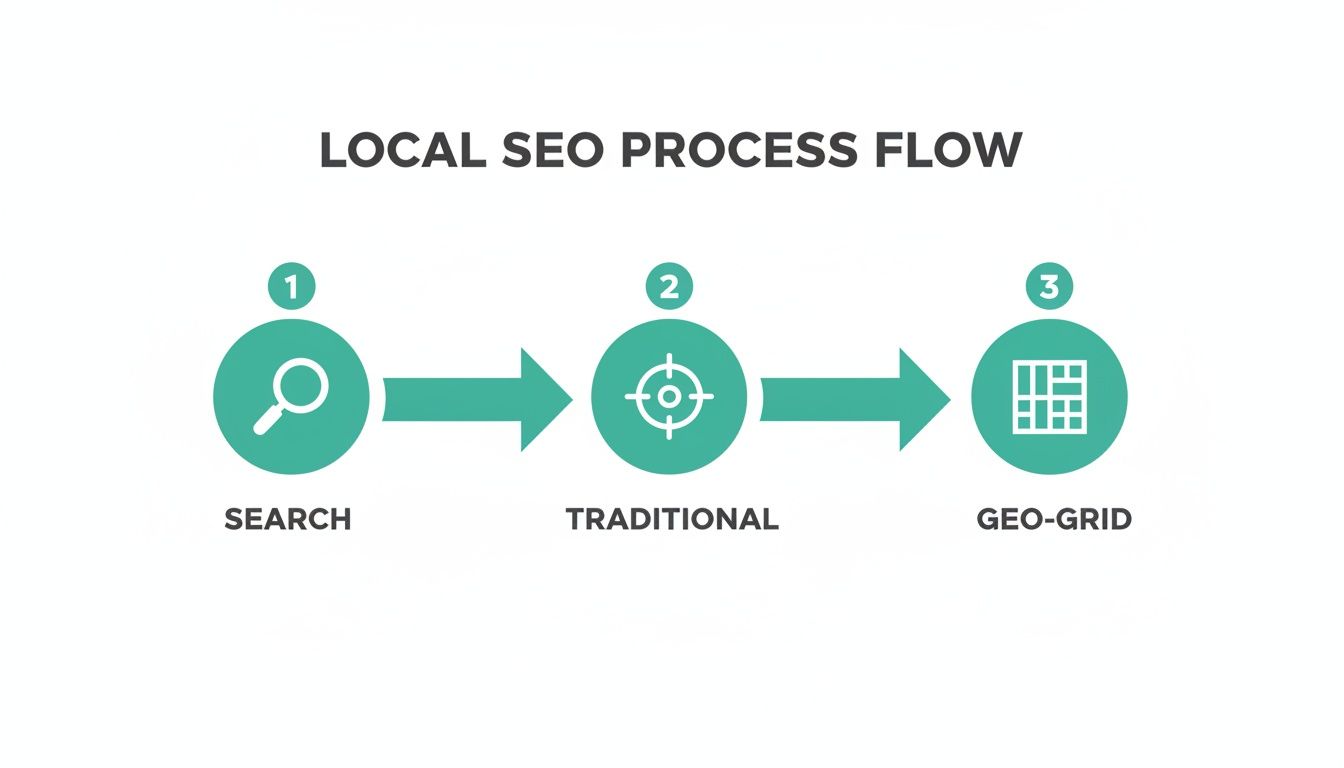
This evolution from a simple search to a full geo-grid analysis is what separates legacy tools from modern local SEO platforms. It’s no longer about a single number; it's about understanding your entire competitive landscape.
To really see why this matters, let's compare the old way with the new.
| Feature | Traditional Rank Checker | Local SEO Rank Checker (e.g., Heatmaps) |
|---|---|---|
| Location Scope | Checks from a single, often random, location. | Simulates searches from hundreds of specific points. |
| Result Type | Mixes local and national organic results. | Focuses on geo-specific Map Pack & organic ranks. |
| Data Visualization | A simple list of keyword rankings (e.g., "Position #5"). | Visual heatmaps showing rank distribution by area. |
| Actionability | Hard to know where to focus improvement efforts. | Pinpoints exact neighborhoods for targeted optimization. |
The table makes it clear: traditional tools just weren't built for the nuances of local search. For a brick-and-mortar business, knowing you rank #5 city-wide is far less useful than seeing you’re #1 in one neighborhood but completely invisible two blocks over.
The Map Pack Battleground
Here’s a crucial distinction these tools make: they separate your rankings in the Google Map Pack from standard organic results. For any business with a physical address—be it a restaurant, clinic, or retail store—the Map Pack is where the real fight for customers happens.
Why? Because that’s where ready-to-buy customers look first. In fact, 42% of local searchers click on one of the top results in the Google Map Pack. If you're not there, you’re missing out on nearly half of your potential foot traffic.
This is why a specialized Google Maps ranking checker is so vital. It doesn't just tell you if you rank; it shows you where you rank with the pinpoint accuracy needed to win over local customers.
From Raw Data to Actionable Strategy
The real magic of a local rank checker is how it turns all this complex location data into something you can actually use. The most powerful format for this is the heatmap.
A heatmap takes your ranking data and overlays it on a map of your city, using a simple color-coded system to show your visibility at a glance.
- Green areas are your strongholds—neighborhoods where you’re dominating, likely in the top 3 of the Map Pack.
- Yellow and orange areas show where your visibility is slipping. You might be on the edge of the first page, but you're not a top contender.
- Red areas are your blind spots. In these parts of town, you are effectively invisible to potential customers searching for your services.
This instantly transforms abstract numbers into a clear, strategic guide. You can see precisely where your marketing is hitting the mark and, more importantly, where your biggest opportunities for growth lie. It's no longer just data; it's an actionable blueprint for conquering your local market.
Understanding the Metrics That Actually Matter
Let’s be honest: just knowing your rank is a vanity metric. Seeing you’re #3 for a keyword is nice, but it doesn't tell you anything about whether that position is actually driving calls, clicks, or foot traffic. The first step toward a real local SEO strategy is moving beyond simple rank tracking and measuring what drives revenue.
A single number can never capture the full story of your presence in a market. You need tools that give you richer, more contextual data. This is where features like Heatmap Visualization become essential. Instead of a spreadsheet, you get an at-a-glance view of your visibility across every neighborhood, instantly showing you where you’re a local hero and where you’re practically invisible.
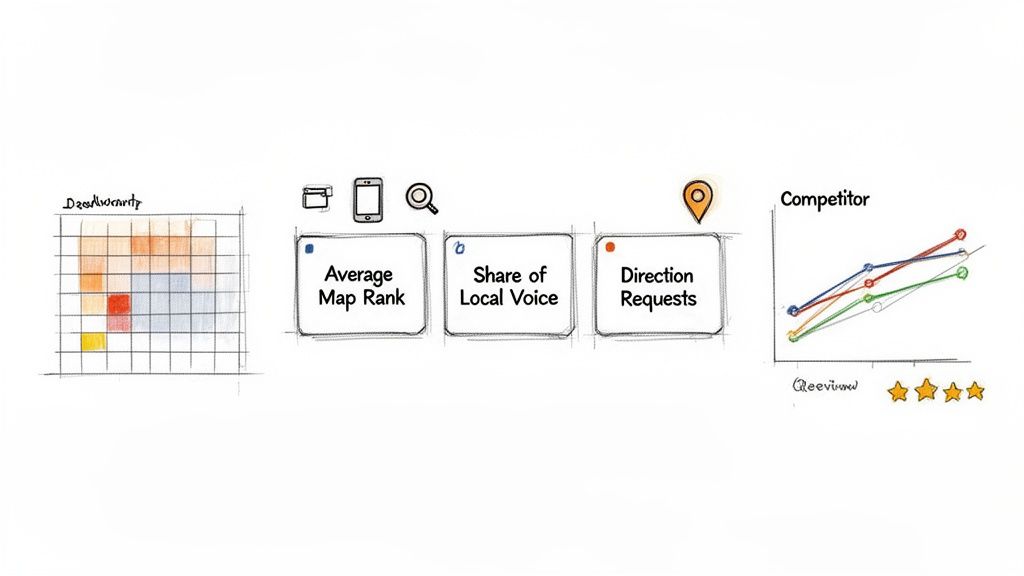
This kind of visual data is far more actionable. It helps you pinpoint exactly where your marketing efforts will make the biggest difference.
Core Metrics for Local Success
When you're looking at a rank-checking tool, you need to hunt for the metrics that give you a deep, competitive understanding of your performance. These are the numbers that actually signal growth.
-
Average Map Rank: Think of this as your GPA for a specific keyword across an entire city. It averages your position from all the different points on your heatmap, giving you a single, high-level score to quickly see how you’re doing overall.
-
Share of Local Voice: This is your market share in local search, plain and simple. It calculates how often you appear in the top results compared to everyone else, giving you a clear benchmark of your dominance. Are you a whisper or a roar?
-
Competitor Tracking: The real magic happens when you can add your local rivals and see their heatmaps right next to yours. This isn't just about spying; it's about uncovering their weaknesses and finding strategic opportunities to steal their lunch money.
These metrics help you decode the complex world of local search. To get an even clearer picture of what moves these numbers, it’s worth digging into the core local SEO ranking factors that Google’s algorithm cares about most.
Metrics for Multi-Location Brands
For businesses juggling multiple storefronts, the right metrics are even more crucial. A Multi-Location Dashboard is an absolute must-have. It’s the only way to compare performance across different cities or regions from one central command center.
This consolidated view helps you immediately spot which locations are crushing it and which ones are lagging behind. By focusing on metrics that connect visibility to real-world actions—like calls and direction requests—you can finally prove the ROI of your local marketing with undeniable data.
Turning Hyperlocal Data Into Profitable Actions
Data is just a collection of numbers until you use it to make a decision. The real power of a local SEO rank checker isn't just seeing where you rank; it's using that visual intelligence to take specific, profitable actions that grow your business.
Passively monitoring your ranks is like watching the scoreboard without ever changing your game plan.
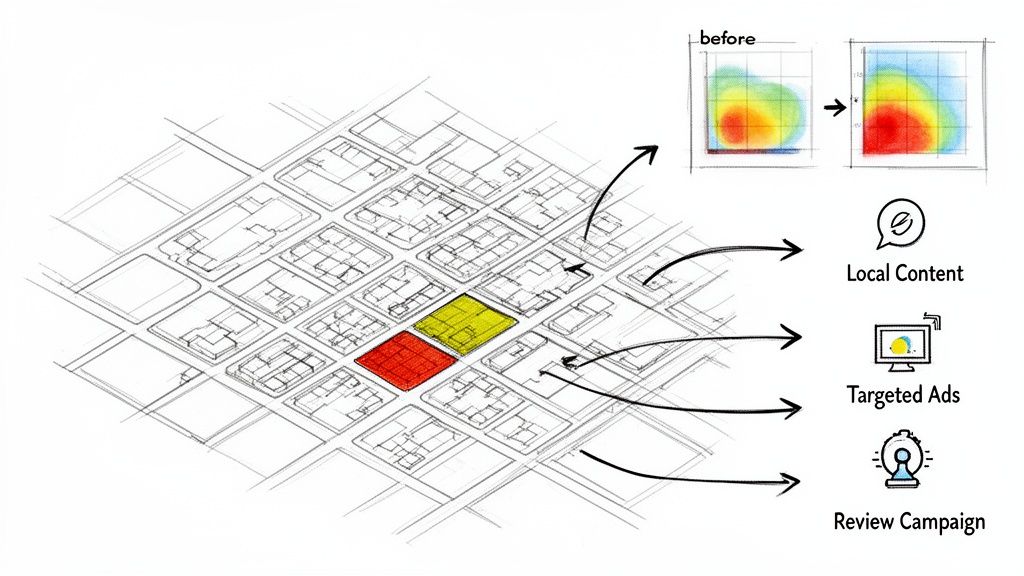
The goal is to shift from observation to execution. Your heatmap isn't just a report card; it's a treasure map pointing directly to your biggest opportunities for new customers. Each red or yellow spot on your geo-grid represents a neighborhood filled with potential customers who currently can’t find you.
From Insight to Impact: A Real-World Scenario
Let’s make this real. Imagine a wellness clinic in Miami uses a local rank checker and discovers a glaring problem. Their heatmap for "IV therapy Miami" is bright green right around their downtown location, but it turns completely red in a high-income residential area just two miles away.
This single insight is a game-changer. They now know exactly where their marketing is failing and can build a targeted strategy to fix it.
Armed with this hyperlocal data, the clinic can stop wasting its budget on generic, city-wide campaigns and start focusing its resources where they will have the greatest impact. It’s the difference between marketing with a shotgun and a sniper rifle.
Based on this heatmap data, their next steps become crystal clear and directly tied to driving revenue.
Prioritizing Your Next Moves
Instead of guessing what might work, the clinic can now implement a plan backed by real data. The heatmap gives them a clear "if this, then that" roadmap.
-
Launch Hyper-Targeted Ads: They can create a Google Ads campaign with a precise location target, set exclusively for that underperforming, high-income neighborhood. The ad copy can be tailored to resonate with residents in that specific area.
-
Develop Localized Content: The clinic can create a new blog post or service page titled "The Best IV Therapy in Miami's Design District." This content, optimized for the target neighborhood, directly addresses the visibility gap.
-
Bolster Local Authority: Seeing a competitor dominating a key service term in that red zone might prompt a new strategy. For instance, they could launch a targeted review generation campaign, encouraging recent clients from that area to leave feedback, strengthening their social proof and relevance for that specific location.
This strategic approach is indispensable for multi-location brands and single storefronts alike. Especially when 76% of people who conduct a local search on their smartphone visit a physical place within 24 hours, and 28% of those searches result in a purchase.
By pinpointing and fixing visibility gaps, you are directly tapping into a stream of high-intent customers who are ready to act. You can learn more about how local search behavior drives sales and why accurate tracking is so critical.
Harnessing Local Engagement to Influence Rankings
Heatmaps and hyperlocal data are great for telling you where you need to improve. But the real pros use a more advanced strategy to climb the Map Pack faster. They don't just wait for signals to happen—they actively create the real-world engagement that Google’s local algorithm is built to reward.
Think of it this way: your rank isn't just about keywords anymore. It’s becoming more and more about how many people search for your brand by name, click for directions, visit your site from the Map Pack, or call your business. These actions are powerful proof that you matter in the real world.
Creating the Signals Google Values
At the end of the day, Google just wants to recommend businesses that are popular and trusted. So when its algorithm sees a spike in real user activity aimed at your Google Business Profile, it takes that as a huge vote of confidence in your local authority.
This is where a local SEO rank checker becomes your secret weapon. It doesn't just show you where you rank; it shows you the exact areas where your engagement is falling flat. By finding these "red zones," you can zero in on generating the user behaviors that will make the biggest difference, right where you need it most.
The big idea is simple but powerful: you can actively create the signals that Google’s algorithm is looking for. This moves beyond traditional SEO, helping you build local authority faster and accelerate your journey to the top of the Map Pack.
For example, imagine a sudden increase in direction requests coming from a specific neighborhood. That sends a crystal-clear signal to Google that your business is a go-to spot for people in that area. That user behavior directly strengthens your relevance for anyone searching from that location.
Turning User Behavior Into Ranking Fuel
So, how do you actually get people to generate these signals? It’s all about connecting your digital marketing with real-world customer actions.
Here are a few practical ways to get started:
- Brand Name Searches: Encourage customers to find you by searching your business name. A simple "Find us on Google" mention in your marketing materials can be a great nudge.
- Website Clicks: Drive traffic from your social media or email campaigns directly to your Google Business Profile, making it easy for them to click through to your website from there.
- Direction Requests: Run geo-targeted social media ads promoting an in-store offer with a clear "Get Directions" call-to-action.
- Phone Calls: Put your phone number front-and-center in local ads and content so customers can call you right from your profile.
- Reviews and Ratings: A steady flow of fresh, positive reviews tells Google that customers are consistently happy. Actively asking for feedback is a must; you can learn more about how to get Google reviews compliantly to build that social proof the right way.
When you strategically encourage these behaviors, you’re doing more than just engaging with customers. You’re feeding Google’s algorithm the exact data it needs to see your business as a local leader. This turns your rank checker from a simple report card into an active tool for growth.
Measuring Your Success and Proving ROI
Visibility is great, but revenue is better. The final piece of the local SEO puzzle is tying all your hard work directly to business growth. A great local SEO rank checker is the tool that makes this possible. It's what gives you the hard data to prove your strategy isn't just a marketing expense—it's an investment that pays for itself.
After all, you can't manage what you don't measure. Consistent tracking is the only real way to show the value of your work to clients, bosses, or your own team.
From Rankings to Revenue
One of the most powerful ways to demonstrate progress is with a simple before-and-after. Imagine showing your team a heatmap from three months ago, covered in red and yellow dots, and then pulling up today's map, glowing with green across all your target neighborhoods. The visual proof is immediate and undeniable.
From there, you can connect those visibility gains to the metrics that actually matter to the business.
- Increased Phone Calls: Are more calls coming in from your Google Business Profile? As you climb the Map Pack rankings in key areas, this number should go up.
- More Direction Requests: A jump in people asking for directions is one of the clearest signs that online visibility is driving real-world foot traffic to your locations.
- Higher Website Clicks: As more people find you in local search, more of them will click through to your site to book an appointment, learn more, or make a purchase.
A powerful local SEO rank checker doesn't just show you where you stand; it gives you the data to prove your value and confidently plan your next move. It transforms your local marketing from an art into a science.
By tracking these connections over time, you can spot trends, set realistic goals, and put your marketing budget where it will have the biggest impact. When you can definitively show that a 15% improvement in your average map rank led directly to a 10% increase in appointment bookings, you’ve closed the loop. You’ve proven your ROI.
Common Questions About Local Rank Checkers
You've got questions, we've got answers. Here are a few of the most common things people ask when they start digging into their hyperlocal search performance.
How Often Should I Check My Local Rankings?
For most local businesses, checking your rankings weekly or bi-weekly is the sweet spot. This rhythm helps you spot real trends and see what competitors are up to, without getting lost in the noise of daily ups and downs.
Many modern platforms will send you automated reports on this schedule anyway. It’s just enough data to make smart decisions and tweak your strategy without obsessing over every little fluctuation.
Can I Use a Rank Checker for Cities Where I Don’t Have a Physical Location?
You can try, but you’ll be fighting a losing battle. A local SEO rank checker is built to measure your visibility around a physical business address because Google’s local algorithm is obsessed with proximity. Trying to rank in the Map Pack for a city where you have no storefront is next to impossible.
It’s also a good way to get on Google’s bad side, as it often violates their guidelines. The smartest move is to use the tool to completely own the service area where your customers actually are.
Key Takeaway: A local rank checker doesn’t replace Google Business Profile insights—it explains them. GBP tells you what happened (e.g., you got 50 calls), while a rank checker shows you why by revealing exactly where you’re visible on the map.
Does This Replace My Google Business Profile Insights?
Nope. Think of it as the perfect partner to your GBP data.
Your Google Business Profile tells you the results—how many calls you got, how many people clicked to your website. A local rank checker gives you the story behind those numbers. It shows you why calls are up or down by revealing your search visibility street by street. It provides the competitive, hyperlocal context that GBP just doesn't offer.
Ready to see your true local visibility and turn insights into customers? Nearfront combines AI-powered heatmaps with engagement tools to get you ranking higher in the neighborhoods that matter most. Get started with Nearfront today.