
Winning in local search means being the first and best answer when a customer searches nearby. It all starts with a rock-solid foundation, and that foundation is a perfectly optimized Google Business Profile. Forget everything else for a moment—this is your digital storefront, and it's the single most powerful tool you have.
Your Foundation for Local Search Dominance
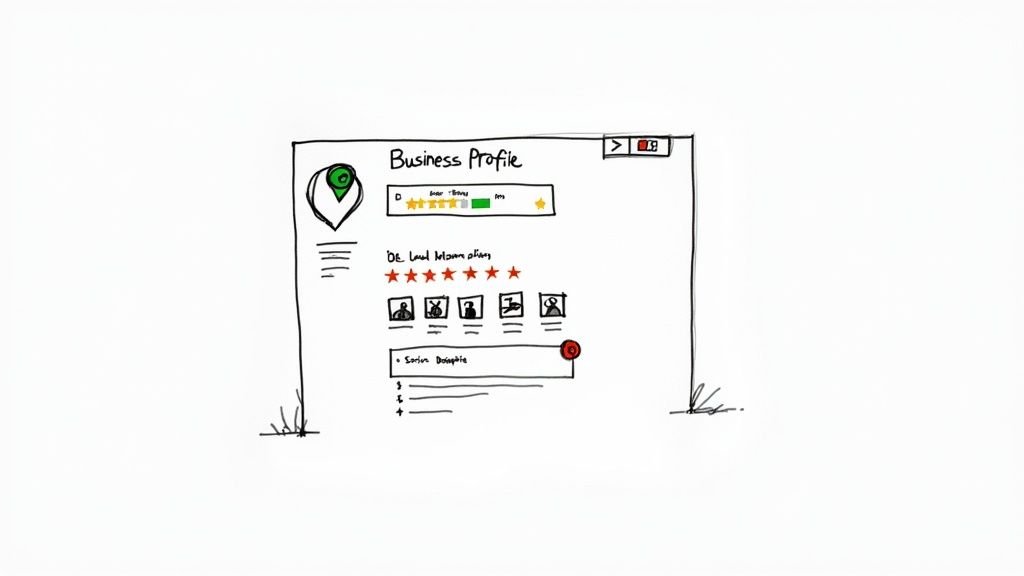
Before you even think about complex strategies, you have to get your Google Business Profile (GBP) right. This isn't just another directory listing; it's the central hub Google uses to populate the coveted Local Pack and Maps results. Nailing this from the start builds the authority and trust that your competitors are probably overlooking.
The data doesn't lie. Local searches are packed with buying intent—a staggering 76% of “near me” mobile searches result in a store visit within 24 hours. When you consider that nearly half of all Google searches have local intent, a complete and active profile is non-negotiable. In fact, a fully optimized GBP makes a business appear 2.7 times more trustworthy, which translates directly into more calls, clicks, and customers walking through your door.
Beyond the GBP Basics
Too many businesses just fill out their name, address, and phone number (NAP) and call it a day. That's a huge mistake. To truly own your local market, you have to treat your profile like an active, dynamic marketing channel.
Take your business categories, for example. Your primary category is one of the most critical local SEO ranking factors. It tells Google exactly who you are and what you do. Don't just settle for "close enough." See what your top-ranking competitors are using. A cafe that's famous for its weekend brunch should be categorized as a "Brunch Restaurant," not just a generic "Restaurant." That small distinction matters.
And don't forget about secondary categories. They're your chance to cast a wider net. A yoga studio could easily add:
- Pilates Studio
- Wellness Center
- Meditation Center
These extra categories help you show up for a broader range of related searches without weakening your core identity.
To keep it simple, here's a quick checklist of the most critical elements to focus on.
Google Business Profile Optimization Checklist
This table breaks down the core components of your GBP and why each one is so important for climbing the local search rankings.
| GBP Element | Optimization Action | Impact on Ranking |
|---|---|---|
| Business Name & NAP | Ensure 100% accuracy and consistency across all online profiles. | High: Foundational for trust and avoiding duplicate listings. |
| Primary Category | Choose the most specific and accurate category for your main service. | Very High: Directly tells Google what you do and which queries to rank you for. |
| Secondary Categories | Add all relevant categories that describe your other services. | High: Increases visibility for a wider range of related search terms. |
| Business Description | Write a compelling, keyword-rich summary of your business. | Medium: Opportunity to include local terms and unique selling points. |
| Services/Products | Detail every service or product with descriptions and pricing. | Medium: Helps you rank for long-tail, specific searches and informs customers. |
| Photos & Videos | Consistently upload high-quality, geotagged media. | High: Boosts engagement and signals to Google that your business is active. |
| Reviews & Responses | Actively solicit reviews and respond to every single one (good or bad). | Very High: A top factor for trust, social proof, and ranking. |
| Google Posts | Regularly publish updates, offers, and events. | Medium: Keeps the profile fresh and signals ongoing activity to Google. |
| Q&A Section | Proactively ask and answer common questions about your business. | Medium: Provides helpful info and shows you're an engaged business owner. |
Getting these elements right isn't a one-time task—it's an ongoing process that separates the businesses that show up from the ones that get chosen.
Crafting Descriptions and Services that Convert
Your business description is prime real estate. Ditch the generic mission statement and use that space to weave in important local keywords and highlight what makes you unique. Mention the specific neighborhoods you serve or popular local products.
For instance, a Chicago plumber should write something like: "Your trusted plumbing expert serving Lincoln Park and Lakeview for over 20 years. We specialize in emergency repairs and eco-friendly drain cleaning." It’s far more powerful than just "We provide plumbing services."
Pro Tip: Use the "Services" feature to create mini-landing pages right inside your GBP. For every service you offer, write a detailed description (up to 1,000 characters) and add the price if you can. This gives searchers instant answers and helps Google match your profile to more specific, high-intent queries.
Finally, remember that your GBP is a living, breathing profile. Consistently upload high-quality photos of your team, your work, and your storefront. Use Google Posts to announce specials or share updates. And most importantly, actively solicit reviews, respond to every single one, and answer questions in the Q&A section. All of these actions send powerful engagement signals to Google, proving your business is active, relevant, and deserves that top spot.
Building Authority with Local Citations and Backlinks
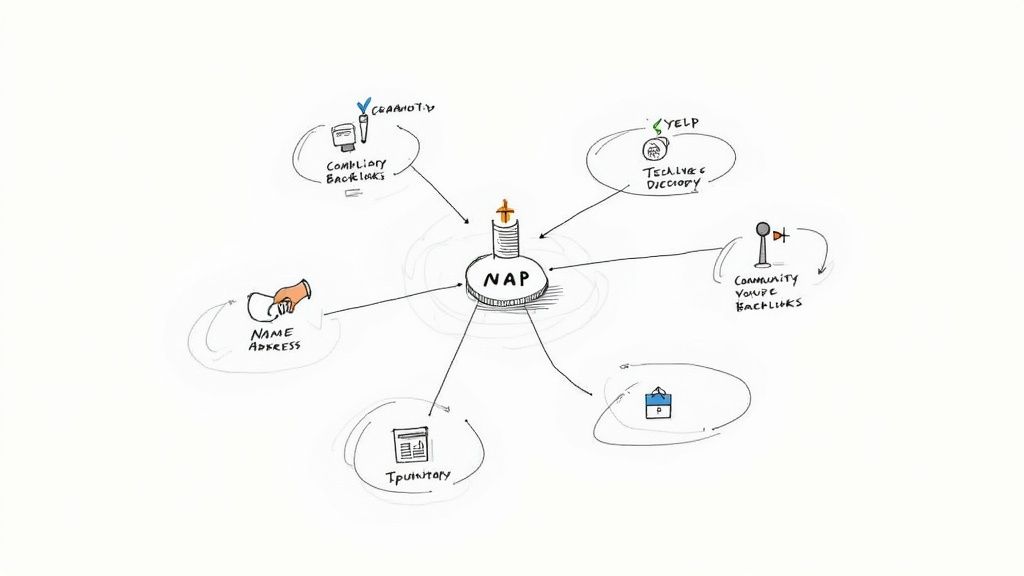
Once your Google Business Profile is dialed in, it's time to broadcast that authority across the web. This is where local citations and backlinks come in. Think of them as votes of confidence from other websites that prove to Google you’re a legitimate, established player in the local scene.
Every citation is just a mention of your business's Name, Address, and Phone number (NAP). The game is to make sure this info is identical everywhere. Inconsistencies—even a small typo in a street name or a missing suite number—create confusion for search engines and kill the trust you're working so hard to build.
Mastering Your Citation Ecosystem
First things first: you need to run an audit of your existing online footprint. You’d be surprised what you find. A few simple searches for your business name often turn up old listings with wrong phone numbers or a previous address. These are digital dead ends, and they actively hurt your rankings.
Your mission is to hunt down and fix every single error. Start with the heavy hitters:
- Major Aggregators: These are the big data providers that feed hundreds of other sites. Get your NAP right with them, and you create a ripple effect of accuracy.
- Core Directories: This is your non-negotiable list—Yelp, Apple Maps, Bing Places. Being present and correct here is table stakes.
- Industry-Specific Sites: Every niche has its own trusted directories. A contractor needs to be on HomeAdvisor. A doctor should be on Zocdoc. For a solid list to get you started, check out the most impactful small business directories that actually drive results.
After you've cleaned up the mess, you can start building fresh, high-quality citations. Focus on platforms that are relevant to your city and your industry to send the strongest possible signals to Google.
A consistent NAP across the web is the bedrock of local authority. Google sees this uniformity as a powerful indicator of a trustworthy, operational business, which is a key component if you want to dominate local SEO.
Earning Backlinks That Actually Matter
While citations are all about consistency, backlinks are about credibility. A backlink is simply a link from another website to yours, and Google treats a high-quality local backlink as a massive endorsement. These links signal that your business is a prominent, respected part of the local community.
Generic link-building tactics are a waste of time here. To move the needle, you need links that are geographically and contextually relevant. These are the kinds of links your competitors can't easily replicate, giving you a serious, long-term advantage.
Strategies for High-Impact Local Link Building
Forget chasing link quantity. The goal is to earn links from reputable local sources. This approach not only juices your SEO but also builds real community relationships that can drive referral traffic for years.
Here are a few proven ways to earn powerful local backlinks:
- Sponsor a Local Event: Getting behind a local 5K, a little league team, or a community festival almost always earns you a link from the organization’s website. This tells Google you're an active, invested member of the community.
- Partner with Nearby Businesses: Team up with a non-competing business for a joint promotion. A local gym could partner with a nearby health food store for a "New Year, New You" package. This creates natural cross-promotion and valuable links from each other's sites.
- Get Featured in Local News: Have a great origin story, a company anniversary, or a new community initiative? Pitch it to local bloggers and news outlets. A feature story can land you one of the most authoritative local links you can possibly get.
- Host a Community Workshop: Offer a free class related to your expertise. A local accounting firm could host a "Small Business Tax Tips" seminar, inviting local business groups who will likely link back to the event page on your site.
Each of these moves reinforces your local relevance, weaving a web of trust signals that Google simply can't ignore. This one-two punch of clean citations and earned backlinks is a cornerstone of any strategy designed to dominate local search.
Creating Content That Captures Local Intent
Technical SEO gets you on the playing field. Hyper-local content is how you win.
A perfectly optimized Google Business Profile and clean citations are table stakes—they tell Google what you are and where you are. But content is what proves you belong there. It’s what demonstrates your expertise and connection to the community you actually serve.
Forget the generic, one-size-fits-all blog posts. To really dominate local SEO, your content has to speak the language of your specific audience. It's the difference between being a random pin on a map and becoming the neighborhood’s go-to authority.
Uncovering Hyper-Local Keywords
Great content starts with knowing what your local customers are actually searching for. This isn't about broad industry terms; it's about digging for the granular keywords that signal someone is ready to buy, right here, right now.
A downtown Chicago restaurant might target "best restaurants in Chicago." But a smart restaurant in Wicker Park is going after long-tail phrases with real intent:
- "best brunch spot near Damen Avenue"
- "dog-friendly patio wicker park"
- "late-night tacos milwaukee ave"
These hyper-local keywords are gold. They’re less competitive and attract a much more qualified customer. Think about how real people search when they need something nearby—they use neighborhoods, cross-streets, and local landmarks. Your keyword research has to mirror that reality.
Building Location-Specific Service Pages
If your business serves multiple neighborhoods or cities, creating dedicated pages for each one is one of the most powerful moves you can make. And no, this doesn't mean just copying your main service page and swapping out the city name. That's a fast track to a Google penalty.
Each location page needs to be a unique, valuable resource. A plumber serving the Denver metro area should have distinct pages for "plumbing services in Highlands Ranch" and "emergency plumber in Aurora."
Key Insight: A killer location page does more than list services—it tells a story. Feature a case study from a client in that specific neighborhood. Mention local landmarks ("we're just down the road from City Park"). Talk about common problems unique to that area, like issues with older pipes in historic homes. This is how you prove you're a true local expert.
These pages become highly relevant landing spots for local searchers, dramatically boosting your chances of ranking for those critical "near me" queries. They signal to Google that you have a genuine, boots-on-the-ground presence in the community.
Content Ideas That Build Local Authority
Beyond your core service pages, your blog is where you cement your status as a local expert. The goal is to create content that’s genuinely helpful to people living in your service area, positioning you as more than just a business.
Consider these high-impact ideas:
- Neighborhood Guides: Write the definitive guide to a neighborhood you serve. A real estate agent could create "The Ultimate Guide to Living in the North Loop," covering the best coffee shops, parks, and local events.
- Local Event Roundups: Publish seasonal posts about what's happening in town. A family-friendly dentist could post "Top 10 Kid-Friendly Fall Activities in Boulder."
- Highlighting Local Partners: Feature other non-competing businesses you love. A wedding planner could write a post on the "Best Wedding Venues in Napa Valley," linking to each one and building local relationships.
- Community-Focused Case Studies: Frame your success stories with a strong local angle. Instead of a generic title, try something like, "How We Helped a LoHi Restaurant Pass Their Health Inspection with Flying Colors."
This kind of content does more than just rank. It attracts local backlinks, gets shared within the community, and builds a level of trust that technical SEO alone can never buy. It’s the human element that connects your business to the heart of your city, turning searchers into loyal customers.
Mastering Reviews and Customer Engagement
In local search, reviews are everything. They're the new word-of-mouth, the social proof that convinces a potential customer to choose you over the shop next door. More than just feedback, a steady flow of fresh, positive reviews tells Google your business is alive, trusted, and a staple in the community.
But here’s the thing: you can't just sit back and hope for reviews to appear. That’s a recipe for falling behind. To really move the needle, you need a proactive system to generate feedback—one that feels like a natural part of a great customer experience, not a pushy sales tactic.
Build a Proactive Review Generation Machine
The secret to getting more reviews isn't complicated. It's about asking at the right moment. That magic window is usually right after a successful service or a happy purchase when the customer's satisfaction is at its peak.
Your job is to make it incredibly easy for them to share that positive experience. Here’s how:
- Personalized Email & SMS: A day or two after their visit, send a quick message. Thank them for their business and drop a direct link to your Google review page.
- QR Codes on Receipts: Make it frictionless. A quick scan with a phone can take a happy customer straight to your review page before they’ve even left your parking lot.
- A Simple, Human Ask: Train your team to say something natural. "We loved having you today! If you had a great experience, sharing it on Google really helps others find us."
The goal is to weave the "ask" into your daily operations. When it becomes a consistent, repeatable part of your process, your review count transforms from a trickle into a steady, reliable stream.
The Art of Responding to Every Single Review
Getting the review is just step one. The real magic happens when you respond—to all of them. A business that actively engages with feedback, both good and bad, signals incredible customer service to everyone watching.
Keep your responses simple but effective:
- Be Fast: Aim to reply within 24 hours.
- Get Personal: Use the reviewer's name. Mention a specific detail from their comment.
- Amplify the Good: Thank them for positive feedback and echo what they loved.
- Handle the Bad with Grace: Apologize for a poor experience and offer to take the conversation offline to fix it. Never, ever get defensive.
Pro Tip: Sneak in a keyword or your location when you reply to a glowing review. Something like, "Thanks, Sarah! We're so glad you enjoyed our deep-tissue massage. We pride ourselves on being the go-to wellness center in the RiNo Art District." This subtly reinforces your local authority for Google.
Look Beyond Reviews: Crucial Engagement Signals
While reviews are king, Google is watching for a whole host of other user actions. These engagement signals are powerful proof that your business is a popular, relevant choice in the real world.
Think about what a motivated customer does. They don't just read; they act.
Key signals include:
- Click-to-Call Actions: How many people tap the "Call" button on your profile? This is a high-intent signal of an immediate need.
- Direction Requests: This is gold. Someone clicking for directions is one of the strongest indicators of foot traffic that Google can track.
- Website Visits: Clicks from your Google Business Profile to your website show that searchers are digging deeper and want more information.
- Photo Views: Are people swiping through your photos? High view counts signal strong interest in what you offer and the vibe of your business.
Understanding these metrics is non-negotiable. Tools like Nearfront's engagement signal tracking show you exactly which actions are driving real value. This allows you to fine-tune your profile to encourage more of these high-impact behaviors. When you master both reviews and engagement, you're sending an undeniable message to Google: your business is the top choice in town.
Measuring and Scaling Your Local SEO Success
If you're not measuring your local SEO, you're just guessing. To really win, you have to move beyond vanity metrics like website traffic and start tracking the numbers that actually grow your business. This is how you turn a checklist of tasks into a predictable, data-driven growth machine.
The old way of thinking was all about a single, city-wide ranking. But local search just doesn't work like that anymore. A customer searching from the north side of town sees completely different results than someone just two miles south. Your visibility is a patchwork quilt, not a single blanket.
Moving Beyond Basic Analytics
Standard analytics tell you if someone landed on your site, but they can't tell you how they found you or how visible you are block-by-block. To get the real story, you need to dig into more granular, hyper-local metrics.
This means you need to get obsessed with:
- Keyword Rankings by Neighborhood: Don't settle for knowing you rank #5 in "Chicago." You need to know you're #2 in Lincoln Park but completely invisible in Wicker Park for the exact same search.
- Google Maps Visibility: Where does your pin actually show up when a potential customer is looking? Are you front and center, or are you buried under a dozen competitors?
- Qualified Lead Generation: How many direction requests, phone calls, and website clicks are you actually generating? These are the actions that ring the cash register.
This is where the game has changed. Think about the difference between the old way and the new way of measuring what matters.
Traditional vs. Advanced Local SEO Measurement
| Metric | Traditional Method | Advanced Method (e.g., Nearfront) | Strategic Advantage |
|---|---|---|---|
| Rankings | Single, city-wide rank | Hyper-local grid tracking (heatmaps) | Pinpoint weak areas and target specific neighborhoods for growth. |
| Visibility | Impression counts in GBP | Visual heatmaps showing map prominence | See exactly where you appear on the map vs. where you're invisible. |
| Leads | Total website clicks | Clicks, calls, and direction requests from GBP | Attribute real-world actions directly to your local SEO efforts. |
| Competitors | Manual spot-checks | Automated share of voice tracking | Understand your true market share and who is stealing your customers. |
The gap is huge. Advanced tools like Nearfront's heatmaps give you that block-by-block visual of your Google Maps visibility, showing you instantly where you're strong and where you're losing. That’s an insight you simply can’t get from standard analytics, and it uncovers opportunities your competitors don't even know exist.
This focus on customer actions creates a powerful feedback loop. Every positive interaction builds on the last, strengthening your local authority.
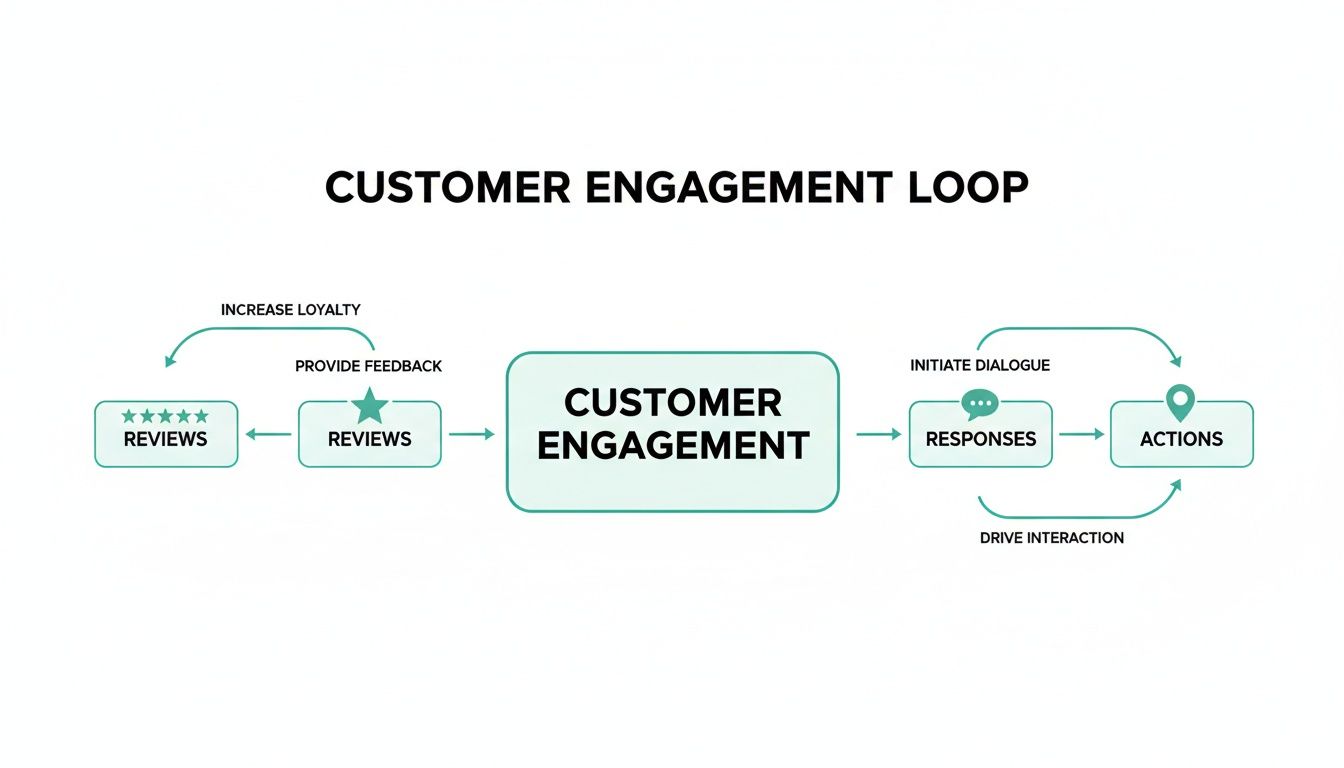
As the diagram shows, each positive review and quick response encourages more customers to act, which in turn tells Google you're a trusted local business.
Scaling Success for Multi-Location Businesses
Managing local SEO for one storefront is a challenge. For ten, fifty, or hundreds? It can feel impossible without the right system. The trick is to centralize your data while still acting on those hyper-local insights.
A multi-location dashboard is non-negotiable. It gives you a single screen to monitor every store, compare performance city-by-city, and see which marketing efforts are actually moving the needle. You can spot underperforming locations in seconds and apply the winning strategies from your top stores.
For instance, a dashboard might show your Miami location gets a ton of calls from ranking for "best CBD oil," while your Denver store crushes it with direction requests from "dispensary near me." This is gold. It lets you tailor your content and GBP strategy for each market to play to its unique strengths.
Automating Reporting to Prove Your ROI
One of the biggest headaches in local SEO is proving its value to your boss or your client. Manually exporting data, wrestling with spreadsheets, and trying to build a report that tells a clear story is a massive time sink.
Automation is a game-changer here. When you have automated reports with clear before-and-after snapshots, you can easily show the lift from your work. Being able to draw a straight line from your optimization efforts to a spike in phone calls makes the value of what you do undeniable. If you're looking to level up your reporting, exploring different local SEO reporting tools can show you what's possible.
By tracking the right metrics, you change the conversation from "Are we doing SEO?" to "How much revenue did our SEO drive last month?" This is the final, critical piece for any brand that's serious about not just ranking, but truly dominating local search for the long haul.
Burning Questions About Local SEO
If you're digging into local search, you've probably got questions. The world of local SEO is full of nuances, and it’s easy to get stuck wondering what to do next. Let's tackle some of the most common questions we hear from businesses trying to climb the local rankings.
How Long Until I See Local SEO Results?
This is the one everyone asks, and the only honest answer is: it depends. Local SEO isn't like flipping a switch on a paid ad campaign where traffic starts flowing instantly. It's an investment in building a long-term asset.
Generally, you can expect to see real, meaningful movement in your rankings within 3 to 6 months of consistent, focused work.
But that timeline can shift based on a few big factors:
- Your Competition: Trying to rank as a "personal injury lawyer in Los Angeles" is a much steeper climb than being the "best new bakery in a small town." Crowded markets take more time.
- Your Starting Point: Is your business brand new with zero digital footprint? That's a longer road than an established company that already has some citations and a history of reviews.
- Your Effort: How consistently are you working on it? A steady drumbeat of GBP optimizations, new reviews, and fresh local content will always speed things up.
Think of it like getting a garden to grow. You have to prep the soil, plant the seeds, and water consistently. The hard work pays off, but it doesn't happen overnight.
Key Takeaway: Patience and consistency are everything. Local SEO compounds over time, building a real competitive moat that's hard for others to cross. Don't chase shortcuts or black-hat tricks—they'll only set you back.
Can I Do Local SEO Without a Physical Address?
Yes, absolutely. This is a huge misconception that trips up countless service-area businesses (SABs)—think plumbers, mobile detailers, or consultants who work from home. Google gets it. They've designed the system for businesses that serve customers at their locations, not the other way around.
The trick is setting up your Google Business Profile the right way from the start. You'll still need to provide a real address for verification (your home is fine), but you can—and absolutely should—hide it from the public on your profile.
Instead of a map pin, Google will show your designated service areas. You can define these by city, zip code, or even specific neighborhoods. From there, your entire strategy shifts to proving you're the most relevant choice within those zones, using location-specific content and customer reviews that mention those towns or neighborhoods.
How Many Google Reviews Do I Actually Need?
There's no magic number. Stop chasing a specific quantity and start focusing on creating a consistent and steady stream of new, positive reviews.
Here's why: A business with 50 reviews spread out over two years looks way more authentic and active to Google than a business with 100 reviews that all showed up in one week and then went silent.
A steady velocity of new reviews sends a powerful signal that your business is open, popular, and consistently making customers happy. Your goal should be to build a simple, repeatable process for asking every single happy customer for a review. That ongoing effort is infinitely more powerful than a one-time push.
What's More Important: Local On-Page SEO or My Google Business Profile?
That’s like asking if an engine or the wheels are more important for a car. You're going nowhere without both working together.
Your Google Business Profile is your foundation. For most local searches, it's the very first thing a potential customer sees. It's the absolute king when it comes to getting seen in the Local Pack and on Google Maps.
But your website’s on-page SEO is what gives your GBP its authority and depth. When you create hyper-local service pages and blog posts, you're sending powerful signals to Google that you're not just in the area—you're an expert for the area.
A well-optimized GBP gets you in the game, but strong on-page SEO is what helps you win it and convinces people to actually become customers.
Ready to stop guessing and start seeing exactly where you rank block-by-block? Nearfront provides the visual heatmaps and engagement data you need to prioritize your efforts and prove your ROI. See how our AI-powered platform can help you outrank the competition and drive more customers through your door. Learn more at Nearfront.