
Let's be honest, marketing for dermatologists isn't what it used to be. Gone are the days when a steady stream of word-of-mouth referrals was enough to keep the lights on. Today, it’s all about building a robust digital presence that attracts, educates, and ultimately converts patients online.
To stand out, you need a smart mix of local search optimization, high-value content, and a stellar online reputation. This isn't just about survival; it's the blueprint for growth in an increasingly crowded field.
The Shift in How Patients Choose Dermatologists
The patient journey has fundamentally changed. It no longer starts with a referral from a primary care physician—it starts with a Google search.
Before a potential patient ever calls your office, they’ve already done their homework. They’re searching, comparing local practices, and digging into online reviews to decide who they can trust. This shift makes a strong digital footprint completely non-negotiable for any dermatology practice that wants to grow.
Think of your website, Google Business Profile, and social media pages as the new front door to your clinic. When someone in your city searches for the "best dermatologist for acne," they expect to find a professional website, clear information about your services, and real patient reviews. If you're missing these key pieces, you're practically invisible to a huge portion of your potential market.
This isn't just about being seen; it's about building trust before a patient even steps through your door. A well-oiled marketing strategy is your chance to showcase your expertise and commitment to patient care, making your practice the obvious choice from the very first click.
Capturing a Growing Market
The demand for dermatology is booming. The global market is set to climb from around USD 1.6 billion in 2025 to over USD 2.0 billion in the next decade. This isn't just for medical treatments like acne or psoriasis; it includes a massive demand for high-value aesthetic services like injectables and laser treatments.
With North America leading the charge, localized digital marketing becomes your single most powerful tool for capturing this wave of new patients. You can read more about the growing dermatology market to get a full picture of the opportunity at hand.
The whole process can feel complex, but it boils down to a clear, actionable flow.
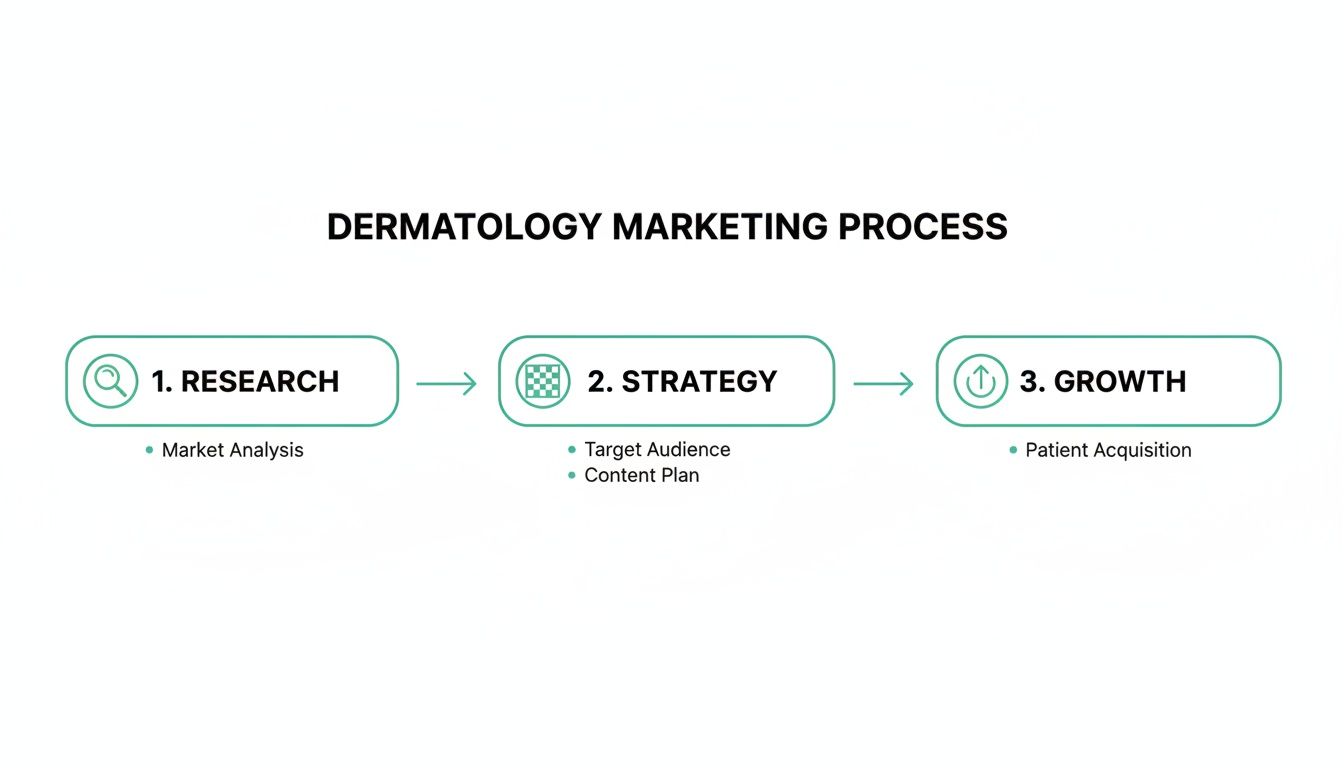
As you can see, successful marketing isn't about guesswork. It’s a deliberate, step-by-step process that moves from understanding your market to executing a strategy that drives real growth.
The Core Pillars of a Successful Strategy
To connect with today’s patients, your marketing for dermatologists needs to be a multi-channel effort. It’s not about picking one thing and hoping for the best. It's about integrating several core pillars that work together to attract new patients and keep them coming back.
The table below breaks down these essential pillars, their primary goals, and the kind of impact you can expect.
Core Pillars of Dermatology Marketing at a Glance
| Marketing Pillar | Primary Goal | Key Action | Expected Impact |
|---|---|---|---|
| Local SEO & Google Maps | Be the first choice for "near me" searches. | Optimize your Google Business Profile and website for local keywords. | Increased calls, direction requests, and website clicks from local patients. |
| Content & Paid Ads | Build authority and capture immediate demand. | Publish expert blog posts on conditions/treatments and run targeted ads. | Attracts organic traffic long-term and fills appointment slots quickly. |
| Reputation Management | Build trust and social proof. | Proactively request and respond to patient reviews on Google and Healthgrades. | Higher conversion rates and a stronger, more trustworthy brand image. |
| Referral Partnerships | Generate high-quality patient referrals. | Build relationships with local primary care physicians and medspas. | A steady stream of pre-qualified, high-value new patients. |
Each pillar plays a distinct but complementary role. When executed together, they create a powerful engine for sustainable patient acquisition.
The key takeaway is this: A winning marketing plan does more than just make you visible. It builds a compelling case for why a patient should choose your practice over all the others. It communicates expertise, showcases real results, and builds trust from the very first interaction.
Dominating Local Search and Google Maps
When a potential patient needs a dermatologist, where do they turn? Almost always, it starts with a simple search: "dermatologist near me."
Winning that search isn't just a nice-to-have; it's the bedrock of modern patient acquisition. If you can capture this high-intent local traffic, you can consistently fill your appointment book.
This is where your Google Business Profile (GBP) comes in. It's no longer just a digital business card. Think of it as your digital front door—the first impression that determines whether a patient clicks to call you or keeps scrolling to a competitor.
Turning Your Google Business Profile into a Patient Magnet
A half-finished, unmanaged GBP profile is a massive missed opportunity. To transform it into a machine that generates new patients, you need to obsess over the details. The goal is to give Google so much clear, accurate, and compelling information that it has no choice but to show your practice for local dermatology searches.
Get the basics right, but don't stop there. Go way beyond just your name, address, and phone number (NAP).
- Get Granular with Categories: Of course, your primary category is "Dermatologist." But what about secondary categories? Add specifics like "Cosmetic Dermatologist," "Medical Spa," or "Skin Care Clinic" if they fit. This simple tweak helps you show up for a much wider range of service-related searches.
- List Every Single Service: Use the "Services" feature to list everything you offer—from medical procedures like mole removal and skin cancer screenings to cosmetic treatments like Botox, fillers, and laser hair removal. Give each one a clear description and, if you can, pricing information.
- Your Photos Are a Visual Consultation: Ditch the stock photos. Upload professional shots of your office, your team, and your treatment rooms. Most importantly, with proper consent, showcase HIPAA-compliant before-and-after photos. These images are powerful social proof that helps patients visualize their own results.
Pro Tip: Make it a habit to upload new photos and post weekly GBP updates. Announce a new treatment, share a special offer, or post some quick skincare tips. This consistent activity signals to Google that your profile is active and relevant, which can seriously boost your rankings in the local map pack.
For a much deeper dive, our guide on how to optimize your Google Business Profile walks you through a step-by-step checklist. It’s an invaluable resource for making sure no detail gets overlooked.
Build Your Website Around Your Location
Your website and your GBP profile are a team. A strong local SEO strategy requires content on your site that proves your authority in your specific geographic area. This means you need more than a single "Contact Us" page.
If you run a multi-location practice, each office needs its own unique page. This isn't optional. Each page should feature the specific address, a local phone number (not a toll-free one), an embedded Google Map, and content written for that community. Mentioning nearby landmarks or neighborhoods is a great way to strengthen those local signals.
Even for single-location clinics, creating service pages with a local focus is a game-changer. Don't just make a page for "Microneedling." Create one for "Microneedling in [Your City]." This strategy helps you rank for those super-specific, high-intent searches like "best Botox provider in downtown [Your City]."
The Technical Stuff That Makes a Big Difference
Beyond what patients see, two technical elements work behind the scenes to help you dominate local search: local citations and schema markup.
Local citations are simply mentions of your practice's Name, Address, and Phone number (your NAP) on other websites. We're talking about directories like Yelp, Healthgrades, and Vitals, plus local chamber of commerce sites. The key here is 100% consistency. Even a tiny variation, like using "St." on one site and "Street" on another, can confuse search engines and water down your authority.
Schema markup is code you add to your website that helps search engines understand your content on a deeper level. For a dermatology practice, you can use "Medical Clinic" schema to explicitly tell Google about your practice type, the services you offer, and your exact location. This structured data helps Google show richer information in the search results, making your listing stand out and appear more trustworthy.
Nailing these technical pieces ensures Google sees your practice not just as another business, but as the premier local authority for dermatological care.
Attracting Patients with Content and Paid Ads
While dominating local search is your foundation, you can't just wait for patients to find you. The next layer of your growth strategy involves actively reaching out and capturing their attention. This is where a two-pronged approach—expert content and targeted paid ads—comes into play.
When you pair them correctly, you create a powerful engine that builds long-term trust while seizing immediate opportunities.
Answering Patient Questions with Expert Content
Your future patients aren’t just looking for a service list; they’re searching Google for answers. They're asking things like, "what are my options for treating cystic acne?" or "is microneedling worth it for acne scars?"
By creating high-quality, educational blog posts and in-depth service pages that address these exact questions, you do two things brilliantly.
First, you establish your practice as a trusted authority before they even think about booking. Second, you start pulling in high-intent organic traffic from search engines—a genuine asset that pays dividends for years.
The trick is to focus your content on the high-value procedures you want to be known for.
- Medical Dermatology: Write detailed articles on conditions like eczema, psoriasis, or rosacea. Dive into the symptoms, causes, and the latest treatment options you provide.
- Cosmetic Dermatology: Create content around the treatments people are curious about. Explain the real benefits of Botox, break down the science behind laser resurfacing, or compare different types of dermal fillers.
- Procedural Guides: Develop "What to Expect" guides for specific procedures. This simple step helps manage patient expectations, eases anxiety, and makes them far more likely to book a consultation.
This kind of foundational content isn't just a "set it and forget it" task. It becomes the fuel for your social media posts, email newsletters, and entire marketing flywheel. For more ideas on structuring these efforts, this guide on digital marketing for local businesses has some great strategies that apply perfectly to dermatology clinics.
Capturing Immediate Demand with Paid Advertising
Content marketing builds your reputation over the long haul, but paid advertising delivers results right now. It lets you jump to the front of the line, right in front of people actively searching for a dermatologist. For most practices, the best channels are Google Ads and social media platforms like Meta (Facebook and Instagram).
Google Ads are your go-to for capturing high-intent searches. When someone in your city types "Botox deals near me," your ad should be the first thing they see. It's all about being there at the precise moment of need.
Social media ads, on the other hand, are fantastic for building awareness and reaching specific demographics. You can target users based on age, location, and interests (like beauty and wellness), making it the perfect tool for promoting new aesthetic services or seasonal specials to an audience that's already interested.
A Real-World Scenario Combining Content and Ads
Let's say your practice is launching a new laser treatment for sun damage. Here’s what a coordinated strategy looks like in action:
- Create Foundational Content: First, you publish a comprehensive blog post titled, "How Laser Therapy Can Reverse Sun Damage." You'll explain the technology, include before-and-after photos (with consent, of course), and answer all the common questions.
- Launch a Targeted Google Ad Campaign: Next, you run Google Ads targeting keywords like "sun damage treatment," "laser for dark spots," and "hyperpigmentation laser therapy." The ads send people to a dedicated landing page about the new service.
- Run a Social Media Awareness Campaign: At the same time, you launch a Meta ad campaign targeting women ages 35-65 in your service area who have shown interest in luxury skincare. The ad would feature a short, compelling video of the procedure and a special introductory offer.
This integrated approach works because every piece supports the others. The blog post builds organic authority for the long term, the Google Ad captures immediate search demand, and the social media ad drums up new interest. Together, they create a steady, reliable flow of qualified leads.
Building Trust Through Online Reputation

In medicine, trust is everything. While you build clinical expertise in the exam room, a modern dermatology practice starts earning trust long before a patient ever walks through the door.
Your online reputation—shaped by patient reviews on Google, Healthgrades, and Yelp—is now one of the first things a potential patient checks. It’s their litmus test for your practice.
A stellar reputation isn't something you just hope for; it's something you build, system by system. Passively waiting for reviews to trickle in is a recipe for a skewed, and often unfairly negative, online presence. You have to be proactive.
The good news? The overwhelming majority of your patients have a great experience. Your job is to make it incredibly simple for them to share it.
Proactively Cultivating Patient Reviews
The single most effective way to get a steady stream of positive, recent reviews is to ask. But the request has to be timely, personal, and frictionless. Sending a request a week after an appointment is too late—that positive glow has faded.
The sweet spot is within 24 hours of their visit. That’s when the experience is still fresh.
- Automated SMS and Email Requests: Use your practice management software or a dedicated reputation tool to fire off an automated text or email the day after an appointment. Keep it simple: "Hi [Patient Name], we loved seeing you today! Would you mind sharing your experience with our team? It helps us improve and helps others find our clinic."
- A Direct Link is Non-Negotiable: Always, always provide a direct link straight to your Google review page. Forcing someone to search for your profile adds steps and kills your completion rate.
It's also critical to make these requests compliant. For a deep dive into the do's and don'ts, you can learn more about how to get Google reviews compliantly and keep your practice protected.
Responding to Every Single Review
Getting reviews is only half the battle. Responding to them—both good and bad—is just as important. It proves you're listening, you care about patient feedback, and you’re an active part of your community. This builds immense trust with the person who left the review and, just as importantly, with everyone else reading them.
A thoughtful response strategy can turn a negative review into a powerful demonstration of your commitment to patient care. It also amplifies the positive sentiment of a glowing review.
A consistent response plan is a clear signal to prospective patients that you value feedback and are dedicated to excellence.
Handling Positive Feedback
When a patient leaves a five-star review, your response should feel personal and appreciative. Ditch the generic, copy-pasted replies.
- Acknowledge Specifics: Did they mention a staff member by name or something they particularly liked? Call it out. "Thank you, [Patient Name]! We're so glad to hear that [Staff Member's Name] made your visit comfortable. We'll be sure to pass along your kind words."
- Reinforce Your Values: This is a great chance to subtly reinforce your practice's mission. "We strive to provide a welcoming and professional environment, and your feedback confirms we're on the right track. Thank you!"
Managing Negative Feedback Gracefully
A negative review can feel like a punch to the gut, but it's really an opportunity. How you handle it publicly says more about your practice than the review itself.
The golden rule is simple: take the conversation offline immediately.
- Acknowledge and Apologize: Start by thanking them for the feedback and apologizing that their experience wasn't up to par. "Thank you for sharing your feedback. We are sorry to hear your experience was not what you expected."
- Don't Get Defensive: Never, ever argue or try to "correct" the patient online. It only escalates the situation and makes your practice look unprofessional.
- Provide a Path to Resolution: Offer a direct line to solve the problem privately. "Our patient care coordinator would like to connect with you directly to learn more. Please call us at [Phone Number] or email [Email Address] at your convenience."
This HIPAA-compliant approach shows you take concerns seriously without ever discussing protected health information in a public forum. It screams professionalism and a genuine desire to make things right—a powerful signal to anyone researching your practice.
Growing Your Practice with Referrals and Partnerships

While a rock-solid digital presence is non-negotiable, some of your best new patients will walk through the door because someone they trust sent them. Don't overlook the power of old-school relationships.
A well-tended referral network creates a steady, reliable stream of qualified patients. These are people who arrive with a built-in sense of confidence in your expertise, making the entire patient journey smoother from the start.
This kind of marketing for dermatologists is all about building genuine connections in your local health and wellness community. It’s the perfect complement to your digital efforts, tapping into established circles of trust and turning other local experts into your biggest advocates.
Build a Strong Medical Referral Network
Your colleagues in other specialties are sitting on a goldmine of high-quality referrals. They see patients every day who need your specialized care, making an introduction to your practice a natural next step. The trick is to stop passively hoping for these referrals and start actively cultivating the relationships.
First, identify the right providers in your area. Your ideal partners are often:
- Primary Care Physicians (PCPs) who are the frontline for identifying skin conditions that need a specialist.
- Pediatricians managing common childhood issues like eczema, warts, and teenage acne.
- Plastic Surgeons who may need to refer patients for pre-op skin health, cancer screenings, or non-surgical treatments.
- OB/GYNs who treat patients with hormonal skin changes during pregnancy or menopause.
Your goal is simple: make referring to your practice the easiest, most obvious choice. Your referral process should be completely frictionless. Always—and I mean always—send a follow-up note to the referring doctor detailing the patient's care plan. This professional courtesy closes the loop, reinforces their decision to trust you, and strengthens the relationship for next time.
Forge Alliances with Complementary Businesses
Looking beyond the medical world, strategic partnerships with local wellness and beauty businesses can introduce your practice to a completely new audience. These businesses serve clients who are already investing time and money into their appearance and well-being, which makes them perfect candidates for your cosmetic dermatology services.
Think about teaming up with high-end medical spas, trusted salons, or even boutique fitness centers. These partnerships can be structured in many ways to create a win-win for everyone involved.
For instance, you could co-host a "Skincare 101" event with a local med spa, where you provide the expert medical insights they can't. Or, create a co-branded guide on post-workout skincare that a local fitness studio can hand out to its members.
Initiatives like these establish your practice as a cornerstone of the local wellness community. This synergy is incredibly powerful when you consider the scale of the skincare market. The global acne treatment market alone is on track to hit USD 16.8 billion by 2034. You can learn more about the growth drivers in the dermatology industry on ibisworld.com. These partnerships help you capture patient interest from multiple angles, combining clinical expertise with aesthetic demand.
Your Dermatology Marketing Questions Answered
When you're juggling patient care and running a practice, figuring out marketing can feel like a huge distraction. Most dermatologists I talk to have the same core questions, whether they're just starting out or looking to scale up. Let's break down the most common ones with some straightforward, practical answers.
A question that comes up constantly is, "How much should I actually spend on marketing?" There's no single magic number, but a good rule of thumb for a growing practice is to earmark 5% to 10% of your total revenue for marketing.
If you’re a brand new practice or launching a major push for high-value cosmetic services, you’ll probably need to be more aggressive. In that case, investing closer to 12% upfront is smart to gain momentum quickly.
Then there's the social media question: "Do I really need to be on something like TikTok?" It all comes back to your goals. If your bread and butter is cosmetic services and you want to connect with a younger audience, then yes, visual platforms like Instagram and TikTok are absolute gold mines. But if your practice is more focused on medical dermatology, your time is much better spent dominating Google and maintaining a professional, informative Facebook page.
What Marketing Channel Gives the Best Return?
From what I've seen across hundreds of practices, the highest ROI almost always comes from a powerful duo: Local SEO and Google Ads.
Local SEO, and specifically a meticulously optimized Google Business Profile, is your long-term engine for growth. It consistently delivers a stream of high-intent patients who are actively searching for a "dermatologist near me." The best part? The long-term cost is incredibly low once you gain traction.
On the flip side, Google Ads are your sprinter. They deliver immediate results. Running a targeted campaign for high-margin procedures like Botox or laser resurfacing can get your phone ringing with qualified leads right away. The trick is to send that ad traffic to a dedicated landing page built for that one service, not your general homepage. It makes a world of difference for conversions.
For most dermatology practices, the marketing strategy that delivers reliable, predictable growth is a blend of long-term authority building through SEO and short-term lead generation from highly targeted paid ads.
How Long Does It Take to See Marketing Results?
This is where setting the right expectations is crucial. Different channels work on different timelines, and knowing this from the start will save you a lot of anxiety.
-
Paid Advertising (Google & Social Ads): You'll see action almost immediately. A well-built campaign can start generating calls and appointment requests within the first week.
-
Local SEO (Google Maps): You can start seeing initial ranking improvements in 1-3 months after optimizing your Google Business Profile. However, consistently hitting the top 3 "Map Pack" for competitive keywords often takes 6 months or more of dedicated, ongoing effort.
-
Content Marketing & Website SEO: This is the marathon, not the sprint. It can easily take 6-12 months for new blog posts or service pages to climb the ranks and start bringing in a meaningful amount of organic traffic.
Ultimately, great marketing for a dermatology practice isn't about finding one silver bullet. It's about building a cohesive system where every channel—your website, your Google listing, your ads—works together to create a steady, predictable flow of new patients.
Ready to dominate your local market and turn searches into patients? Nearfront uses AI-powered local SEO to get your dermatology practice ranked higher on Google Maps, driving more calls and in-office visits. Learn how we can boost your visibility.