When you’re trying to win at local marketing, everything starts with two core assets: a professional, mobile-friendly website and a perfectly optimized Google Business Profile.
These aren't just line items on a marketing checklist. They are your digital storefront and your welcome mat, the first impression you make on nearly every potential customer. Get this foundation right, and everything else you do will work that much better.
Building Your Digital Foundation
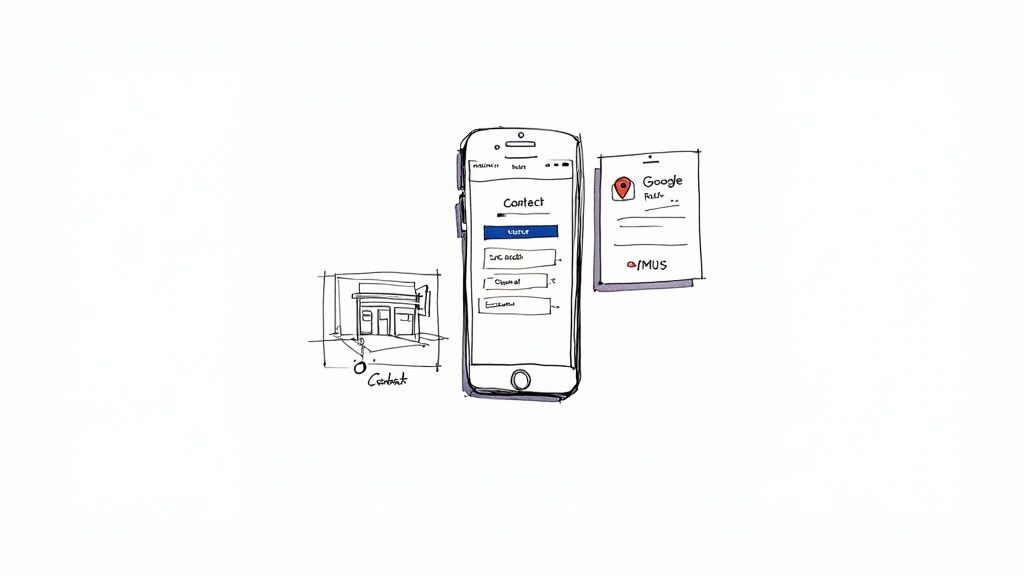
Before you can even think about dominating the Google Map Pack or running hyper-targeted local ads, you need a solid digital home base. For a local business, this isn't a "nice-to-have"—it's the bedrock of your entire strategy.
Think of it this way: all roads lead back here. Every social media post, every local SEO effort, every ad you run will eventually send people to your website or your Google profile. If those platforms are weak, you’re just leading potential customers to a dead end.
The numbers don't lie. A shocking 31% of U.S. shoppers have admitted to walking away from a small business simply because it didn’t have a website. And it gets more specific: 61% of mobile users are more likely to contact a local business if its site is optimized for their phone. A clunky mobile experience is a dealbreaker. (You can dig into more small business website statistics to see the full picture).
To get this right from the start, let's break down the essentials into a quick checklist.
Local Marketing Foundation Checklist
Here’s a quick-reference table to make sure you have the absolute basics covered. These are the non-negotiable first steps for building a strong online presence.
| Component | Key Action | Why It Matters |
|---|---|---|
| Website | Build a clean, mobile-first website. | This is your 24/7 salesperson and credibility hub. |
| Contact Info | Make your phone, address, and hours impossible to miss. | Removes friction for customers ready to connect. |
| Calls-to-Action (CTAs) | Add clear buttons like "Get a Quote" or "Book Now". | Tells visitors exactly what to do next. |
| Service Pages | Create a unique page for each core service you offer. | Helps you rank for specific, high-intent searches. |
| Google Business Profile | Claim and fully complete your profile. | This is your digital billboard on Google Search & Maps. |
| Photos & Videos | Upload high-quality, recent images of your work/store. | Builds trust and shows customers what to expect. |
| Reviews | Actively encourage and respond to customer reviews. | Social proof is one of the biggest drivers of local conversions. |
Nailing these fundamentals sets the stage for everything that follows, from advanced SEO to paid advertising.
Your Website Is Your Digital Storefront
Your website is so much more than an online brochure. It's your 24/7 salesperson and your number one credibility signal. When someone lands on your site, they should instantly get who you are, what you offer, and how to get in touch.
The secret here is to prioritize function over flash. A clean, intuitive layout that works flawlessly on a smartphone is infinitely more valuable than a complex design that only looks good on a desktop. Remember, a huge chunk of local searches happen when people are out and about, phone in hand.
For a local business website to be truly effective, it has to include these core elements:
- Prominent Contact Information: Your phone number, address, and business hours need to be front and center. Put them in the header, the footer, and on a dedicated contact page. Don’t make people hunt for it.
- Clear Calls-to-Action (CTAs): Guide visitors with obvious buttons like "Request a Quote," "Schedule an Appointment," or "Call Us Today."
- Mobile-First Design: Test your website on your own phone. Can you easily tap buttons and read text without pinching and zooming? If not, you're losing customers.
- Optimized Service Pages: Don't lump everything onto one page. Create individual pages for each service (e.g., "Residential Plumbing" vs. "Commercial HVAC"). This is a game-changer for ranking in specific local searches.
A great local website answers three questions in under five seconds: What do you do? Where are you located? How can I get in touch? If a visitor has to hunt for this information, you've likely already lost them.
Optimizing Your Google Business Profile
If your website is your digital storefront, your Google Business Profile (GBP) is the massive, illuminated sign on the busiest street in town. It’s often the very first interaction a potential customer has with your brand, appearing directly in Google Search and Maps.
Honestly, neglecting your GBP is like locking your front door during business hours.
Optimizing it is one of the highest-impact things you can do in online marketing for local businesses. A complete, active profile builds tremendous trust with both Google and your customers. It signals that you're a legitimate, active business that’s invested in its local presence.
A fully fleshed-out profile gives people everything they need to make a decision without ever clicking through to your site. They see your hours, read reviews, find your phone number, and get directions—all straight from the search results. This frictionless experience is exactly what modern consumers expect, and Google rewards the businesses that provide it.
Winning the Local SEO Game
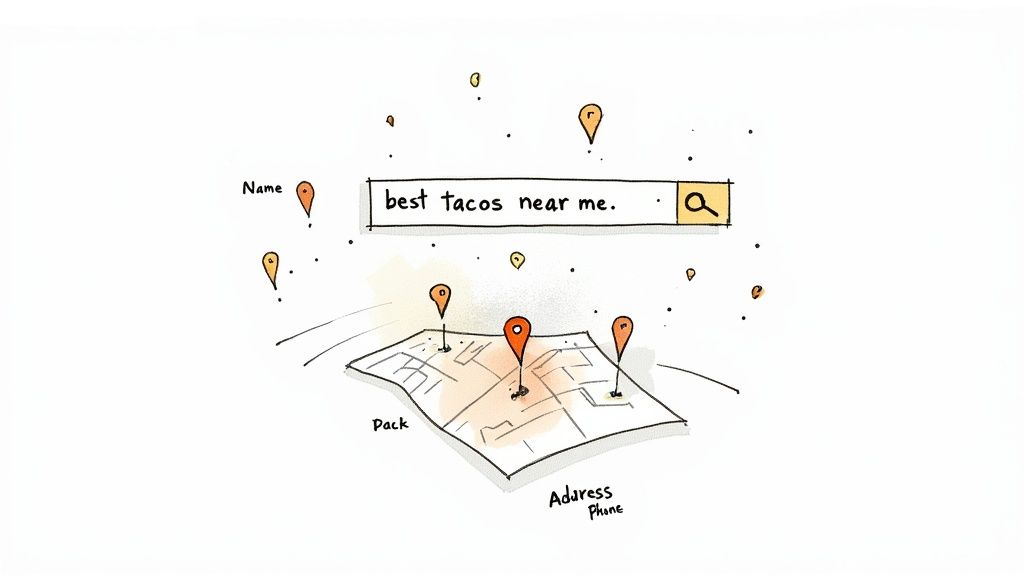
Showing up in that coveted Google Map Pack isn't about luck. It's the direct result of a smart, repeatable strategy that convinces Google you're the most trustworthy and relevant answer for a local customer's search. This is the heart and soul of local SEO.
Think of it this way: local SEO is a specialized slice of online marketing for local businesses that zeroes in on visibility for searches like "emergency plumber near me" or "best coffee shop downtown." These aren't just casual browsers; they're high-intent customers ready to walk through your door.
The opportunity here is massive. Every month, a staggering 97 billion local searches take place online, which in turn drive 1.5 billion visits to physical locations. In fact, 46% of all Google searches have local intent, and an incredible 88% of people who search for a local business on their phone visit a store within 24 hours. The line between a local search and a real-world sale has never been shorter.
Mastering Local Keywords
To win at local search, you have to get inside your customers' heads. What are they actually typing into their phones when they need you? It’s almost never just your business name.
Your keyword strategy needs to hit three core areas:
- Service-in-Location Keywords: This is your bread and butter. Think "HVAC repair in Scottsdale" or "family dentist in Brooklyn." Simple, direct, and effective.
- "Near Me" Searches: People are lazy, and Google knows it. For "restaurants near me" or "hardware store open now," Google uses the searcher's location. A perfectly optimized Google Business Profile is your ticket to showing up here.
- Hyper-Local Identifiers: This is where you can get a real edge. People talk about their neighborhoods, not just their cities. Optimizing for phrases like "financial advisor near Central Park" or "car wash in the Heights" captures customers who think and search like true locals.
Once you understand these variations, you can start building out your online presence to match how real people search.
The Power of Consistent NAP
One of the most foundational—and often overlooked—pieces of local SEO is NAP consistency. That stands for Name, Address, and Phone number. Search engines like Google are constantly cross-referencing this information across the web to verify that your business is legitimate.
If Google finds five different versions of your address or phone number scattered across various online directories, it creates confusion and signals untrustworthiness. Those little inconsistencies can absolutely kill your chances of ranking in the local map pack.
Your goal is to make sure your business's NAP is 100% identical everywhere it exists online. We're talking your website, Google Business Profile, Facebook, Yelp, and dozens of other local directories. Even a tiny variation like "St." versus "Street" can muddy the waters.
A quick audit is the best place to start. Google your business name and see what pops up. Jot down any inconsistencies you find and start the process of claiming and correcting those listings. The cleaner your digital footprint, the more confident Google will be in sending customers your way. For a deep dive, our guide on how to optimize your Google Business Profile will walk you through getting your most important listing dialed in.
Creating Content That Speaks to Your Community
Finally, great local SEO isn’t just about technical fixes. It's about creating content that proves you’re an active, authoritative part of your local community. A business that regularly talks about what's happening in its service area sends powerful signals to Google that it's a true local expert.
This doesn't need to be complicated. Here are a few dead-simple ideas to get you started:
- Write about a local event you're sponsoring or attending. This ties your brand directly to a real-world community activity.
- Create a case study featuring a well-known local client. It provides killer social proof while highlighting your work right in the neighborhood.
- Develop a neighborhood guide. A post like "Our Favorite Lunch Spots in the Design District" positions you as a helpful local resource, not just another business trying to sell something.
This kind of content naturally weaves in local keywords and shows you're invested in the community, building trust with both customers and search engines. It’s a powerful way to separate yourself from competitors who are just checking the boxes.
Build Trust and Climb the Ranks with Online Reviews

Let's be clear: in local marketing, your online reputation isn't just part of your brand. It's your most valuable currency.
Potential customers are constantly looking for social proof, and nothing speaks louder than genuine reviews from their neighbors. These reviews are a direct reflection of your customer experience and one of the heaviest-weighted factors in Google's local search algorithm.
More than just star ratings, reviews tell a story. They build a layer of trust that no ad campaign can ever buy. When someone sees you have a steady stream of recent, positive feedback, it cuts right through their indecision. They feel much more confident choosing you over a competitor with a handful of old, stale reviews.
Encourage a Constant Flow of Feedback
The key to a bulletproof reputation is to consistently get new reviews. A profile with 200 reviews from three years ago is way less powerful than one with 50 reviews from the last three months. Freshness signals to both Google and customers that your business is active, relevant, and still delivering great service.
But asking for reviews can feel awkward. The secret is to build it into your natural workflow. Don't be pushy—just make it incredibly easy for happy customers to share their thoughts.
Here are a few simple but effective ways to do it:
- Timing is everything. The absolute best time to ask is right after a positive interaction—when they’ve just praised your work or are thrilled with their purchase.
- Use simple tools. A follow-up email or text message a day or two after their visit with a direct link to your Google review page removes all friction.
- Prompt them in-store. A small, well-placed sign at your checkout counter with a QR code can be a gentle and highly effective nudge.
Getting this right is critical. For a deeper dive into the dos and don'ts, our guide on how to get Google reviews compliantly lays out the entire roadmap.
Turn Every Review into a Marketing Asset
Getting reviews is only half the battle. How you respond is where you truly stand out and show every potential customer what you're made of. Responding to reviews is a huge ranking factor and a massive opportunity to build public trust.
Responding to both positive and negative feedback shows you're an engaged owner who actually cares about what customers think. This simple act can turn a happy customer into a lifelong advocate and show a critic you're committed to making things right.
A thoughtful response to a great review amplifies that positive feeling. A professional, calm response to a negative one can defuse the situation and even win that customer back. Remember, your reply isn't just for the original reviewer; it’s for every single future customer who reads it.
Showcase Your Best Testimonials
Once you've collected those fantastic reviews, don't just leave them sitting on Google. Put them to work across your entire digital footprint. This social proof reinforces your credibility at every touchpoint.
Strategically feature your best reviews on:
- Your Website's Homepage: A few powerful quotes right up front build instant trust with new visitors.
- Dedicated Service Pages: Add relevant reviews to specific pages. A glowing review about your emergency repair work belongs on your emergency services page, where it has the most impact.
- Social Media Graphics: Turn a killer quote into a visually appealing graphic for Facebook or Instagram. It's authentic, engaging content that celebrates your customers and your team.
Connect With Your Community Online
A rock-solid digital foundation and great SEO get people in the door. But social media and local ads? That’s how you become a part of their daily lives.
This is your direct line to the community—a chance to move beyond just selling things and start building real relationships. Forget blasting out generic, one-size-fits-all marketing. To win here, you have to be unapologetically local.
The whole game is to become a neighborhood hub online. It's about sharing community news, hyping up local events, and turning your social feed into a place where your neighbors feel seen and connected. When you nail this, you’re not just another business; you're part of the local fabric.
Become the Go-To Local Hub on Social Media
Start thinking of your social media profiles less like ad channels and more like the community bulletin board at the local coffee shop. The goal is to post stuff that’s so genuinely relevant to your neighbors that they can't help but engage. This isn't about a constant sales pitch. It's about giving back with content that's rooted in the place you all share.
For example, a local restaurant could post a huge "Congrats!" to the high school football team after a big win. A hardware store could share the weekend weather forecast with a friendly reminder to prep for an incoming storm.
Here are a few simple ideas to get you started:
- Team Up with Other Local Businesses: Partner with that non-competing coffee shop down the street for a joint giveaway. You both get in front of each other's local followers. It's a win-win that feels totally authentic.
- Share Your Customers' Content: Did someone post a great photo from your store? Ask if you can reshare it and be sure to tag them. It's powerful social proof that costs you nothing but a little time.
- Promote Local Happenings: Post about the farmer's market, a charity 5k, or the neighborhood block party. It shows you’re invested in the community's success, not just your own bottom line.
This simple shift turns your social presence from a one-way megaphone into a real, two-way conversation. That’s how you build loyalty and stay top-of-mind.
Run Hyper-Targeted Ads That Actually Work
Paid advertising is where you can get surgically precise, making sure every dollar you spend is pulling its weight. With platforms like Google Ads and Facebook Ads, you can skip the broad, city-wide campaigns and zoom in on the specific neighborhoods that drive your business.
This is where local businesses have a massive leg up on the big national chains. You can speak directly to the people in a specific zip code or even a one-mile radius around your front door.
The goal of local paid ads isn't to reach everyone. It's to reach the right everyone—the people who can actually walk through your door tomorrow. Hyper-targeting is your superpower.
Imagine you own a yoga studio. Instead of targeting your entire city, you could run a Facebook ad aimed at women aged 25-55 who live within a two-mile radius and have shown interest in wellness. That’s an incredibly smart use of your budget. You’re reaching people who are not only interested but also close enough to become regulars.
And this stuff works. The social commerce space is exploding—it's projected to hit $1.17 trillion this year. Platforms like TikTok are absolute powerhouses, with some ads seeing a 2.4x return on ad spend—more than double the median benchmark—because their algorithms are just that good. For local businesses, this is huge. We know that 56% of consumers now blend online browsing with in-store shopping, and social media is often where that journey starts. (You can dig into more ecommerce statistics to see how this trend is playing out).
The takeaway is simple: targeted social ads are a direct line to more foot traffic.
Scaling Your Marketing Across Multiple Locations
Running the online marketing for one shop is tough enough. But scaling it across ten, fifty, or a hundred locations? That’s a whole different beast.
The complexity multiplies fast, and you’re suddenly trying to keep the brand consistent while letting local managers do their thing. It’s a tricky balancing act. The only way to win is with a central strategy that’s executed locally.
Here’s the golden rule: each location is its own local business. You have to treat every single storefront as a unique entity with its own Google Business Profile, its own neighborhood, and its own customers. A one-size-fits-all playbook from corporate just won’t connect.
This is why having a solid framework is non-negotiable. You need smart workflows and the right tools to handle everything from review replies to local social media posts without creating total chaos.
Unifying Your Digital Footprint
The bedrock of any multi-location strategy is perfect data consistency. Every single one of your locations needs its own, perfectly optimized Google Business Profile (GBP). This isn't optional if you want to show up in local search.
That means the Name, Address, and Phone number (NAP) for your "Elm Street" shop must be identical everywhere—on its GBP, its dedicated webpage, and every online directory. The same goes for your "Maple Avenue" location. Even tiny differences create confusion for search engines and customers, and your rankings will suffer for it.
For multi-location brands, consistency is your greatest asset. It builds trust with Google's algorithm, making it confident in showing your individual stores for relevant "near me" searches. Inconsistency, on the other hand, is a red flag that can suppress your visibility across the board.
For a deeper dive into the technical side, check out our guide on local SEO for multiple locations. It walks you through the whole process of getting your data locked in without messing things up.
Creating High-Performing Location Pages
While a Google Business Profile is critical, it can't be the only online home for your stores. Every single location deserves its own dedicated page on your main website. And I don't mean a cookie-cutter page with a different address slapped on it—these are powerful, localized marketing assets.
A great location page needs to include:
- Unique Local Content: Don't just list the address. Talk about the neighborhood, mention a local landmark, or introduce the store manager by name. This shows Google and your customers that you're actually part of the community.
- Location-Specific Reviews: Embed a feed of positive reviews from that specific store's GBP. It’s some of the best, most authentic social proof you can get.
- Clear Calls-to-Action: Make it dead simple for visitors. Include a "Get Directions" button that opens right into Google Maps and a click-to-call phone number.
These pages kill two birds with one stone. They give visitors a great experience once they land on your site, and they provide Google with rich, indexable content that helps each store rank for its own local keywords.
Streamlining Localized Advertising Efforts
When it comes to paid ads for multi-location brands, it’s all about precision. Forget running broad, generic campaigns. You have the power to create hyper-local ads that speak directly to customers living just a few miles from each individual store.
The flow is actually pretty simple, but incredibly effective.
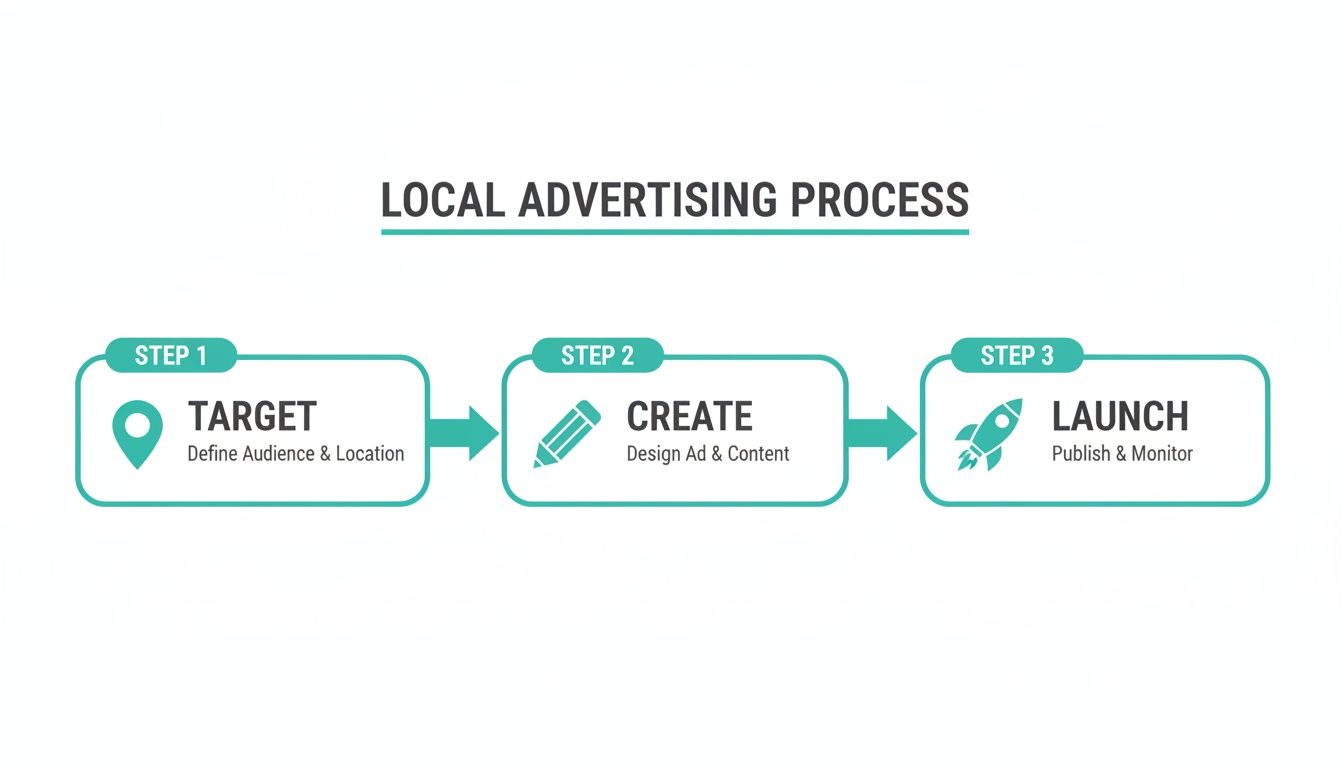
You just pinpoint the right local audience, craft an ad that’s actually relevant to them, and launch it. This targeted approach means your ad spend works harder, reaching people who are far more likely to walk through your doors. It's about spending smarter, not just spending more.
All the marketing in the world means nothing if you can't prove it's working. You can spend all day posting on social media and tweaking your website, but if those activities don't lead to more customers walking through your door, you’re just spinning your wheels. It’s time to stop guessing and start measuring what actually moves the needle.
Let's cut through the noise. Forget vanity metrics like social media likes or overall website traffic. We need to focus on the numbers that directly translate to revenue—the Key Performance Indicators (KPIs) that show your marketing is a growth engine, not just an expense.
What to Track for Real-World Results
For any local business, the most valuable metrics are tied to customer actions. These are the digital signals that tell you someone is ready to buy, book, or visit.
Your entire measurement strategy should circle around these core activities:
- Google Business Profile (GBP) Actions: This is ground zero for local leads. Jump into your free GBP Insights and watch the numbers that matter: phone calls, direction requests, and website clicks coming straight from your Google Maps listing.
- Website Conversions: What do you want people to do when they land on your site? Make sure you’re tracking form submissions for quotes, online appointment bookings, or even clicks on your main phone number.
- Local Keyword Rankings: When someone searches "plumber near me" or "best pizza in downtown," do you show up? Keeping an eye on your rankings for these high-intent searches tells you if your local SEO is actually doing its job.
These numbers tell a simple, powerful story. More direction requests? Your GBP is driving real foot traffic. A jump in online quote requests? Your website is successfully turning visitors into leads.
Your Simple Monthly Scorecard
You don't need a PhD in data science to figure this out. A simple monthly report, built with free tools, can give you a crystal-clear picture of what's working and where you should double down.
Before we get into the nitty-gritty, let's look at the essential KPIs you should be tracking. Think of this table as your local marketing command center—the handful of metrics that give you a real-time pulse on your business's online health.
Key Performance Indicators (KPIs) for Local Marketing
| Metric | What It Measures | Tool To Track It |
|---|---|---|
| GBP Phone Calls | The number of direct calls initiated from your Google profile. | Google Business Profile Insights |
| GBP Direction Requests | How many people asked for directions to your physical location. | Google Business Profile Insights |
| Website Clicks | The volume of traffic coming to your site from your GBP. | Google Business Profile Insights |
| Website Form Submissions | The number of leads generated through your "Contact Us" or quote forms. | Google Analytics (Goal Tracking) |
| Local Search Rankings | Your position in Google Maps for top 5-10 local keywords. | A rank tracking tool |
| Review Volume & Velocity | The number of new reviews you received in a given month. | Google Business Profile |
This simple set of metrics is your feedback loop. It's how you spot trends, identify what's driving real business, and know when a channel needs a different approach.
A common mistake is obsessing over total website visitors. For a local business, 100 visitors from your service area who are actively searching for your offerings are far more valuable than 1,000 visitors from across the country with no local intent.
Turning Your Data Into Smarter Decisions
Once you have this data, you can finally make informed decisions instead of just guessing.
Notice your ranking for "emergency HVAC repair" is slipping? Maybe it's time to publish a new blog post on that exact topic or run a campaign to get more reviews that mention that service. Getting tons of clicks from your GBP but very few form fills on your website? It’s a huge red flag that your site's call-to-action is weak or confusing.
This is how you turn marketing from a cost center into a predictable, revenue-generating investment. It's not about chasing algorithms; it's about understanding what your customers need and making it easier for them to find you.
Ready to see exactly where you stand in your local market and get the data you need for real growth? Nearfront provides live ranking heatmaps and multi-location dashboards that turn local search data into actionable insights, helping you boost visibility and drive more foot traffic. See how Nearfront can grow your business.