So, what exactly is a local search rank tracker?
Think of it as your business's eyes and ears on the ground. It’s a tool that shows you exactly where you stand on Google when someone nearby searches for something you offer, like "coffee shop near me" or "emergency plumber in downtown." It's your digital compass, pinpointing your exact rank on Google Maps and in local search results for customers in specific neighborhoods, cities, or even down to the zip code.
Why Your Business Needs a Local Search Compass
Imagine your local market is a treasure map. Every single day, potential customers are out there, phones in hand, searching for the 'X' that marks your spot. They aren't just browsing—they're ready to buy. They need the closest coffee shop now, an emergency plumber at 10 PM, or a restaurant with great reviews for dinner tonight.
In this world, your position on that digital map isn't a vanity metric. It's the engine that drives foot traffic, phone calls, and actual revenue.
If you can't measure your position, you're flying blind. You might assume everyone in the city can find you, but in reality, your business could be completely invisible just a few miles down the road. A local rank tracker cuts through the guesswork, giving you a crystal-clear, unbiased view of how real customers see you.
The Modern Customer Journey Starts Online
The way people find and choose local businesses has completely changed. Forget the Yellow Pages or billboards; today's customer journey begins with a quick search. This simple shift makes your online visibility the single most important factor for any brick-and-mortar business.
A local search rank tracker lets you:
- See Your True Visibility: Understand how you actually rank in the specific areas you serve, not just from the distorted view of your office computer.
- Spot Growth Opportunities: Pinpoint neighborhoods where you're lagging and could easily grab more market share.
- Keep an Eye on Competitors: Watch what your rivals are doing, which keywords they're targeting, and where they're beating you.
From Data to Dollars
Local rank trackers aren't just a "nice-to-have" anymore. With the explosion of 'near me' searches—where a staggering 46% of all Google searches now have local intent—ignoring your rankings is like leaving cash on the table. Without tracking, businesses constantly miss out on the high-intent customers that local SEO delivers better than almost any other marketing channel. You can dig into more of these SEO statistics to see the full picture.
In local search, proximity is everything. A customer two blocks away can see completely different results than someone two miles away. A local tracker is the only tool that can measure this hyper-local reality and prove you’re visible to the customers who matter most.
This guide is here to demystify local rank tracking. We'll walk through actionable strategies for everyone, from single storefronts to sprawling multi-location brands, and show you how to turn that raw ranking data into real-world success you can measure.
How a Local Search Rank Tracker Actually Works
Ever wondered why searching for "best pizza" on your phone shows different results than on your office computer? It’s all about personalization and proximity. Google’s whole game is to give you the most relevant answer for you, right now, based on where you’re standing, your search history, and a dozen other signals.
While that’s great for someone trying to find lunch, it’s a huge headache for businesses trying to figure out where they actually stand in the market.
This is where a local search rank tracker comes in. It’s designed to give you a completely unbiased, objective view. It doesn't perform a search from your own biased location. Instead, think of it as a digital secret shopper that simulates searches from hundreds or even thousands of specific, neutral locations around your business.
It’s like a specialized GPS for your online presence. Instead of showing you a route from your current location, it instantly shows you what a potential customer sees from any street corner, neighborhood, or zip code you want to win.
Simulating a Customer's Search
A sophisticated local rank tracker doesn’t just ping Google from one random spot. It lays a digital grid over a city and simulates searches from each point on that grid. This is how you get hyper-accurate data for those money-making keywords like "emergency plumber near me" or "walk-in clinic open now."
The process is pretty straightforward:
- You Define the Area: First, you tell the tool the exact city, zip codes, or even specific neighborhoods you care about.
- The Tracker Sets the Location: The tool then configures its search bots to appear as if they’re physically located within those boundaries you set.
- It Conducts the Search: Next, it queries Google for your target keywords from each of these simulated spots, totally clean of any personal search history or cookies.
- Data is Collected and Mapped: Finally, the tool grabs the search engine results page (SERP)—including your position in the Map Pack and local organic results—for every single location it checked.
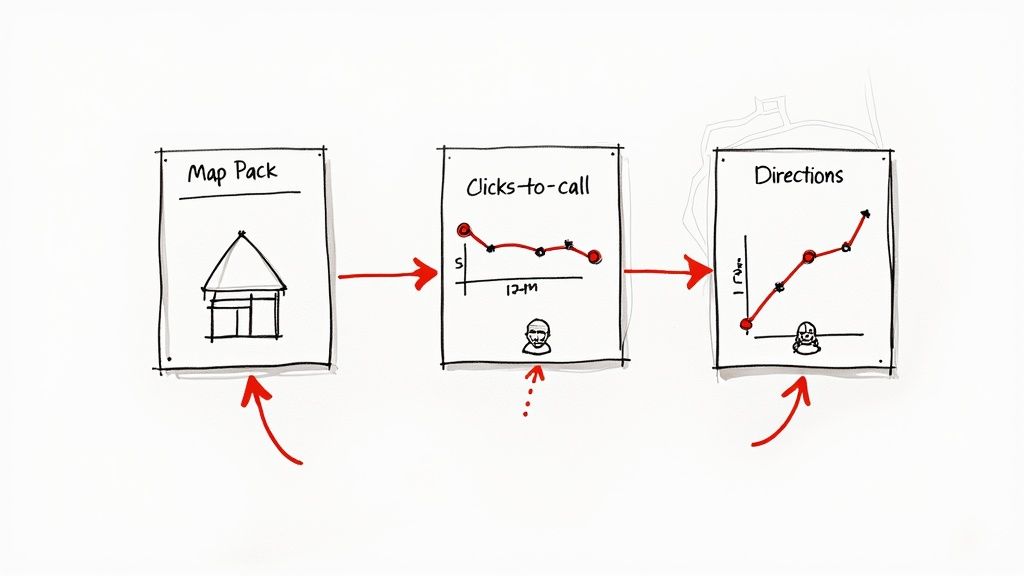
This gives you a real, comprehensive picture of your visibility. The infographic below breaks down this journey from the customer's point of view, showing how they discover, navigate, and ultimately walk through your doors thanks to local search.
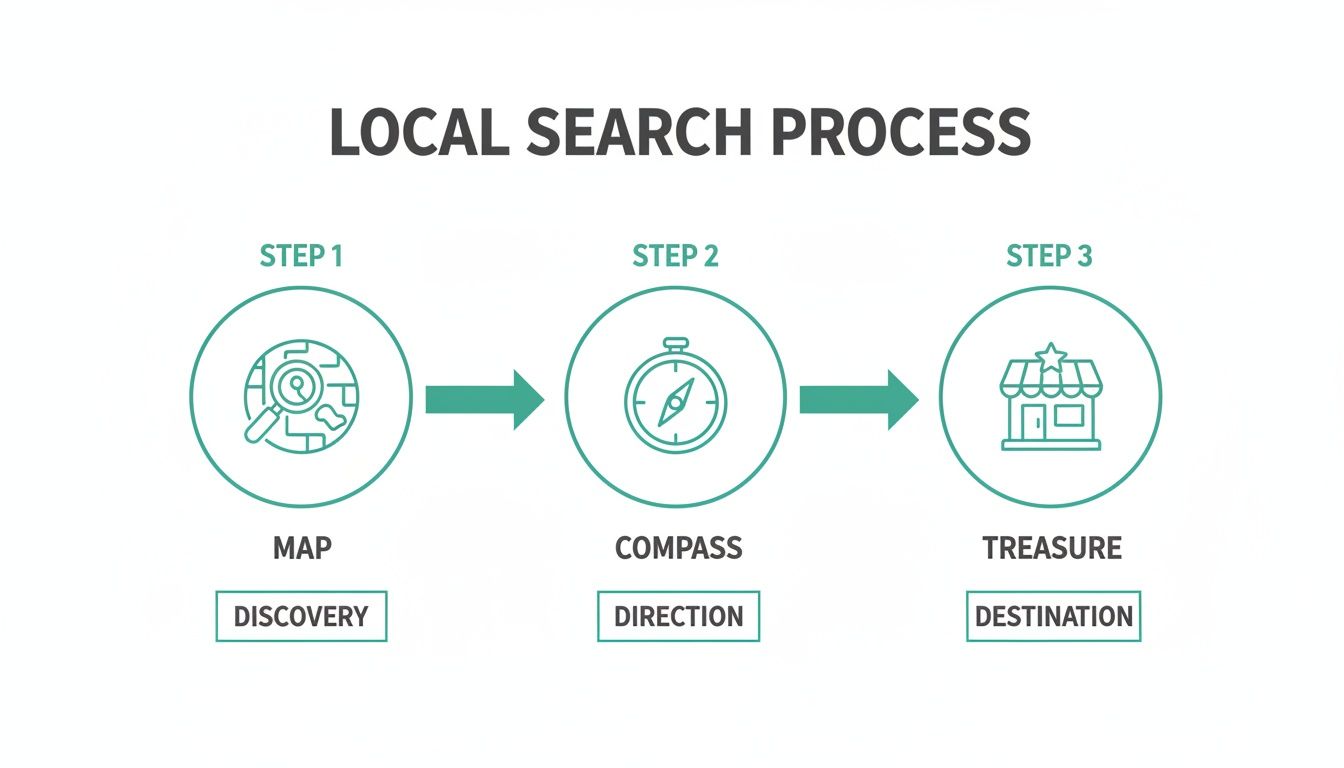
This visual flow makes it clear: a customer’s journey is a straight line from their phone to your storefront, and your ranking is the bridge that gets them there.
Why This Unbiased Approach Is Critical
Without this kind of simulated, third-party approach, you’re basically grading your own homework. A quick search from your office computer will almost always show your business ranking well because Google knows you’re associated with it. This creates a dangerous false sense of security.
A true local search rank tracker pops the personalization bubble. It shows you what a brand-new customer sees—which is the only perspective that actually matters for growing your business.
Local search results are incredibly volatile, which makes this even more important. Your rankings can change drastically from one city block to the next. A coffee shop could rank #1 for "bakery in downtown" when searched from one side of the street but be completely invisible just three blocks away.
A good local SEO ranking checker is the only reliable way to spot these "ranking deserts" and find your biggest opportunities for growth. Once you understand the tech behind it, you can stop guessing and start building a real, data-driven strategy.
Why Multi-Location Brands Need a Centralized View
Trying to manage local SEO for a multi-location brand is like conducting a massive orchestra where every musician is in a different city. Each storefront is its own instrument, playing to a unique local audience. If one location is out of tune, it can throw off the entire brand's harmony. Without a central conductor's podium, you're left with chaos, not a symphony.
This is the classic headache for franchises and national chains. A marketing strategy that kills it in Austin might be a complete dud in Boston. Customer habits, local competitors, and even regional slang can create wildly different search environments for each store.
You simply can't manage dozens or hundreds of locations with a one-size-fits-all playbook. It just leads to inconsistent online listings, wasted ad spend, and missed opportunities in your most promising markets. You're essentially flying blind, guessing what works location by location.
Unifying Performance with a Central Dashboard
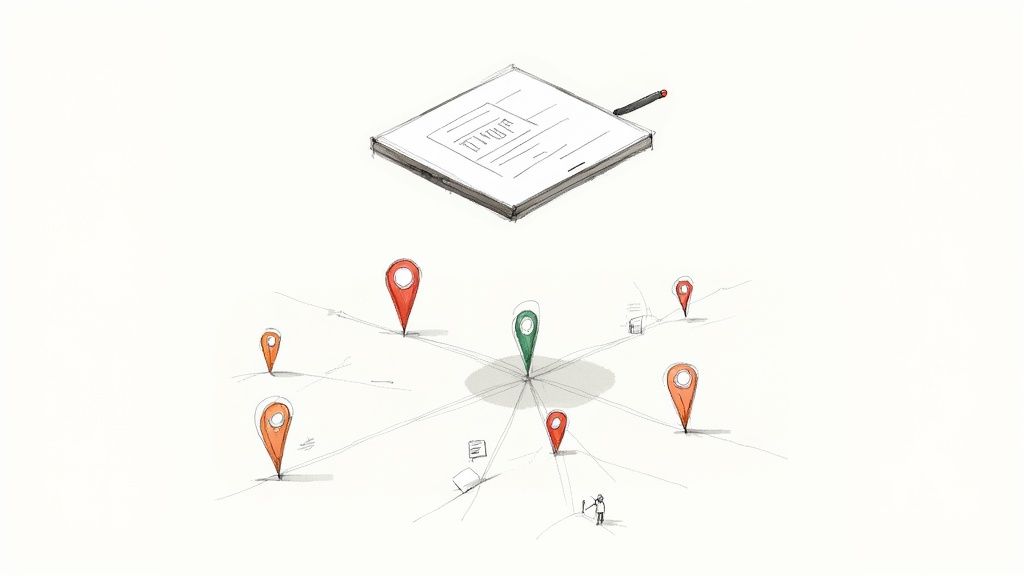
A powerful local search rank tracker acts as that conductor's podium. It brings every location's performance into a single, unified dashboard. Instead of juggling separate accounts or wrestling with messy spreadsheets, you get a clean, top-down view of your entire network.
This centralized view completely changes how you manage local SEO. Suddenly, you can compare how your Chicago storefronts are doing against your Miami locations with just a few clicks. It's no longer about how one store is doing in a vacuum; it's about network-wide intelligence.
A multi-location dashboard turns scattered data points into a strategic map. It lets you see the entire battlefield at once, showing you where you're strongest, where you're weakest, and exactly where your competitors are vulnerable.
This big-picture perspective is what allows you to make smart, scalable decisions that actually benefit the entire brand.
From Data Overload to Strategic Action
With a unified dashboard, you can finally move past just tracking numbers and start asking the strategic questions that drive real growth. A good rank tracker helps you pinpoint exactly what actions will move the needle across the board.
For instance, you can:
- Identify Top Performers: See which locations are consistently crushing their local Map Pack and for what keywords. What are they doing right?
- Diagnose Underperformers: Find out which stores are practically invisible online and figure out why. Are they targeting the wrong keywords, or did a new competitor just move in?
- Replicate Success: Analyze the playbook of your best-performing locations and roll it out across the ones that are struggling.
- Allocate Resources Intelligently: Put your marketing dollars and team support where they're needed most or have the biggest potential for growth.
Imagine a national coffee chain sees its San Diego locations are outranking Starbucks for "best espresso," while its Seattle stores are falling behind. A centralized tracker lets them dig into the San Diego data, see what's working—maybe it's a focus on specific review keywords or locally-targeted content—and apply those lessons to the Seattle market.
Winning in a Hyper-Local World
This level of precision is no longer optional. The reliance on Google for local discovery is massive and growing. It's projected that by 2025, an incredible 87% of consumers will use Google for local searches, a big jump from 81% in 2021. For brands, this means showing up in Google's local results is the main path to getting customers in the door.
This makes a centralized local search rank tracker an indispensable tool. It's the only practical way to manage the complexity of hundreds of local markets at the same time. By understanding what makes each location unique while maintaining a cohesive brand strategy, you can make sure every "instrument" in your orchestra is perfectly tuned for success. Tools like these are fundamental; explore our guide on the best local SEO tools to see how they fit into a larger strategy.
Decoding the Metrics That Drive Local Growth
If you think local search performance is just about hitting that #1 spot, you're only seeing a tiny piece of the puzzle. Raw ranking data is interesting, but on its own, it doesn't tell you the whole story. A truly powerful local search rank tracker connects your online visibility to the real-world customer actions that actually grow your business.
Think of each metric not as a grade on a report card, but as a clue on a map showing you exactly what your customers are doing. By decoding these signals, you stop just tracking numbers and start making strategic moves that drive real growth—turning visibility into phone calls, foot traffic, and sales.
Beyond Position: The KPIs That Matter
Sure, seeing your business climb the ranks feels good. But the real value is in what happens next. These Key Performance Indicators (KPIs) are what bridge the gap between a potential customer seeing you and choosing you.
- Google Map Pack Position: This is the most valuable real estate in local search. Landing in the top three map results is the goal, because that’s where the majority of high-intent customers click. They’re ready to act, right now.
- Local Organic Rankings: These are the traditional "blue link" results sitting just below the Map Pack. A strong showing here builds your authority and captures anyone who scrolls past the initial map view.
- Search Visibility Score: This is a blended, high-level metric that gives you a quick snapshot of your market share. It essentially calculates how often you’re showing up across a whole range of keywords and locations.
These top-of-funnel metrics are your foundation. But they're just the beginning.
Connecting Rankings to Real-World Actions
This is where the magic really happens. A winning local SEO strategy doesn't stop at the top spot; it translates that ranking into a customer walking through your door. These next metrics are direct measures of your ROI.
The most valuable metrics are those that measure a customer's journey from their screen to your front door. Clicks, calls, and direction requests aren't just data points—they are active steps a customer is taking toward making a purchase.
Your tracker absolutely must connect your visibility to these bottom-of-funnel actions:
- Clicks-to-Call: This is a direct line to a new customer. It tracks how many people tapped the "call" button right from your Google Business Profile. Pure purchase intent.
- Direction Requests: This is one of the strongest signals of incoming foot traffic. It counts how many people asked Google Maps for directions to your physical store.
- Website Visits: This shows how many users clicked from your local listing to your website, giving you another chance to tell your story and convert them.
Essential Local SEO Metrics and Their Business Impact
Here's a quick summary of the most critical local rank tracking metrics and what they signify for your business's growth and customer engagement.
| Metric | What It Measures | Why It's Crucial |
|---|---|---|
| Map Pack Position | Your rank within the top 3 map results for a specific search query. | Captures 42% of local clicks and targets high-intent customers ready to convert. |
| Clicks-to-Call | The number of users who initiate a phone call from your GMB listing. | A direct measure of immediate customer interest and lead generation. |
| Direction Requests | How many users request driving directions to your physical location. | The strongest indicator of imminent foot traffic and in-person sales. |
| Search Visibility | Your overall presence across a basket of relevant local keywords. | Provides a high-level view of your market share and brand awareness. |
| Website Clicks | The volume of traffic driven to your website from your GMB profile. | Measures your ability to pull customers deeper into your conversion funnel. |
Tracking these metrics isn't just an exercise in data collection; it's about understanding consumer behavior. By 2025, it's estimated that 80% of local searches will convert into customers, making it a channel you can't afford to ignore.
To truly master this, you need to understand how all these pieces fit together. You can dive deeper by exploring our guide on local search ranking factors, which breaks down what Google’s algorithm values most. When you focus on the metrics that drive real actions, your rank tracker becomes less of a reporting tool and more of a powerful engine for growth.
Choosing the Right Features for Your Tracker
Picking a local search rank tracker isn't just about grabbing the first tool you see. It’s about choosing a partner that gives you a real strategic advantage. With so many options on the market, it’s easy to get bogged down in feature lists that all start to look the same.
The key is to think beyond simply checking where you rank. A basic tool might tell you you're #5 for "best pizza near me," but a great tool tells you why—and shows you exactly where you're losing to the competition, block by block.
Beyond Basic Rank Checking
Let's get the obvious out of the way first. Any decent local rank tracker has to nail the fundamentals. It must be able to accurately simulate a search from the exact zip codes, neighborhoods, and cities your customers are in. If it can't do that, it's useless. But that’s just table stakes.
To actually get a competitive edge, you need features that help you see the story behind the data. This is what separates a simple reporting tool from a real strategic asset. The goal isn't just to see where you rank, but to understand how that position turns into actual calls, clicks, and customers walking through your door.
This screenshot shows what I mean. Instead of a boring spreadsheet of rankings, a modern tracker gives you a visual, map-based view of your performance.
This kind of heatmap immediately shows you "ranking deserts"—areas where you're invisible—and hotspots where you're crushing it. That’s intelligence you can actually act on.
Must-Have Features for Strategic Value
When you're comparing platforms, look for these game-changing features. They're what turn raw data into a clear roadmap for growth and make a local search rank tracker the command center for your entire local SEO strategy.
- Geotargeting and Heatmap Visualizations: Seeing your rankings on a map is non-negotiable. It instantly shows you where to focus your marketing budget and where your blind spots are.
- Intuitive Multi-Location Dashboards: If you run a franchise or a brand with multiple locations, a centralized dashboard is a must. It lets you see who your top-performing managers are, compare stores, and figure out what’s working so you can replicate it everywhere.
- Robust Competitor Tracking: You're not operating in a bubble. The best tools let you track your direct competitors for the same keywords and locations, giving you a clear benchmark and showing you where their strategy is weak.
A great rank tracker doesn’t just give you your report card. It shows you the entire playing field—where you’re winning, where your competitors are vulnerable, and where your next big opportunity is waiting.
Ultimately, the right tool feels less like a data feed and more like an extension of your team. It should empower you to make smarter, faster decisions that lead directly to more visibility, more phone calls, and more foot traffic. Don't settle for anything less.
Turning Ranking Data into Actionable Strategy
Raw data from your local search rank tracker is like an unread treasure map. It shows you where the gold is, but it won’t dig it up for you. The real magic happens when you translate those numbers into a concrete business strategy that drives more foot traffic, phone calls, and actual revenue.
Anyone can collect data—that’s the passive part. Taking action is what separates the market leaders from everyone else. This is about transforming your rank tracking reports from a simple scorecard into a dynamic playbook for growth. A winning strategy isn't just celebrating a #1 rank; it's about understanding why you earned it and how to replicate that success across every location and keyword you care about.
The whole process boils down to a simple, powerful loop: Measure, Analyze, Optimize, and Repeat.
Identify Your Low-Hanging Fruit
The smartest place to start is with the quick wins. Dive into your tracker's reports and look for keywords that are already on the move—maybe something that’s jumped from position #8 to #5. These are your low-hanging fruit. You’ve already got momentum, and a little extra push is all it might take to land you in the coveted Google Map Pack.
For instance, if you see "emergency plumber in west-end" climbing the ranks, you can immediately double down by:
- Publishing a new blog post titled "Why West-End Residents Trust Us for Emergency Plumbing."
- Launching a geo-targeted ad campaign focused squarely on that neighborhood.
- Asking recent customers from that specific area for a quick Google review.
These kinds of targeted actions can turn a rising rank into a top-three position that starts generating leads almost overnight.
Find Gaps in Your Competitor's Armor
A great local rank tracker doesn't just watch you; it lets you spy on your competitors just as closely. This is where you uncover massive strategic opportunities. Look for valuable keywords where your top rivals are weak or completely absent. Are they ignoring a specific service you offer or a neighborhood they haven't targeted?
Let's say you notice a competitor ranks poorly for "vegan bakery downtown," but you happen to offer killer vegan options. That's your opening. You can exploit this weakness by optimizing your Google Business Profile with "vegan" in the description, uploading new photos of your vegan treats, and creating content that speaks directly to that audience. You're not just competing anymore; you're strategically capturing the market share they’re leaving on the table.
A ranking drop isn’t a failure—it’s an early warning system. It gives you a chance to diagnose and fix a problem before it seriously impacts your bottom line.
A sudden dip for a keyword that brings in business can signal all sorts of issues—a string of negative reviews, incorrect business hours on your profile, or even a new competitor aggressively moving in on your turf. When you treat these drops as diagnostic alerts, you can react swiftly, protect your hard-earned visibility, and keep your growth on track. This proactive mindset is what turns your tracker from a simple tool into an essential engine for sustainable local success.
Still Have Questions? Let's Clear Things Up.
Even after laying out the game plan, a few questions always pop up. Let's tackle the most common ones so you can move forward with confidence.
How Often Should I Check My Local Rankings?
For most businesses, checking in weekly is the sweet spot. It's frequent enough to catch important trends, react to algorithm updates, or see a competitor making a move, but not so often that you get bogged down by meaningless daily blips.
Now, if you're in the middle of a major local SEO push or fighting for keywords in a super-crowded market like New York or LA, you might want to bump that up to every few days. This gives you much faster feedback on whether your efforts are actually working.
Can I Track My Competitors' Local Rankings?
Not only can you, but you absolutely have to. Any worthwhile local rank tracker lets you plug in your top competitors and see exactly how you stack up against them for the same keywords, in the same neighborhoods.
This is one of the single best ways to find gaps in their strategy. You'll see where they're weak, spot opportunities they're missing, and get a brutally honest picture of the competitive landscape.
Why Do My Rankings Look Different on My Phone vs. The Tracker?
This is probably the most critical concept to get right. When you search on your own phone, you're seeing personalized results. Google knows your exact location, your search history, and what you've clicked on before. It's giving you, specifically, what it thinks is the best answer.
A local search rank tracker, on the other hand, gives you objective, unbiased data. It simulates a search from a neutral, specific point (like the center of a zip code) with zero search history. The tracker shows you what a brand-new customer in that area actually sees.
Relying on your phone for data is a huge mistake—it will always give you a skewed, overly optimistic view of how visible you really are. The tracker is your source of truth.
Ready to stop guessing and see where you really stand? Nearfront gives you the AI-powered heatmaps and multi-location dashboards you need to turn local searches into paying customers. Find out where you truly rank and get the insights to dominate your local market. Start tracking with Nearfront today!