If you’re running a multi-location brand, a one-size-fits-all marketing plan is a recipe for getting lost in the noise. To truly connect with customers, you have to meet them where they are—in their neighborhood, with a solution to their immediate problem.
It’s the difference between being just another generic option and becoming the go-to local choice.
Why Generic Marketing Fails Multi-Location Brands

The way people search has completely changed. They’re not just looking for "pharmacies" anymore; they're searching for "pharmacies near me open now." This shift to hyper-local, high-intent searches means a generic, corporate-level message just doesn’t cut it. It’s invisible to the people you need to reach most.
Think about a family on a road trip looking for dinner. Their search isn't for your national brand name; it's for "best family restaurant exit 24." Or a new homeowner who needs a plumber right now. They're going to search for "emergency plumber in downtown Austin," not a national franchise's homepage.
In these moments, the most visible, relevant, and trusted local option always wins.
The Power of Local Intent
The data tells the same story. Local searches now make up a staggering 46% of all Google searches. It gets better: 76% of people who run a local search on their phone visit a business within 24 hours. And to top it off, 28% of those searches lead to a purchase.
This isn't just about getting found. It’s about being chosen at the exact moment a customer needs you. A smart local strategy marketing plan makes sure each of your locations shines in its own community.
A brand can have a thousand locations, but to the customer searching on their phone, only one location matters: the one that can solve their problem right now. Your strategy must reflect this reality.
Building Your Framework for Local Dominance
To win, multi-location brands have to stop marketing like a single, massive entity. You need to act like a collection of local businesses, each deeply connected to its community. This requires a dedicated framework that treats every single location as its own unique market.
Here’s what that approach helps you do:
- Become More Relevant: Speak directly to the specific needs, events, and culture of each neighborhood you're in.
- Build Real Trust: Showcase local reviews, feature your local team, and get involved in the community. Credibility follows.
- Improve Visibility: Own the "near me" searches and map results by optimizing for local keywords and engagement signals.
- Drive Higher Conversions: Turn those online searches into foot traffic, phone calls, and sales by being the most convenient and trusted solution.
This guide will walk you through the actionable steps to build, execute, and measure a powerful local strategy that turns every one of your storefronts into a neighborhood leader.
Laying the Foundation: Your Local Presence Audit
Before you even think about tactics, you need a brutally honest look at your digital footprint. Kicking off a local marketing strategy without a baseline audit is like starting a road trip with no map—you’ll be moving, but probably in the wrong direction.
This audit isn't about finger-pointing. It's about data. The goal is to get a clear snapshot of how customers see your brand at the neighborhood level, one location at a time. Think of it as a health check-up for each storefront, zeroing in on the exact signals Google and your customers use to decide if you’re credible and relevant.
Getting Your Google Business Profile in Order
For a local customer, your Google Business Profile (GBP) is often their first handshake with your brand. When details are messy and inconsistent across different locations, it creates confusion and erodes trust. For both users and search engines, this is a red flag.
A thorough GBP audit is non-negotiable. Start by spot-checking a few different locations.
- Business Name: Is it exactly the same on every single profile? Resist the urge to add keywords or location names, like "Main Street Cafe – Downtown" when it should just be "Main Street Cafe."
- Categories: Have you picked the most specific primary and secondary categories? A profile listed as a "Coffee Shop" attracts a totally different crowd than one simply labeled "Restaurant." It matters.
- Photos: Are the images high-quality and recent? Do they show that specific location? Stock photos are a dead giveaway. People want to see your actual storefront, the inside, and maybe even your team.
Most of these inconsistencies pop up when well-meaning local managers make uncoordinated updates. Centralizing this data is a cornerstone of effective local presence management and ensures every customer gets the same, reliable brand experience.
Nailing NAP Accuracy Everywhere Else
Your business info doesn't just live on Google. It's scattered across a huge web of online directories—think Yelp, Apple Maps, and dozens of industry-specific sites. The consistency of your NAP (Name, Address, Phone Number) data across all of them is a fundamental signal for local SEO.
Even tiny differences, like "Street" vs. "St.," can weaken your digital authority.
An inaccurate phone number or a misspelled street on a key directory isn't just a small data error—it's a lost customer. Each mistake is a potential dead end for someone actively trying to find you.
Use a citation scanning tool or just manually check the top 10-15 directories in your industry for a handful of your locations. Get everything into a spreadsheet. This list becomes your first big cleanup project, and it's something you have to tackle before you start any new marketing pushes.
Auditing Reviews and Local Landing Pages
Finally, you have to look at the human element. What are your customers actually saying, and what happens when they click from your profile to your website?
First, dig into review sentiment. Look past the star ratings on GBP, Yelp, and Facebook and read the actual comments for different branches. You'll start seeing patterns. Maybe your downtown spot gets constant praise for amazing service, while a suburban one always has complaints about parking. This kind of qualitative feedback is gold for fixing operational issues and finding marketing angles.
Next, take a hard look at your local landing pages. Does each location's page have a unique title tag and meta description that includes the city or neighborhood? Is there location-specific content, like team bios, local customer testimonials, or photos from community events? A generic, corporate page that just lists an address is a huge missed opportunity. Your audit should flag every page that needs to be localized to properly connect with its community.
Dominating Local Search and Map Results
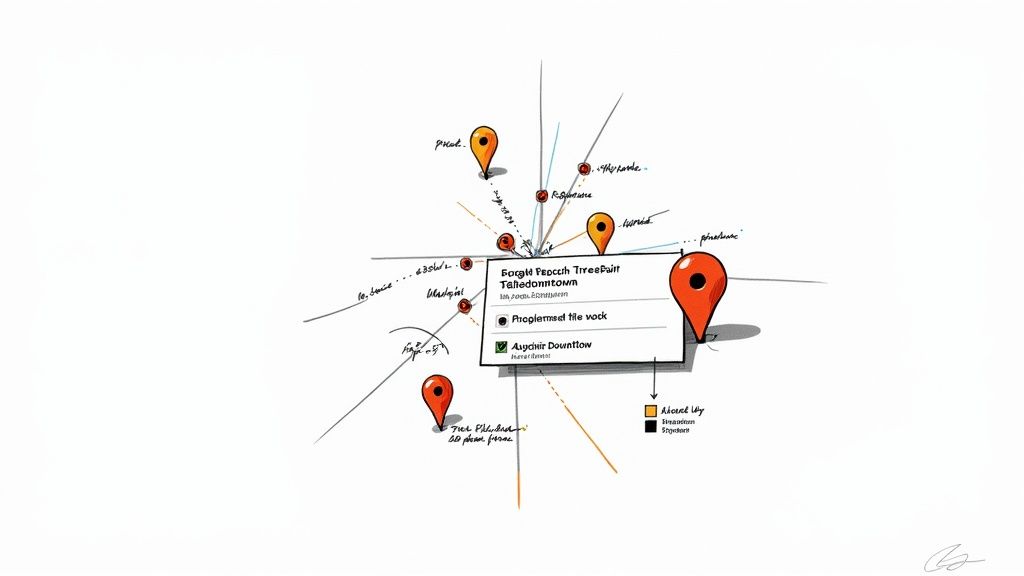
Alright, with your audit complete, you know where you stand. Now it’s time to stop reacting and start building a strategy that gets you seen.
This means getting hyper-specific. Forget broad, corporate keywords like "tire shop." Real customers don't search that way when they have a flat. They search with intent. They search for "24-hour tire repair downtown" or "best coffee shop with wifi near me."
That’s the mindset shift. You have to think like a local looking for an immediate solution. Generic keywords pull in low-intent traffic, while localized, specific terms attract people who are ready to pull out their wallets. An effective local strategy marketing plan is built on this simple truth.
This isn’t just a theory; it’s what separates the winners from everyone else. The data shows that 94% of high-performing brands run a dedicated local marketing strategy. In contrast, only 60% of average brands do the same. That gap tells you everything you need to know. For more on this, check out these local marketing findings from BrightLocal.
Mapping Keywords to Each Location
One of the biggest mistakes I see is a one-size-fits-all keyword list applied across every single location. It just doesn’t work. A hardware store in a packed city has a completely different customer base than one out in the suburbs.
Your keyword strategy needs to reflect that reality.
Fire up a simple spreadsheet. List out each location, then start brainstorming keyword variations that match its unique environment.
- Urban Location: Think smaller spaces and immediate needs. Keywords could be "apartment-friendly paint," "balcony gardening supplies," or "tool rental near me."
- Suburban Location: Think bigger projects and property maintenance. Here, you’ll focus on terms like "lawn mower repair," "bulk mulch delivery," or "best outdoor deck stain."
This isn't about guessing. Use tools like Google Keyword Planner and filter by city or zip code to validate what people are actually searching for. This process connects your SEO directly to the needs of each community you serve.
Optimizing Your Local Landing Pages
Your local landing pages are where the magic happens. It’s where a searcher becomes a customer. A generic page with just an address and phone number is a digital dead end.
Each page needs to be a rich, compelling resource that convinces both Google and your potential customers that this specific location is their best option.
Here’s your non-negotiable checklist for every local landing page:
- Unique Title Tags & Meta Descriptions: Don't be generic. Weave in the city, neighborhood, and a core local keyword. Think: "Expert iPhone Repair in SoHo | Fast Screen Replacements."
- Embedded Interactive Map: Don't just list the address—show them. An embedded Google Map is a massive local ranking signal.
- Location-Specific Testimonials: Social proof is everything. Feature reviews from customers who have actually been to that specific store.
- Real Photos of the Location: Get rid of stock photos. Show off your actual storefront, your team, and the inside of your shop. Authenticity builds trust.
Every local page should instantly answer three questions for a visitor: Where are you? What makes this location special? And why should I choose you over the competitor down the street?
Implementing Local Business Schema
Now for the technical bit. You need to speak Google's language, and that language is schema. Local Business schema is just a snippet of code on your site that feeds search engines the critical details for each location—address, phone number, hours, and so on.
Think of it as a perfectly organized digital name tag for each of your storefronts. It helps Google understand your information and display it accurately in the search results, especially in the coveted Local Pack. It might sound complex, but most modern website platforms and plugins make adding schema a pretty straightforward process.
Expanding Beyond Google
Google is the 800-pound gorilla, but it’s not the only game in town. Your customers are looking for you on other platforms, and you need to be there when they do. A strong local strategy means being visible everywhere your customers are.
Make sure you're optimizing your presence on these key platforms:
- Apple Maps: This is non-negotiable for anyone with an iPhone. Claim and optimize your listings through Apple Business Connect.
- Yelp: Still a powerhouse for reviews and recommendations, especially for restaurants and local service businesses. An active Yelp profile can be a serious source of leads.
- Industry-Specific Directories: If you’re a contractor, you need to be on Angi. A doctor? Get on Zocdoc. Find the top directories for your niche and build out killer profiles.
By diversifying your digital footprint, you build a more resilient and authoritative brand presence in every market you operate in.
Building Local Trust Through Content and Reviews

Getting seen in local search is a great start, but visibility alone doesn't pay the bills. The real endgame of any local marketing strategy is turning that attention into trust.
When a potential customer is looking at you and a competitor down the street, trust is the ultimate tiebreaker. It’s the magic that transforms your map pin into a neighborhood hub people genuinely want to do business with.
You get there through two powerful channels: authentic local content and a rock-solid review management strategy. It's about showing the human side of your brand and proving you're an active part of the community—not just another faceless storefront.
Crafting Content That Feels Genuinely Local
Creating unique content for dozens or even hundreds of locations can feel like a nightmare. But it doesn't have to be. The secret is empowering your local teams and focusing on high-impact activities that showcase each store's unique personality.
Your goal is to get away from generic, corporate blog posts and create stuff that connects on a personal level. Localization isn't just about swapping out a city name; it's a deep strategy of cultural and regional adaptation. Think about Coca-Cola's classic "Share a Coke" campaign, which used popular local names in each country. It made people feel seen. You can learn more about how cultural relevance drives local marketing success on BestVersionMedia.com.
Here are a few practical ways to generate this kind of content without burning out your teams:
- Team Spotlights: A simple "Meet the Manager" or "Employee of the Month" social media post with a photo and a quick, fun Q&A does wonders for putting a human face on the business.
- Community Involvement: Did one of your locations sponsor a little league team or join a neighborhood cleanup? Share photos! This is powerful proof that you’re truly invested in the community.
- Location-Specific Success Stories: Turn a glowing customer review into a short testimonial post. Highlighting how your team at a specific branch solved a customer's problem is incredible social proof.
The most compelling local content often has the least production value. An authentic, behind-the-scenes phone photo from a community event will always outperform a polished stock image because it tells a real story.
To help you get started, this matrix breaks down a few content ideas by goal and effort level.
Local Content Idea Matrix
| Content Type | Primary Goal | Effort Level | Example |
|---|---|---|---|
| Team Spotlights | Build Familiarity | Low | A "Meet the Manager" Instagram post with a fun Q&A. |
| Customer Testimonials | Generate Social Proof | Low | Turn a positive Google review into a graphic for social media. |
| "How-To" Videos | Demonstrate Expertise | Medium | A short video from a local expert on a common customer problem. |
| Community Event Recaps | Show Local Investment | Medium | A blog post with photos from a sponsored charity 5k. |
| Neighborhood Guides | Increase Local SEO | High | A guide to "The Best Coffee Shops Near Our Downtown Location." |
This isn't an exhaustive list, but it's a great starting point for brainstorming content that actually connects with the people you're trying to reach.
Mastering Your Review Management Strategy
Online reviews are one of your most powerful local marketing assets, period. A steady stream of positive feedback is a massive ranking signal for Google and a direct line to building trust. In fact, research shows 73% of consumers use social media and review sites to find new local businesses.
Your strategy here has two simple parts: encouraging new reviews and responding thoughtfully to every single one you get.
How to Encourage More Customer Reviews
- Make it Effortless: Put QR codes at the checkout counter that link straight to your Google Business Profile review form.
- Use Simple Follow-ups: A day after a purchase or service, send a brief, personalized email or text asking for feedback.
- Train Your Staff: Empower your frontline employees to ask happy customers directly. A simple, "We'd love to hear about your experience on Google!" can work wonders.
Responding to Both Praise and Criticism
How you handle feedback is just as important as getting it. A smart response strategy shows that you're listening and that you genuinely care.
When replying to a positive review, get more specific than a generic "Thanks!" Mention something they brought up in their comment. For example, "We're so glad you enjoyed the new patio! Our team worked hard on it, and we can't wait to see you again soon." It shows you actually read it.
Handling negative reviews requires a calm, professional approach. Always thank them for the feedback, apologize for their experience, and offer to take the conversation offline with a direct contact number or email. This shows other potential customers that you take concerns seriously and are committed to making things right. That public display of accountability can be more powerful than a five-star review.
Amplifying Your Reach with Local Paid Ads
Organic growth is a fantastic long-term engine, but sometimes you just need to hit the accelerator. That's where targeted paid advertising comes in. It gives you an immediate boost, putting your business right in front of potential customers the moment they’re looking.
This isn't about blanketing a city with ads and hoping for the best. It’s about surgical precision. A smart paid media plan weaves right into your broader local strategy marketing, amplifying your organic wins and grabbing high-intent customers you might otherwise miss. The key is to think local at every single step.
Pinpoint Targeting on Google and Social Media
The real magic of local paid ads is their ability to eliminate waste. You can zero in on the specific neighborhoods and zip codes that matter most to each of your locations. Every dollar you spend is reaching a relevant audience.
Platforms like Google Ads and Meta (for Facebook and Instagram) offer incredibly granular targeting options.
- Radius Targeting: You can draw a circle—say, a 5-mile radius—around a specific store to catch people who live or work right there.
- Zip Code Targeting: Perfect for focusing on certain affluent or high-density neighborhoods that match your ideal customer profile.
- Behavioral Targeting: This is where it gets really powerful. You can layer location data with what users are actually doing. For instance, target people who recently searched for "emergency plumber" and are physically within your service area right now.
This level of detail turns your ad budget from a shot in the dark into a targeted investment. To get started with the nitty-gritty, our guide on using Google Ads for local business walks you through setting up campaigns that actually drive foot traffic.
Don't just target a city. Target the people walking past your front door. The goal of local paid ads is to turn a digital impression into a real-world visit, and that starts with a hyper-specific geographic focus.
Crafting Ad Copy That Resonates Locally
Generic ad copy gets you generic results. It's that simple. To actually connect with people, your ads need to speak the language of the community they're serving. This means going beyond your national brand talking points and highlighting what makes each location unique to its neighborhood.
Effective local ad copy almost always includes things like:
- Location-Specific Offers: "Get 20% off your first order at our Downtown Austin location this week only!"
- Community Event Mentions: "Hitting the farmer's market this Saturday? Stop by our booth for a free sample!"
- Neighborhood Landmarks: "We're just around the corner from Central Park—perfect for a post-walk coffee."
Imagine a multi-location pizza chain. An ad that just says "Great Deals on Pizza" is background noise. But what about an ad that says, "Gearing up for the high school football game Friday? Get our 'Wildcat Special' family meal deal at our Northwood location." Now that's an ad that feels relevant and compelling.
Generating Engagement with Local Social Campaigns
Paid social media isn't just about pushing ads into people's feeds. It's an incredible tool for sparking authentic local engagement that builds a real community around each of your locations.
Try running a contest for a specific branch, like a photo competition where followers have to tag your location’s Instagram account to win a prize. Suddenly, you have a flood of user-generated content and social proof tied directly to that one storefront.
Another killer tactic is partnering with neighborhood micro-influencers. I'm not talking about celebrities; I mean the local food blogger, the community organizer, or the well-known parent with a strong local following. An endorsement from them feels less like a corporate ad and more like a trusted recommendation from a neighbor, driving authentic interest in a way a national campaign never could.
Measuring Success and Prioritizing Your Efforts
Let's be blunt: if you can't measure your local marketing, you can't improve it. It’s that simple. Moving past random tactics requires a solid system for tracking what's working, what's a waste of money, and where to double down for the biggest impact across all your locations.
A real local strategy marketing plan is built on data, not guesswork. Vague goals like "get more visibility" are useless. You need to dial in on specific Key Performance Indicators (KPIs) that tie every action back to actual business results.
Defining Your Core Local KPIs
Your reporting shouldn't be a data dump that nobody reads. Instead, focus on a handful of metrics that tell a clear story about how each location is performing.
I like to break these down into a few key buckets:
- Visibility Metrics: Are people even seeing you? Track your average rank in the Google Local Pack for your top 5-10 money-making keywords at each location. Also, keep an eye on total search impressions for your Google Business Profiles.
- Engagement Metrics: This is where you see intent. Measure clicks-to-website, clicks-for-directions, and clicks-to-call straight from your GBP listings. These aren't just vanity metrics; they represent real customers taking action.
- Conversion Metrics: This is the bottom line. Track form fills, appointment bookings, and phone call conversions that come from your local landing pages. This is how you connect all that digital activity to actual revenue.
This visual gives a simple framework for how to think about your goals, whether you're trying to flood the top of the funnel with traffic or drive immediate sales.
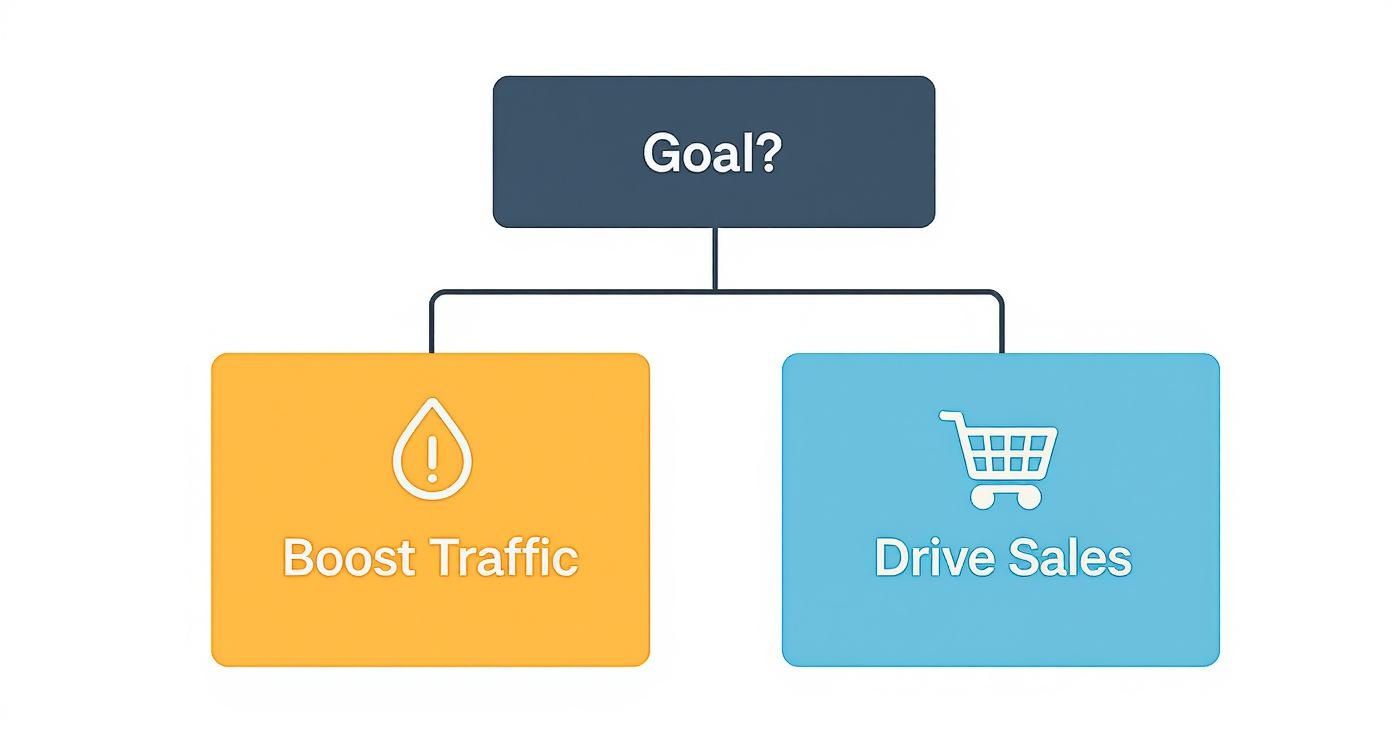
The big takeaway here is that every single tactic should start with a clear objective. That objective then dictates the strategy you deploy for each location.
The Priority Matrix Framework
For any brand with more than a few locations, the biggest challenge is knowing where to focus your energy. A store in a hyper-competitive downtown market needs a completely different playbook than one in a sleepy suburb.
This is where a Priority Matrix becomes your best friend.
It’s a surprisingly simple tool for scoring each location based on just two factors: Current Performance (how are they doing right now?) and Market Opportunity (how much potential is there?). You can score performance using things like current rankings and review ratings. For market opportunity, look at local search volume for your main keywords and population density.
Your highest-priority locations are those with low current performance but high market opportunity. These are the untapped goldmines where a focused effort will produce the most significant ROI, fast.
By plotting every location on this simple four-quadrant matrix, you get an instant roadmap. You’ll see which branches need an aggressive optimization push, which just need basic maintenance, and which are already crushing it. This data-driven approach stops the guesswork and lets you allocate your budget and time where they'll make the most difference.
Got Questions? We've Got Answers.
Putting together a local marketing plan, especially when you're juggling dozens or even hundreds of locations, always brings up some tough questions. Let's tackle a couple of the most common ones I hear from brands.
How Do I Scale a Local Strategy Across Hundreds of Locations Without a Huge Team?
This is the big one. The answer isn't hiring more people; it's about getting smarter with your systems and technology.
First things first, lean on tools built specifically for multi-location businesses. You need something that can automate the repetitive, time-sucking tasks like managing your citations and keeping an eye on reviews across all your storefronts.
Next, create simple content templates. Think of them as a starting point that your local managers can easily personalize. They can drop in photos of their team or post about a local community event they’re sponsoring. This keeps the content authentic and relevant without creating a huge bottleneck for a central marketing team.
The real secret to scaling is focusing your manual, high-touch efforts where they'll make the biggest impact. Use the data from your initial audit to pinpoint the locations with the most growth potential. Give them your direct attention and let smart, automated processes handle the rest.
What's a Realistic Budget for Local Marketing?
Your budget is going to depend heavily on how competitive your market is and, of course, how many locations you have. But you can get a solid start by earmarking funds for two main areas: essential software and a dedicated local paid ads budget.
Here’s a practical way to think about it:
- Tools: Plan on $100-$500/month for a good local SEO and listing management platform. This is your foundation.
- Paid Ads: You don't need to go all-in at once. Start with a test budget of $10-$20 per day for each of your high-priority locations on Google or Facebook. See what works, then scale up based on the return you're getting.
And remember, the biggest investment isn't always cash. It’s often the time your team dedicates to creating genuine content and actually engaging with your local community.
Ready to see exactly where you rank in every neighborhood and turn local searches into real customers? Nearfront gives you the AI-powered heatmaps and local engagement signals you need to dominate Google Maps. See how it works.