So, what is local map SEO? It's all about optimizing your business's online presence to show up higher in local map searches, especially in that all-important "Local Pack" on Google. Think of it as the art and science of turning a search on a phone into a customer walking through your front door.
Why Your Business Needs to Master Map SEO

Stop thinking of Google Maps as just a tool for directions. It’s the new town square. It's the first place people go when they have an urgent need, whether they’re looking for the "best coffee near me" or an "emergency plumber."
Mastering local map SEO is like getting the best storefront in that digital town square. It's about making sure you’re the first and most obvious answer when a customer is ready to pull out their wallet.
Showing up in the top map results—what we call the "Local Pack" or "3-Pack"—gives you instant credibility and a massive visibility boost. For any local business, this isn't a vanity metric; it’s a direct pipeline to new customers and revenue. These searches are dripping with commercial intent, which means the person searching is usually just moments away from visiting a store or making a call.
The Power of High-Intent Searches
The real magic here is capturing customers at their exact moment of need. Unlike big, slow-burn branding campaigns, map optimization connects you with people who are actively trying to solve a problem right now. Their search is a clear signal that they’re ready to buy.
If you’re not focused on your map visibility, you’re basically invisible to your most motivated customers. You're just handing them over to the competitor who shows up a few pixels above you.
A well-optimized map listing is a bright, digital beacon for your business. It doesn’t just show people where you are; it convinces them why they should choose you. This happens by:
- Grabbing Immediate Visibility: You show up first when someone in your area is looking for exactly what you offer.
- Building Instant Trust: A profile stacked with positive reviews and accurate info tells both Google and customers that you’re reliable.
- Driving Direct Action: You make it dead simple for people to get directions, call you, or visit your website with a single tap.
The Unique Challenges for Local Businesses
But here’s the rub: winning on Maps isn't a walk in the park. Single-location shops have to punch above their weight against established brands. Multi-location businesses face a constant struggle to keep information consistent and locally relevant across dozens, or even hundreds, of different listings.
Each location has its own neighborhood, its own set of competitors, and its own customer quirks that demand a tailored approach. This complexity makes a unified local marketing strategy absolutely critical if you want to scale your success.
This guide is your roadmap. We’re going to break down how the Google Maps algorithm actually works, which ranking factors you really need to care about, and how to build a smart workflow that gets results. By the end, you'll see how to turn your map listings from simple pins on a map into powerful machines for customer acquisition.
Cracking the Code: The Google Maps Algorithm and the Local Pack
To win at local SEO, you first have to understand how the game is played. Think of the Google Maps algorithm as the ultimate local guide—its one and only job is to give searchers the most relevant, accurate, and trustworthy answer to what they’re looking for right now.
The grand prize for any local business is a spot in the Google Local Pack, often called the "3-Pack." This is that prime real estate at the top of the search results: three business listings, a map, and a direct line to customers ready to buy. Landing here is like getting your business on the main digital billboard in town. It means immediate visibility, instant credibility, and a flood of high-intent clicks, calls, and foot traffic.
The Three Pillars of Local Rankings
So, how does Google decide who gets those coveted spots? It’s not some big mystery. The algorithm’s decisions boil down to three core concepts: Relevance, Proximity, and Prominence. Get these right, and you're well on your way.
Let's break down what each one really means for your business.
- Relevance: This is simple: how well does your business match what someone is searching for? If they type in "gluten-free bakery," Google’s bots immediately start scanning business profiles, websites, and reviews for those exact keywords. The closer the match, the better your chances.
- Proximity: This one is just as straightforward. How far is your business from the person searching? Unsurprisingly, Google gives a heavy advantage to businesses that are physically closer to the user. It’s all about convenience.
- Prominence: This is a measure of your business's overall authority and reputation online. How well-known are you? Google figures this out by looking at things like the number and quality of your online reviews, how consistently your business info appears across the web, and how strong your website is.
A business with killer prominence—think hundreds of glowing reviews and features on local blogs—can absolutely outrank a competitor that’s a few blocks closer. Proximity is a huge factor, but a rock-solid reputation can close the distance.
How These Pillars Work Together
These three pillars don't work in silos; they feed into each other to create a full picture of your business. Let's say you own a bike repair shop.
- Relevance: Your Google Business Profile is dialed in. Your primary category is "Bicycle Repair Shop," and your services list things like "flat tire repair," "bike tune-up," and "custom wheel building."
- Proximity: Someone searching for "bike shop near me" is standing three blocks away with a flat tire. You’re right there.
- Prominence: You’ve got 75 five-star Google reviews from happy cyclists, and your shop is listed with the correct hours and address on Yelp and a few local cycling directories.
When all three of these signals line up, Google sees your shop as the perfect answer for that searcher. You’re relevant, you’re close, and you’re trusted. That powerful combination is exactly what lands you in the Local Pack.
Nailing these fundamentals is the foundation of any winning local SEO strategy. Every tactic and trick ultimately comes back to boosting your performance across these three key areas. For a much deeper look into the nitty-gritty signals Google uses, check out our guide on the most important local SEO ranking factors that directly impact your map visibility. By focusing your energy here, you’ll build a dominant presence on Google Maps that lasts.
The Ranking Signals That Actually Matter for Maps
So, we know Google’s local algorithm boils down to three main pillars: Relevance, Proximity, and Prominence. But what does that actually mean for your business? It’s time to turn that theory into action.
Think of your Google Business Profile (GBP) as the digital storefront for every single one of your locations. It’s not just a listing; it’s the single most powerful tool you have for telling Google who you are, what you offer, and why a searcher should walk through your doors. A weak, incomplete profile sends all the wrong signals.
A thoroughly optimized profile, on the other hand, is a magnet for local customers. In fact, businesses with complete and accurate profiles are 2.7 times more likely to be considered trustworthy by users. To get this part right, our complete guide on how to optimize your Google Business Profile is your next stop.
This is how Google sees it—a constant balancing act between these three core areas.
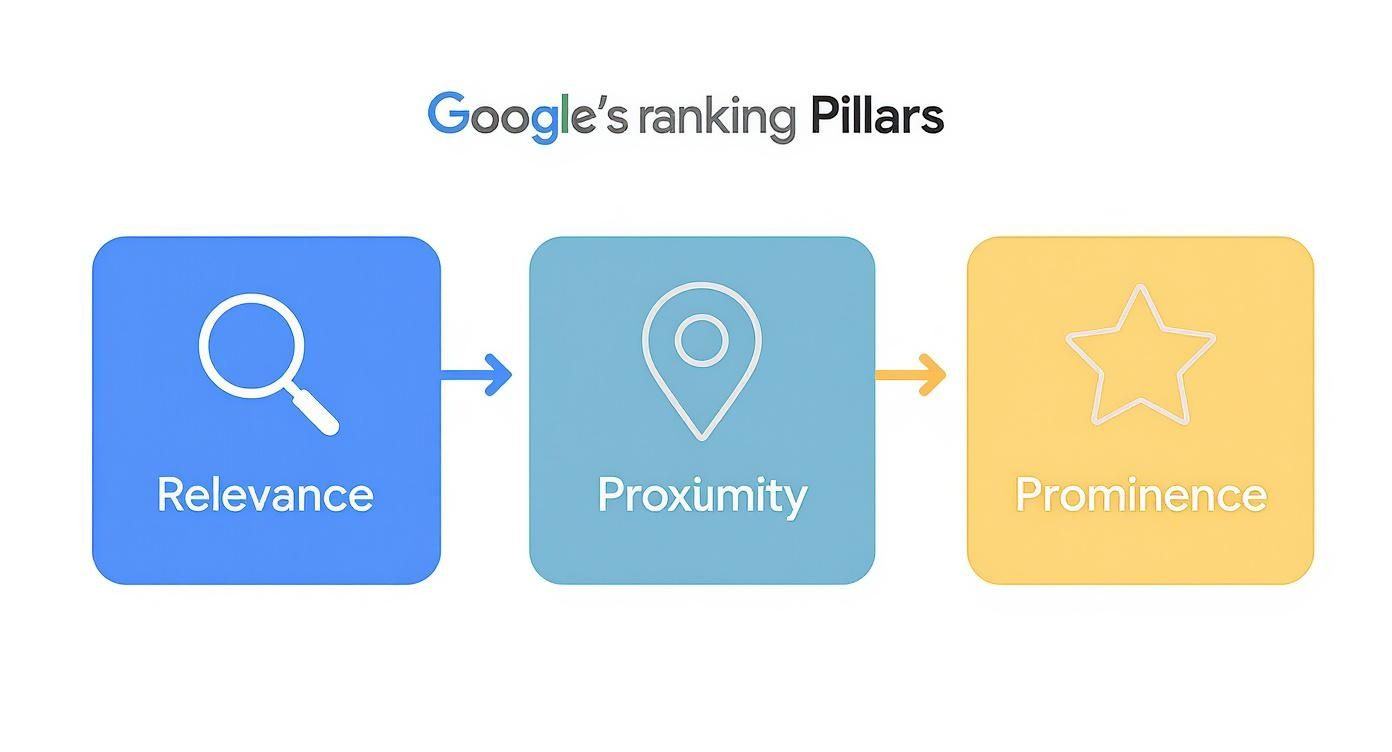
You can't just excel in one. Dominating the Map Pack means sending strong signals across all three pillars, consistently.
Below is a quick breakdown of the key factors that move the needle in local map rankings. Think of these as the levers you can pull to directly influence how Google perceives and ranks your business.
Key Local Map Ranking Factors and Their Impact
| Ranking Factor | Description | Impact on Ranking |
|---|---|---|
| GBP Optimization | A fully completed Google Business Profile, including categories, services, photos, and posts. | High: The most direct and powerful way to influence your relevance and prominence. |
| Review Signals | The quantity, quality, and velocity of new customer reviews, plus owner responses. | High: Strong social proof that builds trust with both Google and customers. |
| Proximity | How close your business is to the person searching. | High: A fundamental factor, though its influence can be mitigated by strong prominence. |
| NAP Consistency | Ensuring your Name, Address, and Phone number are identical across all online directories. | Medium: Foundational trust signal. Inconsistencies create confusion and hurt rankings. |
| On-Page SEO | Your website's content, including location-specific pages and local schema markup. | Medium: Reinforces your GBP signals and provides Google with deeper context about your expertise. |
| Behavioral Signals | Clicks, calls, direction requests, and website visits originating from your GBP. | High: Direct evidence that searchers find your listing relevant and engaging. |
While you can't control every factor (like proximity), you have complete control over the rest. Focusing on these areas is how you systematically climb the rankings.
Your GBP Optimization Checklist
To turn your profile into a ranking machine, you need to be meticulous. Google rewards businesses that give users the most complete and helpful information.
- Choose Powerful Business Categories: Don't just pick "Restaurant." Be specific: "Italian Restaurant" as your primary category, then add "Pizza Delivery" and "Catering" as secondary ones. This is a massive relevance signal.
- Write a Keyword-Rich Description: This is your elevator pitch to Google and potential customers. Weave in the local search terms people actually use to find businesses like yours.
- Leverage Google Posts and Q&A: Use Posts to announce offers, highlight new products, or share events. Proactively add common questions to your Q&A section and answer them. This activity shows Google you’re engaged and actively managing your presence.
The Undeniable Power of Customer Reviews
Reviews are the currency of local trust. They are one of the most visible and influential signals for both the algorithm and the people searching. A steady flow of positive reviews tells Google you’re a popular, high-quality choice in the area.
But it’s not just about getting a 5-star rating. Google looks deeper:
- Review Velocity: How often are you getting reviews? A consistent trickle is far better than a one-time flood.
- Review Recency: A review from last week carries much more weight than one from two years ago.
- Owner Responses: Are you responding to reviews? Engaging with both happy and unhappy customers shows you care and are actively involved.
NAP Consistency: The Foundation of Trust
Beyond what’s on your GBP, Google is constantly cross-referencing your information across the web to make sure you are who you say you are. Your NAP (Name, Address, Phone Number) needs to be 100% identical everywhere it appears—from Yelp and Tripadvisor to smaller industry directories.
Think of each matching citation as a vote of confidence. When Google sees the same data everywhere, it trusts your location and business details. Any inconsistency, no matter how small, erodes that trust and can torpedo your rankings.
On-Page Signals: Connecting Your Website
Finally, don't forget your website. Google looks at it to validate the information on your GBP and get more context. Your site needs to reinforce the same local signals.
This means putting your NAP information clearly on your website, building out individual pages for each location or key service, and using local schema markup to spoon-feed search engines structured data. When your website and GBP tell the same cohesive story, you build a powerful digital presence that Google can't help but reward.
A Prioritized Workflow for Maximum SEO Impact

Knowing what to do is one thing. Knowing where to start is everything. A winning local map SEO strategy isn't about throwing everything at the wall to see what sticks—it’s about a methodical plan that builds on itself.
Think of it like building a house. You wouldn’t put up the roof before you pour a solid foundation. In local SEO, that foundation is your Google Business Profile (GBP). The walls are your customer reviews, and the roof is a clean, consistent set of citations.
This isn't just some checklist. It's a proven roadmap designed to create a flywheel effect, where each step makes the next one more powerful.
Phase 1: Master Your Google Business Profile
Your first, absolute priority is to claim and obsessively optimize your Google Business Profile for every single location. This is non-negotiable. Your GBP is the command center for your entire local footprint and the single biggest lever you can pull for map rankings.
Before you even think about backlinks or social media, your profile needs to be a perfect, complete, and compelling snapshot of your business. Google rewards profiles that give users everything they need to know, right then and there.
Here’s where you put your energy first:
- Claim and Verify Every Listing: This is step one, always. You need full control of each location's profile. Verification is how you prove to Google you’re the rightful owner.
- Complete Every Single Field: Don’t be lazy here. Fill out business hours, write a keyword-rich description, upload high-quality photos, and list all of your products and services. Leave nothing blank.
- Select Hyper-Specific Categories: Choose the most accurate primary category, then add every relevant secondary category you can. This is one of the strongest signals you can send Google about what you actually do.
Phase 2: Build a Powerful Review Engine
Once your GBP foundation is rock-solid, shift your focus to getting a steady stream of real customer reviews. Reviews are the fuel for prominence, showing both Google and customers that your business is active, trusted, and popular.
The goal is to build a simple, repeatable process for generating feedback. Don't just hope customers will leave a review; you have to ask. Make it frictionless.
A business with 50 recent, positive reviews will almost always crush a competitor with 100 old ones. The velocity and recency of your reviews matter just as much as the overall rating.
To get your review engine firing on all cylinders:
- Create a Direct Review Link: Generate a short, shareable link from your GBP that takes people straight to the review form. No extra clicks.
- Ask at the Right Time: The perfect moment to ask is right after a great experience—a successful purchase, a helpful service call, or a compliment.
- Respond to Every Review: Engage with both the good and the bad. Responding shows you’re listening and actively managing your reputation.
Phase 3: Solidify Your Authority with Citations
With your profile dialed in and reviews flowing, the final foundational piece is to build and clean up your local citations. Citations are just mentions of your business's Name, Address, and Phone number (NAP) on sites like Yelp, Tripadvisor, and other industry directories.
Think of each consistent citation as another vote of confidence in Google’s eyes. When your NAP is identical everywhere, it confirms the data in your GBP is accurate and trustworthy. Inconsistencies, even a typo, create doubt and can drag down your rankings.
For multi-location businesses, this step is absolutely critical. Manually keeping track of NAP consistency across hundreds of listings is a nightmare. This is where tools that automate citation management become essential for scaling your efforts.
By following this order of operations, you focus your energy where it counts most, creating a powerful foundation that drives real, lasting results on Google Maps.
How to Measure Your Local Map SEO Success
Pouring money and effort into local map SEO without tracking your results is like driving blind. Sure, you’re moving, but are you even going in the right direction? You absolutely have to connect your optimization efforts to real business outcomes—it’s the only way to prove value and make smarter decisions down the line.
This isn’t about chasing vanity metrics. We need to focus on the Key Performance Indicators (KPIs) that actually translate to revenue. Think of it this way: a higher ranking is nice, but a ringing phone and a full schedule are what really pay the bills. The goal is to draw a straight, undeniable line from your visibility on the map to your bottom line.
Mastering Google Business Profile Insights
Your first stop should always be your Google Business Profile (GBP) Insights dashboard. This free tool is a goldmine. It shows you exactly how real customers are finding and interacting with your listing. It's basically your digital store manager, telling you how many people walked by, how many glanced in the window, and how many decided to come inside.
Inside GBP Insights, you’ll find the metrics that truly matter. These aren't just abstract numbers; they represent real customer actions that signal a high intent to buy.
The three most critical metrics to watch are:
- Website Clicks: This tells you how many people saw your profile and were intrigued enough to click through to your site for more info.
- Direction Requests: This is a huge signal for foot traffic. Every single request is a potential customer actively trying to get to your physical location.
- Phone Calls: For a lot of businesses, a direct phone call from a GBP listing is the most valuable conversion you can get, often leading straight to a booking or a sale.
Visualizing Your True Visibility with Geogrids
While GBP Insights tells you what actions customers took, it doesn't show you where you’re actually visible. Your ranking isn't some static number; it changes dramatically depending on where the searcher is physically located. You could be #1 for someone searching across the street but completely invisible to a customer just two miles away.
This is where local rank tracking tools with geogrids become essential. Tools like the live heatmaps in Nearfront create a visual map of your rankings across your entire service area. They place a grid over the city and run searches from each point, showing you exactly where you’re strong—and, more importantly, where you're weak.
Think of a geogrid as a visibility X-ray for your business. It exposes your blind spots and highlights your strongest areas, giving you a true picture of your local map SEO performance that a single ranking number could never provide.
This detailed view lets you spot underperforming neighborhoods and tweak your strategy to win more customers where it counts.
Connecting Data to Your Bottom Line
Ultimately, measuring success comes down to proving a clear Return on Investment (ROI). The final step is connecting these local SEO metrics to actual revenue. It takes a little bit of simple math, but it provides undeniable proof that your strategy is working.
The data on user behavior already shows the incredible value here. A staggering 76% of people who make a local search on their smartphone visit a business within 24 hours, and 28% of those searches lead to a purchase. Even better, 78% of local mobile searches result in an offline sale, proving the direct link between digital visibility and real-world transactions. These conversion rates are why a focused local SEO effort is so critical. You can see more on how local search drives sales in this detailed breakdown of local SEO statistics.
By tracking the month-over-month increase in calls, direction requests, and website traffic coming from your GBP, you can attribute a real portion of your new customer growth directly to your map optimization. This data-driven approach turns local SEO from a marketing expense into a predictable engine for business growth.
Your Top Questions About Map SEO, Answered
As you get into local map SEO, a lot of questions pop up. It can seem complicated from the outside, but the core ideas are actually pretty simple once you cut through the noise. Let's tackle the questions we hear most often from business owners, with straight answers to help you move forward.
These aren't just theories; they're practical insights for the real-world challenge of making your business the obvious choice on Google Maps.
How Is Map SEO Different from Traditional SEO?
Think of it this way: traditional SEO is like trying to get your online store featured in a national magazine. You're up against everyone, everywhere, for the broadest possible audience.
Map SEO, on the other hand, is like becoming the go-to, most-recommended shop on your town's main street. It’s hyper-focused on a specific geographic area and a completely different set of rules.
Here’s where they really differ:
- The Goal: Traditional SEO is usually about getting people to your website to read content or buy something online. Map SEO is all about making the phone ring, getting direction requests, and bringing people through your actual door.
- What Matters for Ranking: Traditional SEO obsesses over backlinks and a website's overall authority. Map SEO puts a massive premium on your Google Business Profile, customer reviews, and making sure your business info is consistent everywhere online.
- User Intent: Someone searching "how to fix a leaky faucet" (traditional SEO) is in research mode. The person searching "plumber near me" (map SEO) needs to hire someone, right now.
What's a Realistic Timeline for Seeing Results?
This is the million-dollar question, and the only honest answer is: it depends. Local map SEO is a marathon, not a sprint. While you can get some quick wins, real, lasting dominance is built with consistent effort over time.
Generally, you can expect to see some initial movement within 3 to 6 months. This might be a small uptick in calls from your profile or showing up in a few more searches on the map. To lock in those top-3 Map Pack spots for competitive terms, you're often looking at 6 to 12 months of solid work.
Don't get discouraged if you don't jump to the #1 spot overnight. The key is to look for steady, incremental progress in your core metrics—more calls, more direction requests, and wider visibility on your geogrid reports.
Do Things Like Google Posts Actually Help Rankings?
Yes, but probably not how you think. A single Google Post isn't going to magically rocket you up three spots. Instead, it has a powerful indirect effect on what Google truly cares about: user engagement.
When you consistently use features like Posts, Q&A, and add new photos, you're sending strong signals to Google that your business is active and relevant. This activity encourages more people to click, call, and interact with your profile. Those user actions—those behavioral signals—are a direct ranking factor.
So while one post won't change your world, a consistent strategy of using these tools absolutely moves the needle over time.
How Should I Handle Negative Reviews?
First off, don't panic. A bad review isn't a disaster. In fact, a profile with a few less-than-perfect reviews often looks more authentic than one with a flawless 5.0 rating. What really matters is how you respond.
Here's a simple, effective playbook:
- Respond Quickly and Publicly: Get back to them within 24-48 hours. A fast, public reply shows everyone you’re paying attention.
- Be Professional, Not Defensive: Thank them for the feedback and apologize for their bad experience (even if you think they're wrong). Never get into a public fight.
- Take the Conversation Offline: Offer to make it right. Give them a direct phone number or email and ask them to reach out so you can resolve the issue privately.
This approach shows every potential customer who reads that review that you're committed to great service, turning a negative into a positive.
Ready to stop guessing and start seeing exactly where your business ranks on the map? Nearfront provides live ranking heatmaps and actionable insights to help you dominate local search and turn visibility into foot traffic. Discover how our AI-powered platform can accelerate your local map SEO results. Explore Nearfront today.