
In a market where consumers search for "near me" solutions, simply having a digital presence is no longer sufficient. Winning the local battle requires a focused, neighborhood-centric approach that transforms your business from just another option into the definitive local choice. True success is not just about being found; it's about being chosen by the customers walking past your door every day. This is where a robust set of local marketing strategies becomes your most valuable asset, turning proximity into profit.
This comprehensive guide moves beyond generic advice to provide a prioritized, actionable blueprint of the most effective local marketing strategies that multi-location brands and single storefronts can implement immediately. We will dissect the tactics that drive real-world results, from dominating Google's local search results and Map Pack to building authentic community partnerships that foster loyalty.
You will learn how to precisely optimize your digital footprint for hyperlocal visibility, engage your community through targeted social and event-based initiatives, and build a stellar online reputation that customers trust. More importantly, we'll cover how to use specific data, like Nearfront's heatmaps and automated reporting, to not only guide your strategy but also prove its impact on foot traffic and revenue. This list is designed to equip you with the tools needed to translate online discovery into measurable, in-store success, ensuring your business thrives exactly where it matters most: your own neighborhood.
1. Strategy 1: Master Your Google Business Profile for Maximum Visibility
Your Google Business Profile (GBP) is no longer just a digital listing; it's your primary local storefront. It's often the first interaction a local customer has with your brand, making it the single most critical asset in your local marketing toolkit. A fully optimized profile doesn't just provide information. It builds trust, answers questions preemptively, and directly influences a customer's decision to call, visit, or click.

Mastering GBP involves a continuous cycle of updating information, engaging with customers, and strategically using every feature to signal relevance to Google's local algorithm. This is a foundational element of any successful local marketing strategy because it directly impacts your visibility in the Local Pack and on Google Maps, where high-intent customers are actively searching.
Actionable Implementation Steps:
- Quarterly Information Audits: Verify your name, address, phone number (NAP), hours, and service categories are 100% accurate. Inconsistency erodes trust with both users and Google.
- Proactive Q&A Management: Don't wait for customers to ask questions. Populate your GBP Q&A section by asking and answering your own most frequent questions about parking, services, or appointments.
- Consistent Google Posts: Use Google Posts at least twice a week to announce promotions, highlight new products, or share company news. Always include a clear call-to-action (CTA) like "Call Now" or "Learn More."
- Fresh Visual Content: Upload new, high-quality photos and videos every month. Showcase your exterior, interior, team members, and products or services in action. For businesses without a physical storefront, discover how to optimize your Google Business Profile for service-area businesses.
- Rapid Review Response: Aim to respond to every single review within 24 hours. Acknowledging both positive and negative feedback demonstrates active management and excellent customer service.
2. Local Social Media Marketing
Social media for local businesses is not about broadcasting to the masses; it's about building a hyper-engaged neighborhood community. It transforms platforms like Facebook, Instagram, and TikTok from global stages into your local town square, where you can connect directly with customers, share timely updates, and humanize your brand. This approach fosters loyalty and drives real-world foot traffic by making your business a visible and active part of the local conversation.
Leveraging social media is a core component of modern local marketing strategies because it provides a direct line to your community. By creating content that reflects local culture, events, and interests, you build an audience that feels seen and connected to your brand on a personal level. It’s the digital equivalent of a friendly wave and knowing your customers by name, creating a powerful moat of loyalty that competitors can’t easily replicate.
Actionable Implementation Steps:
- Geotag Every Post: Always tag your business location in every post, Story, and Reel. This simple action makes your content discoverable to users searching for or exploring that specific area. For Facebook, ensure you have a dedicated location page set up correctly to maximize this effect.
- Embrace Local Hashtags: Move beyond generic industry hashtags. Research and consistently use popular local tags like
#YourCityEats,#NeighborhoodName, or#YourCityEventsto insert your brand into relevant local conversations and increase visibility among nearby users. - Run Hyper-Targeted Ads: Use the powerful location-targeting features on platforms like Facebook and Instagram. Create ad campaigns with a tight radius (e.g., 1-5 miles) around your storefront to promote special offers, events, or new products directly to potential customers who are physically close.
- Feature Your Community: Make your customers and neighboring businesses the stars of your content. Share user-generated photos (with permission), run a "local business of the week" spotlight, or collaborate on a giveaway with another non-competing local shop.
- Engage Proactively: Don't just post and walk away. Dedicate time each day to respond to comments and messages, and actively comment on posts from other local businesses, community groups, and influencers. Building a digital community requires active participation.
3. Local SEO & Keyword Optimization
Beyond your Google profile, your website must be finely tuned to capture local search intent. Local SEO is the practice of optimizing your site's content and technical structure to appear for location-based queries like "emergency plumber in Brooklyn" or "gyms near me." It’s about signaling to search engines that your business is the most relevant and authoritative answer for a customer in a specific geographic area.
A robust local SEO strategy ensures that when potential customers search for your services, your business appears prominently on search engine results pages (SERPs). This goes hand-in-hand with your GBP efforts, creating a powerful, cohesive presence that captures users at every stage of their local search journey, from broad discovery to specific, high-intent queries.
Actionable Implementation Steps:
- Create Hyperlocal Service Pages: Develop dedicated pages on your website for each core service in each specific neighborhood or city you serve (e.g., "HVAC Repair in Scottsdale" and "AC Installation in Tempe"). This allows you to rank for highly specific, long-tail keywords.
- Optimize On-Page Elements: Include your target city and neighborhood names naturally within page titles, meta descriptions, H1 tags, and body content. For example, a page title could be "Boutique Fitness Classes in Downtown Austin | Your Gym Name."
- Implement Local Business Schema: Add local business schema markup to your website's code. This structured data gives search engines explicit information about your business, including its address, hours, and service type, which can enhance your visibility.
- Build Local Backlinks: Earn links from other reputable local businesses, community blogs, or news sites. A link from the local Chamber of Commerce or a neighborhood event sponsor is a powerful trust signal for search engines.
- Analyze Local Search Intent: Use keyword tools to understand how local customers search. Prioritize keywords that indicate immediate intent, such as "open now," "near me," or service-specific terms combined with your location. You can learn more about the critical local SEO ranking factors to prioritize your efforts.
4. Community Partnerships & Local Collaborations
Tapping into your local ecosystem is one of the most powerful and authentic local marketing strategies available. Building strategic relationships with other nearby businesses, nonprofits, and community groups creates a network effect, amplifying your reach and embedding your brand directly into the fabric of the neighborhood. This approach goes beyond simple advertising; it’s about creating shared value and mutual marketing opportunities.
A strong partnership allows you to connect with an established, relevant audience that already trusts your collaborator. It’s a warm introduction that builds instant credibility and fosters a sense of community support. When a local fitness studio and a health-focused restaurant collaborate on a nutrition workshop, or a bookstore and a coffee shop co-host an author event, both brands benefit from cross-promotion and enhanced customer loyalty.
Actionable Implementation Steps:
- Identify Complementary Partners: Look for non-competing businesses that share a similar target audience. Think about the natural customer journey: where do they go before or after visiting you?
- Create a "Value-First" Proposal: When approaching a potential partner, clearly outline the mutual benefits. Focus on how the collaboration will help their business by offering cross-promotional exposure, new customer traffic, or enhanced value for their existing patrons.
- Launch a Co-Branded Offer: Create a simple, compelling joint promotion. For example, a hair salon and a nearby boutique could offer a "Style & Shop" package with a discount for visiting both locations on the same day.
- Co-Host Quarterly Events: Plan and execute joint events at least once per quarter to maintain momentum. This could be anything from a small in-store workshop to sponsoring a booth at a neighborhood street festival.
- Amplify Across All Channels: Ensure both partners promote the collaboration equally across their social media, email newsletters, websites, and in-store signage to maximize visibility and impact.
5. Build Community Trust with Local Event Marketing & Sponsorships
Digital strategies are essential, but nothing builds authentic local connections like face-to-face interaction. Sponsoring or participating in local events like farmers' markets, sports tournaments, or community fairs puts your brand directly in front of an engaged, geographically relevant audience. This approach moves beyond simple advertising; it demonstrates your commitment to the community, creating memorable experiences and fostering goodwill that digital ads can't replicate.
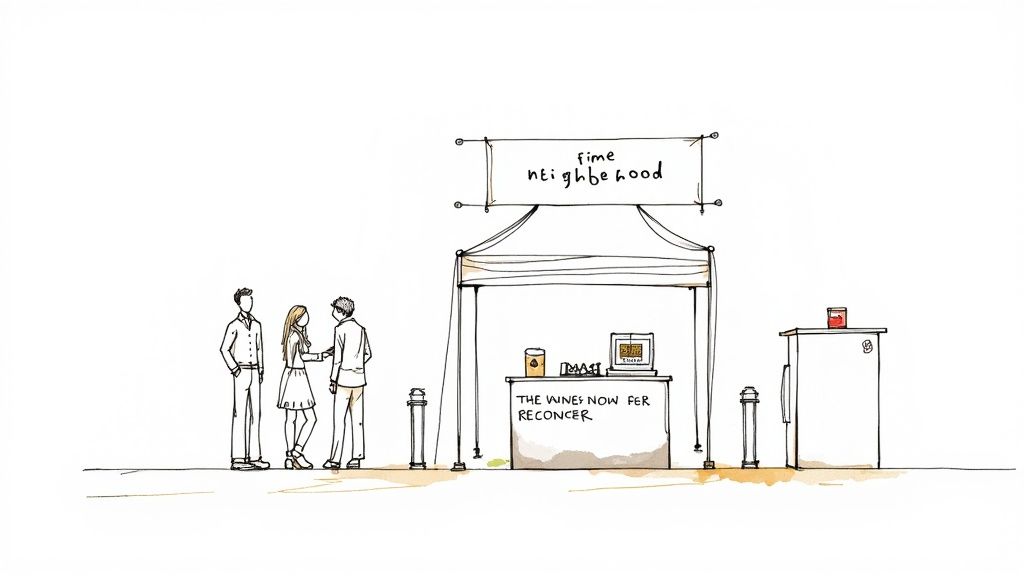
Effective event marketing isn't just about showing up. It's about creating an interactive and valuable touchpoint that aligns with your brand. Whether a local gym sponsors a 5K run or a restaurant participates in a food truck festival, these activities position your business as an integral part of the local fabric. This strategy is a powerful way to generate leads, increase brand recall, and prove you're more than just a business, you're a neighbor.
Actionable Implementation Steps:
- Align Events with Your Audience: Don't sponsor an event just for exposure. Choose opportunities that attract your ideal customer. A wellness clinic, for example, would gain more traction at a health expo than a music festival.
- Create an Interactive Experience: Move beyond a simple table with flyers. Design a booth with a game, a free sample, or a unique giveaway to draw people in and create a memorable interaction.
- Train Your Team for Engagement: Staff your booth with enthusiastic team members trained to do more than hand out brochures. They should be ready to engage in genuine conversations and represent your brand's personality.
- Incorporate a Lead Capture Mechanism: Use the event to build your marketing lists. Offer a prize drawing or a special discount in exchange for an email address or a social media follow.
- Amplify Your Presence Socially: Promote your participation before, during, and after the event. Use live video, post photos of attendees at your booth, and share a recap to extend the event's reach online.
6. Local Email Marketing & Newsletters
While social media and search get much of the attention, email remains one of the most powerful and direct local marketing strategies for building lasting customer relationships. It provides a direct line of communication to an audience that has already expressed interest in your business, allowing you to nurture leads, drive repeat visits, and increase customer lifetime value with personalized, relevant content.
Unlike platforms controlled by algorithms, your email list is a valuable asset you own. A well-executed local email strategy moves beyond generic promotions. It creates a community hub, delivering neighborhood-specific news, exclusive local offers, and updates that make subscribers feel like insiders. For multi-location brands, this channel allows for highly segmented campaigns that speak directly to the unique interests of customers in different service areas or cities.
Actionable Implementation Steps:
- Build Your List In-Store and Online: Actively collect email addresses at your physical location through a simple signup sheet, a QR code at checkout, or by offering a small incentive. Simultaneously, use prominent opt-in forms on your website’s homepage and local landing pages.
- Segment Your Audience Locally: Don't send the same email to everyone. Segment your subscriber list by location, neighborhood, or past purchase history to send hyper-relevant content. A local restaurant, for example, could send different weekly specials to subscribers based on their nearest branch.
- Craft Compelling Local Subject Lines: Grab attention in a crowded inbox by including local references. Use subject lines like, "A Special Offer Just for Our Boston Neighbors" or "This Week's Fresh Finds at Our Cambridge Location."
- Provide Community-Centric Value: Your newsletter shouldn't just be about sales. Share updates on local events you're sponsoring, highlight a local partner, or provide tips relevant to the community. This builds brand loyalty beyond transactions.
- Maintain a Consistent Cadence: Whether it's weekly or monthly, stick to a predictable schedule so subscribers know when to expect your emails. Test different send times to discover when your local audience is most likely to open and engage.
7. Create Authoritative Local Content & Blogs
Content marketing isn't just for global brands; it's one of the most powerful local marketing strategies for building community trust and attracting organic search traffic. By creating content that directly addresses the specific questions, needs, and interests of your local audience, you position your business as the go-to neighborhood expert. This strategy moves beyond simple promotion and provides genuine value, which in turn boosts your local SEO authority.
A local HVAC company writing a blog post on "Preparing Your Furnace for a Chicago Winter" or a real estate agent creating a "Guide to Family-Friendly Neighborhoods in Austin" are prime examples. This content answers specific local queries, builds topical relevance for search engines, and provides shareable resources that keep your brand top-of-mind. It's a long-term investment that pays dividends in both customer loyalty and search engine visibility.
Actionable Implementation Steps:
- Identify Hyperlocal Topics: Use tools like Google Trends (filtered by city) or "People Also Ask" to find questions your local community is searching for. Focus on topics related to local events, neighborhood challenges, or community news.
- Feature Local Voices: Interview other local business owners, community leaders, or long-time residents. This not only provides unique content but also builds valuable backlinks and community relationships when they share the feature.
- Develop Neighborhood-Specific Guides: Create detailed guides for the specific neighborhoods you serve. A dentist could write about "The Best Kid-Friendly Activities in the Pearl District" to attract local families, naturally weaving in their services.
- Optimize for "Near Me" and Local Intent: Naturally incorporate keywords like "[service] in [neighborhood/city]" or "[product] near [local landmark]". Ensure every post is optimized with local schema and geo-tagged images.
- Promote Through Local Channels: Share your content in local Facebook groups, on your Google Business Profile via Google Posts, and in email newsletters targeted to your local customer base.
8. Launch Hyper-Targeted Local Paid Advertising Campaigns
While organic strategies build long-term momentum, local paid advertising offers immediate visibility and precision targeting. Platforms like Google Ads and Meta (Facebook and Instagram) allow you to place your business directly in front of high-intent customers within specific zip codes, neighborhoods, or even a few blocks from your physical location. It’s a powerful way to accelerate growth, promote time-sensitive offers, and capture demand the moment it arises.
Unlike broad national campaigns, local PPC is about efficiency and relevance. You can tailor ad copy to mention specific local landmarks, target users who have recently visited a competitor, or run promotions exclusively for a particular neighborhood. This level of granularity makes your marketing spend incredibly effective, ensuring you only pay to reach potential customers who can actually visit your store or use your service. This is one of the most direct local marketing strategies for driving immediate foot traffic and leads.
Actionable Implementation Steps:
- Start with Tight Geofencing: Begin your campaigns by targeting a small, highly relevant radius (e.g., 3-5 miles) around your location. You can expand later, but starting small maximizes budget efficiency and provides clearer performance data.
- Localize Your Ad Copy: Don't use generic messaging. Incorporate local keywords like your city or neighborhood ("Best Pizza in Downtown Denver"). This increases relevance and click-through rates.
- Utilize Location Extensions: In Google Ads, always enable location extensions. This feature adds your address, a map to your location, and your phone number directly to your ad, making it easy for users to find you.
- A/B Test Local Creatives: Test ad images featuring local scenery, your storefront, or your team against more generic stock photos. Localized visuals often build more trust and connection with the audience.
- Track In-Store Conversions: For eligible businesses, set up Google Ads store visit conversions. This powerful feature uses anonymized, aggregated data to track how many people who clicked your ad later visited your physical location, proving direct ROI.
9. Build Authority with Local Directory & Citation Management
Citations are mentions of your business's name, address, and phone number (NAP) across the web on directories like Yelp, Apple Maps, industry-specific sites, and local chamber of commerce pages. Think of each consistent citation as a vote of confidence for your business. The more accurate and widespread these votes are, the more Google trusts that your location data is correct, which directly boosts your local search authority.
Managing these listings is a foundational local SEO task that prevents customer confusion and sends powerful ranking signals to search engines. Inaccurate or inconsistent information creates friction for customers and erodes search engine trust, actively harming your visibility. A clean citation profile is a non-negotiable component of any robust local marketing strategy.
Actionable Implementation Steps:
- Conduct a Citation Audit: Use a tool like BrightLocal or Moz Local to find existing citations. Identify and record all inconsistencies, duplicates, and outdated listings in a spreadsheet to create a cleanup plan.
- Prioritize Core Directories: Start by ensuring your NAP, website, and hours are 100% identical on major platforms like Google, Apple Maps, Yelp, and Facebook. These hold the most weight.
- Build Hyperlocal & Niche Citations: Seek out industry-specific directories (e.g., HomeAdvisor for a plumber, OpenTable for a restaurant) and local chamber of commerce or city-specific sites. These niche citations signal strong local relevance.
- Establish a Consistent Description: Write a master business description that includes your primary local keywords. Use this same description across every directory you manage for brand and messaging consistency.
- Schedule Biannual Updates: Set a calendar reminder every six months to re-audit your key citations. Verify all information remains correct, especially after any changes to your hours, phone number, or address.
10. Local Reputation Management & Review Marketing
Your online reputation is your digital word-of-mouth, directly influencing whether a local customer chooses you or a competitor. Actively managing reviews across platforms like Google, Yelp, and industry-specific sites is no longer optional; it's a core component of modern local marketing strategies. This involves systematically encouraging new reviews, responding to all feedback, and using that input to improve operations.
A strong reputation with a high volume of recent, positive reviews sends powerful trust signals to both potential customers and search engines. For local search algorithms, review signals like quantity, velocity, and rating are critical ranking factors. A well-executed review marketing program builds social proof, improves visibility, and creates a valuable feedback loop for your business.
Actionable Implementation Steps:
- Systematize Your Review Requests: Don't leave reviews to chance. Implement an automated process using text or email follow-ups after a service or purchase. Make it easy with direct links or QR codes in-store.
- Respond to Every Review Within 48 Hours: Acknowledge all feedback promptly. Thank positive reviewers by name and reference their specific comments. Address negative reviews professionally, take the conversation offline, and avoid defensive language.
- Turn Feedback into Action: Use your reviews as a source of invaluable customer intelligence. Regularly analyze feedback to identify recurring issues or areas of excellence that can inform staff training and operational improvements.
- Highlight Positive Reviews in Your Marketing: Showcase your best 5-star reviews on your website, social media channels, and even in-store signage. This leverages social proof to reinforce trust with potential new customers.
- Monitor All Relevant Platforms: While Google is key, don't neglect other platforms important to your industry, such as Yelp, Trustpilot, or TripAdvisor. Use a reputation management tool to consolidate monitoring and responding.
12. Cultivate and Amplify Social Proof with a Proactive Review Strategy
Social proof, especially in the form of online reviews, is the modern-day word-of-mouth. For local businesses, a steady stream of positive, recent reviews on platforms like Google, Yelp, and industry-specific sites is a powerful trust signal. It directly influences both consumer purchasing decisions and local search rankings, making it a non-negotiable component of any robust local marketing strategy.

A proactive review generation and management system goes beyond passively hoping for good feedback. It involves actively encouraging satisfied customers to share their experiences and professionally handling all feedback, positive or negative. This approach not only boosts your online reputation but also provides invaluable insights into customer sentiment and operational performance, turning feedback into a growth engine.
Actionable Implementation Steps:
- Implement a Review Request System: Don't just ask for a review; make it easy. Use SMS or email follow-ups after a purchase or service with a direct link to your preferred review platform. Personalize the request to increase conversion rates.
- Train Staff on the Ask: Empower your frontline employees to identify happy customers and ask for a review at the peak of their positive experience. Provide them with small, branded cards that include a QR code linking directly to your review profiles.
- Showcase Positive Reviews: Amplify your best reviews by sharing them as testimonials on your website, as graphics on social media, or even as printed signage in your physical location. This reinforces positive sentiment and encourages others to contribute.
- Establish a Negative Review Protocol: Create a clear, calm process for responding to negative feedback. The goal is to acknowledge the issue publicly, take the conversation offline to resolve it, and demonstrate to other potential customers that you take concerns seriously.
- Analyze Review Content: Regularly read through your reviews to identify recurring themes. Use this direct customer feedback to pinpoint areas for operational improvement, from customer service to product offerings.
12-Point Local Marketing Strategy Comparison
| Strategy | Implementation Complexity (🔄) | Resource & Cost Requirements (⚡) | Expected Outcomes (⭐ 📊) | Ideal Use Cases (💡) | Key Advantages (⭐) |
|---|---|---|---|---|---|
| Google My Business Optimization | 🔄 Low–Medium — simple setup, regular upkeep | ⚡ Low — time for updates and photos | ⭐⭐⭐⭐ — strong local visibility; quick local search gains 📊 | Local storefronts, service-area businesses | Free; improves map rankings; review-driven trust |
| Local Social Media Marketing | 🔄 Medium — ongoing content & moderation | ⚡ Low–Medium — creative time; optional ad spend | ⭐⭐⭐ — good engagement and brand awareness 📊 | Cafés, boutiques, events, community-focused brands | Direct engagement; organic sharing; low-cost ads |
| Local SEO & Keyword Optimization | 🔄 Medium–High — technical + content work | ⚡ Medium — SEO tools and expertise | ⭐⭐⭐⭐ — high-intent organic traffic; long-term gains 📊 | Legal, trades, appointment-based services | Targets local searchers; cost-effective long-term |
| Community Partnerships & Collaborations | 🔄 Medium — coordination and relationship work | ⚡ Low–Medium — shared resources, time | ⭐⭐⭐ — expands reach; trust-building impact 📊 | Small businesses seeking audience expansion | Shared audiences; reduced costs; authentic connections |
| Local Event Marketing & Sponsorships | 🔄 High — complex planning and execution | ⚡ High — venue, staffing, materials | ⭐⭐⭐⭐ — high visibility and strong engagement; measurement can be indirect 📊 | Brands seeking in-person presence and PR | Face-to-face interaction; memorable brand moments |
| Local Email Marketing & Newsletters | 🔄 Medium — list building and segmentation | ⚡ Low — platform costs; content time | ⭐⭐⭐⭐ — high ROI; drives repeat business 📊 | Retailers, restaurants, service providers with repeat customers | Direct, measurable channel; highly personalizable |
| Local Content Marketing & Blogging | 🔄 Medium–High — consistent production and SEO | ⚡ Medium — content creation resources | ⭐⭐⭐⭐ — builds authority and organic traffic over time 📊 | Experts, Realtors, service businesses wanting thought leadership | Long-term SEO value; supports other channels |
| Local Paid Advertising (PPC & Local Ads) | 🔄 Medium — setup, targeting, optimization | ⚡ High — ongoing budget and management | ⭐⭐⭐⭐ — immediate visibility and measurable conversions 📊 | Time-sensitive promotions, new openings, competitive markets | Fast results; precise geotargeting; scalable |
| Local Directory & Citation Building | 🔄 Low–Medium — list creation and maintenance | ⚡ Low — time investment; often free | ⭐⭐⭐ — stabilizes local SEO and discoverability 📊 | All local businesses; essential baseline presence | Multiple touchpoints; improves NAP consistency |
| Local Reputation Management & Review Marketing | 🔄 Medium — monitoring and response workflows | ⚡ Low–Medium — tools and response time | ⭐⭐⭐⭐ — strong impact on conversions and rankings 📊 | Service providers, healthcare, hospitality | Builds trust; influences purchase decisions; feedback insights |
From Strategy to Action: Building Your Local Marketing Flywheel
We've explored a comprehensive suite of local marketing strategies, from the foundational necessity of Google Business Profile optimization to the community-building power of in-person events. Each tactic, whether it's hyper-targeted social media advertising, consistent citation building, or a proactive reputation management program, holds the potential to connect you with more local customers. However, the true path to market leadership isn’t found by picking just one or two of these strategies from a list.
The most successful brands understand that these tactics are not isolated channels. They are interconnected gears in a much larger machine: your local marketing flywheel. A powerful local flywheel is created when each component feeds and accelerates the others, generating self-sustaining momentum that consistently attracts and retains customers.
The Power of Interconnection
Consider how these elements work together. A well-attended local event you sponsor doesn't just generate goodwill for a day. It provides a wealth of content: photos and videos for your social media channels, stories for your local blog, and new contacts for your email newsletter. Optimizing your website for local keywords isn't just an SEO exercise; it makes your hyperlocal Google Ads more relevant and cost-effective by improving your Quality Score.
Likewise, earning a new five-star review (a key part of reputation management) directly improves your visibility and click-through rate in local search results. Promoting that review on social media provides powerful social proof that encourages other customers to visit. This synergy is the core principle of a dominant local presence. A single action creates a ripple effect, strengthening multiple facets of your marketing and making your brand more visible, credible, and appealing.
From Theory to Tangible Results
Implementing these local marketing strategies effectively requires a shift in mindset. It’s about moving from a checklist mentality to a holistic, integrated approach. Instead of asking "Did we update our GBP this week?", the question becomes "How can our latest GBP post amplify our current in-store promotion and local ad campaign?" This integrated thinking transforms disparate actions into a cohesive and powerful narrative that resonates with your community.
The key to orchestrating this complex interplay is data. Without a clear understanding of what’s working, you're merely guessing. This is where a robust measurement framework becomes non-negotiable.
Key Takeaway: Stop viewing your marketing efforts as separate tasks. Start building a system where each strategy amplifies the others. Strong SEO makes ads cheaper, great events create social content, and positive reviews boost your search ranking. This interconnected system is your flywheel.
Your Actionable Path Forward
To turn this knowledge into tangible growth, your next steps should be clear and deliberate. Don't try to boil the ocean. Instead, focus on building momentum with a structured plan:
- Audit and Prioritize: Begin by auditing your current efforts against the strategies discussed. Where are your biggest gaps? Use data to identify the lowest-hanging fruit. Is your Google Business Profile incomplete? Are your online citations inconsistent? Start there.
- Integrate One New Connection: Choose two strategies and create a direct link between them. For instance, commit to turning every community partnership into a dedicated local content piece for your blog and a multi-post story for your Instagram.
- Measure and Refine: Implement a tracking system. Use tools that give you a clear view of your local search performance, like keyword rank heatmaps and competitor analysis. This data is your guide, telling you where to double down and where to adjust your approach.
Mastering these local marketing strategies is the definitive way to transform your business from just another option into a cornerstone of the community. It's how you become the default choice for customers in your neighborhood. By building a powerful, data-informed flywheel, you don’t just compete for local customers; you build lasting relationships that fuel sustainable growth.
Ready to stop guessing and start dominating your local market? Nearfront provides the critical data you need, from competitor GMB insights to local keyword rank tracking heatmaps, to prioritize your local marketing strategies and prove their impact. See how our platform can give you the clarity and control to build your flywheel at Nearfront.