Local presence management is the art and science of making sure your brand’s information is accurate, consistent, and easy to find everywhere customers look online. Think of it as controlling the digital front door for every single one of your physical locations—from Google Maps and Apple Maps to local directories and social media.
The goal? To attract nearby customers and drive real-world foot traffic.
Why Local Presence Is Your Biggest Untapped Asset
Imagine a potential customer searching "best coffee shop near me" on their phone. In seconds, Google serves up a list. That tiny moment is where you either win a new customer or send them straight to a competitor.
This isn't just about one listing. For multi-location brands, it’s about managing hundreds or even thousands of digital front doors. An inconsistent or incomplete presence kills trust. If a customer drives to a location that your listing says is "open" only to find it closed, they aren't just annoyed—they're probably never coming back.
The Modern Customer Journey Begins Locally
The path to purchase has changed. It no longer starts with a big ad campaign; it starts with a hyper-local, high-intent search on a smartphone. Customers expect immediate, accurate info tailored to their exact location. A strong local presence is how you meet them in that moment of need.
The whole sequence happens in a matter of minutes:
- Discovery: A customer needs something right now and searches on their phone.
- Evaluation: They scan the local results, comparing ratings, photos, and hours.
- Decision: They pick the business that looks the most professional, trustworthy, and convenient.
- Action: They click for directions, call the store, or head right over.
Without a deliberate strategy, you’re leaving all of this completely to chance.
"Your brand's reputation isn't just what you say about yourself. It’s the sum of every local review, every accurate map pin, and every updated holiday hour. In the eyes of the customer, the quality of your local listing reflects the quality of your in-store experience."
Turning Searches into Tangible Business Growth
The data is crystal clear: focusing on local visibility isn't just a marketing tactic—it's a core business driver.
The connection between a local search and a real-world sale is incredibly direct. Let's look at the numbers.
The Real Impact of Local Search Behavior
This table highlights key data points that connect customer search habits directly to tangible business outcomes.
| Statistic | Impact on Business |
|---|---|
| Nearly 46% of all Google searches have local intent. | Almost half of Google's massive search volume is from people actively seeking local business information. |
| 98% of consumers use the internet to find local business details. | Your digital storefront is no longer optional; it's the primary way customers find you. |
When you see that nearly half of all Google searches are from people looking for something nearby, the opportunity becomes obvious. And with 98% of consumers relying on the internet to find you, a weak digital presence means you’re practically invisible.
This is exactly why a well-defined local presence is the bedrock of any serious local marketing strategy.
By making sure every location has a perfectly optimized and engaging profile, you’re not just showing up in more searches. You’re building a reliable system that turns those searches into measurable outcomes—phone calls, direction requests, and most importantly, customers walking through your door. It’s about making a powerful first impression, everywhere, every time.
Auditing Your Digital Footprint Like a Pro
Before you can build a stronger local presence, you need a blueprint of what you're actually working with. An audit isn't just a checklist—it's a deep dive into your brand's entire local ecosystem. The real goal is to uncover the hidden issues that are quietly sabotaging your performance, one location at a time.
A proper audit goes way beyond simple checks. You're looking for the mission-critical problems: inconsistent NAP data (Name, Address, Phone Number), rogue duplicate listings created by data aggregators, and negative sentiment trends hurting specific stores. These small inconsistencies might seem minor, but they create friction for customers and slowly erode trust with search engines.
It all boils down to the simple journey a customer takes from searching online to walking through your door.
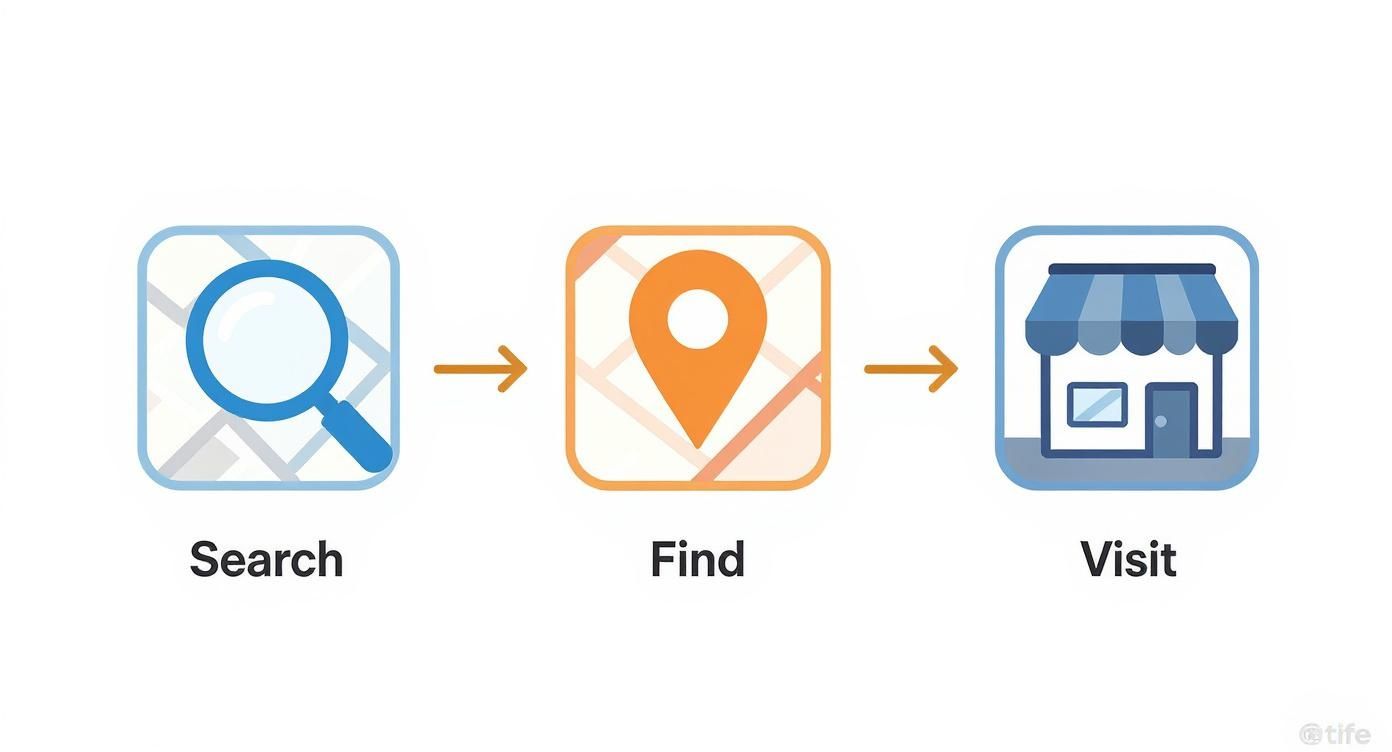
This flow from search to visit is exactly why every single piece of your local data has to be flawless. It’s what guides real customers to your locations.
Uncovering NAP Inconsistencies
Your NAP (Name, Address, Phone number) data is the bedrock of local presence management. I can't stress this enough: absolute consistency across every single platform is non-negotiable. Google uses this data as a primary signal to verify that your business is legitimate and that a specific listing corresponds to a real-world location.
Even tiny variations can cause huge headaches. For instance, if one directory lists your address as "Main St." while another uses "Main Street," algorithms might interpret these as two different places. This dilutes your authority and, worse, confuses potential customers. These discrepancies usually pop up from old data, user-generated listings, or automated data services pulling incorrect information.
Having this information perfectly aligned everywhere is the first, most crucial step toward building a trustworthy digital footprint for each and every location.
A common mistake is treating the audit as a one-and-done project. Your digital footprint is constantly changing. New listings can appear without you ever knowing, and customer reviews shift daily. An effective audit is an ongoing process, not a task you check off a list and forget about.
How to Prioritize Your Audit for Multi-Location Brands
Let's be real: auditing hundreds of locations can feel completely overwhelming. The key is to stop trying to boil the ocean. Instead, adopt a prioritization model based on performance gaps and market opportunities. This turns a daunting task into a manageable, strategic process.
I always recommend segmenting your locations into tiers:
- Tier 1 (High-Priority): These are your underperforming stores in high-opportunity markets. They might have terrible local search rankings, poor review scores, or a mess of NAP inconsistencies despite being in a competitive area. These locations offer the biggest potential for a quick ROI.
- Tier 2 (Optimization-Ready): These spots are doing okay, but there's obvious room to grow. Maybe the foundation is solid, but they're missing optimized photos, recent Google Posts, or an active Q&A section.
- Tier 3 (Maintenance Mode): These are your top performers with strong, consistent profiles. The focus here is simply monitoring for new issues and maintaining their high standards, not a complete overhaul.
By categorizing your locations this way, you can funnel your resources where they'll make the most immediate impact. Start with your Tier 1 stores and build a detailed action plan for each one based on what you find.
Before you start making changes, get a baseline for each location's visibility with a comprehensive local SEO ranking checker. This data-driven approach is what makes sure your local presence management efforts are both efficient and incredibly effective.
Building Your Foundational Local SEO Strategy
Okay, you've finished your audit and you know exactly where the gaps are. Now it's time to build. This is all about getting the fundamentals right for every single one of your locations—turning each digital profile into a perfect mirror of the physical store.
And it all starts with the most important platform on the map: Google Business Profile (GBP).
Think of each GBP listing as its own mini-website. For many customers, it’s the very first time they'll interact with that specific location, so every detail has to be spot-on. We're moving way beyond just the basic Name, Address, and Phone number (NAP). It's about using all the rich features Google gives you to bring that profile to life.
Mastering Your Google Business Profile
A great GBP is a mix of accuracy and appeal. You need to give searchers the essential info they’re looking for, but you also need to tell a story that makes them actually want to walk through your door. The details you fill out here directly impact your ranking in the local pack and whether someone chooses you over the competitor down the street.
First up, nail your primary category. If you're a coffee shop that also serves a great lunch, your primary category needs to be "Coffee Shop," with "Restaurant" as a secondary one. That kind of precision helps Google show you for the most relevant searches.
From there, it's about filling out every single field you can with rich, location-specific information.
- Compelling Photos: Get high-quality, recent images of the storefront, the inside, your products, and your team. We've seen profiles with at least 100 images get significantly more engagement than ones with just a handful.
- Useful Attributes: Use attributes to answer customer questions before they even have to ask. Do you have Wi-Fi? Wheelchair-accessible parking? These little details can easily be the tiebreaker for a potential visitor.
- Accurate Hours: This one is non-negotiable. Keep your business hours—including special holiday hours—updated religiously. Nothing frustrates a customer more than showing up to a closed store when Google said it was open. That's a guaranteed way to earn a negative review.
A classic mistake multi-location brands make is using the same generic photos and descriptions across all their profiles. Each location is unique, and its GBP should show that. A photo of the local team or a description that mentions a neighborhood landmark makes the profile feel real and connected to its community.
Beyond Google: Managing Your Core Listings
While Google is the undisputed king of local search, it’s not the only game in town. A solid local presence strategy means keeping things consistent across other key platforms where customers are looking for you. The two big ones to prioritize are Apple Maps and Yelp—they have massive user bases and a real influence on where people decide to spend their money.
The guiding principle is the same everywhere: absolute consistency. Your business name, address, phone number, and website must be identical across the board. This consistency builds trust with both real people and the algorithms that rank your business.
Manual Updates vs. Automation Software
Look, if you have just a handful of locations, manually updating each profile on Google, Apple, and Yelp is probably doable. But once you scale beyond five or ten storefronts, that approach becomes a nightmare of inefficiency and human error.
This is the point where investing in a listing management software becomes a strategic necessity, not a luxury.
These platforms let you update your information from a single dashboard and push those changes out to dozens, or even hundreds, of directories at once. It’s a massive time-saver, but more importantly, it ensures your data stays consistent everywhere. The right tool will also lock down your core information, preventing random people from making unauthorized changes and helping you find and remove duplicate listings.
This foundational work is about more than just getting found; it’s about building a digital presence that’s trustworthy, attractive, and drives real-world business. The impact is enormous. Local stores drove over $6.04 trillion in global consumer spending, proving the incredible power of local commerce. And this is backed up by data showing 82% of consumers are willing to spend more at local businesses, showing a clear preference for community-based retail. You can learn more about how consumers support local businesses and what it means for your marketing. This data proves it: a meticulously managed local presence isn't just an SEO task—it's a direct line to more sales and loyal customers.
Turning Local Listings into Engagement Hubs
A static listing is a wasted opportunity. In today's market, your local profiles need to do more than just display an address and phone number—they have to become active community hubs that build trust and convince customers to walk through your door.
Think of each local profile, especially your Google Business Profile, as a living, breathing part of your brand. The goal is to create a space where customers can interact with you, find timely info, and see the kind of authentic social proof that makes them choose you over the competition. This isn't just about being present; it's about actively converting searchers into foot traffic.

Cultivate and Manage Your Local Reputation
Your online reputation is built one review at a time. Reviews send powerful signals to both potential customers and search engines, showing that your business is active, popular, and trustworthy. For ranking high in the local pack, a steady stream of recent, positive feedback is non-negotiable.
But just hoping for good reviews isn’t a strategy. You need a system.
- Send a follow-up email or SMS with a direct link to leave a review.
- Put up simple in-store signage with a QR code that leads to your review page.
- Train your team to mention leaving feedback after a great customer interaction.
Responding to reviews is just as important. A quick, professional response to a negative review can salvage a bad experience. And thanking a customer for a positive one shows you're paying attention. For multi-location brands, create a few response templates to keep the brand voice consistent while still letting local managers add a personal touch. If you need a solid foundation, check out our guide on how to get Google reviews compliantly.
Use Google Features to Spark Conversations
Google gives you several tools designed to drive engagement right on your profile. Using them consistently keeps your listing fresh and gives your audience valuable, timely information.
Google Posts: These are basically free, hyper-local ads. Use them weekly to announce a promotion, show off a new product, share news about a local event, or even introduce a store's team members. Posts expire, so they’re perfect for time-sensitive content that creates a bit of urgency.
Q&A Feature: The Questions & Answers section is a goldmine. It's often overlooked, but it’s incredibly powerful. Customers ask questions directly on your profile, and anyone can answer. Don't wait for the public to respond—jump in and proactively populate this section yourself by asking and answering the common questions your staff hears all the time. This instantly positions you as a helpful authority and makes sure the information out there is accurate.
"Your Google Business Profile isn't a set-it-and-forget-it tool. It's a daily conversation with your community. The brands that win are the ones who show up every day to answer questions, respond to feedback, and share what makes their local store special."
Tell Each Location's Story with Fresh Visuals
Photos are often the first thing a user looks at on your profile. Generic stock images or a storefront picture from five years ago just won't cut it. Each of your locations has its own character, and your photos need to reflect that.
Get in the habit of regularly uploading high-quality, authentic images of:
- The current storefront and interior.
- Happy customers (with their permission, of course).
- Your team at work.
- New products or seasonal displays.
These visuals bring your physical space to life online and help customers picture themselves there before they even arrive.
This hyper-local approach is playing out on a massive scale. The global location-based advertising market hit USD 111.156 billion in 2023 and is projected to soar to USD 296.82 billion by 2030. This growth is fueled by the very tech that powers local presence management, proving how vital it is to connect with customers where they are. You can discover more insights about these marketing trends from Grand View Research. By turning your listings into real engagement hubs, you’re tapping directly into this powerful trend.
Measuring What Matters and Automating for Scale
Executing a great local presence strategy is only half the job. If you can't prove it’s actually working, you're flying blind. To show real value, you have to look past vanity metrics and zero in on the Key Performance Indicators (KPIs) that directly impact your bottom line.
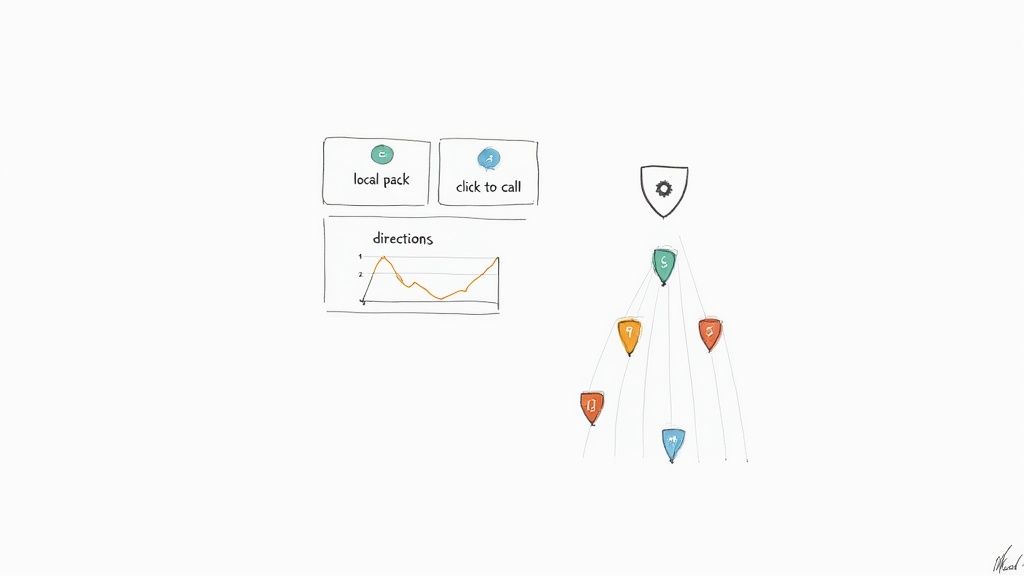
How do you know if all this effort is driving real customer actions? You measure what matters. This means tracking your position in the local pack, the number of phone calls you’re getting, and how many people are hitting that "Directions" button on your Google Business Profile. These are the tangible results that lead to real foot traffic and sales.
Identifying Your Core Local KPIs
It's easy to get distracted by numbers like profile views. They look good on a chart, but they don't always mean your business is growing. The real story comes from the metrics that signal high-intent customer behavior—the numbers that show someone is actively trying to find and visit one of your physical locations.
Your reporting should revolve around these core metrics:
- Local Pack Rankings: Where do your locations show up for your most valuable keywords? This is your visibility score in the markets that count.
- Click-to-Call Rate: How many people are tapping the "Call" button on your profile? For service businesses, this is a direct lead.
- Direction Requests: This is one of the strongest buying signals you can get. A user asking for directions is very likely on their way to your door.
- Website Clicks: Tracking clicks from your GBP to your location pages shows how your local profiles are feeding your own web properties.
These are the KPIs that tell you what’s working. You can find them in Google Business Profile Insights or pull them into specialized platforms like Nearfront to get a crystal-clear picture of your local marketing ROI. You can literally draw a straight line from your optimization efforts to an increase in calls, direction requests, and ultimately, in-store visits.
"So many brands get lost in a sea of data. The key is to isolate the handful of metrics that are a direct proxy for foot traffic. If your direction requests are up 30% month-over-month, you can be confident your strategy is bringing more people through the door."
Here’s a quick rundown of the metrics that truly define success at the local level. These are the numbers that answer the most important questions about your performance.
KPIs That Truly Define Local Success
| KPI | What It Measures | Tool to Use |
|---|---|---|
| Local Pack Rankings | Your visibility in the top 3 map results for priority keywords. | Local Rank Tracker, Nearfront |
| Google Business Profile Clicks | High-intent actions: calls, direction requests, website visits. | Google Business Profile Insights |
| Google Search Impressions | How often your locations appear for "Discovery" (non-branded) terms. | Google Business Profile Insights |
| Google Maps Views | How often users see your locations when browsing Maps directly. | Google Business Profile Insights |
| Review Volume & Velocity | The number and frequency of new reviews being posted. | Reputation Management Software |
| Review Response Rate | The percentage of reviews that receive a reply. | Reputation Management Software |
By focusing your reporting on these KPIs, you move the conversation from "Are we doing local SEO?" to "How is local SEO growing our business?"
Embracing Automation for Multi-Location Brands
Let's be real. Managing local presence for a dozen locations—let alone hundreds—is impossible to do well manually. The sheer effort to update listings, respond to every review, and track performance for each store would bury any team. Smart multi-location brands don't just throw more people at the problem; they use technology to build efficient, scalable workflows.
This is where specialized local presence management platforms come in. They act as a central command center, letting you manage everything from a single dashboard. This shift frees up your team to focus on bigger-picture strategy and community engagement instead of getting stuck in the weeds of repetitive, manual tasks.
Automation isn’t about replacing marketers; it’s about making them more strategic. A solid platform takes care of the time-sucking tasks that are critical for a strong local presence but offer little strategic value when done by hand.
Think about it: instead of a marketing manager spending an entire day manually updating holiday hours for 150 stores, a platform can push those changes live everywhere in minutes. This is the difference between treading water and making real progress. It turns local presence management from a logistical nightmare into a powerful, measurable growth engine for your brand.
Common Questions About Managing Local Presence
Even the slickest local presence strategy runs into tricky situations. Let's tackle a few of the most common questions multi-location brands ask, with straightforward answers you can use right away.
How Can We Keep Brand Consistency Across All Our Locations?
The secret is a "centralized guidelines, localized execution" model. It’s a bit of a mouthful, but it works.
Your corporate team sets the foundation: brand standards, pre-approved templates for review responses, and a library of official marketing assets. This creates a strong, consistent brand experience no matter where a customer finds you.
But here’s the key: you then empower your local managers to take those resources and make them relevant to their community. They might use a branded Google Post template but customize it to shout out a local charity event or run a store-specific promo. This approach gives you the best of both worlds—the power of a unified brand with the authentic, neighborhood feel that builds real trust.
Should We Focus on a High Volume of Reviews or a High Average Rating?
This isn't an either/or question. Think of it as a sequence. First, you need volume.
A steady stream of recent reviews is a huge signal of relevance to both customers and search engines. It proves your business is active, popular, and a current player in the local scene.
That consistent volume naturally builds a stable, trustworthy average rating over time. Let's be real: a location with a 4.6-star rating from 500 reviews feels way more credible than one with a 4.8-star rating from just 10 reviews. The first one can easily absorb a random negative comment; the second one is fragile.
Focus on building a system that consistently generates new reviews. A high, stable rating will follow as a natural result of that constant customer feedback.
How Often Should We Be Updating Our Local Listings?
Stop thinking of your listings as static entries in a phone book. Treat them like you would a social media profile—they need to be active.
Your core information—Name, Address, and Phone number (NAP)—should be locked down and perfectly consistent. But the dynamic parts of your profile are where the real opportunity is.
Here’s a simple cadence to get you started:
- Daily: Jump on new customer reviews and questions. A quick response shows you’re engaged and actually care about what people are saying.
- Weekly: Get a new Google Post published. They expire after seven days, so a weekly update is the bare minimum to keep your profile looking fresh and promote what’s happening now.
- Quarterly: Add new, high-quality photos. Show off seasonal changes, new products, or your team. Keep the visuals current.
- Instantly: The moment business hours change, a service is updated, or you have a temporary closure, update your listing. This is a massive trust factor for customers.
Maintaining this rhythm signals to Google that your business is active and reliable, which can give your local rankings a nice boost. More importantly, it prevents the outdated info that leads to frustrated customers and, you guessed it, negative reviews.
Ready to stop guessing and start seeing real results from your local presence management? Nearfront gives you the tools to track your true local visibility, automate engagement signals, and turn local searches into real-world foot traffic. See how Nearfront can boost your rankings today.